
A glass of orange juice left on the counter can slowly form a layer of pulp at the bottom. A muddy jar of water does something similar, with larger mineral particles settling first. In both cases, gravity is doing the separating—but it can be painfully slow.
Now picture a dairy plant clarifying milk, a wastewater facility removing sludge, or a pharmaceutical plant recovering fine crystals from a liquid. Waiting for gravity alone may take too long, require enormous tanks, or fail to capture very small particles.
Industrial centrifuges address that problem by spinning a mixture at high speed. Their apparent simplicity—a rotating bowl, basket, or tube—hides a careful balance of fluid mechanics, particle behavior, materials engineering, and process control.
The central idea is straightforward: rotation creates a very strong outward acceleration. The useful engineering lies in turning that force into a reliable separation without damaging the product, overloading the machine, or sending valuable material out with the waste.
🌀 What an Industrial Centrifuge Actually Does
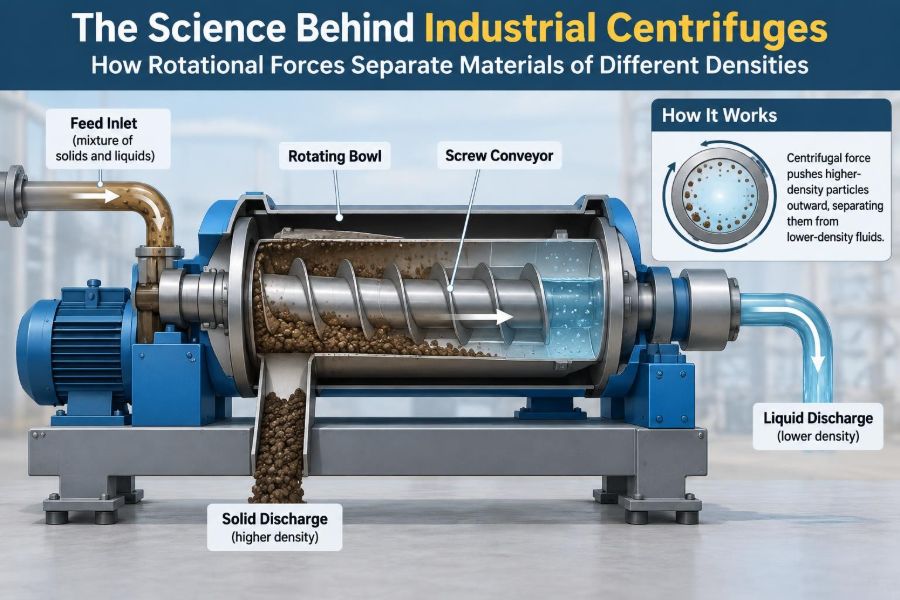
An industrial centrifuge separates components in a mixture by exploiting differences in density, particle size, shape, or immiscibility. The mixture enters a rotating chamber, and components respond differently to the strong acceleration field inside it.
In a slurry, denser solid particles generally migrate outward toward the bowl wall while a lighter liquid remains closer to the axis. In a liquid-liquid mixture, such as oil and water, the denser liquid forms the outer layer and the lighter liquid occupies an inner layer.
A centrifuge does not create density differences. It makes existing differences act much faster than they would under ordinary gravity.
🌍 Why Gravity Settling Is Often Not Enough
Gravity clarifiers work well when particles are relatively large, density contrast is substantial, and there is plenty of residence time. But many process streams contain fine solids, viscous liquids, emulsions, or droplets that settle very slowly.
A centrifuge can generate acceleration hundreds or thousands of times greater than gravitational acceleration, depending on its radius and rotational speed. This can shrink a separation that would need a large settling tank into a much smaller continuous machine.
That advantage has trade-offs. Centrifuges consume mechanical energy, need careful maintenance, and can be less forgiving of changing feed conditions than a simple gravity tank.
⚙️ The Rotational Force Behind Separation
In a rotating reference frame, material appears to experience an outward centrifugal effect. Engineers often express the associated acceleration as a = ω²r, where ω is angular velocity and r is distance from the axis.
The equation reveals two useful facts. Acceleration rises with the square of rotational speed, so a modest increase in speed can have a large effect. It also rises with radius, which is why bowl geometry matters as much as motor power.
Strictly speaking, the actual inward force keeping matter on a circular path is centripetal. In separation design, however, the outward apparent force in the rotating frame is the practical way to describe how phases redistribute.
🧱 Density Difference Sets the Direction
Inside a spinning liquid, pressure increases moving outward. A denser phase responds more strongly to this pressure field than a lighter phase, so the denser material preferentially occupies locations farther from the axis.
For a solid-liquid mixture, a particle denser than the liquid tends to move outward. If the particle is less dense than the liquid, it moves inward instead; this principle is used in some flotation-like and density-classification operations.
Density difference is the starting point, not the whole answer. A tiny density difference may still be separable, but it often demands a larger settling area, longer residence time, higher speed, or a different machine design.
🔬 Particle Size Changes the Separation Rate
Larger particles usually migrate through a liquid faster than smaller ones because the separating force grows with particle volume. Very fine particles have little mass relative to their surface area, so fluid drag strongly resists their motion.
This is why a centrifuge may efficiently remove coarse crystals while allowing ultrafine particles to remain suspended. The effect is not necessarily a defect: engineers can deliberately choose settings that classify particles by size.
When fines must be captured, options include increasing residence time, reducing throughput, using a disc-stack centrifuge, adding a flocculant to form larger agglomerates, or selecting filtration rather than centrifugation.
🌊 Viscosity Resists Motion
Viscosity is a fluid’s resistance to flow. A highly viscous liquid creates greater drag on particles and droplets, slowing their radial migration even when the density difference is favorable.
Cold oils, concentrated syrups, polymer solutions, and dense sludges can therefore be challenging feeds. Warming a stream can reduce viscosity and improve separation, but only if heating will not degrade the material, increase vapor hazards, or disrupt downstream requirements.
For small, slowly moving particles in a simple regime, settling behavior is often introduced through Stokes’ law. Real industrial feeds may depart from that ideal because particles are irregular, concentrations are high, and flow inside the machine is complex.
🧪 Solid-Liquid Separation in Slurries
A slurry is a mixture of insoluble solids suspended in liquid. Centrifuges can clarify the liquid, thicken the solids, wash a solid cake, or recover solids for further processing.
Consider a crystallization process producing salt crystals in a mother liquor. A basket centrifuge can retain the crystals on a perforated screen while liquid passes through. The crystal bed may then be washed and spun further to reduce remaining liquid.
The desired result depends on the process. A mineral operation may prioritize dry, recoverable solids, while a beverage operation may prioritize a clear liquid with minimal product loss.
🛢️ Liquid-Liquid Separation and Immiscibility
Two liquids must be sufficiently immiscible to form distinct layers in a centrifuge. Oil and water are the familiar example, but industrial systems also separate organic solvents from aqueous phases and recover oils from process water.
After spinning, the heavier liquid forms an outer annulus and the lighter liquid forms an inner annulus. Separate outlets are positioned to withdraw each layer while limiting cross-contamination.
A stable emulsion complicates this picture. If droplets are extremely small or protected by surfactants, they may not coalesce easily. More speed alone may not solve the problem; temperature adjustment, chemical treatment, or a coalescer may be needed.
🥛 The Special Case of Milk and Cream
Milk is a useful everyday example because it contains fat droplets dispersed in an aqueous phase. Since milk fat is less dense than the surrounding liquid, it moves toward the rotational axis in a centrifugal separator.
Continuous dairy separators skim off cream from one outlet while discharging skim milk from another. They can also remove small amounts of sediment and other heavier material, depending on configuration.
Milk illustrates a broader lesson: “heavier goes outward” is correct, but the valuable product is not always the outer stream. Engineers must identify which phase contains the desired component before choosing outlets and operating conditions.
🧭 Clarification, Thickening, and Dewatering
These terms describe different goals and should not be used interchangeably. Clarification aims to produce a liquid with fewer suspended solids. Thickening increases the solids concentration in a slurry. Dewatering removes as much liquid as practical from collected solids.
| Goal | Primary product | Typical operating emphasis |
|---|---|---|
| Clarification | Clean liquid | Fine-solid capture and low liquid turbidity |
| Thickening | Concentrated slurry | Controlled solids discharge |
| Dewatering | Moist solid cake | Drainage and mechanical liquid removal |
A machine optimized for one goal may not be ideal for another. For example, a clear liquid outlet does not automatically mean the discharged solids are dry.
🧺 Basket Centrifuges and Filter Cakes
A basket centrifuge uses a rotating perforated basket lined with a filter medium. Liquid passes through the medium and basket openings, while solids accumulate as a cake on the inner wall.
This design is common when crystals or granular solids must be recovered, washed, and discharged. The cake itself becomes part of the separation system: as it builds, it can improve fine-particle retention but also increase resistance to liquid flow.
Uneven cake buildup creates imbalance. Feed distribution, basket loading, cake thickness, and discharge procedure must be controlled to protect the equipment and maintain product consistency.
🔩 Decanter Centrifuges for Continuous Sludge Handling
A decanter centrifuge has a horizontal rotating bowl and an internal screw conveyor, called a scroll. The bowl generates the separating field, while the scroll moves settled solids toward a conical end for continuous discharge.
Decanters are widely used for wastewater sludge, drilling mud, food-processing residues, and many chemical slurries. They tolerate relatively high solids loads compared with machines designed mainly for polished liquid clarification.
The scroll rotates at a slightly different speed from the bowl. That differential speed controls how long solids remain in the machine and strongly affects cake dryness, torque demand, and solids conveyance.
💿 Disc-Stack Centrifuges for Fine Separations
A disc-stack centrifuge contains many closely spaced conical discs inside a vertical bowl. The discs create a large effective settling area in a compact volume and shorten the distance particles or droplets must travel.
This makes disc-stack machines well suited to low-to-moderate solids concentrations, fine-particle clarification, and liquid-liquid separation. Common applications include edible oils, fermentation broths, fuel treatment, and pharmaceutical process streams.
They are not universal solutions. Heavy solids loading can block passages or demand frequent cleaning, and fragile biological materials may be affected by shear or processing conditions.
🧲 Tubular-Bowl Centrifuges and High G-Force
Tubular-bowl centrifuges use a long, narrow, rapidly rotating bowl. Their geometry can generate very high centrifugal acceleration, making them useful for difficult clarification tasks involving very fine solids or small density differences.
The narrow bowl limits the amount of solids that can accumulate before cleaning or manual discharge is required. As a result, these machines fit relatively low-solids feeds better than thick sludge applications.
High acceleration should not be confused with automatic superiority. Capacity, cleanability, product sensitivity, and batch versus continuous operation can matter more than maximum G-force.
📐 Residence Time and Throughput
Every separation needs time. A particle or droplet must migrate far enough to reach its target zone before the bulk fluid carries it to an outlet. Higher feed rate generally reduces that available residence time.
If a centrifuge is pushed beyond its practical hydraulic capacity, solids may escape in the clarified liquid, two liquid phases may leave partially mixed, or product quality may become unstable. This is often seen as rising turbidity or changing outlet composition.
Throughput therefore cannot be selected from a nameplate alone. It depends on feed properties, separation target, temperature, solids loading, and the machine’s internal design.
🎯 The Sigma Concept and Equivalent Settling Area
For clarification, engineers often use the sigma factor, written as Σ, to compare a centrifuge with gravity settling. It represents an equivalent settling area under idealized assumptions.
A larger sigma factor generally means that, for a given feed and target particle, the machine can process more liquid than a smaller settling area would allow. Disc-stack designs achieve high effective area because of their many discs.
Sigma theory is valuable for preliminary estimates and scale-up, but it is not a guarantee of plant performance. Nonideal flow, solids accumulation, shear-sensitive flocs, and feed variability can all change the result.
🌡️ Temperature Can Help or Hurt
Temperature affects viscosity, density, and sometimes phase behavior. Heating a viscous oil may make droplets migrate and coalesce more readily, improving liquid-liquid separation. Cooling may help in other processes where a product must crystallize.
However, temperature can also damage proteins, volatilize solvents, change emulsion stability, or create pressure-management challenges. The best temperature is therefore a process decision, not simply the warmest condition equipment can tolerate.
Operators should evaluate the whole system: upstream heat transfer, centrifuge seals, vapor control, product specifications, and downstream cooling or recovery.
🧬 Flocculants Can Make Tiny Solids Separable
Flocculants are chemicals, often polymers, that encourage fine suspended particles to form larger clusters called flocs. Larger flocs usually separate faster because their effective size increases.
In wastewater treatment and mineral processing, correct flocculant selection and mixing can transform centrifuge performance. Too little chemical may leave fines dispersed; too much or overly aggressive mixing can create weak, shear-sensitive flocs or waste reagent.
Jar tests and pilot trials are useful because feed chemistry changes. A dosage that works on one sludge or process batch may not transfer directly to another.
💥 Shear, Product Damage, and Delicate Materials
High rotational speed does not automatically mean every component experiences destructive shear. Still, feed zones, pumps, narrow passages, and discharge mechanisms can subject material to significant stresses.
Cells, protein aggregates, fragile crystals, and some emulsions can be altered by these conditions. In biotechnology, for example, an operating window may balance rapid cell removal against preserving a sensitive intracellular or extracellular product.
Testing should measure the property that matters: viable cells, crystal size distribution, enzyme activity, droplet size, or product purity. A visually clear outlet alone is not sufficient evidence of acceptable processing.
⚖️ Bowl Balance Is a Safety Requirement
A rotating bowl stores substantial kinetic energy. Even a small uneven mass distribution can create vibration that grows rapidly with speed, stressing bearings, shafts, foundations, and the bowl itself.
Common sources of imbalance include uneven solids deposits, incomplete cleaning, damaged components, poor reassembly, and nonuniform cake formation. Modern units may monitor vibration and shut down when a limit is exceeded.
Never treat repeated vibration alarms as a nuisance. They indicate a condition that deserves investigation by trained personnel following the manufacturer’s procedures and site safety rules.
🛡️ Containment, Guards, and Safe Operation
Industrial centrifuges require robust housings, interlocks, guards, and operating procedures because high-speed rotating equipment presents mechanical hazards. A cover should not be opened while the bowl is rotating, even if the machine appears to be slowing.
Process hazards add another layer. Flammable solvents may require inerting, suitable electrical classification, ventilation, grounding, and vapor-tight design. Corrosive or toxic feeds demand compatible materials and controlled cleaning methods.
Safe operation is a system responsibility involving equipment design, maintenance, training, inspection, and disciplined response to abnormal noise, vibration, temperature, or leakage.
🔧 Materials of Construction Matter
Stainless steels are common in food, pharmaceutical, and many chemical applications, but no single alloy suits every service. Chlorides, strong acids, caustics, abrasive solids, and solvents can each require different material choices.
Abrasive particles can wear bowl liners, scroll flights, nozzles, and feed zones. Corrosion can weaken components or contaminate product. Elastomer seals must also be compatible with temperature, cleaning chemicals, and process fluids.
Material selection should consider not only normal operation but also cleaning cycles, upset conditions, and the consequences of trace metal contamination in the final product.
🧼 Cleaning and Cross-Contamination Control
Residue trapped in a bowl, disc stack, piping, or solids discharge can contaminate the next batch or gradually impair performance. Hygienic industries often use clean-in-place systems, while other services need scheduled manual cleaning or dismantling.
Cleaning validation is especially relevant when products change frequently or when deposits are difficult to inspect. The goal is not merely a clean-looking exterior; it is removal of residues from product-contact zones.
Cleaning must be compatible with the equipment. Excessively aggressive chemicals, temperatures, or mechanical methods can damage seals, coatings, and precision surfaces.
📊 What Operators Should Monitor
Reliable separation is easier to maintain when operators track both machine condition and product outcomes. Useful indicators vary by design and application, but often include:
- Feed rate, feed temperature, and feed solids concentration
- Bowl speed, differential speed, torque, and vibration
- Outlet turbidity, moisture content, phase purity, or solids recovery
- Pressure, seal condition, bearing temperature, and abnormal noise
Trends are often more informative than a single reading. A gradual torque increase may signal changing feed rheology or solids buildup before it becomes a blockage or quality failure.
🚫 Common Mistake: Treating Speed as the Only Control
Increasing speed raises centrifugal acceleration, but it may also increase energy use, wear, vibration sensitivity, and product stress. It cannot compensate indefinitely for poor flocculation, unsuitable feed temperature, inadequate residence time, or an incorrect machine type.
Similarly, reducing throughput may improve separation but can make the process uneconomical. The engineering objective is an operating window that meets quality requirements at an acceptable capacity and maintenance burden.
A structured troubleshooting sequence usually starts with feed characterization, then checks operating variables, mechanical condition, and sampling methods before making large setpoint changes.
🧩 Choosing a Centrifuge for the Job
Selection begins with the separation duty, not with a preferred machine. Engineers need to know whether the feed contains solids, one liquid phase, or two immiscible liquids; how much material must be processed; and what quality target applies.
- Use a filter basket when retaining and washing a solid cake is central.
- Consider a decanter for continuous, relatively high-solids slurry processing.
- Consider a disc-stack unit for fine clarification or liquid-liquid separation at lower solids loading.
- Consider a tubular bowl for demanding, low-solids clarification requiring high acceleration.
Pilot testing remains valuable because laboratory samples may not reproduce full-scale rheology, emulsions, fouling, or feed variability.
🏭 Where Industrial Centrifuges Appear
These machines operate across chemical engineering sectors. In wastewater treatment, they dewater sludge. In food production, they clarify juices, separate cream, and recover edible oils. In pharmaceuticals and biotechnology, they can harvest cells, clarify broths, or recover crystals.
Petroleum, renewable fuels, mining, pulp and paper, specialty chemicals, and recycling operations also use centrifuges. The products differ, but the design questions recur: what moves outward, what stays inward, how quickly can it migrate, and how will each stream be removed?
This repeated pattern makes centrifugation a foundational unit operation rather than a niche piece of equipment.
🔍 A Practical Troubleshooting Example
Imagine a hypothetical decanter producing wetter solids than usual. Raising bowl speed might help in some cases, but it should not be the first automatic response. The cause could be lower feed solids, a viscosity change, altered polymer performance, excessive feed rate, or an inappropriate differential speed.
A useful investigation compares current feed and operating data with known good conditions. Check representative samples, verify instrument readings, examine torque and vibration trends, and inspect for wear or abnormal discharge behavior when safely possible.
This method avoids chasing symptoms. Centrifuge problems are frequently process-system problems expressed at a rotating machine.
📈 Scale-Up Requires Caution
A successful benchtop spin test shows that separation is possible; it does not by itself specify an industrial centrifuge. Laboratory tubes have different flow paths, residence-time distributions, feed zones, and solids-handling behavior from continuous production machines.
Scale-up should account for throughput, solids accumulation, cleaning frequency, heat generation, startup and shutdown behavior, and the consequences of feed variation. Vendors and process engineers commonly use pilot data alongside physical-property measurements and machine-specific models.
The strongest scale-up plans define acceptance criteria in advance, such as allowable turbidity, cake moisture, recovery, purity, or product activity.
🧠 The Core Principle to Remember
Industrial centrifugation is accelerated settling in a rotating geometry. A denser phase tends to move outward, while a lighter phase remains closer to the axis; the rate depends on density contrast, particle or droplet size, viscosity, acceleration, and available residence time.
Machine design determines how effectively that basic physics becomes a usable process. Bowl shape, discs, screens, scrolls, outlets, feed zones, and controls all guide separated material to the correct discharge point.
The best centrifuge is not the fastest one—it is the one that achieves the required separation safely, consistently, and with acceptable product loss, energy use, and maintenance.
Once that balance is understood, a centrifuge stops looking like a mysterious spinning drum and becomes what it truly is: a precisely engineered tool for making density differences work on an industrial timescale. 🌀⚗️🔧