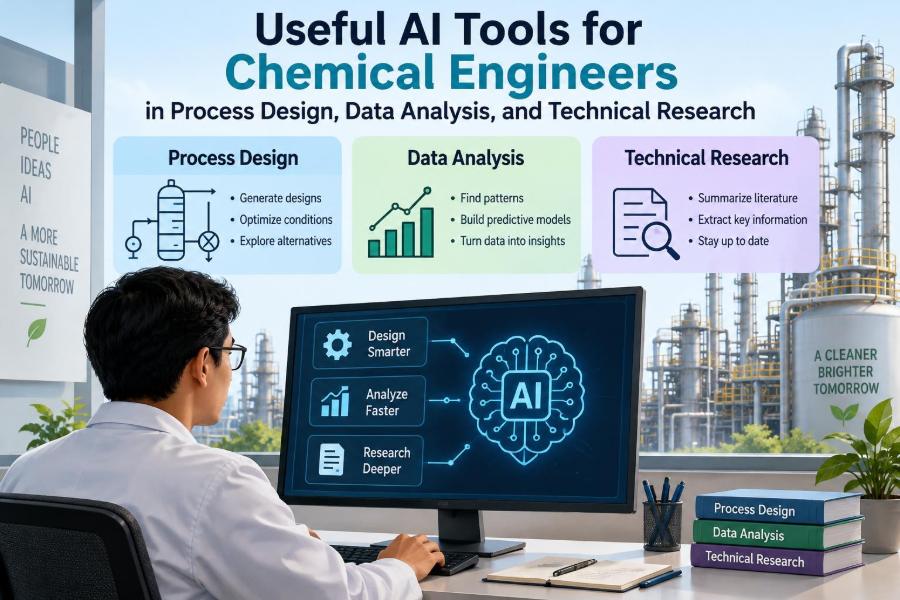

A process engineer is asked to compare three heat-integration options before tomorrow’s design review. A graduate student has hundreds of reactor runs in a spreadsheet but no clear explanation for an unexpected yield drop. A plant team needs to find the operating window that reduces energy use without creating a control problem.
None of these tasks is solved by asking an AI chatbot for “the answer.” They require engineering judgment, reliable data, physical constraints, and a trail that another engineer can review. Yet AI tools can reduce the slow work around these tasks: organizing information, writing code, searching literature, checking calculations, and spotting patterns worth investigating.
For chemical engineers, the useful question is not whether artificial intelligence will replace flowsheets, simulators, laboratory work, or process safety reviews. It is where AI can make the engineering workflow faster and clearer without weakening the discipline that makes a result trustworthy.
The most valuable uses tend to be practical and bounded. AI works well as a capable assistant for defined tasks; it works poorly when treated as an unverified source of process knowledge or as a substitute for accountable engineering decisions.
🧭 What “AI tools” means in chemical engineering
AI is a broad label. In daily engineering work, it usually refers to several different tool types rather than one all-purpose system. Each type has different strengths, inputs, and failure modes.
| Tool category | Typical job | Useful output | Main caution |
|---|---|---|---|
| Language model | Draft, explain, summarize, code | Text, checklists, scripts | Can invent plausible details |
| Machine-learning model | Predict or classify from data | Forecasts, anomaly scores | Depends heavily on training data |
| Optimization tool | Choose values within constraints | Setpoints, designs, schedules | Objective and constraints must be sound |
| Scientific search tool | Locate and organize evidence | Relevant papers and themes | Sources still need verification |
A spreadsheet with regression functions is not suddenly “AI” because it analyzes data. The label matters less than the question: does the tool improve a real engineering task while preserving traceability, validation, and safety?
🏗️ Start with the engineering problem, not the tool
Tool-first thinking produces vague prompts and decorative outputs. Problem-first thinking begins with a decision: select an exchanger configuration, diagnose a compressor issue, estimate a physical property, or screen catalyst formulations.
Define the decision owner, required accuracy, constraints, available data, and cost of being wrong. A quick brainstorming assistant may be adequate for creating a list of possible fouling mechanisms. It is not adequate for approving a relief-device basis.
A useful problem statement might be: “Build a transparent model to estimate distillation-column steam demand from feed rate, feed composition, and reflux ratio, then compare predictions against withheld operating data.” That statement tells you what success looks like.
🧠 Use language models as engineering assistants
General-purpose language models are often most helpful before and after the core calculation. They can turn rough notes into a test plan, explain unfamiliar terminology, draft a Python function, or create a first-pass outline for a technical memo.
They are especially effective when given context: process purpose, units, known constraints, expected output format, and the level of explanation required. Asking “Explain distillation” invites a generic response. Asking for a mass-balance checklist for a binary distillation model is more likely to produce something useful.
Think of the output as a junior colleague’s draft: potentially productive, never automatically approved.
📝 Draft reports without outsourcing judgment
Writing is a real part of engineering work. AI can help structure a calculation note, transform meeting notes into action items, improve sentence clarity, or generate alternative explanations for different audiences.
The engineer should still supply the technical argument. A sound report identifies assumptions, data sources, calculation methods, uncertainty, results, and limitations. A polished paragraph that hides an unsupported assumption is worse than an awkward paragraph that makes the uncertainty visible.
- Provide the model with verified inputs and a required report structure.
- Ask it to flag missing assumptions rather than fill them in.
- Check every number, citation, equipment tag, and conclusion before release.
- Keep the calculation file, source data, and revision history alongside the final document.
💻 Generate code faster, then test it harder
Many chemical engineers use Python, MATLAB, R, VBA, or SQL for repetitive calculations and data handling. A coding assistant can create a starting point for reading a historian export, converting units, fitting a model, or plotting trends.
Its greatest value is often reducing blank-page time. It can also explain existing code, suggest clearer variable names, and help create automated tests. But generated code may silently use an incorrect formula, mishandle missing values, or assume incompatible units.
For example, a script calculating Reynolds number must be checked for the correct characteristic length, viscosity basis, and unit consistency. A script that runs without errors has not necessarily produced a physically meaningful result.
✅ Build validation tests into every script
A robust engineering script needs known-answer tests. For a mass-balance routine, test a simple case where inlet and outlet values are known. For a heat-transfer calculation, compare against a hand calculation or trusted benchmark.
Use assertions to make failures visible. A script should stop or warn if flow rates are negative where they cannot be, compositions do not sum reasonably, or temperatures fall outside the expected sensor range.
assert abs(sum(mole_fractions) - 1.0) < 1e-6
assert flow_rate >= 0
assert pressure_kpa > 0
These checks do not prove a model is correct, but they catch common errors before they appear in a dashboard or report.
📊 Clean data before fitting clever models
Industrial and laboratory data rarely arrive ready for analysis. Tags may have different sampling intervals, maintenance periods may be mixed with normal operation, instruments may drift, and manual entries may contain inconsistent units.
AI cannot rescue a dataset whose meaning is unclear. Establish a data dictionary that records tag names, units, sampling frequency, sensor location, operating meaning, and known quality issues. This is often more valuable than trying several advanced algorithms.
Missing data also require a reasoned treatment. Filling every gap with an average can distort transient behavior. Sometimes the right choice is interpolation; sometimes it is to exclude the interval; sometimes the missingness itself is evidence of an equipment or communications problem.
🔍 Find anomalies without mistaking them for failures
Anomaly-detection methods can identify observations that differ from a learned operating pattern. They are useful for flagging possible exchanger fouling, a valve response change, unusual batch behavior, or a bad instrument signal.
An anomaly is a prompt for investigation, not a diagnosis. A process can change legitimately after a grade transition, feedstock shift, startup, shutdown, or new control strategy. Conversely, a gradual degradation may not be flagged if it becomes the new normal.
Pair statistical alerts with process knowledge. Ask whether the behavior is physically plausible, whether related variables changed together, and whether operating logs explain the event.
📈 Use regression for transparent first models
For many process questions, a simple regression is the right starting point. Linear regression, polynomial terms, and carefully chosen interactions can show how measured inputs relate to an output such as energy intensity, conversion, or product quality.
Transparency matters. If a model says steam use rises with feed flow, an engineer can test whether that direction makes sense. If it predicts a negative utility demand or a response that reverses outside a narrow data range, the limitations become visible.
More complex models may improve fit, but a modest improvement in prediction can be a poor trade if operators and engineers cannot interpret or maintain the result.
🧪 Respect the difference between correlation and mechanism
Historical data can reveal correlations that have no causal meaning. Suppose product purity and cooling-water temperature move together. The actual cause may be seasonal feed composition, a control action, or simply an operating policy that changes with weather.
Mechanistic models use conservation laws, thermodynamics, reaction kinetics, and transport phenomena. Data-driven models learn relationships from examples. The strongest workflow often combines both: use first principles to define structure and data methods to estimate uncertain parameters or correct systematic residuals.
This hybrid approach is particularly useful when the physics is understood but difficult to model perfectly, such as real fouling behavior or complex feed variability.
⚖️ Choose model complexity to match the decision
A model for real-time advisory control needs stable predictions, quick evaluation, and clear behavior near operating constraints. A model for exploratory research may tolerate more computation and uncertainty if it helps reveal a useful trend.
Do not choose a neural network merely because it is sophisticated. If twenty experimental runs must guide a catalyst decision, a simple design-of-experiments model may be more defensible than a high-capacity model that memorizes noise.
The right model is the simplest one that answers the question with adequate accuracy and an understandable range of validity.
🎯 Apply optimization only after defining constraints
Optimization identifies variable values that minimize or maximize an objective, such as utility cost, emissions proxy, production loss, or solvent consumption. It can be powerful for process design and operating decisions.
But the optimizer only understands what it is told. If allowable pressure, minimum reflux, equipment capacity, product specifications, and safety limits are missing, it may recommend an impossible or unsafe point.
A reliable formulation states the objective function, decision variables, equality constraints, inequality constraints, bounds, and assumptions. Review the result for physical realism before treating it as a candidate design.
🧩 Use surrogate models for expensive simulations
Rigorous process simulations and computational fluid dynamics can be too slow to run thousands of times during optimization. A surrogate model, sometimes called a response surface or emulator, approximates the relationship between inputs and simulation outputs.
For example, a team might run a validated simulator at selected feed compositions, temperatures, and pressures, then fit a surrogate to estimate energy use across that region. The optimizer uses the fast surrogate while key candidate solutions are checked again in the rigorous model.
Surrogates should not be trusted beyond the region they were trained on. Extrapolation is especially risky near phase changes, reaction limits, and equipment constraints.
🌡️ Improve heat-integration studies with structured assistance
Pinch analysis and heat-exchanger network design depend on correct stream data, temperature intervals, heat capacities, phase-change duties, and minimum approach assumptions. AI can help organize stream tables, check unit consistency, and generate scripts for energy targeting.
It cannot decide whether stream data represent the real operating case without engineering review. A stream’s heat-capacity flow rate may change with composition, pressure, or phase, and a nominal process condition may not represent the limiting design case.
Use AI to accelerate calculations and scenario documentation, then confirm the thermal logic through established pinch-analysis methods and practical exchanger constraints.
⚗️ Support reaction engineering with data-informed models
AI can help fit kinetic parameters, screen operating variables, classify spectroscopy data, and plan experiments. In catalytic systems, it may identify combinations of temperature, residence time, and feed ratio worth testing.
A fitted model does not replace chemical reasoning. Rate expressions should respect stoichiometry, plausible adsorption behavior where relevant, and mass- or heat-transfer limitations. An apparent kinetic improvement may actually reflect a change in mixing, temperature measurement, or catalyst deactivation.
When possible, use independent experiments to test whether a proposed relationship holds outside the data used to build it.
🧫 Plan experiments that teach you something
AI tools can propose factor ranges, summarize prior runs, and help generate analysis code, but experiment design still needs statistical and chemical discipline. Varying one factor at a time is easy to understand but can miss interactions between factors.
Design of experiments deliberately selects combinations of factors so that main effects and interactions can be estimated efficiently. Randomization, replication, and suitable controls help separate real effects from drift and noise.
Before running a campaign, define the response variable, acceptance criteria, measurement method, safe operating range, and the condition that would make a result uninterpretable.
📚 Search technical literature more strategically
AI-assisted research tools can cluster papers by theme, summarize abstracts, suggest related keywords, and help turn a broad question into a search strategy. This can be useful when entering an unfamiliar area such as membrane separations, carbon capture solvents, or battery recycling.
However, summaries may omit experimental conditions, limitations, or contradictory results. The original paper remains the source for methods, data, and claims. Review publication details, experimental setup, uncertainty, and whether a result applies to your system.
For high-consequence design decisions, use authoritative standards, vendor documentation, validated property data, and appropriately reviewed technical sources rather than relying on a generated overview.
🗂️ Build a reusable research evidence table
A simple evidence table prevents a literature review from becoming a collection of disconnected notes. Record the process, material system, operating conditions, methods, measured outputs, limitations, and relevance to your question.
AI can extract a draft table from papers you provide, but each field should be checked against the source. This is particularly important for units, concentrations, basis of composition, and whether reported performance is from a model, bench experiment, pilot unit, or commercial operation.
The table becomes more useful than a stack of summaries because it exposes where studies are genuinely comparable and where they are not.
🧮 Check units, balances, and physical bounds
Unit conversion and dimensional analysis are ideal areas for automated checks. A tool can scan a calculation workbook or script for mixed pressure units, inconsistent temperature scales, or suspicious magnitudes.
Still, the most important checks are engineering checks: Does mass balance close? Does energy balance close within expected measurement error? Does conversion remain between zero and one? Does the predicted density behave reasonably with temperature and pressure?
Physical bounds are a powerful defense against convincing nonsense. A model should not predict a negative concentration, a heat exchanger exceeding its feasible temperature driving force, or a vessel operating beyond an explicit constraint.
🏭 Connect AI to process simulators carefully
Commercial process simulators remain central for steady-state design, thermodynamic calculations, and equipment sizing workflows. AI can assist around them by generating automation scripts, extracting results, comparing cases, or building surrogates from simulation outputs.
Automation creates a new risk: a script can run hundreds of cases with one mistaken property package, stream mapping, or parameter value. Begin with a small set of hand-reviewed cases before scaling up.
Version-control the simulation file, scripts, input assumptions, and exported results. Reproducibility is not administrative overhead; it is how another engineer can understand why a result changed.
🖥️ Use digital twins with a realistic definition
A digital twin is often described as a digital representation linked to a physical asset or process. In practical chemical engineering, this may range from a monitored equipment model to a detailed, continuously updated process model.
Its value depends on model fidelity, data quality, maintenance, and a clear use case. A twin intended to estimate heat-exchanger fouling needs reliable temperature and flow measurements, a suitable heat-transfer model, and a method to distinguish fouling from changing process conditions.
Calling a dashboard a digital twin does not make it predictive. The useful question is whether the model helps someone make a better, timely, auditable decision.
🔐 Protect confidential process information
Process data can reveal formulations, production rates, equipment configuration, quality issues, and commercially sensitive operating practices. Uploading such information to an external AI service may conflict with company policy, contracts, or cybersecurity requirements.
Use approved tools and understand their data-retention, training, access-control, and logging policies. Remove identifiers where possible, but remember that seemingly anonymous datasets can still reveal sensitive context when combined with other information.
For regulated or safety-critical environments, involve the appropriate information-security, legal, and quality functions before connecting AI tools to plant data or document repositories.
🛡️ Keep process safety outside the “autocomplete” mindset
AI can help create checklists, organize incident records, summarize procedures, and identify topics for a hazard-review agenda. Those are administrative and analytical supports, not replacements for structured process safety work.
Hazard identification, relief-system design, management of change, operating procedures, and safeguarding decisions require qualified review, accurate design information, and established organizational processes. A fluent generated explanation is not evidence that a safeguard is adequate.
Never allow an AI-generated response to become the sole basis for a safety-critical calculation, operating limit, or emergency instruction.
👥 Design for engineers, operators, and technicians
A technically accurate model can fail if its output is difficult to use. Operators need clear context: what changed, how confident is the alert, what variables support it, and what action is permitted by procedure.
Co-design tools with the people who will use them. A useful advisory might show an energy-performance deviation, the contributing measurements, the normal operating band, and a link to the relevant procedure. It should not merely display an opaque “risk score.”
Human factors matter because process decisions occur under time pressure, changing conditions, and competing priorities.
🔄 Monitor model drift after deployment
Models age. Feedstocks change, instruments are recalibrated, catalysts deactivate, equipment is modified, control strategies evolve, and operators adopt new practices. A model trained on last year’s operating data may become misleading without visibly failing.
Monitor prediction error, input distributions, use frequency, and outcomes of recommendations. Set review triggers and assign ownership for retraining, retirement, or escalation. A model without an owner is unlikely to remain reliable.
Keep a fallback method for important decisions, such as a first-principles estimate, manual procedure, or conservative operating envelope.
🚫 Recognize hallucinations and false confidence
Language models may state nonexistent references, incorrect equations, invented software features, or plausible but wrong explanations. This behavior is often called hallucination, but the practical issue is simpler: fluent language can conceal weak evidence.
Warning signs include precise claims without a source, an equation presented without definitions, unusually confident recommendations, and citations that cannot be located. Ask the tool to separate known inputs, assumptions, calculations, and uncertainties, then verify each part.
Do not assume a response is reliable because it uses chemical-engineering vocabulary correctly.
🧾 Create an auditable AI workflow
For consequential work, record the tool used, version where available, prompt or analysis configuration, input data, output, reviewer, validation method, and final decision. The required level of documentation should scale with the decision’s consequence.
This does not mean preserving every casual brainstorming conversation. It means that anyone relying on an analysis should be able to reconstruct the route from source data to conclusion.
- State the intended use and prohibited uses.
- Preserve the approved data and calculation version.
- Document assumptions and model limitations.
- Record independent checks and reviewer comments.
- Define who can approve changes to the workflow.
🎓 Build AI literacy alongside core fundamentals
The engineers who benefit most from AI are not those who memorize prompts. They understand material and energy balances, thermodynamics, reaction engineering, separations, control, statistics, and safety well enough to challenge an output.
Useful AI literacy includes knowing basic data structures, how to inspect a dataset, the difference between training and test data, sources of bias, and why extrapolation is risky. It also includes communicating uncertainty clearly.
Students can begin with small, bounded projects: automate a calculation, fit a transparent model to lab data, or compare an AI-generated explanation with a textbook derivation.
🛠️ A practical starter workflow
Choose a recurring task that is useful but low consequence, such as cleaning a lab dataset, creating plots for a weekly report, or extracting structured information from already approved documents. Avoid beginning with autonomous control or safety calculations.
- Write the engineering question and success criterion.
- Identify approved data sources and remove unnecessary sensitive information.
- Create a simple baseline using hand calculations, rules, or a spreadsheet.
- Use the AI tool for a narrow, documented task.
- Validate against known cases and independent engineering checks.
- Ask users whether the output changes a real decision for the better.
- Keep, revise, or discard the workflow based on evidence.
🌱 Use AI where it reduces friction, not accountability
AI is most useful when it removes low-value friction: repetitive formatting, routine coding, first-pass data exploration, literature organization, and scenario comparison. This gives engineers more time for defining problems, testing assumptions, discussing trade-offs, and reviewing risks.
Its limits are equally clear. Tools do not own the plant, understand an organization’s operating history by default, or bear responsibility for consequences. They can accelerate reasoning, but they do not replace the engineering basis for a decision.
🔑 The core takeaway for chemical engineers
The best AI workflow is not the one with the most advanced model. It is the one that connects a well-defined engineering question to reliable inputs, transparent analysis, physical checks, qualified review, and a documented decision.
Use language models to draft and explore, data models to detect patterns and make bounded predictions, optimization to compare feasible choices, and research tools to navigate information. Then apply the disciplines that chemical engineering already demands: conservation laws, uncertainty analysis, validation, safety, and professional accountability.
AI becomes valuable in chemical engineering when it strengthens sound engineering judgment instead of asking us to suspend it. Used with curiosity and controls, it can make design, analysis, and technical research more efficient without making them less rigorous. 🧪📊⚙️