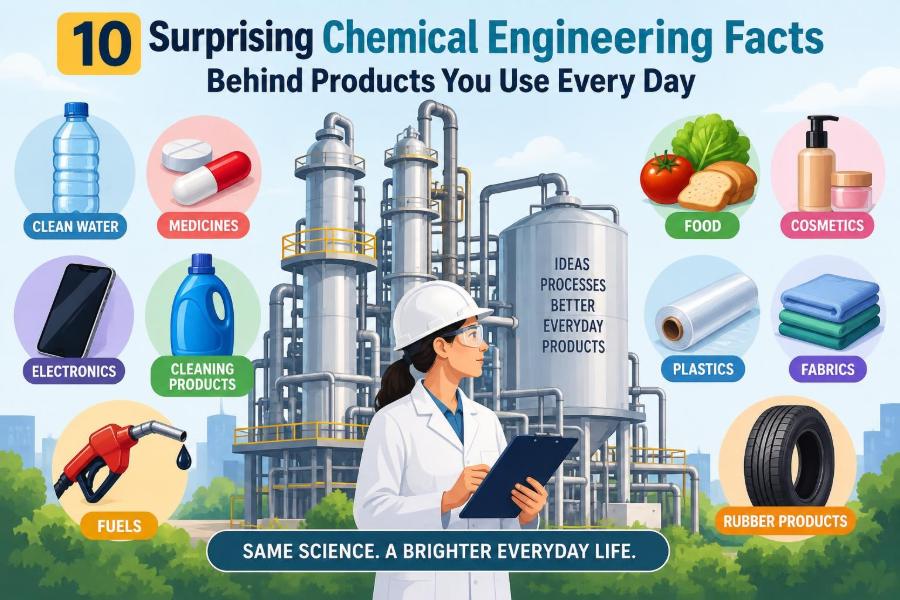

Your morning may begin with a toothbrush, shampoo, coffee, medication, a phone screen, and a packed lunch. None of those objects simply “exists” in its final form. Each depends on controlled reactions, separations, materials, heat transfer, and quality systems.
That is the everyday territory of chemical engineering. The discipline applies chemistry, physics, biology, mathematics, and design to make useful products safely, consistently, and at a scale large enough to reach millions of people.
The surprising part is that chemical engineers often do not invent the molecule itself. They work out how to turn a promising laboratory idea into a reliable process: one that uses manageable amounts of energy and water, produces acceptable waste, and gives the same result from one batch to the next.
Look closely at familiar products and a hidden industrial system appears. Here are ten chemical engineering facts that explain why ordinary goods perform the way they do.
🔍 Fact 1: Chemical engineering is mostly about controlled change
A chemical engineer may work with reactions, but reactions are only one part of the job. A product can change because molecules react, dissolve, crystallize, evaporate, mix, ferment, or move through a membrane.
The central question is usually not “Can this happen?” but “Can it happen predictably, safely, and economically at the required scale?” A dye that works in a test tube is not automatically suitable for thousands of litres of paint.
This focus on control explains why chemical engineering appears in food, semiconductors, clean water, cosmetics, energy, medicines, and packaging—not only in traditional chemical plants.
⚖️ Mass balance is the accounting system behind a product
Every process begins with a conservation rule: material entering a system must leave it, accumulate inside it, or be transformed into another material. Engineers call this a mass balance.
Consider carbonated water. Water, carbon dioxide, flavourings, containers, and cleaning materials enter different parts of the operation. The finished drink, emissions, wastewater, and unavoidable losses must be accounted for.
A mass balance helps locate waste, size equipment, and identify abnormalities. If a process appears to lose too much material, the cause might be a leak, evaporation, residue left in equipment, or an incorrect measurement.
🌡️ Heat transfer quietly determines product quality
Heating and cooling rarely happen instantly or uniformly. Heat moves by conduction through a solid, convection in moving fluids, and radiation from hot surfaces. Equipment design determines how quickly and evenly that movement occurs.
Milk pasteurization is a familiar example. The liquid must reach a specified temperature history sufficient to reduce harmful microorganisms, then be cooled promptly. Too little heating can compromise safety; excessive heating can alter flavour or nutritional quality.
Heat exchangers make this possible by transferring heat across a metal wall while keeping two fluids separate. Their performance can decline when deposits build on surfaces, a practical issue called fouling.
🧊 Your ice cream is a lesson in crystallization
Ice cream feels smooth partly because its ice crystals are kept small. During freezing, water forms crystals while a concentrated mixture of sugar, proteins, fats, and stabilizers remains between them.
Fast, well-controlled freezing and agitation encourage many small crystals instead of a smaller number of large ones. Large crystals create the coarse, icy texture sometimes found after ice cream partially melts and refreezes at home.
This is chemical engineering at the scale of a spoonful: phase change, mixing, cooling rate, formulation, and storage temperature all influence the final texture.
🥛 Emulsions keep oil and water together—temporarily
Oil and water separate because their molecules interact differently. Yet mayonnaise, lotion, salad dressing, and many sauces contain both. They are emulsions: one liquid dispersed as tiny droplets within another.
An emulsifier has regions that associate with both oil and water. It sits at the droplet surface and helps prevent droplets from merging. Egg yolk contributes emulsifying components in mayonnaise; formulated personal-care products often use other surfactants or polymers.
Mixing equipment matters as much as ingredients. It must supply enough energy to break droplets into the desired size without overheating, foaming excessively, or damaging delicate ingredients.
🫧 Surfactants make cleaning a transport problem
Soap and detergent molecules have a water-attracting end and an oil-attracting end. In wash water, they can assemble around oily soil, helping lift it from fabric, dishes, skin, or hard surfaces.
This does not mean every cleaner works by the same mechanism. Some stains dissolve, some are loosened by wetting, and some require enzymes, oxidation, alkalinity, or physical agitation. Water temperature and contact time also matter.
Surfactant design involves trade-offs. A formulation needs effective cleaning and acceptable foam, but it must also remain stable in storage and behave appropriately in wastewater treatment systems.
🧴 Shampoo is engineered for much more than bubbles
A shampoo must spread through wet hair, remove oil and styling residues, rinse away, feel pleasant, and remain stable on a shelf. Those needs can conflict. A stronger cleansing system can remove more natural oils, while a milder system may need help with certain deposits.
Thickeners control flow so the product does not pour like water. Conditioning agents can deposit on hair during rinsing. Preservatives help control microbial growth in a water-rich product, and pH is selected with performance, safety, and ingredient stability in mind.
Foam is often a sensory signal rather than a direct measure of cleaning power. More foam does not automatically mean better cleaning.
🧃 Packaging is an active part of food preservation
A package is not merely a container. It can control the movement of oxygen, water vapour, aromas, light, and microorganisms. For many foods, that protection is central to shelf life.
Different plastics, glass, metals, paper-based laminates, and coatings have different barrier properties. A crisp snack needs protection from moisture; a light-sensitive beverage may need an opaque container; a carbonated drink needs a package that limits gas loss.
Engineers select packaging by considering the entire system: product chemistry, filling temperature, transport conditions, consumer use, recycling pathways, and the package’s interaction with the product over time.
🍞 Bread relies on reaction engineering and gas bubbles
In yeast-leavened bread, microorganisms convert available sugars into carbon dioxide and other compounds. The gas expands existing bubbles in the dough, while a network formed largely by hydrated proteins helps retain that gas.
Temperature strongly affects fermentation rate. Too cold, and production is slow; too warm, and yeast performance and flavour development can change. Baking then sets the structure through protein changes, starch gelatinization, water loss, and browning reactions.
Industrial baking applies chemical engineering principles to mixing, proofing, heat transfer, airflow, and moisture control. A consistent loaf requires far more than a consistent recipe.
☕ Decaffeinated coffee demonstrates selective extraction
Extraction separates a desired substance by dissolving it into another phase. Coffee brewing extracts flavour compounds into water, but decaffeination aims to remove much of the caffeine from green coffee while preserving desirable flavour precursors.
Different commercial methods use different solvents or extraction media, including water-based systems and carbon dioxide under elevated pressure. The details affect selectivity, energy use, recovery, and final quality.
The engineering challenge is not simply removing caffeine. It is removing it selectively, recovering and managing processing materials responsibly, and keeping the beans suitable for roasting and brewing afterward.
💊 A tablet is a carefully designed solid material
A medicine tablet typically contains far more than the active pharmaceutical ingredient. It may include fillers, binders, disintegrants that help it break apart, lubricants that aid manufacturing, and coatings that protect the tablet or modify release.
Powders do not automatically flow or compress well. Their particle size, shape, moisture content, and tendency to segregate can affect dose uniformity. A blend that looks uniform may separate while moving through hoppers if its components behave differently.
For medicines, process control is especially strict because small inconsistencies can matter. Formulation and manufacturing are designed together, not as separate afterthoughts.
⏱️ Extended-release medicines use diffusion and dissolution
Some tablets and capsules are designed to release an active ingredient over time. The mechanism may involve a polymer matrix that swells, a coating that dissolves gradually, or a structure that allows water to enter and dissolved drug to diffuse outward.
Release depends on material properties, geometry, surrounding fluid, and temperature. Crushing or splitting a modified-release product can change that behaviour, which is why patients should follow the product instructions and advice from a pharmacist or clinician.
Not all medicines should be modified, and this article is not medical guidance. The larger lesson is that controlled release is a materials and transport problem embedded in a tiny dosage form.
📱 Phone screens depend on ultra-clean chemical processing
Modern displays use multiple layers with distinct jobs: glass or protective coatings, conductive layers, colour-producing materials, adhesives, and often liquid crystal or light-emitting components. Tiny contamination can cause visible defects or reduce performance.
Manufacturing therefore uses tightly controlled clean environments, precise coating methods, deposition processes, and inspection. A thin film may be only a small fraction of the thickness of a human hair, yet small variations can alter optical or electrical behaviour.
Chemical engineers contribute to coating uniformity, solvent recovery, gas delivery, purification, and waste treatment—often without ever designing the final phone itself.
🧪 Purity has a different meaning for every product
“Pure” sounds universally desirable, but the required purity depends on use. A chemical suitable for an industrial cleaning process may be unsuitable for a food application, while semiconductor manufacturing can demand exceptionally low levels of particular contaminants.
Purification methods include distillation, filtration, adsorption, crystallization, extraction, and membranes. Each removes certain impurities better than others, and each consumes energy, materials, or time.
The target is therefore fit-for-purpose purity, verified by appropriate testing. Chasing unnecessary purity can waste resources; accepting the wrong impurity can cause product failure, safety concerns, or process damage.
🚰 Drinking water is made safe through a treatment train
Water treatment usually relies on several barriers rather than one magical step. Depending on the source and local requirements, operators may remove particles, destabilize colloids, filter solids, disinfect microbes, adjust chemistry, and manage dissolved contaminants.
Coagulation is a useful example. Very fine particles may remain suspended because of electrical effects. Added chemicals can help them form larger clusters, called flocs, that settle or filter more readily.
Water chemistry varies by source and season. A treatment approach that works well for one supply may need adjustment for another, so monitoring is an essential part of safe operation.
🧫 Wastewater treatment uses microbes as process workers
Many wastewater plants use microorganisms to consume biodegradable organic matter. In an aeration tank, operators supply oxygen and mixing so aerobic microbes can grow and carry out useful transformations.
The process is powerful but not effortless. Temperature, pH, oxygen transfer, toxic discharges, nutrient balance, and flow changes can all affect microbial communities. The resulting solids must also be separated and managed.
This is a strong example of biochemical engineering: rather than forcing every separation with energy-intensive equipment, the process uses living systems under carefully maintained conditions.
🧃 Membranes can separate without boiling everything
A membrane is a selective barrier. Depending on its structure and driving force, it can separate particles, salts, gases, or specific molecules. Filtration pitchers, kidney dialysis equipment, industrial water systems, and some food processes all use membrane principles.
Reverse osmosis, for example, applies pressure to drive water through a membrane while retaining many dissolved salts. It can produce high-quality water, but pressure requires energy and the concentrated reject stream needs responsible management.
Membranes can foul when material accumulates on their surfaces. Pretreatment, cleaning cycles, and operating conditions are therefore just as important as the membrane material itself.
🔄 Distillation is everywhere, but it has an energy bill
Distillation separates liquids using differences in volatility—the tendency to enter the vapour phase. Heating produces vapour richer in the more volatile components; repeated contact between rising vapour and descending liquid sharpens the separation.
It is used in fuel refining, solvent recovery, beverage production, and chemical manufacturing. But heating and condensing large flows can require substantial energy, especially when boiling points are close.
Engineers reduce that burden through heat integration, better column design, alternative separations, and process optimization. Distillation is effective, not automatically efficient in every situation.
♻️ Recycling is a separation challenge before it is a melting challenge
Plastics that look similar may have different melting behaviour and different mechanical properties. Labels, pigments, food residues, multilayer packaging, and mixed polymers complicate recycling.
Mechanical recycling often involves collection, sorting, washing, size reduction, and remelting. Contamination can reduce quality, so the recycled material may be better suited to a different application than the original one.
Chemical recycling approaches aim to break materials into smaller molecules or feedstocks, but their suitability depends on the polymer, contamination level, energy demand, and available infrastructure. Neither route is a universal answer.
🧃 Bioplastics are not all compostable in a home bin
“Bio-based” describes where some or all of a material’s carbon came from; it does not automatically describe how the material breaks down. “Biodegradable” and “compostable” also depend on specified environments, timeframes, and conditions.
Some compostable plastics require industrial composting conditions such as elevated temperature and controlled moisture. In a home compost pile, landfill, or natural environment, breakdown may be slow or incomplete.
Good material choices require clear end-of-life planning. A product designed for composting only helps when appropriate collection and processing actually exist.
🔋 Batteries are electrochemical reactors in sealed packages
A battery converts chemical energy to electrical energy through redox reactions, meaning oxidation and reduction occur at different electrodes. Ions travel through an electrolyte while electrons move through the external circuit to power a device.
Battery design balances energy density, power delivery, lifetime, cost, charging behaviour, and safety. Heat is especially significant: resistance and side reactions can generate it, while excessive temperature can accelerate degradation or create hazards.
Thermal management, carefully selected materials, manufacturing cleanliness, and protective electronics all support safe performance. Batteries are chemical engineering products even when their most visible role is electronic.
🧯 Safety begins with understanding the process, not just wearing PPE
Personal protective equipment is necessary in many settings, but it is the last line of defence. Safer engineering begins by eliminating a hazard where possible, substituting a less hazardous material, containing the process, and designing controls and procedures.
Hazards may involve toxicity, flammability, pressure, corrosivity, runaway reactions, dust explosions, or incompatible chemicals. A benign-looking liquid can still create danger under the wrong temperature, concentration, or confinement.
Process safety asks what could deviate from intended operation and what barriers would prevent or limit harm. That mindset applies to laboratories, factories, kitchens, and household storage alike.
📏 Scaling up is not simply making laboratory equipment larger
A reaction that behaves calmly in a small flask can become difficult in a large vessel. Surface area does not increase at the same rate as volume, so removing heat and mixing reactants uniformly can become much harder.
For example, a reaction’s heat generation may rise with the amount of reacting material, while cooling depends strongly on heat-transfer area. Poor mixing can create local hot spots or concentration differences that were insignificant at small scale.
This is why pilot plants, models, and staged scale-up are valuable. Scale changes the physics as well as the quantity.
📈 Sensors turn a process into usable information
Temperature, pressure, flow, pH, conductivity, level, and composition measurements help operators see what is happening inside equipment that cannot be observed directly. Modern plants may use online analyzers, control systems, and statistical methods alongside laboratory tests.
A measurement is only useful if it is representative and reliable. Sensors require calibration, maintenance, sensible placement, and interpretation. A fast but misleading measurement can be worse than a slower trustworthy one.
Automation can maintain stable conditions, but it does not remove the need for engineering judgment. Operators and engineers must understand the process behind the screen.
🧠 Everyday products involve trade-offs, not perfect solutions
A lower-cost package may have a weaker barrier. A stronger detergent may be harder on certain fabrics. A highly purified ingredient may require more processing. A recyclable design may need changes in material choice or collection systems.
Chemical engineering makes those trade-offs visible. Decisions are evaluated across performance, safety, energy, emissions, water use, durability, cost, and end-of-life options. The best choice depends on the specific application and local context.
| Design goal | Possible trade-off |
|---|---|
| Longer food shelf life | More complex barrier packaging |
| Faster manufacturing | Higher energy use or tighter control needs |
| Higher product purity | Additional separation steps |
| Lightweight packaging | Reduced robustness or sorting complexity |
🌍 Sustainability means examining the whole system
A material is not automatically sustainable because it is natural, recycled, lightweight, or reusable. Its impacts depend on raw materials, manufacturing, transport, product lifetime, reuse patterns, collection, and final treatment.
Life-cycle thinking helps avoid shifting a burden from one stage to another. For example, reducing package mass can lower material use, but the package still must protect its contents; wasted food can carry a large environmental burden of its own.
Useful improvements often come from practical details: reducing process losses, recovering heat, extending product life, designing simpler material combinations, and using less hazardous chemistry where feasible.
🎓 What these products reveal about chemical engineering
Ice cream, shampoo, coffee, tablets, water, screens, packaging, and batteries may seem unrelated. Yet each depends on the same recurring ideas: material balances, transport of heat and mass, reaction rates, separations, materials behaviour, control, and safety.
The discipline connects molecular-scale behaviour to full-scale production. It asks how a product will behave not only when freshly made, but also while being shipped, stored, used, cleaned, recycled, or treated as waste.
That broad perspective is why chemical engineers collaborate with chemists, biologists, mechanical engineers, designers, operators, environmental specialists, and quality teams.
✨ The core takeaway: ordinary objects are engineered systems
The next time a lotion spreads smoothly, a tablet dissolves as intended, a drink stays fizzy, or a package keeps food fresh, consider the invisible design decisions behind it. These results come from managing molecules, energy, flows, and uncertainty rather than from chemistry alone.
For students, this is a useful way to see the field: chemical engineering is not confined to reactors and equations, though both matter. It is a practical discipline for transforming materials into dependable products while asking hard questions about safety, scale, resources, and waste.
For working professionals, the same view is a reminder that small changes in formulation, equipment, operating conditions, or packaging can affect an entire value chain.
Chemical engineering is the craft of making everyday chemistry work reliably in the real world. Once you notice that connection, ordinary products become far more interesting. 🧪⚙️🌍