
A distillation column is drifting. Product purity is approaching its lower limit, steam demand is rising, and the outside temperature has changed enough to affect cooling-water performance. An experienced operator sees the trend and makes an adjustment.
That response may be sensible, but the plant has already spent several minutes moving away from its best operating point. Meanwhile, dozens of other variables are changing: feed composition, recycle flow, pressure, furnace duty, valve positions, and equipment constraints.
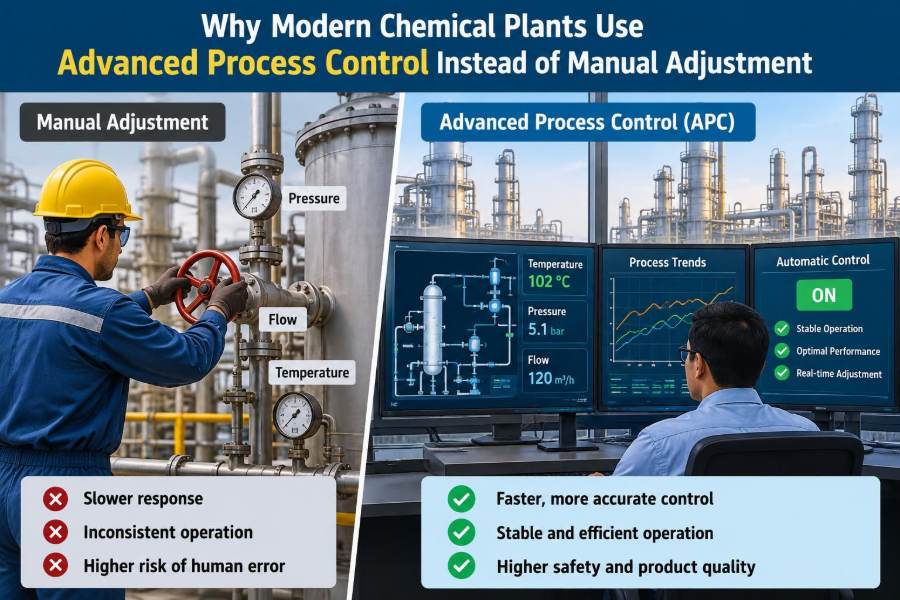
In a small, slow process, manual adjustment can work surprisingly well. In a modern chemical plant, however, the number of interacting variables and the speed of disturbances often exceed what any person can watch, predict, and correct continuously.
This is why many plants use advanced process control, usually called APC. It does not remove the operator from the process. It gives the operating team a more capable way to keep complex equipment safe, stable, efficient, and within specification.
🏭 The plant is a moving system, not a fixed recipe
Chemical plants are often described through steady-state flow diagrams, but real operations rarely sit perfectly still. Feedstocks vary, ambient conditions change, heat exchangers foul, catalyst activity declines, and downstream units change their demand.
Each change can alter temperatures, pressures, compositions, levels, and energy use. The job of control is to respond before small deviations become quality losses, constraint violations, or production interruptions.
🎛️ What manual adjustment actually means
Manual adjustment does not necessarily mean turning a valve by hand. In a control room, it may mean an operator changing a controller setpoint, switching a loop to manual mode, or altering a flow target after reviewing trends.
Human intervention remains essential for abnormal conditions, maintenance decisions, changing priorities, and situations outside the control system’s intended range. The limitation is not operator competence; it is the difficulty of continuously coordinating many decisions at once.
🔁 Basic control comes before advanced control
Most plants first rely on regulatory control, typically proportional-integral-derivative, or PID, loops. A flow controller adjusts a valve to maintain flow, a pressure controller manipulates venting or compression, and a temperature controller changes heating or cooling.
These loops are the plant’s foundation. APC is not a substitute for well-designed basic control. It sits above stable, maintained regulatory loops and coordinates them toward broader operating objectives.
🧠 APC is a supervisory decision layer
Advanced process control uses process measurements, process models, constraints, and optimization objectives to calculate coordinated moves. Rather than asking only, “How do I keep this temperature at its setpoint?”, it can ask, “What combination of moves keeps all important variables within limits while improving the chosen objective?”
That objective may be higher throughput, lower fuel use, more consistent quality, better recovery, or reduced variability. The answer is recalculated repeatedly as measurements change.
📈 Why one-variable-at-a-time correction falls short
Manual control often encourages local thinking: a temperature rises, so reduce heat; a level falls, so increase feed. Those actions can be correct locally but create unwanted effects elsewhere.
For example, increasing reflux in a distillation column can improve overhead separation while increasing condenser load and affecting column pressure. Reducing reboiler steam may save energy but can push bottoms composition toward a limit. Plants are coupled systems, not collections of isolated knobs.
🕸️ Process interactions create hidden trade-offs
A single manipulated variable can affect multiple controlled variables. Likewise, one quality target may depend on several flows, temperatures, and pressures. These are called interactions.
When operators respond independently to interacting measurements, their actions can unintentionally oppose each other. One person or shift may increase a variable to correct a symptom while another adjustment removes the benefit. APC explicitly accounts for the expected cross-effects.
⏱️ Delays make intuition harder to apply
Many chemical processes respond slowly. Material may need minutes or hours to travel through a vessel, reactor, separation train, or analyzer sample system. Thermal systems also retain heat, so a steam change may have a delayed effect.
Delayed feedback makes a process easy to overcorrect. By the time an operator sees the result of one move, several more moves may already have been made. Model-based control can account for expected delay and avoid reacting as though every measurement reflects an immediate cause.
🌊 Variability is costly even when averages look acceptable
A plant can meet an average production target while still losing value through variability. If quality moves widely around its target, operators often run conservatively to avoid occasionally crossing a specification limit.
Lower variability creates useful operating room. A refinery unit, polymer plant, or evaporator system may be able to operate closer to an economic limit when its response is predictable rather than constantly swinging around it.
🧪 Product quality is often measured late
Some of the most important properties are available only from laboratory analysis or online analyzers with sample-conditioning and measurement delays. By the time a quality result is known, the material responsible may already be far downstream.
APC can use faster secondary measurements—such as tray temperatures, pressure differences, flows, and energy duties—to infer the likely direction of quality. These inferred values are sometimes called soft sensors or inferential measurements.
🔍 Inferential control fills the measurement gap
An inferential model is not a replacement for laboratory testing or a properly maintained analyzer. It is an operating aid built from relationships between readily measured signals and a harder-to-measure property.
For a hypothetical distillation system, a model may use selected tray temperatures, reflux flow, reboiler duty, pressure, and feed rate to estimate product composition between analyzer updates. Operators and engineers still need to check that the estimate remains valid when equipment, feedstock, or operating conditions change.
🧮 Model predictive control is a common APC approach
Model predictive control, or MPC, is widely used because it can handle multiple variables, interactions, delays, and limits together. It predicts how the process may respond over a future time horizon, evaluates possible moves, and selects a feasible move sequence.
Only the first calculated move is implemented. At the next update, new measurements are collected and the optimization is solved again. This repeating approach helps the controller adapt to measured deviations without assuming its predictions are perfect.
🚧 Constraints are where APC becomes especially valuable
Every unit operates within constraints: maximum furnace duty, compressor capacity, allowable column pressure, pump limits, emission limits, product specifications, and safe equipment temperatures. In practice, profitable operation often occurs near one or more of these boundaries.
Manual operation near a constraint tends to require a buffer because conditions may shift before someone can respond. APC can track constraints continuously and coordinate moves to approach a limit cautiously while preserving room for uncertainty.
⚖️ APC resolves competing objectives
Plants rarely have one goal. More throughput may require more energy; lower energy use may affect recovery; better purity may reduce yield; and a downstream bottleneck may change which target matters most.
An APC application converts approved operating priorities into a structured decision problem. It does not decide business strategy on its own. Engineers and plant leadership determine the targets, priorities, constraints, and permitted operating envelope.
| Operating question | Typical manual response | APC approach |
|---|---|---|
| Feed rate rises unexpectedly | Correct the most visible deviation first | Coordinate flows, heat input, pressure, and quality indicators |
| Energy limit is approached | Back away with a fixed safety margin | Manage the limit while considering current process direction |
| Quality analyzer is delayed | Wait for the next result and adjust | Use validated inferential signals between updates |
| Several variables interact | Make sequential corrective moves | Calculate simultaneous, constraint-aware moves |
🔥 Energy systems reward coordinated control
Steam, fuel gas, electricity, cooling water, and refrigeration are not merely utility costs; they are process variables that influence capacity and quality. A small change in heat integration can shift conditions across several units.
APC can help keep heat duties closer to what the process needs rather than relying on broad manual margins. The benefit depends on reliable instrumentation and a sound process model. It is not a promise that every unit will always use less energy.
🏗️ Throughput increases expose bottlenecks
When a unit runs below its limiting capacity, many adjustments have little economic consequence. As throughput rises, hidden restrictions become more visible: a compressor reaches surge avoidance limits, a column floods, a furnace reaches duty limits, or a product property approaches specification.
APC helps identify and manage the active constraint. If it does not know about an important physical or operational limit, however, it cannot safely optimize around it. Good constraint design is an engineering task, not a software setting to guess.
🧭 Operators remain central to safe operation
A common misconception is that APC replaces operators. In well-managed applications, operators retain authority and receive better information about what the controller is doing and why.
They monitor alarms, assess unusual conditions, manage start-ups and shutdowns, respond to equipment problems, and place the system in an appropriate mode when process behavior is outside the model’s valid range. APC should make operations more manageable, not less understandable.
🛑 Safety instrumented functions are separate
APC can support stable operation, but it is not a safety instrumented system and should not be treated as one. Emergency shutdown functions, protective interlocks, relief systems, and other independent safeguards have different purposes and design expectations.
A controller may respect a high-temperature operating constraint, but protective systems must still address hazardous deviations if control fails, a sensor fails, equipment malfunctions, or an event develops faster than normal control can respond.
📡 Reliable measurements are the real starting point
An advanced controller is only as credible as its measurements. Drifted transmitters, sticking valves, noisy signals, poor analyzer maintenance, and incorrect engineering ranges can make a sophisticated controller behave poorly.
Before deploying APC, teams typically inspect loop performance and instrumentation health. Fixing a sticky control valve or unstable flow loop may deliver more immediate value than building a complex optimization layer on top of bad data.
🔧 Valve performance is often underestimated
Control valves translate a calculated decision into a physical change. Problems such as stiction—friction that causes a valve to move in jumps—dead band, poor sizing, or unreliable position feedback reduce control quality.
An APC application may repeatedly request a small move that the valve cannot deliver. The resulting mismatch can look like a model problem even though the real issue is mechanical. Field maintenance and control engineering must work together.
🧹 Bad data handling prevents bad decisions
Plant data contain spikes, communications failures, analyzer maintenance periods, and implausible values. A responsible APC design includes validation rules, filtering where appropriate, fallback strategies, and clear behavior when a critical measurement becomes unavailable.
Ignoring bad data is not sophistication. The safer design is usually to reduce the controller’s scope, hold selected targets, or return control to a defined basic-control configuration when confidence in key inputs is lost.
📐 Models need engineering judgment
APC models may be built from planned step tests, first-principles understanding, historical data, or a combination. A model should capture the operating relationships that matter for the intended range, including gains, response times, and interactions.
No model is universally valid. A relationship identified during normal operation may change after a catalyst change, exchanger cleaning, feedstock shift, equipment modification, or major control configuration change.
🧪 Testing should be deliberate and bounded
Identifying process behavior often requires small, planned changes to manipulated variables while observing the response. Such tests need operating approval, clear limits, communication with the control room, and a plan for stopping if conditions move in an unfavorable direction.
The purpose is not to disturb production unnecessarily. It is to obtain enough information to create a controller that behaves predictably within a defined operating window.
🗺️ APC has a valid operating envelope
A controller tuned for normal production may not be suitable during start-up, shutdown, grade transition, severe fouling, or a major equipment upset. These conditions can have different dynamics and constraints.
Good implementations define when APC may operate, which modes are allowed, and how it should be disabled or limited. Clear boundaries make the system easier for operators to trust because unexpected behavior is less likely.
💻 Integration with the control system matters
APC generally exchanges measurements and targets with a distributed control system, or DCS. The DCS continues to execute the underlying control loops, alarms, interlocks, and operator interfaces.
The integration must make modes, setpoints, constraints, and controller status visible. If operators cannot easily tell whether a target comes from APC, a manual setting, or another application, troubleshooting becomes slower and confidence declines.
🔐 Cybersecurity and access control are operational concerns
Because APC depends on industrial data and control networks, it should be managed with the same discipline applied to other connected control assets. Unauthorized changes to models, limits, or interfaces can affect process behavior.
Practical protections include controlled user access, documented changes, backups, tested recovery procedures, and coordination between operations, engineering, automation, and cybersecurity teams. The exact controls depend on site architecture and risk assessment.
👥 Training turns automation into teamwork
Operators do not need to derive every model equation, but they should understand the controller’s objectives, manipulated variables, key constraints, expected behavior, and the correct response to an abnormal situation.
Engineers also need to learn from operators, who understand equipment quirks, shift-to-shift realities, and conditions that may not appear in historical data. The strongest applications combine process knowledge with control expertise.
🧾 Clear displays make decisions auditable
An APC display should show more than a green “running” indicator. Users need to see important targets, active constraints, current moves, variables excluded from service, and whether the controller is limited by a measurement or equipment condition.
This visibility supports diagnosis. If an application is consistently constrained by cooling-water temperature, for example, the team can investigate the physical bottleneck rather than assuming the control system needs more aggressive tuning.
📊 Performance must be monitored after commissioning
Commissioning is not the finish line. Model quality can decay gradually as the plant changes, and a controller may remain enabled while delivering little practical benefit.
Useful monitoring examines controller availability, time spent in automatic mode, constraint activity, model prediction error, valve movement, and relevant process outcomes. Metrics should be interpreted in context; a controller that backs away during an equipment issue may be behaving correctly.
⚠️ Common implementation mistakes
Many disappointing APC projects fail for ordinary reasons rather than exotic algorithmic flaws. They begin with unstable basic loops, unclear ownership, unrealistic objectives, or insufficient operator involvement.
- Optimizing an unreliable measurement: repair or validate the instrument first.
- Using stale constraints: review limits after process and equipment changes.
- Ignoring maintenance: models, analyzers, and valves all require ongoing care.
- Hiding the logic: opaque behavior encourages operators to disable the application.
- Promising too much: APC improves decisions within its scope; it cannot remove physical bottlenecks.
🪜 A practical path to adoption
Plants usually gain more from a staged approach than from trying to automate every decision at once. Start with a meaningful, bounded problem where measurements, manipulated variables, and operating limits are reasonably understood.
- Stabilize basic control loops and correct instrumentation problems.
- Define the operating objective and non-negotiable constraints.
- Involve operators, process engineers, maintenance, and automation specialists.
- Build and test models within approved operating boundaries.
- Commission gradually, with clear fallback modes and performance review.
- Maintain the application as the process evolves.
🏭 Where manual control still makes sense
Not every process needs APC. A small batch operation with infrequent changes, low interaction, slow economics, and a skilled operator may gain little from a sophisticated supervisory controller.
Manual operation can also be appropriate during unusual conditions that lie outside an APC application’s design basis. The right question is not whether automation is inherently better, but whether the process complexity and operating objective justify the additional engineering effort.
🔄 Manual skill and APC serve different roles
Experienced operators recognize patterns that are difficult to encode: an unusual sound from a pump, a maintenance history, a weather-related issue, or a developing equipment problem. Their judgment remains indispensable.
APC contributes a different strength: it can apply a defined strategy consistently, evaluate many measured relationships at once, and react at every update without fatigue or distraction. The most effective plants use both capabilities.
🌐 The broader value is operational consistency
A well-maintained APC application reduces dependence on each individual shift discovering the same best response from scratch. It captures approved operating knowledge in a form that can be applied repeatedly while remaining visible and adjustable to the operating team.
That consistency supports smoother handovers, more reproducible production, and better learning when conditions change. It also creates a clearer record of which constraints and decisions shaped unit performance.
✅ The core principle: control the whole process, not the latest symptom
Modern chemical plants use advanced process control because their processes are dynamic, delayed, interactive, and constrained. Manual adjustment can address visible symptoms, but it struggles to continuously calculate the best coordinated response across many variables.
APC is most useful when it rests on reliable equipment, healthy basic loops, sound models, clear safeguards, and trained people. It is a disciplined extension of process engineering—not a magic layer placed over an unstable plant.
Advanced process control earns its place by helping people operate complex processes closer to their intended limits with greater consistency, while leaving safety, engineering judgment, and operator authority firmly in the system. 🧪⚙️📈