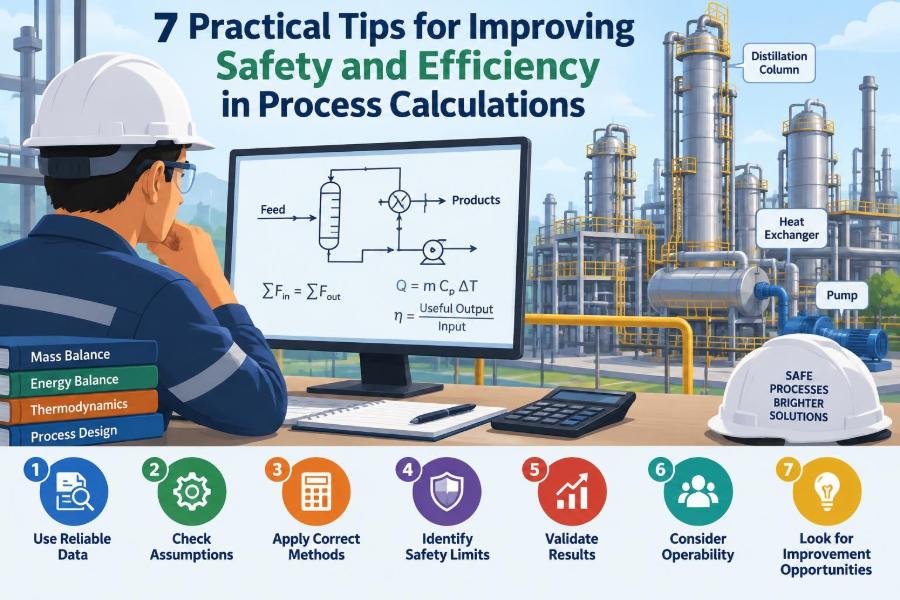

A process calculation can look tidy on paper and still create a bad decision in the plant. A misplaced decimal in a solvent balance, a pressure entered in gauge rather than absolute units, or an unchallenged assumption about phase can change a utility estimate, relief load, equipment size, or operating instruction.
That is why experienced engineers rarely treat calculations as isolated mathematics. They treat them as a structured way of representing a real process, with uncertain measurements, changing conditions, physical limits, and consequences if the answer is wrong.
Students often meet mass and energy balances as classroom exercises with one expected answer. Working professionals use the same principles when data conflict, operating conditions drift, and an answer must be understood by someone else months later.
The good news is that safer calculations are usually more efficient calculations. A disciplined setup reduces rework, makes errors easier to detect, and produces results that can be reviewed, reused, and acted on with confidence.
🧭 1. Start with the Decision, Not the Equation
Before opening a spreadsheet or simulation, state what decision the calculation is meant to support. Are you checking whether a pump can meet a new flow rate, estimating a heat-exchanger duty, validating a tank inventory, or screening a change before detailed design?
A clear purpose determines the required accuracy, boundary, inputs, and deliverable. An early screening estimate may reasonably use conservative assumptions. A calculation that changes a set point, operating envelope, or safety basis needs stronger evidence, documented sources, and independent review.
Write a one-sentence calculation objective at the top: “Determine the maximum expected vapor generation rate during the specified upset for relief-system evaluation.” This prevents a common failure mode: producing a precise number that answers the wrong question.
🧱 Define the System Boundary Explicitly
A system boundary is the imagined line around the equipment or process being analyzed. Everything crossing it must be considered: material streams, heat transfer, shaft work, electrical input where relevant, and accumulation within the boundary.
Draw the boundary even for a simple calculation. For a jacketed batch reactor, deciding whether the boundary includes only the vessel contents or also the jacket changes which heat flows belong in the energy balance.
State what is deliberately excluded. For example, a preliminary exchanger calculation might neglect heat loss from insulated external piping, while a cryogenic line assessment may need to include it. Exclusions are not automatically mistakes; unspoken exclusions are.
🗺️ Draw a Process Sketch Before Building a Model
A process flow diagram is not only a design document. A quick hand sketch can expose missing streams, recycles, drains, vents, sample points, bypasses, and utility connections before they become hidden spreadsheet omissions.
Label each stream with a unique name or number and indicate flow direction. Add known temperature, pressure, composition, phase, and flow information near the line. For a batch process, use a sequence sketch that shows charging, reaction, heating, cooling, venting, and discharge.
Keep the sketch beside the calculation. If a formula cannot be traced to a stream or item on the drawing, ask whether it belongs there.
📏 2. Establish One Coherent Unit System
Unit inconsistency is one of the fastest ways to create a plausible but dangerous answer. It commonly appears when vendor data are in one system, laboratory data are in another, and a spreadsheet silently combines them.
Choose a primary unit system at the beginning, such as SI with kg, kmol, kPa, °C or K, kW, and m³/h. Convert imported values at the point of entry, not repeatedly throughout the workbook.
Temperature deserves special attention. Temperature differences may be expressed in degrees Celsius or kelvin with the same numerical magnitude, but absolute-temperature equations require kelvin. Likewise, gas-law pressure must be absolute, not gauge pressure.
🔍 Put Units Beside Every Input and Output
Do not rely on column headings alone. Display units next to important values in equations, tables, and final results. A reviewer should be able to see whether a flow is kg/h, kmol/h, actual m³/h, or standard m³/h without searching elsewhere.
Dimensional analysis is a practical error check. If an energy-balance expression intended to give power reduces to kJ rather than kJ/h or kW, a time basis is missing. If a calculated density has units of kg/m², a volume term has likely been mishandled.
Software can carry units, but software does not remove engineering judgment. Verify what a tool means by labels such as “standard,” “normal,” “base,” and “actual” conditions.
⚖️ Separate Mass, Molar, and Volumetric Bases
Mass is conserved in ordinary process balances; volume generally is not. A liquid may expand with temperature, and a gas volume can change dramatically with pressure and temperature. Molar flow is often the clearest basis for reacting systems and vapor-liquid equilibrium.
Choose the basis that fits the physics, then convert carefully. For example, combustion stoichiometry is naturally molar, while a pump capacity check may start from actual liquid volume flow and density.
State the basis in the title of each table: “per hour,” “per batch,” “per 1,000 kg feed,” or “at 25 °C and 1 bara.” This simple habit prevents accidental comparisons between quantities on different bases.
🧾 Build a Transparent Input Register
A calculation is only as dependable as its inputs. Create a compact input register that records each key value, unit, source, date or revision, operating condition, and any transformation applied.
This is especially useful when values come from several places: a P&ID, historian trend, laboratory report, equipment datasheet, operating procedure, or property package. It also exposes when a supposedly measured value is actually a design assumption.
| Input | Example source | Check to make |
|---|---|---|
| Feed flow | Flow transmitter trend | Average, range, and meter basis |
| Composition | Laboratory analysis | Sampling point and representativeness |
| Heat capacity | Property method or datasheet | Temperature and composition range |
| Design pressure | Equipment documentation | Gauge versus absolute convention |
🧪 Check Whether the Data Represent the Actual Process
A number can be accurate for the wrong location or time. A tank sample may not represent a stratified vessel. A flow reading may include recycle flow when the calculation requires net production. A laboratory property measured near room temperature may not describe a hot, concentrated process stream.
Ask how the value was obtained and what it represents physically. For transient operations, one steady-state snapshot may hide the peak condition that matters for safety or capacity.
When data quality is limited, record the limitation rather than disguising it with extra decimal places. A bounded estimate is often more useful than a falsely exact input.
🧩 3. State Assumptions Where They Can Be Challenged
Every practical process calculation has assumptions. The issue is not whether assumptions exist; it is whether they are visible, reasonable, and appropriate for the decision.
List assumptions near the calculation rather than burying them in a separate note. Examples include steady state, negligible heat loss, ideal mixing, constant heat capacity, no reaction, or vapor behaving as an ideal gas.
For each major assumption, explain the likely direction of error if it fails. Assuming no heat loss from a heated vessel may overpredict product temperature or underpredict required heating time, depending on the calculation setup.
🌡️ Test the Phase Before Applying Properties
Many serious calculation errors begin with an incorrect phase assumption. A stream near its bubble point may flash when pressure drops. A “liquid” feed can contain dissolved gases. A vapor stream can partially condense in a cold line.
Check temperature and pressure against credible phase information for the mixture. For multicomponent systems, use a suitable thermodynamic method or consult an experienced reviewer; a pure-component boiling point is not generally enough.
Phase matters because density, enthalpy, heat transfer, compressibility, pressure drop, and equipment behavior can change sharply across a phase boundary.
🧠 Use Property Methods Within Their Valid Range
Physical-property correlations and simulation property packages are models, not universal truths. A method that works well for nonpolar hydrocarbons may be a poor choice for strongly associating, electrolytic, polymeric, or highly nonideal mixtures.
Check the temperature, pressure, composition, and phase range behind a correlation whenever possible. Be cautious when extrapolating outside available data, particularly near critical conditions, phase transitions, or extreme concentrations.
If the selected method is uncertain, compare it with a second reasonable approach or use sensitivity bounds. The goal is not to force agreement but to understand whether property uncertainty changes the engineering decision.
🧮 4. Build the Simplest Valid Calculation First
Start with a hand calculation, a structured balance, or a small spreadsheet before constructing a detailed model. A simple model reveals the governing quantities and provides a benchmark for later software results.
For example, a first-pass sensible heat duty can be estimated from mass flow, heat capacity, and temperature change. That estimate will not replace a detailed exchanger design, but it can identify an order-of-magnitude error in a simulator result.
Simplicity is not carelessness. It means matching model complexity to the question while retaining the physical mechanisms that control the answer.
🧷 Keep Equations Traceable and Readable
Use one logical operation per row or clearly named calculation block. Avoid a single long spreadsheet formula containing conversions, lookups, corrections, and final arithmetic. Such formulas are difficult to audit and easy to damage.
Name variables meaningfully: feed_mass_flow is safer than x17. Define symbols if using a written derivation, and show intermediate values where they help a reviewer locate an error.
A traceable calculation lets another engineer reproduce the result without guessing your intentions. It also lets you revisit your own work after the process or inputs change.
🔁 Close Mass and Energy Balances
Balance closure is a powerful diagnostic, not a ceremonial final step. For a steady process without reaction, total mass in should approximately equal total mass out after allowing for known accumulation, losses, and measurement uncertainty.
For energy, compare heat and work entering and leaving with the enthalpy change and accumulation. Perfect closure is not always expected from plant data, but a large mismatch requires explanation before using the result.
When a balance fails, investigate the physical system as well as the arithmetic. Missing vents, unmeasured drains, changing inventory, faulty instrumentation, and incorrect stream composition can all be real causes.
🧯 Include Accumulation in Non-Steady Operations
Steady-state equations are tempting because they are simpler. Yet many plant problems occur during startup, shutdown, grade transition, batch charging, cleaning, upset response, or control-valve movement—conditions where inventory is changing.
For a tank, the general mass balance is input minus output plus generation minus consumption equals accumulation. The accumulation term may explain why inlet and outlet flow readings do not match at a particular moment.
For thermal systems, stored energy in vessel metal, liquid inventory, and contents can dominate short-term behavior. Ignoring it may produce an unrealistic heating or cooling rate.
🚦 Respect Operating and Design Limits
A mathematically feasible answer may still be operationally unacceptable. Check calculated pressure, temperature, flow, level, composition, velocity, and duty against known equipment limits and approved operating envelopes.
Do not assume a nameplate rating answers every question. Limits can depend on temperature, material condition, rotating-equipment curve, allowable differential pressure, process fluid, fouling, control stability, or connected equipment.
If documentation is unavailable or the calculation approaches a limit, treat the result as a trigger for verification—not permission to proceed.
🎯 5. Perform Reality Checks Before Trusting Precision
A result should make physical sense before it earns more detailed analysis. Ask basic questions: Is the sign correct? Does heating increase enthalpy? Does compression require work? Does a higher flow generally increase pressure drop in this system?
Compare with a familiar scale. A small laboratory vessel should not require utility duty comparable to a large production train without a compelling reason. A liquid line should not predict gas-like velocity unless flashing or a unit mistake is involved.
These checks are not substitutes for rigorous methods. They are fast filters for answers that are internally calculated but physically implausible.
📐 Use Order-of-Magnitude Estimates
Estimate the expected magnitude independently using rounded numbers. If a detailed calculation predicts a heat duty of several megawatts but a quick estimate from flow, heat capacity, and temperature rise suggests tens of kilowatts, stop and reconcile the difference.
Order-of-magnitude checks are particularly valuable after copying formulas, changing units, importing data, or revising a model. They catch powers-of-ten errors that can survive many spreadsheet checks.
Document the rough estimate when the calculation has significant safety or capital implications. It gives reviewers a useful second path to the result.
📉 Examine Sensitivity, Not Just the Base Case
A base-case answer can conceal the variables that actually control risk or cost. Sensitivity analysis changes one uncertain input at a time across a realistic range and observes how the output responds.
Suppose a cooling-duty calculation depends on reaction heat, feed concentration, and coolant temperature. If reasonable variation in concentration changes the duty much more than the other inputs, sampling and composition control deserve attention.
Focus on variables that can plausibly vary in operation. Arbitrary extreme ranges may create dramatic outputs without improving the decision.
🛡️ Use Conservative Assumptions Deliberately
Conservatism is useful when uncertainty could lead to an unsafe underestimate, but it must be purposeful. Stacking several worst-case assumptions can create an impossible scenario and lead to oversized equipment, nuisance trips, or misleading risk conclusions.
Identify whether each assumption is conservative for the specific output. A higher temperature may increase vapor pressure but reduce liquid viscosity; it does not necessarily make every calculation result more severe.
When needed, present a realistic case and a justified bounding case. Explain the purpose of each rather than labelling an assumption “conservative” as a substitute for analysis.
🤝 6. Seek an Independent Check for High-Consequence Work
Independent checking means more than asking someone to scan a spreadsheet. The reviewer should understand the objective, inputs, assumptions, boundary, equations, and final use of the result.
For critical work, an effective reviewer may recreate key results using a different method or tool. Agreement between independent approaches increases confidence; disagreement reveals where discussion is needed.
Scale the review to the consequence. A routine utility estimate may need a peer check, while calculations informing relief protection, hazardous chemical handling, structural loads, or operating changes may require formal processes defined by the organization.
🗣️ Make Reviews Easy for the Next Engineer
Good technical communication is a safety control. Put the calculation objective, scope, basis, assumptions, source data, method, results, checks, limitations, and recommendation in a predictable order.
Use plain language around the equations. “The result applies only while the vessel is well mixed” is more actionable than leaving the mixing assumption implied.
A reviewer should be able to answer three questions quickly: What was calculated? Why is the result credible? What must not be inferred from it?
🧰 Control Spreadsheets Like Engineering Documents
Spreadsheets are powerful because they are flexible, and risky for the same reason. Protect formula cells where practical, separate inputs from calculations and outputs, and make changed inputs visually obvious without relying only on color.
Include a revision identifier, preparer, checker, date, and a short change log for calculations that will be reused. Save a static record or PDF of approved results when changes could affect later decisions.
Beware of broken external links, copied values replacing formulas, hidden rows, filters, and cells with inconsistent units. These are ordinary office features that can become engineering hazards.
💻 Validate Software Rather Than Trusting Its Appearance
Simulation and calculation software can solve complex systems quickly, but an error-free status message does not confirm that the model represents the process. Check thermodynamic selections, stream conditions, equipment configuration, convergence behavior, and default assumptions.
Test a model against a hand calculation, a known operating case, or a simpler limiting case. For example, if reaction conversion is set to zero, does the model reduce to the expected nonreacting balance?
Software should make assumptions more visible, not less visible. Record version information and property-method choices when results will be reviewed or reused.
🧹 7. Manage Significant Figures and Rounding Carefully
Extra digits in a spreadsheet are not extra accuracy. Report results with a precision consistent with the input quality and intended use. A flow based on uncertain plant measurements rarely justifies a long string of decimal places.
Keep sufficient internal precision to avoid cumulative rounding error, then round only at the reporting stage. Do not round intermediate material-balance components so aggressively that the final balance appears not to close.
Use language that matches uncertainty: “approximately,” “estimated range,” or “screening value” may be more honest and useful than a single overly precise number.
🚨 Recognize When a Calculation Requires Escalation
Stop and seek additional expertise when the problem includes unfamiliar chemistry, potential runaway reaction, relief-system sizing, toxic or flammable release scenarios, two-phase flow, unstable control behavior, major mechanical loading, or results close to an equipment limit.
Escalation is not a failure of calculation skill. It is recognition that some questions require specialized methods, verified data, formal hazard review, or discipline-specific approval.
Likewise, do not use a preliminary calculation as an operating instruction without the required review and management-of-change process applicable at the site.
📝 Document Limitations Alongside Results
A useful calculation result includes its boundaries. State whether it is valid only for a stated feed composition, flow range, ambient condition, equipment configuration, or assumed control response.
List unresolved uncertainties and recommended next actions. For example: verify the transmitter calibration; obtain mixture vapor-pressure data; confirm whether the bypass can be open during the scenario; perform a dynamic analysis before changing procedure.
This protects future users from applying a valid result outside the conditions that made it valid.
🔄 Turn Repeated Calculations into Reliable Templates
Recurring tasks such as line sizing, pump checks, batch heating estimates, and utility balances benefit from templates. A good template contains protected equations, required input fields, unit prompts, embedded reasonableness checks, and guidance on applicability.
Templates should not become black boxes. Include the governing equations and explain where the method may fail, such as non-Newtonian flow, flashing service, or large changes in physical properties.
Periodically review templates against current standards, site practices, and lessons from actual operation. Reuse should reduce errors, not preserve old assumptions indefinitely.
📚 Learn from Differences Between Prediction and Operation
When plant results differ from a calculation, investigate constructively. The model may have missed heat loss, fouling, composition changes, holdup, measurement bias, control action, or a physical mechanism not included in the original scope.
Comparing predicted and observed behavior is one of the best ways to improve engineering judgment. Update reusable models and templates only after understanding why the difference occurred.
Do not “tune” a factor merely to make a model match one data point. A correction without a physical explanation may fail badly under another condition.
✅ A Practical Seven-Tip Workflow
The seven habits can be used as a compact workflow whenever a process calculation supports a real decision:
- Define the decision and system boundary.
- Standardize units and calculation basis.
- Record data sources and explicit assumptions.
- Build the simplest valid, traceable model.
- Check balances, limits, magnitude, and sensitivity.
- Obtain review appropriate to the consequence.
- Document results, limitations, and revision status.
This workflow does not replace company procedures, codes, or specialist analysis. It creates a dependable foundation on which those more specific requirements can operate.
🏁 The Core Principle: Make Calculations Auditable
The strongest process calculation is not necessarily the longest model or the most polished spreadsheet. It is one where the physical system, data, assumptions, method, checks, and limitations can be followed by another competent person.
Auditability improves efficiency because errors are found earlier and updates are faster. It improves safety because hidden assumptions, invalid data, and unreasonable outputs have more opportunities to be challenged before they influence equipment or operations.
Whether you are solving a student balance or evaluating a plant change, build calculations so that the next person can understand what you did, test what matters, and use the result within its proper limits.
Safe and efficient process calculations come from disciplined thinking made visible: define, verify, calculate, challenge, review, and document. 🧪⚙️✅