
A production line is missing its target. Steam use has climbed, operators are working around a troublesome control loop, and a manager needs an answer before the next customer order is due. The plant may not need a new piece of equipment; it may need someone who can turn scattered operating data into a practical diagnosis.
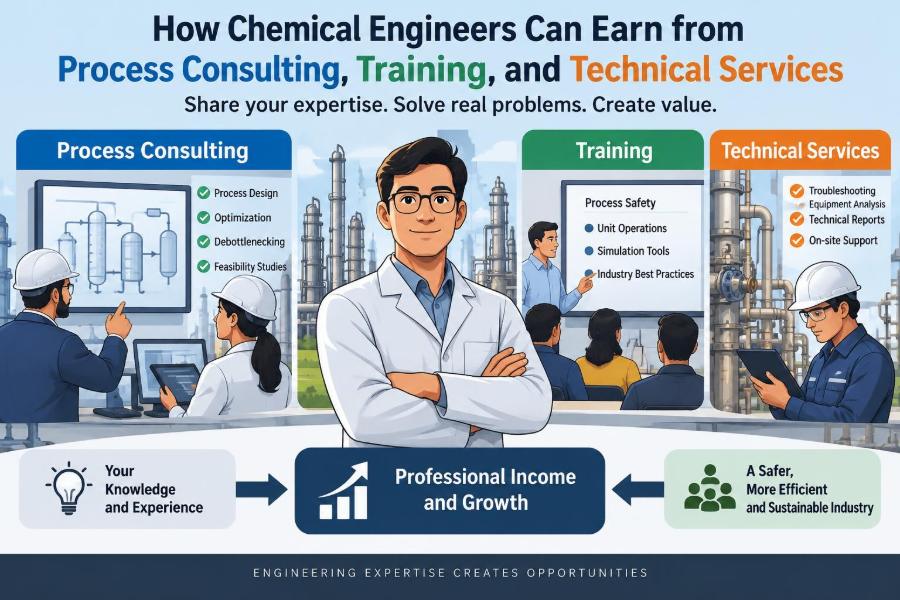
That is where chemical-engineering expertise becomes commercially useful beyond a conventional full-time role. Process consulting, technical training, and specialist services let engineers solve defined problems for manufacturers, laboratories, utilities, engineering firms, and growing process businesses.
For students, this can be a long-term career direction rather than an immediate side business. For experienced professionals, it can become a carefully scoped independent practice, a supplementary income stream, or a route into technical leadership.
The opportunity is not simply “selling knowledge.” Clients pay when engineering knowledge reduces uncertainty, helps people work more safely, improves a decision, or makes a process more reliable. The difference matters.
🔎 Start with the Commercial Value of Engineering
Chemical engineers are trained to connect material balances, energy balances, transport phenomena, reaction behavior, equipment limits, controls, and safety. Many organizations have pieces of that knowledge internally, but lack time or a systematic way to connect them.
A service becomes valuable when it produces an outcome a client can use: a troubleshooting plan, a calculation package, a training program, a process review, or a clearer operating procedure. A report full of equations is not automatically valuable unless it supports an operational decision.
🏭 Recognize the Problems Clients Actually Buy Help For
Clients rarely begin by requesting “mass-transfer expertise.” They describe symptoms: low throughput, inconsistent quality, high utility consumption, repeated filter blockage, slow batch turnaround, unexplained pressure drop, or uncertainty about scale-up.
The engineer’s job is to translate the symptom into an engineering question. For example, a distillation complaint could involve feed variability, reflux control, tray damage, fouling, utility constraints, analyzer error, or an operating target that conflicts with product requirements.
- Operations teams often need fast, structured troubleshooting.
- Managers may need options and trade-offs for an investment decision.
- Newer staff may need role-specific training.
- Small companies may need technical capacity they cannot justify employing full time.
🧭 Choose a Market Before You Choose a Service
“Chemical engineering consultant” is too broad to be a useful market position. A clearer starting point combines an industry, a process area, and a type of outcome.
Examples include utilities optimization for batch plants, separation-process troubleshooting for specialty manufacturers, water-treatment training for facility teams, or process documentation for early-stage chemical companies. Specialization makes it easier for a prospective client to recognize when to call you.
You do not need to stay narrow forever. But a focused first offer is easier to explain, price, deliver, and improve.
🧩 Build Offers Around Defined Deliverables
Clients are more comfortable buying a service when they can see what they will receive. “I can help improve your plant” is vague. “A two-week review of the steam system ending in an opportunity register, assumptions log, and prioritized next steps” is more concrete.
A good deliverable also creates boundaries. It clarifies that an initial assessment is not the same as detailed design, procurement support, construction supervision, or a guarantee of performance.
- Process review memo with findings and data gaps
- Heat and material balance for an agreed operating case
- Standard operating procedure or batch record review
- Training slides, exercises, and competency check
- Control-loop performance screening and improvement recommendations
🛠️ Process Troubleshooting Is a Core Consulting Service
Troubleshooting is often a strong entry service because plants encounter recurring operational problems and value a disciplined investigation. The work should begin with evidence, not a favorite theory.
A practical sequence is to define the symptom, establish when it began, compare normal and abnormal conditions, check measurement quality, generate possible causes, and test the most plausible ones safely. This is essentially root-cause thinking applied with process fundamentals.
Consider a hypothetical evaporator that suddenly consumes more steam. Possible explanations include altered feed solids, fouling, steam-trap issues, vacuum loss, instrument drift, or changed production scheduling. Treating one possibility as fact before checking data can waste both time and credibility.
📊 Turn Plant Data into Decision Support
Many process sites collect large volumes of data but struggle to convert it into useful comparisons. Chemical engineers can provide value by cleaning operating data, defining meaningful performance indicators, and explaining what the indicators do and do not show.
For example, a trend may show that energy use rises with production rate. That alone does not prove inefficiency; some increase may be expected. The useful analysis compares similar operating conditions, identifies deviations, and states uncertainty where data are incomplete.
Spreadsheets, process historians, and carefully checked calculations can be enough for many assignments. Sophisticated software does not replace sound assumptions and unit checks.
⚖️ Use Balances to Find Hidden Losses
Material and energy balances are among the most transferable consulting tools. They force a process story to obey conservation principles: what enters, leaves, accumulates, reacts, or loses energy must be accounted for within reasonable measurement uncertainty.
An incomplete balance can still be useful if assumptions are transparent. It may reveal that a reported yield is inconsistent with feed and product records, that a waste stream deserves sampling, or that a flowmeter requires verification.
Never present an estimated balance as a precise plant truth. Clearly separate measured values, calculated values, and assumptions.
🔥 Find Energy Opportunities Without Overpromising Savings
Energy work can include steam-system reviews, heat-exchanger performance checks, utility mapping, insulation assessments, condensate-return discussions, and heat-integration screening. These projects are attractive because energy costs are visible, but implementation is rarely as simple as changing one operating setting.
A recommendation should consider production constraints, product quality, maintenance condition, control capability, safety, and the capital required. Recovering heat from one stream may create fouling, corrosion, cleaning, or scheduling challenges elsewhere.
The professional approach is to estimate opportunities using stated assumptions and identify what should be measured before committing funds.
🧪 Support Scale-Up and Process Development Carefully
Startups and laboratories may need help moving from bench work to pilot or commercial operation. This is a valuable niche, but it carries substantial uncertainty because mixing, heat transfer, residence-time distribution, solids handling, and reaction selectivity may change with scale.
A consultant can help build a development plan, identify scale-sensitive variables, prepare preliminary balances, and define data needed for design. They should avoid claiming that laboratory performance will transfer directly to a larger vessel.
Good scale-up support turns assumptions into planned experiments rather than hiding them inside a design calculation.
🧱 Offer Process Design Reviews, Not Unqualified Approval
Design reviews can cover process flow diagrams, piping and instrumentation diagrams, equipment lists, utility requirements, design basis documents, and operating narratives. The goal is often to find omissions, inconsistent assumptions, difficult-to-operate features, or unclear interfaces before they become expensive.
However, reviewing a design is not the same as accepting legal responsibility for it. Scope language should state whether the work is an independent technical review, detailed engineering, or formal approval under a regulated framework.
Where licensed professional sign-off or specialized authority is required, obtain the appropriate competence and authorization or involve someone who has it.
🛡️ Keep Process Safety at the Center
Safety advice is not an optional add-on to process work. Changes to temperature, pressure, chemistry, control settings, flow paths, or operating procedures can affect hazards in ways that are not obvious from a simplified model.
Consultants can assist with hazard-review preparation, safeguard verification, relief-system data gathering, safer operating-window definitions, and training. But formal hazard studies and safety-critical calculations require appropriate methods, current information, and qualified participants.
Never treat a remote review or a generic checklist as proof that a process is safe. Site conditions, maintenance history, human factors, and chemical compatibility all matter.
📚 Training Is a Product, Not Just a Presentation
Technical training can become a dependable service when it solves a specific performance gap. A generic lecture on fluid mechanics may be educational, but an operator-focused session on recognizing pump cavitation and responding correctly has a clearer workplace purpose.
Strong training starts by identifying who the learners are, what decisions they make, which mistakes are costly, and what they must be able to do afterward. This determines the depth, examples, exercises, and assessment method.
👩🏫 Design Training for Different Audiences
Operators, graduates, maintenance technicians, sales teams, and managers do not need the same course. Using the same slides for all of them usually produces either unnecessary theory or unsafe oversimplification.
| Audience | Useful emphasis | Suitable format |
|---|---|---|
| Operators | Operating limits, abnormal situations, practical signals | Short modules and scenario exercises |
| New engineers | Fundamentals, calculations, process context | Workshop with worked problems |
| Managers | Trade-offs, risk, capacity, decision questions | Briefing with visual summaries |
| Sales or commercial teams | Process basics and customer pain points | Application-focused sessions |
Training should not encourage people to work outside their authorization. Its purpose is to improve understanding and escalation, not to replace site procedures or competency systems.
🧠 Teach with Plant Scenarios and Calculations
People remember principles better when they can use them. A short exercise on why a pump may cavitate, a simplified mass-balance problem, or a scenario involving a rising reactor temperature turns abstract concepts into operational reasoning.
Use hypothetical cases unless you have permission to use client material. Remove identifying details and confidential operating information from examples, even when discussing lessons learned informally.
💻 Create Repeatable Digital Technical Products
Not all technical income requires continuous on-site work. Engineers can create calculation templates, training modules, checklists, introductory courses, or technical guides that address recurring needs.
These products still require quality control. A spreadsheet with hidden assumptions, unclear units, or unprotected formulas can create bad decisions at scale. Include instructions, version control, limitations, and examples of appropriate use.
Digital products work best as an extension of proven expertise, not as a substitute for learning the subject deeply.
🔧 Provide Technical Documentation Services
Process knowledge is often trapped in the memories of a few experienced people. Documentation services can help organizations clarify operating procedures, process descriptions, training materials, design bases, calculation notes, and change records.
This work is more than formatting. The engineer must reconcile documents with actual process intent, identify contradictions, ask the right questions, and ensure that critical limits are not casually altered.
Document control matters: clients should know the revision, owner, review route, and status of each deliverable.
🧰 Package Small Technical Services
Some clients are not ready for a major consulting project, yet need focused assistance. A compact, fixed-scope service can reduce the barrier to starting a relationship while protecting your time.
- A one-day process-data review
- A calculation audit with an assumptions register
- A pump or heat-exchanger troubleshooting workshop
- A review of a draft operating procedure
- A technical interview panel for a process-engineering hire
Small projects should still use a written scope. Informal requests can expand quickly when the client sees that you are helpful.
🗣️ Translate Expertise into a Clear Value Proposition
A value proposition describes whom you help, what problem you address, and what useful result you deliver. It is clearer than a list of software packages or university modules.
For example: “I help batch-process manufacturers investigate recurring yield variability through data review, process balances, and operator interviews.” This tells a prospective client more than “experienced chemical engineer available for consulting.”
Be specific without making promises you cannot control. Process performance depends on plant conditions, implementation quality, and factors outside a consultant’s authority.
🤝 Find Work Through Trust, Not Aggressive Promotion
Technical services are often purchased through trust. Former colleagues, industry contacts, suppliers, local manufacturers, professional communities, and engineering partners may become sources of referrals when they understand your niche.
Useful visibility can include a concise capability statement, short technical posts, a workshop, or a presentation that demonstrates how you think. Share general lessons, not confidential details from employers or clients.
For early-career engineers, credibility can grow through supervised project work, strong documentation habits, and a reputation for careful analysis. Independence should follow competence, not replace it.
📝 Scope Every Assignment Before Starting
A written scope protects both parties. It should state the problem to be addressed, information provided by the client, deliverables, exclusions, timeline, meetings, review points, fees, and ownership of work products.
It should also identify decisions that remain with the client. A consultant may recommend a test or change; the site remains responsible for authorization, implementation, and safe operation unless a different arrangement is explicitly agreed.
When the assignment changes, document the change. This is not bureaucracy for its own sake; it prevents mismatched expectations.
💰 Price the Work by Effort, Risk, and Value
New consultants often focus only on an hourly rate. Time matters, but so do preparation, meetings, travel, software, insurance, administration, revisions, taxes, and the professional risk carried by the assignment.
Common structures include hourly or daily rates, fixed fees for tightly defined deliverables, retainers for ongoing access, and staged fees tied to project milestones. No one model is always best.
A fixed fee works when the scope and inputs are reasonably predictable. Where the diagnosis is uncertain, an initial paid assessment followed by a separate implementation scope is usually safer than guessing the full effort.
📄 Protect Confidential Information and Intellectual Property
Clients may share formulations, operating data, drawings, customer information, or commercial plans. Treat these as confidential unless there is clear permission to use or disclose them.
Agree on who owns final deliverables, reusable templates, raw data, and pre-existing methods. It is reasonable to retain general know-how, but that does not permit reuse of a client’s confidential details for another client.
Use secure storage, controlled access, and sensible file naming. Confidentiality failures can damage a career faster than most technical mistakes.
⚖️ Understand Liability, Insurance, and Professional Boundaries
Engineering advice can influence safety, quality, environmental performance, and capital spending. Contracts, insurance, local licensing rules, and professional obligations vary by jurisdiction and by the nature of the work.
Before accepting an assignment, consider whether your experience, authority, and insurance match the risk. High-hazard processes, regulated facilities, structural changes, pressure systems, and safety-critical design decisions may require specialized expertise or formal sign-off.
Clear limitations do not eliminate responsibility, but they help ensure that the service is understood accurately. Seek legal, insurance, and professional advice appropriate to your location and practice.
🧑🔬 Build Credibility with Evidence of Good Work
Credibility does not require exaggerated claims. It can come from a well-structured sample report, a carefully anonymized case description, relevant qualifications, technical presentations, and references obtained with permission.
Show your method as well as your subject knowledge. A potential client gains confidence when they see that you define assumptions, verify inputs, communicate uncertainty, and document recommendations clearly.
A portfolio should never expose employer or client information. If an example cannot be anonymized safely, create a fictional teaching case instead.
⏱️ Manage Capacity Alongside a Full-Time Job
Many engineers begin with limited availability. That can work if the service is designed for it: fixed-scope reviews, scheduled training, or documentation projects with realistic milestones are often easier to manage than round-the-clock troubleshooting support.
Check employment contracts for restrictions on outside work, conflicts of interest, confidentiality, and use of company resources. Do not work on private assignments using an employer’s data, software, equipment, or paid time unless explicitly authorized.
Protect rest as well as reputation. Exhaustion reduces calculation quality and judgment.
🚫 Avoid the Most Common Early Mistakes
Several avoidable patterns make independent technical work harder than it needs to be:
- Accepting work outside your demonstrated competence.
- Giving an answer before defining the problem and checking data.
- Allowing unlimited revisions without a scope change.
- Using vague statements about expected savings or performance.
- Underpricing work and then rushing the analysis.
- Sharing identifiable client details in a portfolio or presentation.
- Confusing a training session with authorization to operate equipment.
Each mistake has the same underlying cause: treating professional engineering as casual advice. Reliable services need technical discipline and business discipline together.
📈 Turn One Project into a Better Service System
After each assignment, review what consumed time, which client questions repeated, what data were missing, and which deliverables created the most value. This allows you to improve templates, checklists, intake forms, and pricing.
A repeatable system does not make the engineering generic. It frees attention for the parts that require judgment: interpreting the process, challenging assumptions, and communicating trade-offs.
Ask for feedback on clarity, usefulness, and delivery—not only on whether the client liked the result. Specific feedback improves the next engagement.
🌱 Build Skills Before You Sell Advanced Advice
Students and newer engineers can prepare now by strengthening fundamentals, learning to write concise technical notes, practicing data checks, and seeking exposure to real process operations. Internships, plant visits, laboratory work, and supervised troubleshooting are especially valuable.
Choose a development path that matches the service you hope to provide. An aspiring trainer needs facilitation and instructional design skills; an aspiring consultant needs diagnosis, communication, commercial awareness, and sound technical judgment.
There is no disadvantage in starting with modest services. A carefully delivered process-calculation workshop is more credible than a broad claim to solve every plant problem.
🎯 Match the Service to Your Career Stage
Early-career engineers may be well placed to tutor, create foundational training resources, support documentation under review, or provide data organization within their competence. More complex design and safety work should remain supervised until experience and authorization justify greater responsibility.
Mid-career professionals often have enough operational pattern recognition to offer focused troubleshooting, training, and project reviews. Senior engineers may develop strategic advisory, independent review, mentoring, or specialist-expert services.
The right question is not “What can I sell?” but “What can I deliver reliably, ethically, and safely for this client?”
✅ The Core Principle: Sell Useful Engineering Judgment
Process consulting, training, and technical services can create meaningful income because organizations need clearer decisions and stronger technical capability. The strongest offers connect a specific problem to a defined method and a usable deliverable.
Success depends on more than equations. It requires scope control, communication, confidentiality, quality assurance, professional boundaries, and respect for uncertainty. Chemical-engineering fundamentals provide the foundation; disciplined service delivery turns that foundation into a sustainable practice.
The most durable engineering business is built by solving clearly defined problems with careful analysis, honest limits, and work the client can confidently use. Start small, document well, and let demonstrated competence—not bold claims—create the next opportunity. 🧪📈🤝