
A process plant can spend heavily to create heat for a reactor, oven, distillation column, or drying line, then send a different hot stream straight to a cooling tower, stack, or drain. The two streams may pass through the same building without ever exchanging useful energy.
That familiar mismatch is why heat recovery attracts so much attention in chemical engineering. It offers a way to reuse energy already paid for, reducing fuel demand while often improving process control.
Yet “recover the waste heat” is not a complete design instruction. A hot stream may be too cool, intermittent, dirty, corrosive, or needed at the wrong time to be useful without additional equipment.
The practical question is therefore not whether heat recovery works. It is how much of a site’s available heat can be recovered at a useful temperature, reliably and safely.
🔥 What Heat Recovery Actually Means
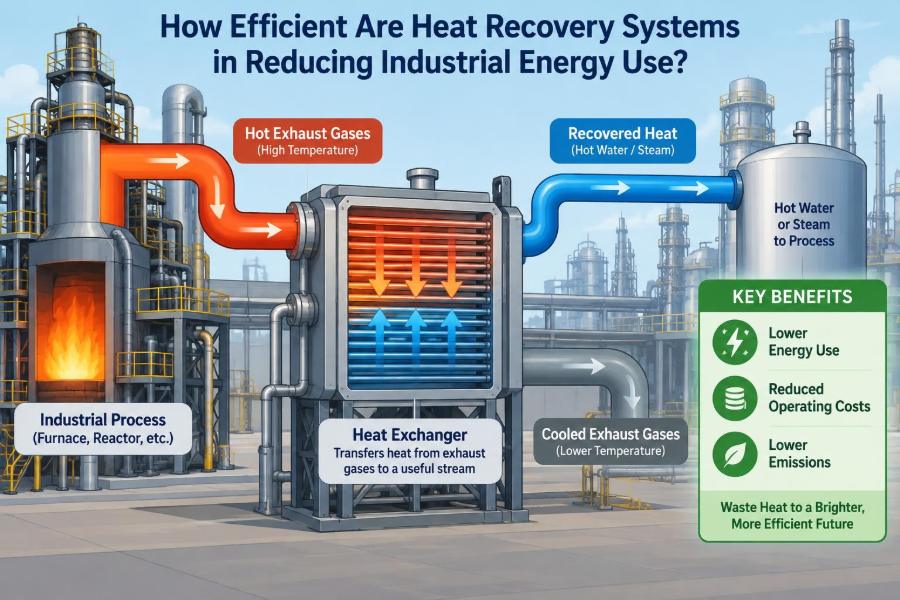
Heat recovery transfers thermal energy that would otherwise be rejected from one stream, piece of equipment, or process area to another user. The recovered heat can preheat air, water, feedstock, combustion fuel, or an intermediate process stream.
It does not create energy. Instead, it reduces the amount of new energy—usually fuel, steam, or electricity—that a plant must purchase or generate.
🏭 Why Industry Has So Much Recoverable Heat
Industrial operations deliberately use high temperatures to drive reactions, separate mixtures, melt materials, remove water, or sterilize products. Afterward, cooling is often required to meet product specifications or protect equipment.
Common heat sources include flue gas, hot condensate, compressor discharge, furnace exhaust, reactor effluent, hot product, wastewater, and refrigeration condenser heat. Their usefulness depends on both temperature and flow stability.
🌡️ Temperature Determines Heat Quality
A megajoule of heat is not equally valuable at every temperature. High-temperature heat can support demanding duties such as steam generation or combustion-air preheating, while low-temperature heat may only be suitable for wash water or building heating.
This distinction is often described as heat quality. Heat naturally flows from hot to cold, and the smaller the temperature difference, the larger and more expensive a heat exchanger usually becomes.
⚖️ Energy Savings Are Not the Same as Recovery Rate
A system might capture a large amount of low-grade heat but displace little expensive fuel. Conversely, a smaller high-temperature recovery project can have substantial value if it replaces steam or direct-fired heating.
Engineers therefore assess more than the fraction of heat captured. They consider fuel displaced, electricity consumed by pumps or fans, operating hours, maintenance needs, emissions effects, and the reliability of the receiving process.
🧮 The Basic Heat-Balance Starting Point
Heat recovery begins with a heat balance: identify where heat enters, where it is used, and where it leaves. For a flowing liquid or gas with no phase change, a first estimate is often expressed as Q = m × Cp × ΔT.
Here, Q is heat duty, m is mass flow rate, Cp is specific heat capacity, and ΔT is the temperature change. Phase changes, variable properties, heat losses, and transient operation require a more detailed calculation.
🔁 The Most Common Recovery Arrangement
The simplest arrangement uses a heat exchanger. A hot process stream passes on one side, a colder stream on the other, and a wall keeps the fluids separate while allowing heat to flow.
For example, a hot reactor effluent may preheat incoming feed before final cooling. This reduces both the heating load upstream and the cooling load downstream—a valuable double effect.
🧱 Choosing the Right Heat Exchanger
Shell-and-tube exchangers are robust and familiar in demanding services. Plate exchangers can achieve close temperature approaches in clean liquid duties, while air preheaters and economizers are common for flue gas.
Selection must account for pressure, temperature, viscosity, solids, fouling tendency, cleanability, leakage consequences, and allowable pressure drop. The exchanger with the highest nominal thermal performance is not automatically the best plant choice.
💨 Flue Gas Economizers and Air Preheaters
Boilers, fired heaters, kilns, and furnaces often exhaust hot flue gas. An economizer can use that heat to preheat boiler feedwater, while an air preheater warms combustion air before it reaches the burner.
Both approaches lower fuel demand, but excessive cooling of flue gas can create problems. Water vapor and acid-forming components may condense, increasing corrosion risk in ducts, stacks, and exchanger surfaces.
💧 Condensate Recovery Is Often a Strong Opportunity
Steam condensate still contains sensible heat and is usually treated water of relatively high quality. Returning it to the boiler system can reduce fuel needed for feedwater heating, as well as make-up water and treatment demand.
Flash steam released when hot condensate pressure is reduced can also be useful. It may serve a lower-pressure steam header, provided the network is designed to handle its variable supply.
🌀 Compressor Heat Is Easy to Overlook
Compressing air or gas raises its temperature. Aftercoolers often reject this heat to ambient air or cooling water so that the compressed gas can be used safely.
Where there is a nearby, steady low-temperature demand, that rejected heat can preheat water or support space heating. Its value is limited when the demand is seasonal or far from the compressor room.
❄️ Refrigeration Systems Can Supply Useful Warmth
Refrigeration is usually discussed as a cooling service, but its condenser rejects heat. That heat is often warmer than the surroundings and may be suitable for water heating, cleaning operations, or moderate-temperature process duties.
Recovery must not compromise condensing pressure control. If the heat user disappears unexpectedly, the refrigeration system still needs a dependable path for rejecting heat.
🧪 Process-to-Process Integration Has the Largest Potential
The broadest approach is to match hot and cold process streams across an entire plant rather than optimize equipment one item at a time. A hot stream can then satisfy a cold stream’s duty before utilities are used.
This method can uncover interactions that isolated projects miss: a new exchanger may reduce steam demand in one area but also reduce recoverable heat available elsewhere.
📌 Pinch Analysis Organizes Those Matches
Pinch analysis is a process-integration method that uses stream temperatures and heat-capacity flow rates to estimate practical targets for minimum heating and cooling utilities. The “pinch” identifies a temperature region where heat transfer is especially constrained.
It is a targeting and design aid, not a promise that every theoretical match can be installed. Layout, contamination, control, batch scheduling, and equipment access still determine what is feasible.
↔️ Minimum Temperature Approach Matters
Heat can only transfer when a driving temperature difference exists. Designers specify a minimum approach temperature to provide adequate exchanger area and reliable operation under real conditions.
Trying to recover every last degree of temperature difference can make an exchanger disproportionately large. The economically sensible approach is usually a compromise between utility savings, installed cost, fouling allowance, and operating flexibility.
📊 A Useful Way to Compare Opportunities
| Opportunity | Typical heat level | Likely use | Key constraint |
|---|---|---|---|
| Furnace exhaust | Medium to high | Combustion air or feedwater | Corrosion and particulate fouling |
| Hot condensate | Medium | Boiler feedwater or flash steam | Pressure management and contamination |
| Hot process effluent | Variable | Feed preheating | Cross-contamination and control interaction |
| Compressor aftercooler | Low to medium | Water or space heating | Matching demand over time |
| Warm wastewater | Low | Incoming water preheat | Fouling, hygiene, and access |
The table is a screening guide, not a universal rule. Actual temperature levels and practicality vary widely with process conditions and site design.
🕒 Timing Can Matter More Than Average Duty
A monthly average may suggest an excellent match, while hourly data show that the hot and cold streams rarely operate together. This is especially common in batch plants, start-up periods, and sites with frequent product changes.
Trend data should be reviewed before committing to a project. A thermal storage tank, intermediate loop, or revised production schedule can sometimes turn a poor time match into a workable one.
🛢️ Thermal Storage Bridges Short Gaps
Hot-water tanks, phase-change materials, and other storage systems can hold recovered energy until a later demand occurs. Storage is most attractive when the temperature level remains useful and the gap is predictable.
It adds capital cost, heat loss, space requirements, and control complexity. Storage cannot solve a fundamental mismatch in temperature quality, but it can solve a mismatch in time.
⚙️ Heat Pumps Upgrade Low-Grade Heat
A heat pump uses electricity to move heat from a lower-temperature source to a higher-temperature sink. In industrial applications, it can make warm wastewater, condenser heat, or cooling-loop heat useful for process heating.
The technology is not “free heat.” Its benefit depends on the required temperature lift, electricity source and price, run hours, and whether the delivered heat displaces fuel, steam, or electric resistance heating.
🔌 Mechanical Vapor Recompression Changes the Equation
Mechanical vapor recompression compresses low-pressure vapor so its saturation temperature rises, allowing it to condense and provide heat at a higher useful temperature. It is often considered for evaporation and concentration duties.
Because the compressor requires electricity, performance must be evaluated as a whole system. It can greatly reduce external steam demand in the right duty, but it is sensitive to vapor composition, fouling, turndown, and maintenance requirements.
🧼 Fouling Quietly Reduces Performance
Deposits of scale, polymers, biological material, soot, oils, or suspended solids add thermal resistance. As fouling grows, outlet temperatures drift, utility use rises, and pressure drop may increase.
A recovery project needs a realistic fouling plan from the start: appropriate velocity, filtration where appropriate, cleaning access, spare capacity, monitoring points, and a defined cleaning method.
🧯 Contamination and Leakage Need Careful Design
Direct process-to-process exchange may be unacceptable if a tube leak could contaminate food, pharmaceuticals, high-purity water, or a product stream. Toxic, flammable, or high-pressure fluids demand additional safeguards.
An intermediate loop can reduce cross-contamination risk by separating the two process fluids with two exchangers and a circulating heat-transfer fluid. This improves isolation but adds a temperature penalty, pumps, and another maintenance system.
🎛️ Control Stability Is Part of Efficiency
Heat integration couples units that may previously have operated independently. A change in feed rate, composition, or temperature on one side of an exchanger can disturb the other side.
Bypass lines, temperature-control valves, utility trim heaters, sensible alarms, and well-designed start-up procedures help preserve product quality. A recovery system that causes frequent upsets may deliver less net value than its heat balance suggests.
📉 Pressure Drop Has an Energy Cost
Heat exchangers, ducts, and added piping create resistance to flow. Pumps, fans, and compressors may need more power to overcome that resistance.
This penalty is often small relative to recovered heat, but it should always be included. Fan power can become particularly significant in large flue-gas or ventilation recovery systems.
🧱 Retrofit Space and Layout Shape Real Projects
A heat-integration diagram can look elegant until it meets an existing plant. Pipe racks may be full, equipment may be elevated, exchanger bundles may be impossible to remove, and long lines may lose valuable heat.
Early site walks are essential. They reveal isolation needs, lifting routes, drainage, access for cleaning, available tie-in windows, and whether the proposed match is physically sensible.
💰 Evaluate Economics Beyond Simple Payback
Simple payback is useful for initial screening, but it can overlook maintenance, utility escalation, production risk, downtime for installation, and equipment life. More complete evaluations may use life-cycle cost, net present value, or internal project criteria.
Projects that reduce a site bottleneck, cooling-water demand, emissions exposure, or water treatment load may have benefits not obvious in a fuel-only calculation. These should be documented rather than assumed.
🌍 Emissions Benefits Depend on What Is Displaced
When recovered heat displaces combustion fuel, it generally reduces associated on-site combustion emissions. When it replaces electrically generated heat, the outcome depends on the electricity supply and the plant’s operating context.
Claims should use measured or well-defined utility reductions, not generic assumptions. The most credible environmental benefit is tied to a clear baseline and a monitored change in consumption.
🦺 Safety Reviews Must Not Be an Afterthought
Recovery systems can introduce hot surfaces, overpressure scenarios, thermal expansion, flammable-fluid inventories, condensation in gas ducts, and new process connections. These changes belong in formal management-of-change and process safety review systems.
Relief protection, isolation, materials compatibility, drainage, access, and operating procedures need review before commissioning. Energy efficiency never overrides the need for safe operation.
🔍 Measure Performance After Start-Up
Commissioning should establish baseline temperatures, flows, pressure drops, utility use, and control responses. Without these data, it is difficult to tell whether underperformance comes from fouling, bypassing, changed production conditions, or an incorrect original assumption.
Useful indicators include recovered duty, approach temperatures, hot- and cold-side pressure drop, exchanger cleanliness trends, and net utility reduction. Metering should support decisions, not simply generate more data.
🚫 Common Mistakes That Limit Savings
- Using design-case stream data without checking normal and minimum operating conditions.
- Matching streams by temperature alone while ignoring flow rate, heat capacity, and timing.
- Underestimating fouling, corrosion, or cleaning downtime.
- Forgetting pump and fan power when calculating net savings.
- Removing all utility trim capacity and making process control fragile.
- Counting the same heat reduction twice across interconnected projects.
These mistakes are avoidable when process, mechanical, operations, maintenance, and control personnel review the concept together.
🗺️ A Practical Screening Workflow
- Map major hot and cold streams, including temperatures, flows, composition, pressure, and operating schedules.
- Rank potential sources by useful temperature, available duty, cleanliness, and reliability.
- Identify nearby demands before considering long pipe runs or complex storage.
- Estimate exchanger area, pressure drop, utilities displaced, and likely maintenance needs.
- Review hazards, operability, control strategy, and installation constraints.
- Monitor the installed system and revise operating practices when actual performance differs from the estimate.
This sequence prevents a common trap: selecting a favored technology before understanding the process problem it is meant to solve.
🧠 What “Efficient” Really Means for Heat Recovery
Heat recovery systems can substantially reduce industrial energy use when a dependable heat source is matched to a compatible demand at the right temperature and time. Direct exchange is often highly effective because it avoids converting heat into another energy form.
But efficiency is not a single percentage printed on a datasheet. It is the combined result of thermal recovery, utility displacement, parasitic power, fouling, uptime, controllability, safety, and economics over the system’s operating life.
The core engineering principle is simple: use the highest-value available heat for the highest-temperature duty it can reliably serve, then use utilities only for the remaining gap.
The best heat recovery project is not the one that captures the most heat on paper; it is the one that delivers dependable net energy savings without compromising the process. With sound data, realistic design assumptions, and careful operation, waste heat can become a practical process resource rather than a constant loss to the environment. 🧪🔥🌍