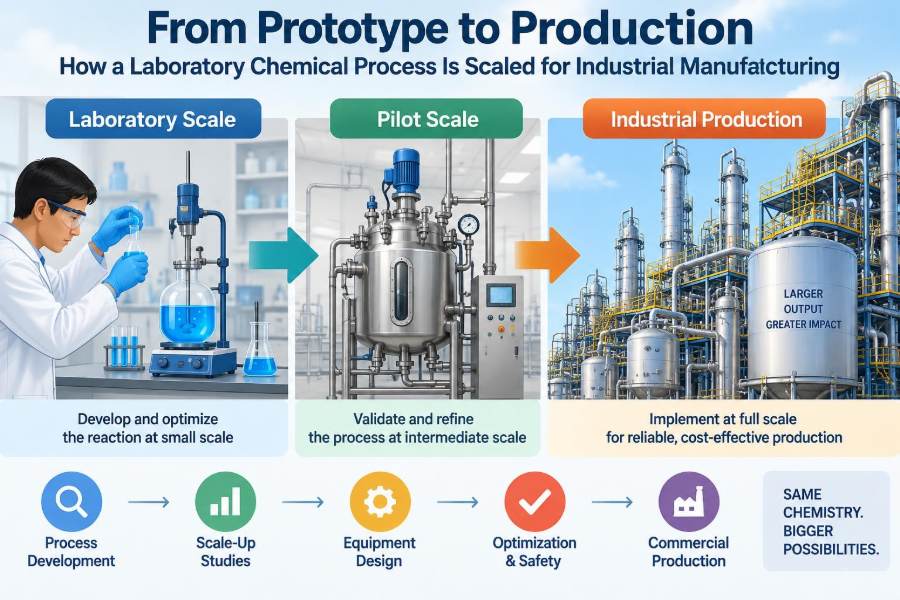

A laboratory reaction can look wonderfully simple: add reagents to a flask, hold a temperature, stir for an hour, and isolate a clean product. The yield is high, the analytical data look good, and the next experiment seems obvious.
Then someone asks the question that changes everything: can this make tonnes of material safely, consistently, and at a cost customers can accept?
That question is where chemical engineering becomes essential. A production plant is not a larger flask. It is a connected system of equipment, utilities, controls, people, quality requirements, and environmental safeguards operating continuously or in repeated batches.
Scaling a laboratory chemical process is therefore a disciplined process of discovering what changes with size, reducing uncertainty, and designing around the constraints that chemistry alone cannot reveal.
🧭 What “scale-up” really means
Scale-up is the translation of a chemical transformation from a small experimental setup into a reliable manufacturing process. It includes reaction chemistry, but also mixing, heat transfer, separations, storage, waste treatment, process control, maintenance, and operator safety.
A useful distinction is that a laboratory procedure describes what was done; an industrial process must define what can be done repeatedly within safe operating limits. A reaction that works once at bench scale is a starting point, not yet a manufacturing route.
🎯 Start with the product specification
Before selecting a reactor or drawing a flowsheet, the team needs a clear product specification. This defines the attributes that make the material fit for its intended use: purity, concentration, particle size, viscosity, colour, moisture, stability, and allowable impurities, among others.
Specifications prevent a common mistake: optimizing only isolated yield. A process with a slightly lower yield may be preferable if it produces a more consistent product, requires simpler purification, or avoids an unstable intermediate.
🧪 Confirm that the chemistry is genuinely understood
Laboratory development should establish more than the preferred recipe. Engineers need to know the reaction network: desired reaction, side reactions, decomposition routes, impurity formation, catalyst behaviour, and sensitivity to water, oxygen, temperature, and reagent ratio.
For example, a reaction that tolerates a five-minute addition in a flask may form an unwanted by-product if local reagent concentration rises during a larger-scale feed. Understanding why impurities form is much more useful than simply knowing that they appeared.
📏 Define the manufacturing basis
Process design begins with a production basis, such as annual demand, campaign size, expected operating days, and target batch size or continuous throughput. These assumptions connect commercial demand to equipment capacity.
They must remain visible because changing them late can reshape the whole design. A plant intended for occasional specialty batches needs different equipment flexibility than a facility supplying a high-volume commodity continuously.
🗺️ Turn the recipe into a process flowsheet
A process flowsheet maps material from raw-material receipt to finished-product shipment. It identifies each major operation: charging, reaction, phase separation, filtration, solvent recovery, drying, packaging, and treatment of off-spec or waste streams.
The first version is often a block flow diagram. It later develops into a process flow diagram with major equipment, streams, flowrates, temperatures, pressures, and compositions. This progression exposes operations that a bench procedure may barely mention, such as washing a solid or recovering a solvent.
⚖️ Close the material balance
A material balance accounts for everything entering and leaving a process. Inputs include raw materials, solvents, wash liquids, catalysts, and sometimes inert gases. Outputs include product, recovered material, emissions, wastewater, residues, and losses retained in equipment.
If the balance does not close reasonably, the process is not yet understood well enough to design. Missing mass may represent evaporation, an unmeasured side product, sampling loss, moisture, or an analytical error. At plant scale, those “small” gaps can affect economics and environmental loading.
🔥 Close the energy balance
An energy balance tracks heat released, absorbed, added, and removed. It reveals utility needs for heating, cooling, evaporation, condensation, drying, and refrigeration.
Heat is often the hidden limitation in scale-up. A vessel’s contents increase with volume, while the heat-transfer area does not increase at the same rate. As a result, a reaction that is easy to cool in a small vessel can become difficult to control in a much larger one.
🌡️ Understand reaction heat and thermal risk
Many reactions release heat, especially additions, oxidations, hydrogenations, neutralizations, and polymerizations. If heat generation becomes faster than heat removal, temperature rises can accelerate the reaction and create still more heat generation.
Development teams use reaction calorimetry and other thermal assessments where appropriate to characterize heat release, accumulation of unreacted material, decomposition behaviour, and cooling requirements. The purpose is not to predict every upset perfectly; it is to establish credible safe operating conditions and safeguards.
🌀 Mixing changes when vessels grow
Stirring does more than keep liquid moving. It distributes reactants, disperses gases, suspends solids, transfers heat to vessel walls, and prevents concentration hot spots. A magnetic stir bar in a flask does not represent an industrial agitator.
Mixing performance depends on impeller type, diameter, speed, baffles, liquid height, viscosity, density, and whether the system contains gas, solids, or separate liquid phases. Engineers use scale-up criteria carefully because no single rule captures every mixing problem.
🧊 Heat transfer is a design constraint, not an afterthought
Industrial vessels remove or add heat through jackets, internal coils, external recirculation loops, and heat exchangers. Each option has limits created by surface area, fouling, utility temperature, pump capacity, and the physical properties of the process fluid.
A viscous slurry may transfer heat poorly near a cooled wall. A reaction with rapid heat release may need a controlled feed rate, lower starting temperature, larger heat-transfer capacity, or a different process route rather than simply a bigger jacket.
⏱️ Residence time and reaction time are not identical
In a batch reactor, reaction time describes how long the batch is held under chosen conditions. In continuous equipment, residence time is the average time material spends in a vessel or pipe.
Neither guarantees that every molecule experiences identical conditions. Real equipment has mixing patterns and residence-time distributions. These matter when reactions are fast, selectivity is sensitive, or solids may settle and remain longer than intended.
🧱 Choose batch, semi-batch, or continuous operation
Batch processing offers flexibility and is common for lower-volume, multi-product, or complex chemistries. Semi-batch operation, where one or more reactants are fed gradually, is especially useful for controlling heat release or gas evolution.
Continuous processing can provide steady operation, smaller equipment inventories, and tighter conditions for some applications. It also requires dependable feed control, startup and shutdown strategies, and equipment that can tolerate disturbances without sending unacceptable material downstream.
| Mode | Often suited to | Key design concern |
|---|---|---|
| Batch | Flexible campaigns and varied products | Batch-to-batch consistency and turnaround time |
| Semi-batch | Controlled additions or heat-sensitive reactions | Feed rate, cooling, and accumulation |
| Continuous | Stable high-throughput production | Steady control, residence time, and startup quality |
🧫 Plan for phase behaviour
Laboratory observations such as “the mixture separated” need industrial interpretation. Which phases form, how quickly do they disengage, what is the emulsion tendency, and how do temperature and impurities affect the split?
Liquid-liquid extraction, crystallization, distillation, gas absorption, and decanting all depend on phase equilibria. Pilot work is often needed because trace surfactants, solids, and mixing intensity can make a clean laboratory separation behave very differently at larger scale.
🔍 Treat separation as part of the chemistry
In many chemical processes, making the molecule is easier than isolating it. Distillation may demand substantial energy; filtration may slow as cake resistance increases; crystallization may trap impurities; and drying may create dust or degrade a heat-sensitive product.
Separation choices should feed back into reaction development. Changing solvent, pH, concentration, or quench conditions can simplify downstream operations enough to outweigh a modest change in reaction yield.
💎 Control crystallization and solid form
When the product is a solid, crystal size and crystal form can be critical quality attributes. They influence filtration speed, washing efficiency, drying behaviour, flowability, dissolution, and final appearance.
Cooling rate, seeding, agitation, supersaturation, solvent composition, and impurities can all alter crystallization. A laboratory product scraped from a beaker does not necessarily reveal how a large crystallizer will behave. Representative filtration and drying trials are therefore valuable.
🧰 Select materials of construction
Equipment must resist the actual chemical environment, not just the main reactants. Corrosion can be driven by chlorides, acids, alkalis, oxidants, moisture, temperature, cleaning chemicals, and impurities concentrated during evaporation.
Common options include stainless steels, glass-lined steel, nickel alloys, polymers, and lined piping. Selection involves corrosion resistance, mechanical strength, cleanability, cost, contamination risk, and the consequences of failure. Compatibility testing and specialist review may be needed for demanding service.
🏭 Design the utility system around real needs
A process cannot operate without utilities: electricity, steam or thermal fluid, cooling water, chilled fluid, compressed air, nitrogen, vacuum, and sometimes process water of defined quality. Their availability sets practical limits on heating, cooling, drying, inerting, and transfer.
Utility design must consider peak demand, not only average demand. Several operations calling for cooling at once can overwhelm a system even when the annual energy total appears reasonable.
🛡️ Build safety into the route from the start
Process safety asks what could deviate from intended operation and what barriers prevent or limit harm. Relevant scenarios include loss of cooling, incorrect charging, blocked vents, overpressure, pump failure, power loss, static ignition, and incompatible material contact.
Structured reviews such as hazard and operability studies help multidisciplinary teams examine deviations systematically. Relief systems, containment, interlocks, alarms, procedures, and emergency response are layers of protection; no single layer should be assumed flawless.
💨 Manage pressure, vapours, and emissions
Industrial equipment is closed more tightly than an open laboratory flask, which changes how vapours and gases are handled. Vents may connect to condensers, scrubbers, adsorption systems, flare systems, or other site treatment arrangements depending on the hazard and facility design.
Pressure control also matters during heating, gas evolution, vacuum operation, and transfers. A line that becomes blocked, a condenser that loses cooling, or an inadvertent reaction can alter pressure quickly. These cases require deliberate engineering, not improvised operating practice.
♻️ Minimize waste before treating it
Waste management begins with route selection. Avoiding an unnecessary solvent, recovering a valuable reagent, increasing concentration, or replacing a difficult separation can reduce waste more effectively than adding a larger treatment unit afterward.
Some residues still require treatment, recovery, or disposal. Engineers characterize streams by composition, variability, volume, hazardous properties, and compatibility. Mixing wastes indiscriminately can eliminate recovery options or create a more difficult treatment problem.
📦 Qualify raw materials and storage
Small research quantities may be unusually fresh or highly purified. Production raw materials arrive in drums, totes, tank trucks, cylinders, or bulk storage, with realistic variability in assay, water content, particle size, inhibitor content, and trace impurities.
Storage conditions can change materials before they reach the reactor. Hygroscopic powders absorb water, volatile solvents create vapour-space concerns, and some monomers or reactive chemicals require controlled temperature or stabilizer management. Incoming specifications and sampling plans turn assumptions into controlled information.
🎛️ Translate operating knowledge into control strategy
A control strategy identifies which variables must be measured, controlled, recorded, or verified. Typical variables include temperature, pressure, flow, level, pH, agitation speed, feed ratio, and conductivity or composition where suitable instruments exist.
Good automation supports operators rather than replacing process understanding. For a temperature-sensitive feed, for instance, the control system may reduce or stop addition if reactor temperature rises beyond a defined limit. The setpoints and interlocks must be based on process knowledge and verified during commissioning.
✅ Define quality through critical process parameters
A critical process parameter is a variable whose variation can affect a quality attribute. It may be reaction temperature, endpoint, seed quantity, drying temperature, wash volume, or a reagent’s water content.
The practical goal is to establish ranges that produce acceptable material, not to insist that every run follows a single laboratory number. This requires representative data, analytical methods that are fit for purpose, and a disciplined approach to deviations.
🔬 Develop analytics that work outside the laboratory
Production decisions need timely, reliable measurements. Some laboratory methods are too slow, delicate, or specialized for frequent plant use, so teams may develop simpler at-line or in-process tests alongside detailed off-line analysis.
Sampling itself deserves attention. A sample from the top of a poorly mixed vessel may not represent the batch; a sample exposed to air may change before analysis. Sampling location, technique, container, quench method, and turnaround time can all influence the result.
🚧 Use pilot plants to answer the right questions
A pilot plant is not merely a small factory. Its main purpose is to reduce uncertainty before full investment. It can test mixing, heat removal, continuous separation, filtration, recycle loops, control response, materials handling, and operator workflow under more representative conditions.
Pilot results must still be interpreted carefully. Equipment geometry, heat-loss fraction, and residence-time behaviour differ across scales. A valuable pilot campaign measures the variables needed for design rather than only demonstrating that product can be made.
📝 Create a reproducible operating procedure
A manufacturing procedure must be explicit enough that trained operators can run the process consistently across shifts. It should define charging order, allowable ranges, feed limits, hold criteria, sampling points, endpoints, transfers, cleaning needs, and responses to expected deviations.
Ambiguous directions such as “heat gently” or “add slowly” are unsuitable in production. They must become observable instructions, such as a controlled temperature range or a maximum addition rate linked to operating conditions.
👷 Design for the people who will operate and maintain it
Process equipment is used by people wearing protective equipment, making connections, reading instruments, collecting samples, cleaning vessels, and responding to alarms. Layout affects whether those tasks can be performed safely and without avoidable errors.
Maintainability also affects reliability. Valves, pumps, filters, instruments, and heat exchangers need access for inspection and repair. A design that works on paper but forces difficult maintenance can create downtime, exposure risks, and inconsistent operation.
💰 Evaluate economics beyond reaction yield
Manufacturing cost includes raw materials, utilities, labour, waste handling, maintenance, quality testing, equipment depreciation, downtime, and losses during startup or cleaning. High yield is valuable, but it is only one contributor.
Consider a hypothetical route that uses an expensive solvent but produces a very clean crystallization. If that solvent can be recovered efficiently and reduces filtration time and reprocessing, it may outperform a cheaper solvent that creates persistent emulsions. Economic choices require the whole process picture.
📈 Commission carefully and learn from the first campaigns
Commissioning verifies that installed equipment, instruments, utilities, controls, and safety functions work as intended. Initial production should proceed with heightened monitoring and clear decision points, because real operating data often reveal issues missed during design.
Changes should be managed through a formal process. A seemingly minor adjustment to an agitator, filter medium, supplier, control setting, or cleaning cycle can alter product quality or safety margins. Documentation preserves the reason for changes and their technical basis.
⚠️ Recognize common scale-up mistakes
- Assuming geometric enlargement preserves performance: heat transfer and mixing do not scale in a simple one-to-one way.
- Optimizing the reaction in isolation: a difficult workup can erase gains made in the reactor.
- Underestimating solids handling: powders, slurries, filters, and dryers often determine the true bottleneck.
- Using unrepresentative raw materials: unusually pure lab inputs can hide robustness problems.
- Leaving safety assessment until late: route changes are usually easier before equipment and procedures are fixed.
🔄 Treat scale-up as an iterative learning loop
Successful scale-up rarely follows a straight line from flask to plant. Laboratory work informs a pilot trial; pilot data revise the design; commissioning data refine procedures and controls. Each stage should answer specific unanswered questions.
This approach is more efficient than treating unexpected results as failures. A filtration problem, for example, may reveal the need to adjust crystallization rather than purchase a larger filter. Learning travels upstream and downstream through the process.
🤝 Work across disciplines early
Chemists, process engineers, analytical scientists, operators, safety specialists, maintenance teams, quality professionals, and environmental staff each see different risks and opportunities. Early collaboration prevents designs that are chemically elegant but impractical to run.
Operators may identify an awkward sampling point; maintenance staff may flag inaccessible seals; environmental specialists may recognize a difficult waste stream. These observations are design inputs, not late-stage objections.
🏁 The central principle of successful scale-up
The core task is to preserve the conditions that make the chemistry work while accommodating the physical realities of industrial equipment. That means managing heat, mass transfer, mixing, separation, containment, variability, and human operation as one connected system.
A sound industrial process is not the one with the most impressive laboratory result. It is the one that consistently makes conforming product within defined safety, environmental, and economic boundaries—and can explain why it will keep doing so.
Moving from prototype to production succeeds when chemical knowledge is converted into controlled, measurable, and resilient process knowledge. That is the bridge between a promising experiment and dependable manufacturing. 🧪🏭📈