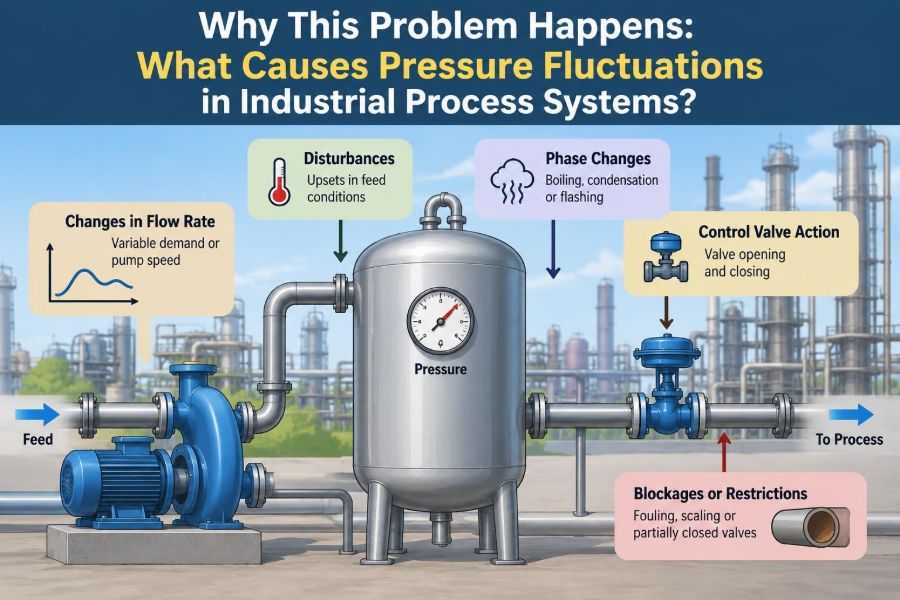

A control-room trend looks calm, then a pressure trace begins to ripple. A compressor changes tone, a control valve starts hunting, and an operator sees alarms approaching their limits. The process may still be producing on specification, but something in the system is no longer behaving steadily.
Pressure fluctuations are common in industrial plants because process systems store and release energy. Fluids move, compress, heat, cool, evaporate, condense, and encounter restrictions. Pumps, compressors, valves, vessels, and controllers each add their own dynamics.
A small pressure variation is not automatically a fault. Some operations deliberately cycle, and every measurement contains some noise. The engineering question is whether the movement is expected, bounded, and safe—or whether it signals instability, mechanical damage, lost control, or an approaching process upset.
Understanding the cause matters because pressure affects flow, phase behavior, equipment loading, product quality, and relief-system performance. The most effective response is rarely “turn the controller down.” It begins by identifying what is creating or amplifying the disturbance.
🔎 What a Pressure Fluctuation Actually Means
Pressure is force per unit area, but in a process system it is also a useful indicator of stored fluid energy. A fluctuation is a change in measured pressure over time. It can be a slow drift, a repeated oscillation, a sharp pulse, or a single transient event.
Its pattern contains clues. A regular cycle often points toward a controller, rotating machine, or periodic operation. An abrupt step may follow a valve movement or pump trip. Random-looking variation may reflect changing feed conditions, poor measurement quality, or turbulent flow.
📏 Not Every Moving Signal Is a Process Problem
Before troubleshooting the plant, confirm that the displayed movement is real. A pressure transmitter can show electrical noise, poor grounding, a plugged impulse line, condensation in a sensing line, or an unsuitable damping setting.
Compare the reading with an independent measurement where practical. Also ask whether the fluctuations appear in related variables such as flow, temperature, valve position, pump speed, or vessel level. A pressure signal moving alone deserves instrumentation scrutiny; several variables moving together usually indicate a process or equipment cause.
🧭 Start With the Shape of the Trend
A good trend includes pressure, setpoint, controller output, valve position or speed command, flow, temperature, and relevant upstream and downstream pressures. Looking at one trace in isolation can make a symptom appear to be a cause.
- Fast spikes: valve action, pressure waves, pulsation, or sensor artifacts.
- Slow cycles: control-loop interaction, inventory changes, heat-transfer effects, or batch operations.
- Step changes: equipment switching, a demand change, or a valve that moved suddenly.
- Rising amplitude: an instability that may worsen if its source is not removed.
Time alignment matters. The variable that changes first is often closer to the initiating disturbance, though dead time can complicate that interpretation.
💨 Compressibility Creates Stored Energy
Gases are highly compressible, so gas-filled piping, receivers, and vessels behave somewhat like springs. A small mass imbalance between inlet and outlet can change pressure noticeably, particularly in small volumes.
Liquids are far less compressible, but liquid systems still store energy through pipe elasticity, entrained gas, flexible hoses, and vessel vapor spaces. Treating all fluids as incompressible can hide the mechanism behind fast transients.
🛢️ Vessel Inventory Drives Slow Pressure Changes
A vessel’s pressure depends on what enters, what leaves, its temperature, and its available vapor volume. In a gas receiver, inlet compressor flow temporarily exceeding outlet demand raises pressure. The reverse causes a fall.
In two-phase vessels, level and pressure are coupled. Increasing liquid level reduces vapor space, while changes in boiling, condensation, or venting alter vapor mass. A level-control action can therefore create a pressure response even when the pressure controller has not moved.
🚰 Flow Changes Create Pressure-Drop Changes
Fluid moving through pipe, fittings, filters, heat exchangers, and valves loses pressure because of friction and local restrictions. In many practical cases, pressure loss rises strongly as flow rises, often approximately with the square of flow under turbulent conditions.
That means a modest demand increase can create a much larger downstream pressure reduction than intuition suggests. A process with little pressure margin may look stable at one throughput and become sensitive at a higher throughput.
🧱 Restrictions Can Turn Into Dynamic Bottlenecks
A partially closed valve, fouled strainer, plugged filter, undersized line, or exchanger with deposits adds resistance. If flow through that restriction changes, the pressure drop changes as well, shifting pressure upstream and downstream.
Restrictions are not always bad; they are often intentional control elements. The problem appears when their pressure loss becomes excessive, changes unpredictably, or leaves too little authority for the valve meant to regulate the process.
🔧 Pump Pulsation and Reciprocating Equipment
Positive-displacement pumps and reciprocating compressors inherently deliver fluid in pulses. Pulsation dampeners, accumulators, properly designed piping, and sufficient system volume help smooth this behavior.
If damping is missing, damaged, incorrectly precharged, or poorly located, the pulses can travel through the system. The result may be a visibly periodic pressure signal, vibration, fatigue at small-bore connections, and unstable flow measurement.
🌀 Centrifugal Pump Instability and Recirculation
Centrifugal pumps perform best within a suitable operating range. At very low flow, internal recirculation can develop near the impeller or suction region. This can cause vibration, noise, heat buildup, and unsteady discharge pressure.
Low suction pressure adds another concern: cavitation. Vapor bubbles can form where local pressure falls below the liquid’s vapor pressure and then collapse in higher-pressure regions. Cavitation may produce noise and damage, but the diagnostic conclusion should be based on operating data, inspection, and pump performance—not sound alone.
🫧 Gas Entrapment Changes Liquid-System Behavior
Air or process gas trapped in a nominally liquid line acts like a compressible cushion. It can cause delayed pressure response, erratic pump discharge behavior, and misleading transmitter readings.
High points, poorly vented equipment, leaking suction connections, and vortexing in tanks are common paths for gas entry. Removing trapped gas and fixing the entry mechanism can stabilize a system without changing the control strategy.
⚙️ Compressor Surge Is a Serious Source of Oscillation
A centrifugal compressor can become unstable when operating at insufficient flow for its pressure rise requirement. In surge, flow may oscillate sharply and can briefly reverse through the compressor. Discharge and suction pressures, flow, vibration, and driver load may all fluctuate.
Anti-surge control exists to keep the compressor away from this operating region by maintaining adequate flow, often through recycle. Surge protection requires application-specific design and testing; operators should follow site procedures rather than attempting ad hoc adjustments during an event.
🔊 Acoustic Resonance Can Amplify a Small Disturbance
Piping containing gas has natural acoustic frequencies. If pulsation from a compressor, valve, or other source occurs near one of those frequencies, the piping system can amplify the pressure wave, much like pushing a swing at the right rhythm.
The visible pressure oscillation may then be much larger than the original forcing disturbance. Changes in pipe length, volume, gas composition, temperature, or operating pressure can shift the system response, which is why a problem may appear only in a specific operating mode.
🚪 Fast Valve Movement Creates Pressure Waves
Rapidly closing a valve stops moving liquid abruptly. The momentum has to go somewhere, so a pressure wave travels through the pipe. This event is commonly called water hammer, although it can occur with process liquids other than water.
Fast-opening valves can also create transients by accelerating fluid suddenly. The severity depends on fluid velocity, line length, pipe material, valve closing time, trapped gas, and system geometry. It should be evaluated using a suitable transient analysis when the consequences could be significant.
🧯 Relief Valves Can Chatter or Cycle
A pressure-relief valve is a protective device, not a normal pressure-control valve. If it repeatedly opens and closes, the system may have inadequate relieving capacity, excessive pressure buildup, an unsuitable installation, excessive inlet pressure loss, or a downstream issue.
Valve chatter can damage the valve and connected piping. It can also make the original pressure problem harder to interpret because each lift creates another disturbance. Relief-device investigation should follow the site’s mechanical-integrity and process-safety procedures.
🎛️ Control Loops Can Hunt
Hunting is a sustained oscillation around a setpoint. A pressure controller may open and close a valve repeatedly because its tuning is too aggressive, its process response is delayed, its measurement is noisy, or the valve does not respond smoothly.
For example, an overly aggressive controller may see a small pressure decrease, demand a large valve movement, overshoot the target, then reverse sharply. The controller is not necessarily “bad”; it may simply be tuned for a different operating condition than the one now present.
📉 Integral Action Can Wind Up
Integral action helps a controller eliminate persistent offset, but it can accumulate output demand when the final control element is at a limit. If a valve is fully open and pressure remains low, the controller may continue integrating error.
When conditions recover, the stored integral action can drive an excessive correction and overshoot. Anti-windup features, sensible output limits, and recognition of actuator saturation reduce this risk.
🕹️ Valve Stiction and Deadband Distort Control
Control valves do not always move exactly when commanded. Stiction is static friction that causes a valve to stick until the actuator force becomes large enough to break it free. Deadband is a range of command change that produces little or no movement.
The controller may keep increasing its output while the valve remains still, then the valve jumps too far. The pressure overshoots, the controller reverses, and a repeating cycle begins. Position feedback, valve travel trends, and maintenance tests can reveal this pattern.
🔁 Interacting Loops Compete for the Same Pressure
A pressure controller, flow controller, level controller, compressor recycle controller, and upstream unit may all influence one pressure indirectly. If their actions are not coordinated, one loop can undo another loop’s correction.
A common example is a downstream flow controller increasing demand while an upstream pressure controller tries to hold header pressure. This is not inherently wrong, but the hierarchy, response speeds, and operating objectives must be clear.
🌡️ Temperature Changes Shift Pressure
In a fixed-volume gas system, heating raises pressure and cooling lowers it. Steam lines, hot-gas headers, blocked-in sections, and vessels exposed to changing ambient conditions can all show thermal pressure movement.
Temperature effects also change fluid density, viscosity, and vapor pressure. A pressure fluctuation may therefore begin with a temperature disturbance, such as changing cooling-water conditions or a furnace duty adjustment.
♨️ Boiling, Condensation, and Flashing Change Volume Rapidly
Phase change can create large volume changes. When liquid flashes to vapor after a pressure reduction, the added vapor volume changes flow and pressure behavior. When vapor condenses, its volume collapses, potentially drawing down pressure quickly.
These effects are central in distillation, refrigeration, steam systems, and flashing services. The correct explanation requires phase-equilibrium and energy-balance thinking, not only a hydraulic pressure-drop calculation.
❄️ Condensate and Steam-System Effects
Steam systems can experience pressure fluctuations when condensate accumulates, steam traps malfunction, demand changes rapidly, or control valves respond too quickly. Condensate is denser than steam and can be accelerated by high-velocity vapor, contributing to damaging hydraulic shocks.
Stable steam pressure depends on good condensate removal, appropriate trapping, sensible control-valve sizing, and a distribution system designed for the expected load range. “More steam pressure” is not always the cure if the actual issue is poor drainage or poor control.
🏭 Header Demand Is Rarely Perfectly Steady
Plant utility headers—air, nitrogen, fuel gas, steam, vacuum, and cooling systems—serve many users. A large consumer starting, stopping, or changing its load can produce a header disturbance seen by every connected unit.
Receivers and buffer vessels reduce the rate of pressure change, but they do not create capacity. If average supply cannot meet average demand, a larger receiver only delays the pressure decline.
🔀 Startup, Shutdown, and Mode Changes Are Special Cases
Many pressure issues occur during transitions rather than steady operation. Lines fill, vessels warm up, controllers change from manual to automatic, compressors load, and valves move through ranges where their behavior differs.
Startup procedures should specify sequencing, ramp rates, vent paths, controller modes, and required confirmations. A stable final operating condition does not prove that the path to reach it is safe or stable.
🧪 Changing Feed Properties Alters the Hydraulics
Composition, density, viscosity, solids content, and vapor fraction can all alter pressure drop and equipment performance. A pump handling a warmer or lighter liquid may see different suction conditions; a gas compressor may operate differently when molecular weight changes.
When fluctuations coincide with a new feed tank, supplier change, blend ratio, or upstream campaign, treat feed properties as a plausible cause. Laboratory data and process samples can be more useful than repeated controller adjustments.
📡 Instrument Installation Can Mislead the Investigation
Pressure taps located near pump discharges, control valves, elbows, pulsating machines, or two-phase flow may sense local turbulence and pulses rather than the representative pressure needed for control. Long impulse lines can introduce lag; plugged or liquid-filled lines can distort the measurement further.
Signal filtering can make a display easier to read, but excessive filtering hides real fast events and adds delay to the control loop. The goal is a measurement design appropriate to the phenomenon, not merely a smoother trend.
🧩 A Practical Troubleshooting Sequence
- Confirm the fluctuation with a second indication or related process measurements.
- Define when it started and what changed: throughput, feed, lineup, maintenance, weather, controller mode, or equipment status.
- Trend pressure with likely drivers and identify sequence, frequency, amplitude, and operating range.
- Check for immediate safety limits, abnormal vibration, high temperature, relief activity, or known operating restrictions.
- Separate likely categories: measurement, control, rotating equipment, hydraulics, phase behavior, or demand disturbance.
- Test one justified hypothesis at a time under approved operating procedures.
This approach avoids a common failure mode: making several changes at once, briefly improving the symptom, and losing the evidence needed to find the root cause.
🛑 Common Troubleshooting Mistakes
Increasing controller gain is often tempting because it makes the loop react faster. If the issue is delay, stiction, saturation, or mechanical pulsation, more aggressive tuning can intensify the oscillation.
- Assuming every cycle is caused by the pressure controller.
- Ignoring the actual valve position and focusing only on controller output.
- Treating relief-valve lifting as routine control behavior.
- Changing operating pressure without checking equipment and process constraints.
- Filtering away a signal without determining whether the underlying pulse is harmful.
- Diagnosing cavitation, surge, or water hammer from one symptom alone.
🧰 Design Features That Improve Stability
Stable pressure begins in design: adequate line sizing, sensible pressure-drop allocation, correctly sized control valves, sufficient buffer volume, appropriate pulsation control, reliable vents and drains, and instrumentation located for representative measurement.
There are tradeoffs. A large vessel may smooth disturbances but slow response and add cost. A very large valve may pass high flow but control poorly at normal load. Good design considers the full operating envelope, including low-load, high-load, startup, and upset conditions.
📊 Use Data to Separate Cause From Correlation
Two variables moving together are not automatically cause and effect. A pressure signal and valve position may both be responding to a third disturbance, such as changing downstream demand.
Useful evidence includes repeatable timing, physical plausibility, changes after a controlled test, maintenance findings, and agreement with mass, energy, and momentum balances. Process historians are powerful tools when trends are interpreted with knowledge of the actual plant configuration.
👷 When Escalation Is Necessary
Escalate promptly when pressure fluctuations approach operating limits, activate protective systems, cause repeated relief activity, accompany significant vibration or noise, threaten containment, or involve rotating-equipment operating limits.
Operations, process engineering, mechanical engineering, controls specialists, and inspection personnel may all need to contribute. Complex dynamic problems often cross discipline boundaries, and a narrow diagnosis can miss the interaction that matters most.
✅ The Core Principle: Find the Energy Source and the Feedback Path
Every meaningful pressure fluctuation needs an energy source or disturbance: changing flow, compression, heating, phase change, valve motion, pump action, or external demand. Sustained oscillation usually also needs a feedback path that repeatedly turns a correction into an overcorrection.
Ask two questions: what is adding or removing pressure-driving energy, and what allows that change to repeat or become amplified? The answers may lie in process inventory, equipment mechanics, piping dynamics, measurement, or control logic. That systems view is more reliable than blaming the first component whose signal appears to move.
Pressure stability comes from matching equipment, piping, measurement, and control behavior to the real dynamics of the process—not from forcing a noisy system to look quiet. Careful trends, sound operating discipline, and focused engineering analysis turn pressure fluctuations from mysterious alarms into understandable process behavior. 🧪⚙️📈