
A production team has developed a promising specialty coating. The recipe works in the pilot plant, customers want several colour variants, and the forecast is encouraging—but uncertain. The first major manufacturing decision is not simply which reactor to buy. It is whether the process should run in discrete campaigns or flow continuously.
Continuous production often looks like the modern default: materials enter steadily, product leaves steadily, and equipment runs close to its design point. For high-volume commodities, that logic is compelling. Yet many excellent processes are deliberately run as batches.
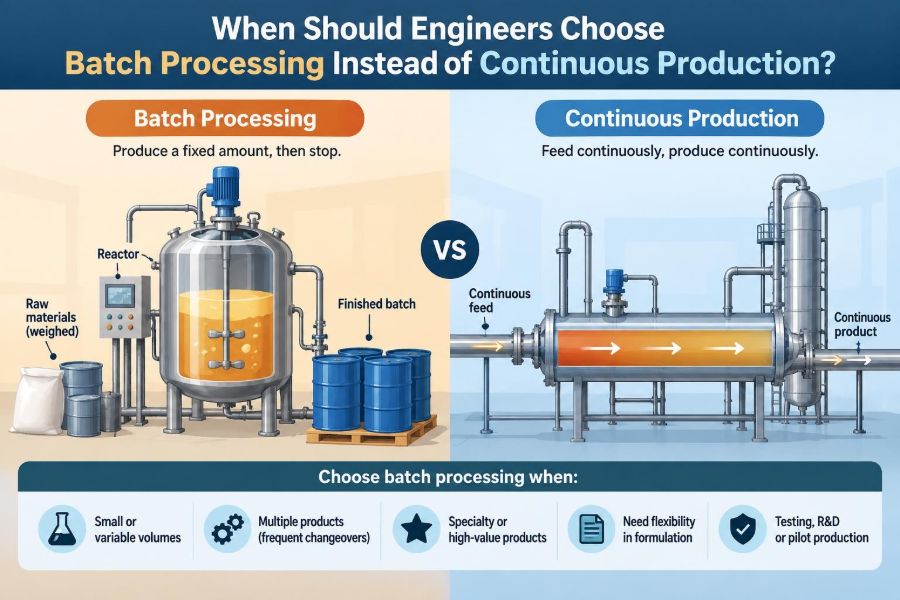
A batch plant is more like a carefully managed kitchen than an assembly line. Operators charge ingredients, control a defined sequence of heating, mixing, reaction, separation, and cleaning steps, then release one identified lot before beginning the next.
The choice affects capital spending, product consistency, safety studies, cleaning, staffing, inventory, and the company’s ability to respond when demand or formulations change. The right answer comes from the process and business case together—not from a belief that either mode is inherently superior.
⚙️ Start With the Two Operating Modes
In batch processing, a finite quantity of material is loaded into equipment and processed over time. A reactor may be charged with solvent and reactants, held at temperature, sampled, discharged, and cleaned before the next batch begins. Each run has a start and a finish.
In continuous processing, feed streams enter and product streams leave at the same time after startup. Conditions are ideally stable, or at steady state, for extended periods. A continuous distillation column and a pipeline polymerization unit are familiar examples.
Some facilities are hybrid. They may make an intermediate continuously, store it in a tank, and then formulate final products in batches. Treating the decision as a strict either-or can hide these useful designs.
📦 Demand Volume Is the First Screen
High, sustained demand favors continuous equipment because its fixed capital and control systems can be used for many operating hours. A continuously operating plant can produce large annual quantities from equipment sized for a comparatively modest instantaneous inventory.
Low or intermittent demand usually points toward batch production. Building a dedicated continuous line for a product made only occasionally can leave expensive assets idle. A batch reactor can instead be scheduled for several products across the month.
Engineers should use expected annual throughput, not a single optimistic sales forecast. Demand variability, product life cycle, and plausible growth cases matter as much as the average forecast.
📈 Stable Demand Matters More Than a High Peak
A brief period of strong orders does not automatically justify a continuous plant. Continuous systems benefit when they can operate for long campaigns with few interruptions. Frequent shutdowns, grade changes, or demand gaps dilute their productivity advantage.
Batch plants tolerate uneven orders more naturally. Production can be concentrated before a seasonal sales period, slowed during weak demand, or scheduled around other products. This flexibility has a cost in labor and turnaround time, but it can prevent chronic underutilization.
A useful question is: can the plant realistically run near a stable rate for long enough to recover the investment and operating complexity of continuous production?
🧪 Product Variety Often Favors Batches
A single reactor train can make multiple formulations when recipes use compatible materials and cleaning can be validated. This is common in paints, adhesives, formulated consumer products, specialty chemicals, and many pharmaceutical operations.
Each product does require a changeover: emptying, cleaning, inspection, setup, and documentation. Still, the ability to make ten grades in one flexible asset may be more valuable than the lower unit cost of a dedicated line for just one grade.
Continuous production becomes more attractive when one grade dominates volume and grade transitions are rare or can be managed through controlled transition material.
🔄 Formula Changes Reward Flexible Equipment
Early-stage products often change. A customer may request a different viscosity, impurity limit, pigment package, solvent system, or active concentration. Regulatory or raw-material changes can also alter a formulation.
Batch equipment lets engineers adjust charge order, hold time, agitation, temperature profile, and setpoints from one campaign to the next within an approved operating envelope. That adaptability is valuable while knowledge is still developing.
A continuous process can also be flexible, but recipe changes may require new feed-control strategies, dynamic testing, modified residence-time assumptions, and a carefully managed transition. The more frequently formulas evolve, the stronger the case for batch manufacture.
🧫 Complex Reaction Sequences Fit Batch Control
Some reactions depend on a deliberate sequence: dissolve a solid, heat gradually, add a reagent slowly, wait for conversion, cool, adjust pH, then quench. A batch reactor accommodates these steps directly because time is an explicit part of the recipe.
This is especially helpful for reactions with induction periods, multiphase behavior, crystallization, or changing viscosity. Operators can respond to samples and process observations without forcing every material element through the same fixed flow path.
That does not mean complex chemistry cannot be continuous. It means continuous operation needs a well-characterized route, reliable feed preparation, and control of the residence-time distribution—the spread of time different fluid elements spend in the system.
🎯 Lot Traceability Is a Practical Advantage
Batch manufacturing naturally creates a defined lot with a recorded history: raw-material identities, quantities, equipment used, processing conditions, samples, deviations, and final test results. If a quality issue appears, the affected material can often be bounded to specific batches.
This structure is useful where release testing, customer certificates, or detailed traceability are central to the business. It also makes investigation more intuitive: engineers can compare one batch record with previous successful records.
Continuous plants can achieve excellent traceability, but material may span equipment over time and transition periods must be clearly defined. Good sampling plans and tank-segregation logic become essential.
🧾 Quality Release Can Shape the Decision
Some products cannot be shipped until laboratory tests confirm identity, purity, moisture, potency, particle properties, or other specifications. Batch production aligns naturally with this release model: isolate the lot, test it, then approve or reject it.
For a continuous line, producers commonly collect product into defined containers or campaign tanks that become the quality lots. This works well, but the sampling plan must represent the entire collection period, including startup and shutdown material.
When analytical methods are slow, highly variable, or destructive, holding identifiable batches may be simpler than trying to make immediate disposition decisions on a flowing stream.
🧼 Cleaning and Cross-Contamination Need Honest Accounting
Multi-product plants must prevent residues from one product entering the next. Batch systems have explicit cleaning windows, which makes cleaning validation and visual inspection straightforward in principle. The downside is lost production time, cleaning chemicals, wastewater, and operator effort.
A dedicated continuous line may avoid frequent cleaning altogether. But a shared continuous line can be harder to clean because piping, filters, dead legs, and long flow paths hold material. Product transitions can generate off-specification interface material.
Engineers should compare total changeover burden, not merely vessel cleaning time. Include line flushing, analytical confirmation, waste handling, and the production time sacrificed during the transition.
🏭 Capital Cost Depends on More Than Vessel Size
Batch plants often have lower initial capital for small capacities because standard vessels, tanks, filters, and utilities can be arranged in a flexible train. One set of equipment may serve several products.
Continuous facilities may require specialized feeders, precise flow control, surge capacity, automated startup and shutdown sequences, online analyzers, and robust process control. These additions can be justified by scale, but they are real project costs.
Conversely, a very large batch requirement can lead to huge reactors, oversized buildings, and extensive parallel equipment. At that point, continuous equipment may be the more economical physical arrangement. Capital comparisons must be based on equivalent annual output and operating availability.
💰 Unit Cost Changes With Scale and Utilization
At high utilization, continuous processes often reduce cost per unit through lower labor per tonne, steadier energy use, less repeated heating and cooling, and smaller work-in-process inventories. These benefits are not automatic; they depend on a stable, well-designed operation.
Batch operations can be economically better at modest volume because their equipment can make multiple products. The apparent cost of a batch may look high if calculated in isolation, while the shared asset provides revenue across a portfolio.
Use a full economic model that includes yield, waste, utilities, labor, maintenance, quality testing, cleaning, inventory, depreciation, and the cost of capacity that sits unused.
⏱️ Cycle Time Is Not the Same as Throughput
A batch may have a long cycle because charging, reaction, cooling, filtration, cleaning, and testing all take time. Improving a single reaction hold may not increase plant output if filtration or cleaning is actually the bottleneck.
Continuous systems can achieve high throughput, but they also have startup, stabilization, maintenance, and transition losses. A nominal nameplate rate says little about saleable output if the line is frequently unavailable.
Map the entire process. For batch production, calculate the cycle time and equipment occupancy for each step. For continuous production, estimate realistic on-stream time and losses during non-steady operation.
🌡️ Heat Transfer Can Push the Choice Either Way
Large batch reactors have less heat-transfer area relative to volume as they scale up. An exothermic reaction that is easily controlled in a small vessel may become harder to cool safely in a much larger one.
Continuous reactors, with their smaller hold-up and high area-to-volume ratio, can sometimes remove heat more effectively. This can make continuous processing attractive for fast, strongly exothermic reactions.
However, batch operation allows slow addition, staged charging, dilution, and temperature ramps that moderate heat release. The correct choice follows a reaction calorimetry and heat-transfer assessment, not a general rule about reactor type.
🛡️ Safety Requires More Than a Smaller Inventory Argument
Continuous equipment often contains less reacting material at any moment, which can reduce the consequences of some runaway scenarios. Shorter residence time may also limit the amount of material exposed to hazardous conditions.
But continuous plants introduce hazards of their own: sustained feed errors, blocked outlets, loss of ratio control, analyzer failures, and difficult-to-detect fouling. A deviation can continue until safeguards detect and stop it.
Batch plants may have a larger vessel inventory, but operators can pause additions, sample, or stop at defined recipe stages. Hazards must be evaluated through credible scenarios, relief design, controls, procedures, and human factors—not by assuming one mode is categorically safer.
🧯 Handling Hazardous Materials May Favor Campaigns
When a raw material is toxic, unstable, odorous, or difficult to contain, fewer transfers and fewer open handling steps are generally desirable. A dedicated continuous system can keep material enclosed from feed to product.
Yet campaign batch production can reduce the frequency of handling if the material is only needed occasionally. It may also permit isolated scheduling, dedicated PPE arrangements, and specialized waste treatment during a known window.
The decision should examine delivery method, storage limits, emissions controls, sampling, maintenance exposure, and emergency response. The hazard profile of the whole facility matters more than the reactor alone.
🧱 Solids and Slurries Often Complicate Continuous Flow
Powders can bridge in hoppers, segregate, absorb moisture, or feed inconsistently. Slurries can settle, erode equipment, plug lines, and foul heat exchangers. These issues do not make continuous solids processing impossible, but they increase development and reliability demands.
Batch vessels can be forgiving because an operator can verify a charge, adjust agitation, and extend mixing time. They also handle temporary viscosity changes during dissolution or reaction more easily.
For continuous operation, reliable solids metering, transport, dispersion, and cleaning must be demonstrated at representative scale. A smooth bench experiment is not enough evidence that a powder will feed consistently for weeks.
🧊 Crystallization and Particle Control Need Careful Thought
Crystal size and shape often depend on supersaturation, cooling profile, seeding, mixing, impurities, and residence time. Batch crystallization gives engineers opportunities to apply a controlled temperature profile and make adjustments based on in-process observations.
Continuous crystallizers can provide consistent operation once tuned, but they require stable feeds and careful control of nucleation, growth, classification, and solids removal. Disturbances can affect particle distributions over a prolonged period.
When the desired solid form is still being developed or changes between products, batch crystallization is frequently the more practical starting point.
🔬 Development Work Benefits From Batch Learning
Process development is an exercise in learning how chemistry and materials behave. Batch experiments make it easy to explore time-dependent effects: add reagent at a different rate, change the aging time, sample at several stages, or test a new workup sequence.
The data can then reveal which variables deserve tighter control. Once the chemistry is mature and the critical operating window is understood, engineers can assess whether continuous flow offers a measurable advantage.
Starting with batches is not a failure to innovate. It is often the lowest-risk path to building the process knowledge needed for a robust future continuous design.
📊 Process Control Maturity Determines What Is Realistic
Continuous production demands stable feeds, reliable instrumentation, control logic, and responses to disturbances. The system must keep key variables such as flow ratio, temperature, pressure, composition, and level within acceptable ranges without constant manual correction.
Batch control is also sophisticated in modern plants, but recipe-based automation can accommodate planned changes over time. A batch sequence may deliberately heat, hold, cool, and transfer in ways that are awkward to describe as a steady state.
Do not select continuous operation solely because automation is available. Select it when the process behavior is understood well enough to automate safely and consistently.
📡 Online Measurement Can Enable Continuous Production
Many continuous processes become practical when composition or quality can be measured quickly enough to guide decisions. Flow, temperature, pressure, density, and conductivity are relatively accessible; detailed impurity profiles or particle characteristics may be slower and harder to monitor.
If quality is only known after a lengthy laboratory test, engineers need hold-up tanks, conservative controls, or a way to segregate potentially affected material. This may reduce the apparent advantage of uninterrupted production.
Online analyzers can be powerful, but they require calibration, maintenance, validation, and plans for analyzer failure. They should be treated as part of the process design, not as an afterthought.
🔧 Maintenance Strategy Changes the Availability Picture
Batch equipment has natural pauses between campaigns for inspection, gasket replacement, filter cleaning, or minor repair. If a vessel is part of a parallel train, production may continue at reduced capacity while one unit is serviced.
A continuous line can run for long periods, but an unexpected failure in a critical pump, instrument, or heat exchanger may stop the whole chain. Redundancy, bypasses, spare parts, and planned shutdowns become central design decisions.
Compare maintainability as well as reliability. Equipment that is slightly less efficient but quickly isolated and repaired may provide better annual output than a highly integrated line with a single difficult failure point.
🚚 Inventory and Supply Chains Affect the Best Mode
Continuous plants generally prefer stable feed supply and steady product dispatch. Interruptions can force shutdowns, create transition material, or upset conditions. This places demands on supplier reliability, storage capacity, and logistics.
Batch plants can sometimes use deliveries more flexibly, accumulating materials before a campaign and making inventory for anticipated demand. That flexibility can be valuable where specialty feedstocks arrive irregularly.
Neither approach removes inventory risk. Batch manufacture may require larger stocks of finished goods, while continuous systems may require dependable buffers to protect operation from short supply interruptions.
🌱 Energy and Waste Must Be Measured Across the Whole Process
Continuous systems can avoid repeated heating, cooling, and vessel cleaning, potentially reducing utility use and wastewater. Their smaller process inventory can also reduce solvent holdup in some applications.
Batch systems may create more cleaning waste and off-specification material during changeovers. However, a batch route may avoid the need for continuous purge streams, constant solvent circulation, or large-scale losses during a long upset.
Environmental comparisons should use material and energy balances for the complete operating pattern. “Continuous” is not automatically greener, and “batch” is not automatically wasteful.
🧭 A Decision Matrix Makes Trade-Offs Visible
Teams often argue from a preferred technology. A weighted decision matrix forces the assumptions into view. Score each option against criteria relevant to the product, then test how the conclusion changes when uncertain assumptions are varied.
| Criterion | Often favors batch | Often favors continuous |
|---|---|---|
| Demand pattern | Low, variable, seasonal | High, stable, long-term |
| Product portfolio | Many grades or frequent changes | One dominant standardized grade |
| Process knowledge | Developing or evolving recipe | Well-characterized, stable behavior |
| Operations | Sequential steps and flexible timing | Repeatable steady-state flow |
| Economics | Shared assets at modest scale | High utilization at large scale |
The matrix is a decision aid, not a substitute for design work. Safety, quality, and technical feasibility should not be hidden by a favorable average score.
🧩 Hybrid Designs Often Deliver the Best Compromise
Many successful processes combine modes. A continuous reactor may produce a stable intermediate, while batch vessels perform formulation, aging, blending, or final adjustment. Alternatively, batches may feed a continuous dryer, distillation unit, or packaging line.
Hybridization lets engineers apply continuous equipment where flow is stable and volume is high, while retaining batch flexibility where recipes vary or quality decisions require discrete lots.
Interfaces deserve close attention. Buffer tanks, scheduling rules, transfer specifications, and material traceability determine whether the hybrid system is resilient or simply complicated.
🚫 Common Mistake: Copying the Competitor’s Process
A competitor may operate continuously because it sells one high-volume grade, has legacy assets, uses different raw materials, or serves a different geography. Their configuration may be entirely rational—and still wrong for your product portfolio.
Likewise, a company with familiar batch equipment may keep using it long after demand and process maturity justify a continuous alternative. Familiarity is useful experience, but it should not substitute for analysis.
Start with your constraints: product requirements, volumes, variability, hazards, site utilities, staffing, and capital horizon. Technology follows the problem.
⚠️ Common Mistake: Ignoring Startup, Shutdown, and Off-Spec Material
Continuous designs are frequently evaluated at ideal steady-state conditions. Real plants start, stabilize, respond to disturbances, shut down, and restart. The material made during these periods may require rework, downgrade, or disposal.
Batch plants have analogous losses from heel material, sampling, filtration, cleaning, and changeovers. Ignoring either set of losses creates an overly optimistic yield and cost estimate.
Include non-routine operation in mass balances, capacity plans, and quality strategies. A design is only as good as its response to ordinary operational reality.
👥 People and Procedures Remain Part of the Process
Batch production often relies on operators following detailed recipes, confirming additions, collecting samples, and recognizing unusual behavior. Clear procedures, training, ergonomic design, and alarm management directly affect quality and safety.
Continuous plants may require fewer repeated manual additions but place greater emphasis on control-room response, instrument maintenance, troubleshooting, and disciplined management of changes. Automation shifts work; it does not remove the need for capable people.
Choose an operating model that matches the organization’s skills and provide the systems needed to sustain it. A technically elegant design can underperform if its operating demands exceed available support.
✅ A Practical Selection Workflow
- Define product demand scenarios, including uncertainty and expected grade mix.
- Map the chemistry, separations, solids handling, quality tests, and cleaning requirements.
- Establish safety-critical behavior through appropriate hazard and thermal assessments.
- Develop credible batch, continuous, and hybrid concepts at comparable capacity.
- Estimate annual saleable output, not just equipment nameplate capacity.
- Compare capital, operating cost, flexibility, maintainability, environmental impacts, and quality risks.
- Pilot the most uncertain technical features before committing to full-scale equipment.
This workflow prevents the team from treating a commercial preference as if it were a process conclusion.
🏁 The Core Principle: Match the Mode to the Uncertainty
Batch processing is usually strongest when demand is uncertain or modest, product variety is high, recipes are evolving, operations are sequential, and traceable lots or flexible scheduling carry real value. Its disadvantages—labor, changeovers, cleaning, and scale limitations—must be managed rather than ignored.
Continuous production is usually strongest when demand is large and dependable, the product is standardized, feed quality is stable, and the process has enough maturity for steady automated control. Its benefits depend on high utilization and robust handling of deviations.
The best decision may change over a product’s life. A company can begin with batch manufacture, learn the process and market, then introduce continuous or hybrid capacity when the evidence supports it.
Choose batch when flexibility, control of discrete lots, and learning value outweigh the efficiency of uninterrupted flow; choose continuous when stable scale and repeatability can genuinely be sustained. The engineering task is to prove which conditions actually exist, then design for them. 🧪⚙️📈