
A fertilizer plant, refinery, steel mill, or chemical complex can look distant from daily life. Yet its products are everywhere: food grown with ammonia-based fertilizers, buildings supported by steel, medicines packaged in plastics, and goods moved by fuels made from industrial feedstocks.
Much of this production depends on hydrogen. For decades, industry has usually made that hydrogen from fossil fuels because the process is mature, continuous, and deeply integrated into existing plants. The result is a difficult climate and engineering problem: hydrogen is useful, but its conventional production can carry a substantial carbon footprint.
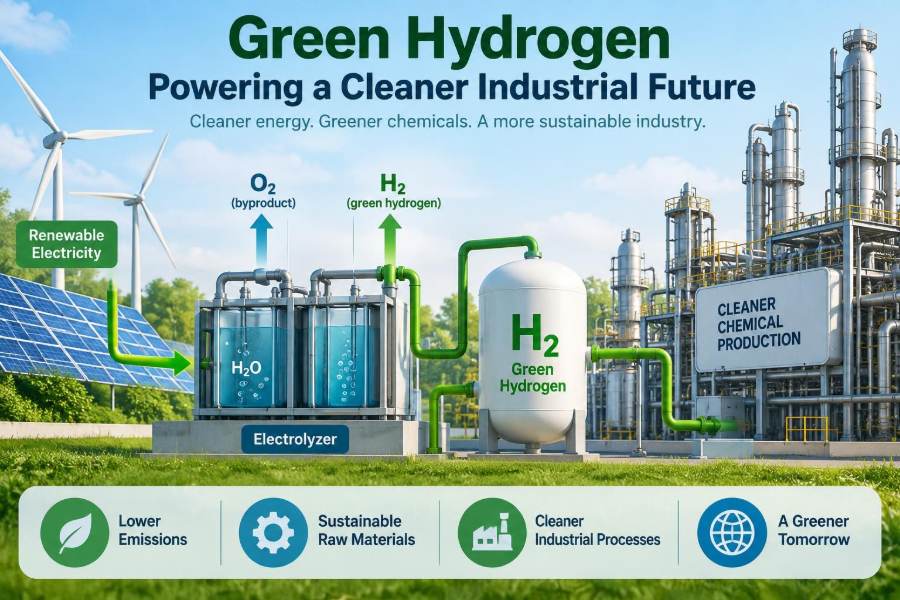
Green hydrogen offers a different route. It is hydrogen produced by splitting water with electricity from low-carbon renewable sources, rather than extracting hydrogen from natural gas or coal. That simple description conceals a demanding system of electrochemistry, power management, purification, compression, storage, and process integration.
The real breakthrough is not that green hydrogen can replace every molecule tomorrow. It is that chemical engineers can increasingly treat low-carbon hydrogen as a design variable—one that changes which reactions are practical, where plants are located, and how industrial production responds to a changing energy system.
⚛️ What Green Hydrogen Actually Means
Hydrogen is an energy carrier and chemical reagent, not a primary energy source found freely in large quantities. It must be produced from compounds such as water, hydrocarbons, or biomass.
Green hydrogen generally refers to hydrogen from water electrolysis powered by renewable electricity. In an electrolyzer, electrical energy separates water into hydrogen and oxygen. The label depends on the electricity source and system boundaries, so responsible claims should account for how the power is supplied and when it is available.
🏭 Why Hydrogen Matters to Chemical Production
Hydrogen is indispensable in many large-scale reactions. It supplies atoms, removes oxygen, saturates chemical bonds, and helps control product composition. Its value lies in chemistry as much as in combustion.
Major uses include ammonia synthesis, methanol production, oil refining, hydroprocessing of fuels and oils, hydrogen peroxide manufacture, and specialty chemical synthesis. Replacing fossil-derived hydrogen can therefore affect several industrial value chains at once.
🔥 The Carbon Problem in Conventional Hydrogen
Most conventional hydrogen is made through processes that convert fossil feedstocks into hydrogen-rich gas. Natural-gas-based steam methane reforming reacts methane with steam, while coal gasification converts solid coal into synthesis gas.
Both pathways produce carbon dioxide directly or require energy that can do so. Carbon capture may reduce emissions in some configurations, but capture performance, fuel supply, methane leakage, energy penalties, and storage arrangements all affect the final result. “Low carbon” is not a single, automatic outcome.
💧 Electrolysis: Splitting Water with Electricity
Electrolysis passes direct current through an electrochemical cell. At one electrode, water is oxidized to oxygen; at the other, hydrogen is formed. The product gases must remain separated, then be dried, purified, and conditioned for their intended use.
Think of an electrolyzer as the reverse of a fuel cell. A fuel cell combines hydrogen and oxygen to generate electricity and water; an electrolyzer consumes electricity to make hydrogen and oxygen. In practice, auxiliary equipment also consumes power, including pumps, cooling, gas treatment, and compression systems.
🔬 The Main Electrolyzer Technologies
Electrolyzers are not interchangeable. Their operating temperature, dynamic response, materials, purity requirements, and maturity vary, which matters when connecting them to a chemical process.
| Technology | Typical strength | Key engineering consideration |
|---|---|---|
| Alkaline electrolysis | Established technology using liquid electrolyte | Gas separation and response to changing power require careful design |
| PEM electrolysis | Compact equipment and strong dynamic response | Uses specialized materials and needs very pure water |
| Solid oxide electrolysis | Can use high-temperature heat efficiently in suitable settings | High-temperature durability and integration remain demanding |
Selection is a system decision, not a brand preference. A plant with steady low-cost electricity has different priorities from one designed to follow variable wind and solar output.
⚡ Electricity Is the Dominant Input
Electricity is usually the largest operating driver for electrolysis because breaking water requires substantial energy. The emissions profile and economics of green hydrogen therefore depend heavily on the carbon intensity, cost, availability, and timing of electricity.
A renewable power purchase agreement may support project development, but an hourly mismatch between electrolyzer consumption and renewable generation can matter in detailed carbon accounting. Grid-connected operation is often more practical than isolated operation, yet it introduces questions about marginal power sources and verification.
🌬️ Matching Electrolyzers with Renewable Power
Wind and solar generation vary with weather and time. Electrolyzers can either operate flexibly with available power or be supported by storage, grid imports, oversized renewable generation, or a combination of these measures.
Flexibility can help absorb renewable output that might otherwise be curtailed. However, frequent changes in operating load affect downstream compressors, purification trains, synthesis loops, maintenance plans, and the reliability expected by a continuous chemical plant.
🧱 Water Supply Is More Than a Footnote
Water is a feedstock for electrolysis, but usable water is not always located where renewable resources are strongest. Electrolyzers commonly require highly treated water to protect membranes, electrodes, and balance-of-plant equipment.
In coastal or water-stressed regions, desalination and water treatment may be part of the project. Their energy demand is usually much smaller than electrolysis demand, but intake design, brine handling, local water rights, and community impacts still need proper evaluation.
🧼 Purity Requirements Shape Plant Design
Different users accept different hydrogen specifications. An ammonia synthesis catalyst, a refinery hydrotreater, a fuel cell, and a laboratory process may have distinct tolerances for moisture, oxygen, nitrogen, sulfur compounds, and other contaminants.
This is why a project cannot stop at “making hydrogen.” Gas drying, deoxygenation, filtration, pressure control, analytical instruments, and quality assurance are essential. A small impurity concentration can damage a catalyst or create a safety issue when large gas flows are involved.
🗜️ Compression, Storage, and Transport
Hydrogen has low volumetric density, so moving and storing it is often harder than producing it. Compression requires energy, and high-pressure equipment must address leakage, embrittlement concerns for some materials, and ignition hazards.
Short pipelines may make sense when production and consumption are close together. For longer distances, options include pipelines, tube trailers, liquefaction, or converting hydrogen into a carrier such as ammonia, methanol, or a liquid organic hydrogen carrier. Each adds equipment, losses, and handling requirements.
🧪 Green Ammonia Changes a Foundational Supply Chain
Ammonia is made by reacting nitrogen with hydrogen in the Haber-Bosch process. Nitrogen can be separated from air, but the hydrogen has traditionally come from fossil feedstocks. Replacing that input with green hydrogen can reduce the production-stage emissions associated with ammonia.
Ammonia is also easier to ship than hydrogen in many cases, although it is toxic and requires stringent containment. It may serve as fertilizer feedstock, chemical intermediate, energy carrier, or marine fuel candidate, but each use has different safety and emissions considerations.
🌿 Fertilizer Production and Food Systems
For fertilizer producers, green hydrogen is relevant because ammonia is the starting point for products such as urea and ammonium nitrate. A lower-carbon ammonia supply can reduce emissions within the manufacturing chain.
That does not make all fertilizer impacts disappear. Field emissions, nutrient runoff, application practices, and soil conditions remain major environmental questions. The practical lesson is to separate production emissions from the broader lifecycle effects of how fertilizer is used.
🧫 Methanol and the Need for a Carbon Source
Methanol synthesis uses hydrogen together with carbon-containing feed gases. Green hydrogen can lower the fossil contribution of the hydrogen portion, but methanol still needs a carbon source.
That carbon may come from biomass, industrial point sources, or captured carbon dioxide. The climate implications depend on the source, capture energy, transport, and the eventual use of methanol. If methanol is later burned, its carbon returns to the atmosphere; if it becomes a durable material, the timing and accounting differ.
⛓️ Ironmaking Is a Promising but Demanding Use
Hydrogen can act as a reducing agent in direct reduced iron processes, removing oxygen from iron ore and producing water rather than carbon dioxide at the reduction step. This offers a route to lower-emission primary steelmaking when the hydrogen and electricity are low carbon.
Ore quality, electric arc furnace capacity, electricity supply, pellet availability, and plant retrofits all influence feasibility. Hydrogen-based reduction is not a simple drop-in replacement for every blast furnace or every steel grade.
🛢️ Refineries Face an Integration Challenge
Refineries already consume large quantities of hydrogen for desulfurization and upgrading heavy streams. Green hydrogen could displace part of the internally produced or purchased fossil-derived hydrogen, particularly where fuel specifications still require hydroprocessing.
Yet refineries operate as tightly coupled energy and material systems. Changing hydrogen supply can alter furnace fuel balances, steam networks, carbon dioxide flows, and economics. Engineers must assess the whole refinery rather than viewing an electrolyzer as an isolated utility.
🧯 High-Temperature Heat and E-Fuels
Some industrial processes need high-temperature heat that is difficult to electrify directly. Hydrogen combustion is one possible option, though direct electric heating, heat pumps, biomass, process redesign, or other fuels may be better in particular cases.
Hydrogen can also be combined with nitrogen or captured carbon to make e-fuels and chemical energy carriers. These routes can be valuable where direct electrification is impractical, but every conversion step consumes energy. Using electricity directly is often more efficient when the application allows it.
🔄 From Steady Plants to Flexible Operations
Traditional chemical plants are designed for stable feed rates and long operating campaigns. Renewable-powered hydrogen introduces an incentive to vary production with electricity availability, creating a new optimization problem.
Buffer storage can decouple the electrolyzer from a steady ammonia or methanol loop. Alternatively, flexible synthesis processes may follow changing hydrogen supply within limits. The best arrangement depends on storage cost, product value, catalyst behavior, start-up requirements, and the cost of lost production.
📈 Process Integration Is Where Value Is Won or Lost
A successful project links mass balance, energy balance, control strategy, utilities, and economics. For example, oxygen from electrolysis may have a nearby use, but it should not be treated as guaranteed revenue unless there is a reliable local market and a suitable purity specification.
Likewise, waste heat recovery may improve overall efficiency, but low-grade heat is useful only when a matching heat sink exists. Pinch analysis, heat integration studies, and realistic operating cases are more informative than headline efficiency figures alone.
🧮 Measuring Carbon Intensity Properly
Hydrogen should be evaluated by lifecycle carbon intensity, not color labels alone. Relevant boundaries can include electricity generation, equipment construction, water treatment, compression, transport, upstream fuel emissions, and the treatment of co-products.
Method choices matter. A facility powered by a dedicated renewable asset may be assessed differently from one drawing from a mixed grid. Transparent assumptions about time matching, certificates, curtailment, and system boundaries are essential for credible comparisons.
💰 Why Cost Comparisons Can Mislead
Comparing only the cost per unit of hydrogen misses major differences in delivery pressure, purity, availability, storage needs, and the value of flexible operation. A low production cost is not useful if the plant cannot receive hydrogen when it needs it.
Capital expenditure, financing, renewable interconnection, electrolyzer utilization, water treatment, and grid charges can all dominate project outcomes. As a result, the most favorable sites often combine strong clean-power resources with industrial demand, infrastructure, and workable permitting conditions.
🗺️ Location Determines More Than Sunshine and Wind
A remote site may have excellent renewable resources but lack water, ports, pipelines, skilled maintenance support, or customers. An industrial cluster may have weaker renewable generation but offer existing utilities, chemical consumers, storage caverns, and shared infrastructure.
Location decisions should compare delivered hydrogen or product cost, not simply electricity potential. They should also consider land use, transmission constraints, local acceptance, emergency response capability, and whether products can move economically to market.
🛡️ Hydrogen Safety Requires Specific Discipline
Hydrogen is colorless, odorless, highly flammable, and capable of leaking through small openings. Its flames can be difficult to see, and its wide flammability range in air demands robust prevention and detection systems.
Good practice includes ventilation, classified electrical equipment where appropriate, leak detection, pressure relief design, controlled venting, compatible materials, clear isolation procedures, and training. Existing process safety methods—hazard and operability studies, layers of protection analysis, management of change, and emergency planning—remain central.
🧱 Materials and Embrittlement Risks
Under some conditions, hydrogen can enter metals and reduce ductility or contribute to cracking. The risk depends on material composition, microstructure, pressure, temperature, stress, gas purity, and service history.
This does not mean every steel component is unsuitable. It means material selection, welding procedures, inspection intervals, and design codes must match the service. Reusing existing gas infrastructure requires verification, not assumption.
🎛️ Control Systems Must Handle Fast Change
Electrolyzers can respond more quickly than many downstream chemical units. That mismatch requires coordinated controls: hydrogen pressure must stay within limits, storage inventory must be managed, and synthesis loops must avoid unstable operation.
Digital monitoring can help forecast renewable output and schedule equipment, but it does not replace sound control engineering. Sensor reliability, cybersecurity, fallback logic, and manual operating procedures matter when a plant moves between normal, reduced-load, and shutdown states.
🧑🔧 Skills for Chemical Engineers
Green hydrogen projects sit at the intersection of reaction engineering, electrochemistry, separations, utilities, process control, safety, and lifecycle assessment. Engineers who understand interfaces between these fields will be especially valuable.
Useful capabilities include reading electrolyzer performance curves, developing heat and material balances, specifying gas quality, evaluating compressor duty, participating in hazard reviews, and questioning carbon-accounting assumptions. The goal is not to become an expert in every discipline, but to recognize where one subsystem changes another.
🚧 Common Project Mistakes to Avoid
Several errors recur when hydrogen concepts are discussed too broadly:
- Treating renewable electricity as continuously available without modeling actual generation and grid constraints.
- Assuming hydrogen purity, pressure, and delivery rate will automatically match an existing consumer.
- Counting oxygen or waste heat as revenue before confirming a stable customer and specification.
- Comparing technologies with different lifecycle boundaries or capacity factors.
- Ignoring water treatment, permitting, storage, and safety systems in early cost estimates.
Early front-end engineering should test these interfaces before a project becomes locked into an appealing but incomplete concept.
⚖️ Green Hydrogen Is Not the Answer to Every Use
Hydrogen is most compelling where it replaces a chemical feedstock, provides a reducing agent, or serves a process that is difficult to electrify directly. It is less compelling where electricity can be used efficiently without first converting it into hydrogen.
For example, direct electric heating may outperform hydrogen combustion for certain heat duties, while battery-electric systems may suit many transport applications better than hydrogen. A credible decarbonization strategy ranks options by the physics and constraints of each use case, not by a preference for one molecule.
🌍 Policy, Certification, and Market Rules Matter
Industrial buyers increasingly need evidence about product carbon intensity, especially where regulations, procurement rules, or customer requirements differentiate lower-carbon materials. This creates demand for certification and traceability systems.
Rules are still evolving across regions and sectors. Project teams should avoid assuming that a certificate, emissions factor, or eligibility criterion will remain unchanged over a plant’s lifetime. Contract structures need enough flexibility to manage policy and market uncertainty.
🔗 Industrial Clusters Can Lower Barriers
Shared infrastructure can make early projects more practical. A cluster may share renewable connections, water treatment, pipelines, storage, oxygen handling, port facilities, laboratories, and emergency response resources.
It can also aggregate demand. A single electrolyzer serving several nearby users may achieve better utilization than isolated small units, although shared systems require clear allocation, reliability, ownership, and safety responsibilities.
🧭 A Practical Way to Evaluate a Project
Start with the chemical need rather than the technology label. Define how much hydrogen is needed, at what pressure and purity, with what availability, and for which process consequence if supply is interrupted.
- Map the current hydrogen source and full utility balance.
- Model renewable supply, grid interaction, and storage under realistic time profiles.
- Compare delivered cost and lifecycle emissions using stated assumptions.
- Assess integration, hazards, permits, water, and infrastructure early.
- Test phased deployment options before committing to full scale.
This sequence helps distinguish a technically interesting electrolyzer from an industrially workable production system.
🔭 What Progress Will Actually Look Like
Progress will not always appear as a single dramatic replacement of fossil hydrogen. It may appear as a refinery blending in low-carbon hydrogen, an ammonia plant adding electrolytic supply, a steel project pairing direct reduction with renewable power, or a cluster building shared storage and pipelines.
Learning will come from operating data: degradation rates, maintenance needs, dynamic behavior, product quality, safety performance, and the reliability of supply contracts. Demonstration projects are valuable when their results improve the next design rather than merely proving that equipment can run.
✅ The Core Principle: Match the Molecule to the Job
Green hydrogen can reshape industrial production because it connects renewable electricity to chemical reactions that cannot simply be switched to a wire. Its strongest role is as a carefully specified reagent, reductant, fuel, or intermediate within a well-integrated process.
The central engineering question is not “Can hydrogen be made?” It is whether clean electricity, water, equipment, storage, controls, safety systems, and downstream chemistry can work together at the required scale and reliability. When those conditions align, green hydrogen becomes a meaningful tool for reducing industrial emissions rather than a standalone promise.
Green hydrogen changes industrial production most effectively when engineers treat it as part of a complete chemical system—not as a substitute molecule in isolation. That systems mindset will determine where it delivers real value in the years ahead. ⚗️🌱🔧