
A process line has been operating smoothly for years—until a small leak appears beneath insulation. The fluid is not especially aggressive at room temperature, the pipe was made from a familiar stainless steel, and the outside looks almost unchanged. Yet a local attack has quietly penetrated the wall.
This is the practical challenge of corrosion engineering: materials do not resist corrosion in the abstract. They resist, or fail to resist, a particular chemical environment, at a particular temperature, pressure, flow condition, geometry, and operating history.
For chemical engineers, material selection is therefore not simply a catalog exercise. It affects containment, product purity, plant availability, maintenance strategy, capital cost, and above all, process safety.
A good choice begins with understanding what the material will actually experience—not what the process diagram says it should experience on an ideal day. 🧪
🧭 1. Start with the real corrosion problem
Corrosion is the deterioration of a material through chemical or electrochemical interaction with its environment. For metals, this often means conversion of the metal into more stable compounds such as oxides, sulfides, or salts.
The first question is not “Which alloy is best?” It is “What damage mechanism could occur here?” Uniform thinning, pitting, cracking, erosion, and external corrosion can demand very different solutions.
A material that performs well in one service can fail rapidly in another because the controlling mechanism has changed.
🔍 2. Define the process envelope
Engineers build a process envelope: the credible range of conditions the equipment may see during normal operation, startups, shutdowns, cleaning, regeneration, and upsets.
Design based only on a nominal temperature and composition can be dangerously incomplete. Short excursions may create a more severe environment than steady operation.
- Minimum, normal, and maximum temperature
- Pressure and phase behavior
- Expected composition and impurities
- Concentration changes during evaporation or drying
- Cleaning chemicals and residual contaminants
💧 3. Identify the corrosive species
Water is often the enabling ingredient because it supplies an electrolyte for electrochemical corrosion. But many other species determine severity: acids, alkalis, chlorides, sulfides, oxygen, carbon dioxide, oxidizers, and dissolved metals.
Small concentrations can matter. Chloride contamination, for example, can be decisive for localized corrosion of some stainless steels even when the bulk stream is otherwise benign.
Ask where each species originates: feedstocks, utilities, catalysts, cleaning agents, atmospheric exposure, or decomposition products.
🌡️ 4. Treat temperature as a material-selection variable
Temperature commonly accelerates chemical reactions and transport processes, so corrosion rates often rise as temperature increases. More importantly, temperature can change the form of attack.
An alloy may tolerate an aqueous solution at ambient conditions but become vulnerable to pitting, stress corrosion cracking, or rapid general corrosion at elevated temperature.
Temperature gradients also matter. A hot wall, cool bulk liquid, or condensing surface can create a local chemistry unlike the measured process temperature.
🧪 5. Consider concentration, not just chemical names
Saying that a service contains sulfuric acid, sodium hydroxide, or hydrochloric acid is not enough. Corrosion behavior may vary sharply with concentration, temperature, aeration, and flow.
Some metals form protective films in selected concentration ranges and lose them outside those ranges. Conversely, a diluted solution may sometimes be more corrosive than a concentrated one because of changes in oxidizing behavior or water activity.
Always define concentration at the metal surface when possible, not merely in the feed tank.
⚗️ 6. Account for pH and acid-base chemistry
pH is a useful screening indicator for aqueous systems, but it is not a complete corrosion specification. It does not identify the acid anion, the oxidizing strength of the fluid, dissolved salts, or the effects of temperature.
Strong acids may cause high general corrosion rates, while alkaline solutions can attack amphoteric metals and certain alloys under specific conditions.
Engineers should also consider hydrolysis, neutralization zones, and local acidification beneath deposits or in crevices.
🫧 7. Do not overlook oxygen and oxidizing conditions
Oxygen can either worsen or reduce corrosion, depending on the metal and environment. It supports cathodic reactions in many aqueous corrosion systems, but it can also help maintain protective passive films on stainless steels and other alloys.
Oxygen concentration cells are especially important. A shielded region with less oxygen than an exposed region can become anodic and corrode preferentially.
This is why stagnant water under gaskets, deposits, or insulation deserves serious attention.
⚡ 8. Understand the electrochemical cell
Most aqueous metallic corrosion involves anodic and cathodic reactions. At the anode, metal atoms dissolve; at the cathode, a reduction reaction consumes electrons.
Corrosion proceeds when both reactions can be sustained through electrical and ionic paths. Altering the environment, breaking the circuit, or stabilizing a protective film can reduce damage.
This framework helps engineers reason beyond memorized alloy lists. It explains why aeration, conductivity, surface area ratio, and electrical contact can all matter.
🛡️ 9. Learn what passivity really means
Many corrosion-resistant alloys rely on a thin, adherent surface film. Stainless steels depend largely on chromium-rich passive films; aluminum and titanium also develop protective oxide layers in suitable environments.
Passivity is not invincibility. Certain ions, temperatures, reducing conditions, or mechanical damage can destabilize the film or prevent its repair.
A passivating alloy should be selected only after confirming that the actual environment supports its protective behavior.
🕳️ 10. Screen for pitting corrosion
Pitting is localized penetration that can occur while most of a surface remains apparently intact. It is particularly hazardous because a low average corrosion rate can conceal deep damage.
Halide ions, especially chlorides, are common promoters of pitting in passive alloys. Elevated temperature, stagnant conditions, deposits, and oxidizing conditions can increase susceptibility.
Selection may require a more resistant alloy, lower chloride exposure, better drainage, smoother fabrication, or a change in process chemistry.
🪤 11. Design against crevice corrosion
Crevice corrosion develops in narrow, shielded gaps where fluid exchange is restricted. Flanges, gaskets, lap joints, threaded connections, deposits, and poorly drained supports can all create vulnerable geometries.
Within a crevice, local chemistry can become more acidic and concentrated than the bulk fluid. An alloy that resists open-surface pitting may still be vulnerable in a tight crevice.
Good design removes unnecessary gaps, promotes drainage, and avoids trapping aggressive solutions. 🔧
📉 12. Distinguish uniform corrosion from local attack
Uniform corrosion produces relatively even wall loss. It is often easier to predict, inspect, and manage through a corrosion allowance or planned thickness monitoring.
Localized attack is harder to accommodate with extra thickness because failure can occur at a single small site. Material choice for pitting, crevice corrosion, or cracking must emphasize resistance to initiation, not only average metal-loss rate.
| Damage form | Typical feature | Selection implication |
|---|---|---|
| Uniform corrosion | Broad wall thinning | Rate data and corrosion allowance may be useful |
| Pitting or crevice corrosion | Deep local penetration | Improve alloy resistance and eliminate trapping conditions |
| Stress corrosion cracking | Cracks under tensile stress | Control material, stress, and environment together |
| Erosion-corrosion | Accelerated loss in high-velocity zones | Address flow, solids, geometry, and hardness |
🧵 13. Evaluate stress corrosion cracking
Stress corrosion cracking requires a susceptible material, a specific environment, and tensile stress. The stress may come from operating pressure, thermal expansion, residual welding stress, cold work, or restraint.
Cracking can progress with little visible general corrosion. Chloride-bearing environments are a familiar concern for some austenitic stainless steels, but many alloy-environment combinations have their own cracking risks.
Material selection must be paired with stress reduction, proper heat treatment where applicable, and control of the corrosive environment.
🌊 14. Check flow, velocity, and impingement
Flow can be beneficial when it prevents deposits and concentration gradients, but excessive velocity can strip protective films or accelerate mechanical removal of corrosion products. Entrained solids, bubbles, and liquid droplets intensify the risk.
Elbows, tees, reducers, control valves, pump discharges, and dead-ended branches deserve special review because local turbulence differs from average line velocity.
For erosion-corrosion, changing geometry or operating conditions may be as important as upgrading the alloy.
🪨 15. Include solids, deposits, and fouling
Deposits create differential aeration, trap corrosive liquid, and interfere with passive-film repair. Under-deposit corrosion is common where salts, scale, biological material, corrosion products, or process solids accumulate.
Fouling also changes heat transfer, which may raise wall temperature and alter local concentration through boiling or evaporation.
A selection review should ask not only what flows through the equipment, but what might remain on the surface after the flow changes.
🌫️ 16. Separate vapor, liquid, and condensation zones
A vessel can contain several corrosive environments at once. The immersed liquid zone, vapor space, liquid-vapor interface, and condenser may each require separate assessment.
Condensate can be unexpectedly aggressive because volatile components concentrate differently from the bulk liquid. A dry gas may be harmless until it reaches a cool surface and forms an electrolyte.
Materials should therefore be mapped by location, not assigned only at equipment level.
🔩 17. Beware galvanic corrosion
Galvanic corrosion occurs when dissimilar conductive materials are electrically connected in an electrolyte. The less noble material may become anodic and corrode faster.
The area ratio is important: a small anode coupled to a large cathode can be particularly unfavorable. Fasteners, weld overlays, instrument connections, and mixed-metal repairs are common locations.
- Use compatible material combinations where practical.
- Provide electrical isolation when it suits the service.
- Consider coating strategy carefully; coating only the anodic member can be risky if defects expose a small area.
🔥 18. Review high-temperature corrosion separately
At high temperatures, corrosion may occur without an aqueous electrolyte. Oxidation, sulfidation, carburization, nitridation, and attack by molten salts or deposits can control material performance.
Alloying elements that form stable surface scales are often valuable, but scale adherence, thermal cycling, gas composition, and deposit chemistry remain critical.
Do not apply room-temperature aqueous corrosion intuition directly to furnaces, reactors, heaters, or hot-gas systems.
🧬 19. Match alloy families to their strengths and limits
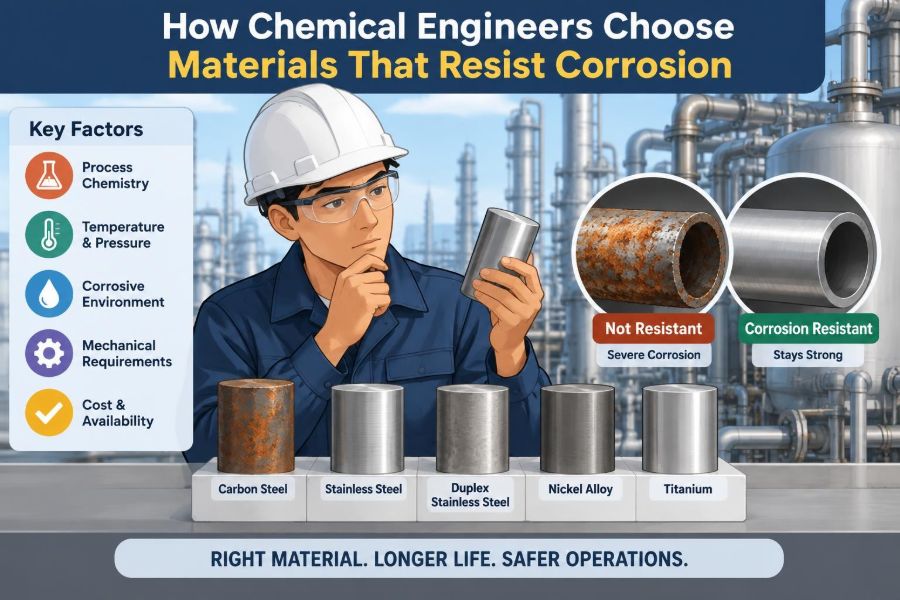
Carbon steel is economical and widely used where general corrosion is low or can be managed. Stainless steels offer useful passivity in many oxidizing aqueous services, while nickel-based alloys can provide stronger resistance in demanding reducing acids, chlorides, or high-temperature environments.
Titanium is exceptionally resistant in many oxidizing chloride-containing waters because of its stable oxide film, but it is not universal. Copper alloys, aluminum alloys, zirconium, tantalum, and reactive metals each have specialized roles.
No alloy family is “corrosion-proof.”
🧱 20. Consider nonmetallic materials too
Polymers, elastomers, ceramics, glass, graphite, and lined equipment can be excellent solutions when metals are unsuitable. Their limitations differ from those of alloys: permeability, temperature limits, mechanical strength, thermal shock, solvent swelling, creep, and damage sensitivity may govern.
For lined equipment, the lining, substrate, adhesive system, seams, nozzles, and repair methods must all be evaluated.
Material selection is often a system choice rather than a decision about the wetted surface alone.
🧷 21. Specify the material condition, not only the grade
A material name is incomplete without its product form, heat treatment, welding condition, surface finish, and required properties. Plate, pipe, forging, casting, weld metal, and heat-affected zones can behave differently.
Cast materials may have different microstructures from wrought products. Cold work can raise strength but may affect cracking susceptibility in certain services.
Clear specifications reduce the gap between the engineer’s intent and the equipment that is eventually fabricated.
🧑🏭 22. Treat welds as part of the corrosion system
Welds introduce compositional variation, residual stress, geometric discontinuities, heat-affected microstructures, and possible surface contamination. A parent metal with good resistance does not guarantee a corrosion-resistant welded assembly.
Selection should address filler metal, welding procedure, post-weld cleaning, heat treatment where needed, inspection, and accessibility for maintenance.
Crevice-like weld defects and heat tint on stainless steel can be especially important in aggressive aqueous service.
📐 23. Use design details to support the material
Even an excellent material can fail in a poor geometry. The best corrosion-control strategy frequently combines material selection with sensible mechanical design.
- Eliminate dead legs and stagnant pockets.
- Provide complete drainage and venting.
- Avoid sharp changes in flow direction where erosion is credible.
- Use gaskets, fasteners, and attachments compatible with the environment.
- Allow for inspection, cleaning, and replacement.
Designing out the mechanism is usually preferable to relying solely on a more expensive alloy.
🧮 24. Use corrosion allowance carefully
A corrosion allowance is extra thickness added to accommodate expected uniform wall loss during a design life. It can be practical for predictable, relatively uniform attack in metallic equipment.
It is not a cure for pitting, cracking, or severe under-deposit corrosion. These mechanisms can perforate a thick wall locally long before the average thickness is consumed.
When localized damage is plausible, focus first on mechanism control, alloy resistance, inspection strategy, and process design.
🧫 25. Use data, testing, and field evidence intelligently
Published compatibility information is a starting point, not a final answer. Its applicability depends on whether the tested environment truly matches concentration, temperature, impurities, flow, and metallurgical condition.
Useful evidence can include operating history from comparable equipment, laboratory immersion tests, electrochemical testing, exposure coupons, and examination of failed components.
Testing should reproduce the critical condition whenever possible. A polished coupon in a well-mixed beaker may not represent a crevice, welded joint, or heat-transfer surface.
📊 26. Balance lifecycle cost and consequence
The lowest purchase-cost material may create high costs through frequent replacement, lost production, contamination, monitoring, or risk controls. Conversely, selecting the most resistant alloy everywhere can waste capital and complicate fabrication.
A sound decision weighs initial cost against expected service life, inspection demands, repairability, failure consequence, and availability of qualified fabrication.
Critical containment boundaries often justify a more conservative choice than easily replaceable, low-consequence components.
🗂️ 27. Document the selection decision
Material selection should be traceable. Future engineers need to know what service was assumed, why an alloy or lining was chosen, what uncertainties remained, and what operating limits protect the equipment.
A useful record includes the process envelope, damage mechanisms considered, selected materials by zone, corrosion allowance rationale, joining requirements, inspection plan, and restrictions on cleaning or chemical changes.
This documentation is especially valuable when feedstocks, utilities, or production campaigns change years later.
🚨 28. Revalidate after process change
Corrosion control is not finished at commissioning. A new supplier, different impurity profile, increased temperature, revised cleaning procedure, altered flow rate, or longer shutdown can change the corrosion environment.
Management-of-change reviews should explicitly ask whether the material basis remains valid. Inspection findings should feed back into the corrosion model rather than being treated as isolated maintenance events.
Unexpected deposits, leaks, discoloration, or changes in corrosion-product chemistry are clues worth investigating early.
✅ 29. The core principle: select for the whole system
The central principle is simple: choose materials for the actual corrosion mechanism in the actual service, then support that choice with sound design, fabrication, operation, and inspection.
Chemical engineers succeed when they connect chemistry to equipment reality. They consider bulk fluid and local conditions, steady state and upset conditions, parent metal and welds, material resistance and geometry.
A durable plant is rarely the result of one “magic” alloy. It is the result of a disciplined, evidence-based system decision.
The right corrosion-resistant material is the one that remains fit for service under the conditions the equipment will truly face—not merely the conditions written on a simplified datasheet. 🧱🧪🔍