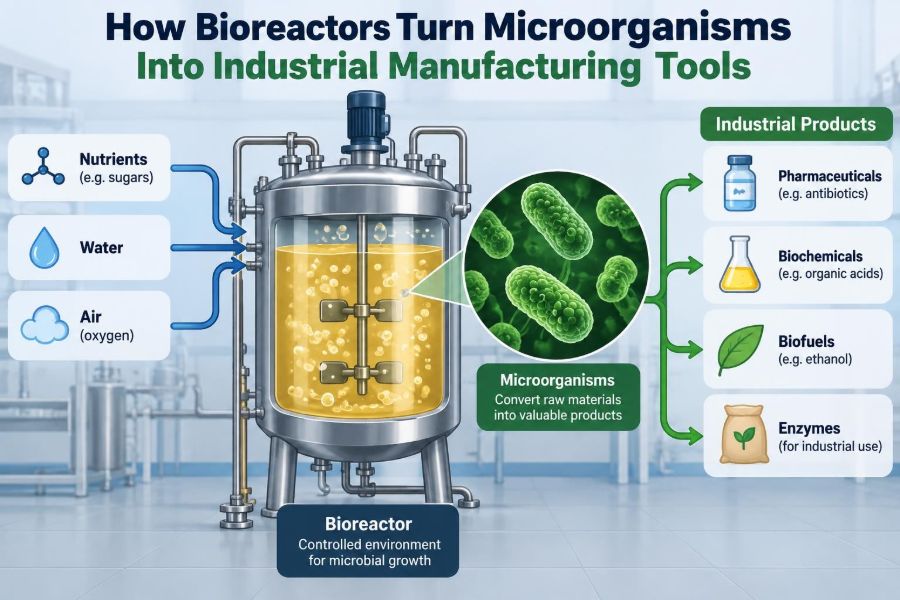

A stainless-steel vessel in a pharmaceutical plant may look less dramatic than a refinery column or a polymer reactor. Yet inside it, billions of living cells can be converting sugar, air, and carefully controlled nutrients into an enzyme, a vaccine component, an antibiotic, an organic acid, or a food ingredient.
The cells do not work simply because they have been placed in a tank. They need a stable environment: the right temperature, acidity, oxygen supply, mixing intensity, nutrient balance, and time. A small shift in one variable can change what the cells make, how fast they grow, or whether an entire batch remains usable.
This is where chemical engineering meets microbiology. A bioreactor is not merely a container for microorganisms; it is an engineered system for controlling biological production at a useful scale.
Understanding bioreactors helps engineers translate a promising organism in a laboratory flask into a dependable industrial manufacturing process. The central challenge is to keep living catalysts productive while managing transport, heat, contamination, and variability. 🧪
🧬 1. What a Bioreactor Really Is
A bioreactor is a vessel or system designed to support and control a biological reaction. In industrial practice, the biological catalyst may be a bacterium, yeast, fungus, mammalian cell, plant cell, or even an isolated enzyme.
Most people picture a tank containing microbes, but the full system includes sensors, pumps, gas-delivery equipment, heat-transfer surfaces, control loops, sterile connections, and downstream interfaces. The vessel is only one part of the manufacturing platform.
When microorganisms are used, the process is often called fermentation, even when it involves oxygen and is not fermentation in the narrow biochemical sense.
🏭 2. Why Industry Uses Living Cells
Microorganisms can perform chemical transformations that are difficult to achieve selectively with conventional catalysts. Their enzymes operate under relatively mild conditions and can build complex molecules with precise molecular structures.
Depending on the organism and process, bioreactors can manufacture:
- Therapeutic proteins, vaccines, and antibiotics
- Industrial enzymes for detergents, textiles, and food processing
- Organic acids, amino acids, vitamins, and flavors
- Biofuels and renewable chemical intermediates
- Biomass products such as baker’s yeast, probiotics, and single-cell protein
The same broad equipment concept can therefore support very different products. What changes is the biology, recipe, operating strategy, and quality requirements.
⚗️ 3. Microorganisms Are Living Catalysts
In a conventional catalytic reactor, a catalyst speeds up a reaction without reproducing itself. A microbial culture is more complicated: cells catalyze reactions, consume feedstocks, grow, adapt, produce by-products, and eventually lose activity.
Cells convert substrate through networks of metabolic reactions. Some carbon becomes new cell material, some becomes the desired product, some is released as carbon dioxide or other by-products, and some energy is dissipated as heat.
This means a bioreactor must be designed around cell physiology, not just reaction stoichiometry. The best conditions for rapid growth may not be the best conditions for product formation.
🌱 4. From Feedstock to Product
The manufacturing story begins with a feedstock. Carbon sources may include sugars, glycerol, organic acids, oils, or gases, while nitrogen, phosphorus, trace metals, and vitamins support cellular growth and metabolism.
The organism takes up these materials and converts them through metabolism. Engineers describe the outcome with balances around key components: biomass, substrate, oxygen, carbon dioxide, product, and heat.
A simplified conceptual balance is:
Accumulation = Input - Output + Generation - Consumption
For a batch reactor there is no liquid outlet during cultivation, but gases enter and leave, heat must be removed, and each component changes over time.
🧫 5. Choosing the Right Host Organism
The organism is the core manufacturing machine. Selection depends on the molecule required, expected productivity, feedstock tolerance, product safety, genetic tools, and the type of downstream purification needed.
Bacteria often grow quickly and are widely used for enzymes and simpler recombinant products. Yeasts are robust industrial organisms and can perform some modifications that bacteria cannot.
Filamentous fungi are valuable enzyme producers but can create challenging broths. Mammalian cells are frequently used for complex therapeutic proteins because they can perform important protein modifications, though they usually require more delicate culture conditions.
🧪 6. Strain Development Sets the Starting Point
No reactor design can fully compensate for a poorly performing strain. Before scale-up, scientists may select natural variants, adapt cells to process conditions, or use genetic engineering to improve productivity and reduce unwanted metabolic pathways.
Useful strain traits include stable product expression, fast growth when desired, tolerance to substrate and product concentrations, resistance to stress, and a consistent product-quality profile.
However, a high-producing strain in a small flask is not automatically an industrial strain. It must remain stable and productive across seed trains, larger vessels, and repeated manufacturing campaigns.
🌡️ 7. Temperature Controls Biology and Engineering
Temperature affects enzyme activity, growth rate, membrane behavior, protein folding, and product formation. Cells generally have a workable temperature range, but the preferred point can vary by organism and production phase.
Metabolism also generates heat. As cultures become denser and more active, the cooling demand can become a central scale-up limitation. Heat-transfer area does not increase as quickly as vessel volume when tanks become larger.
Engineers use jackets, internal coils, external heat exchangers, and controlled feed rates to remove heat. Temperature control is therefore both a biological requirement and an equipment-design problem.
🧪 8. pH Is More Than an Acidity Number
pH influences enzyme function, nutrient solubility, membrane transport, charge interactions, and product stability. Microbial metabolism can shift pH as cells consume nutrients and release acidic or basic compounds.
A pH probe measures the broth, while a controller may add acid, base, or another corrective solution. In some processes, gas composition can also influence pH through dissolved carbon dioxide.
Maintaining pH does not mean every microscopic region is identical. Good mixing is needed so additions disperse rapidly rather than exposing cells near an inlet to a damaging local pH extreme.
💨 9. Oxygen Transfer Often Limits Aerobic Processes
Many production organisms require oxygen for respiration. Oxygen is only sparingly soluble in aqueous broth, so a bioreactor must continually transfer it from gas bubbles into the liquid and then to the cells.
The engineering challenge is often summarized by the oxygen transfer rate:
OTR = kLa(C* - CL)
Here, kLa represents the volumetric mass-transfer capability, C* is the saturation concentration under operating conditions, and CL is the dissolved oxygen concentration in the broth.
If cellular oxygen uptake exceeds oxygen transfer, dissolved oxygen falls and metabolism may shift. Product formation, yield, and cell health can all be affected. 🌬️
🌀 10. Spargers and Impellers Work as a Team
A sparger introduces gas near the bottom of many stirred-tank bioreactors. Impellers break up and disperse bubbles, circulate the liquid, and reduce gradients in temperature, nutrients, and dissolved gases.
Gas flow alone may not deliver oxygen efficiently because large bubbles rise quickly. Stronger mixing can improve dispersion and gas-liquid contact, but it also increases power consumption and may create shear stress.
Designers balance impeller type, agitation speed, gas rate, vessel geometry, and antifoam use. The target is sufficient mass transfer and mixing without unnecessarily harming the culture or making operation inefficient.
🫧 11. Foam Is a Real Process Hazard
Proteins, surfactants, cell debris, and gas sparging can produce persistent foam. Foam may carry cells into exhaust filters, cause false level readings, foul equipment, or create contamination risks if it escapes controlled pathways.
Common approaches include mechanical foam breakers, controlled antifoam addition, foam probes, and operating conditions that reduce excessive aeration or agitation. Each option has trade-offs.
Antifoam can suppress bubbles, but it may also alter oxygen transfer and complicate downstream purification. Therefore, foam control should be considered during process development, not treated as a minor operating inconvenience.
🥣 12. The Culture Broth Changes During Production
A fermentation broth is dynamic. Early in a run it may be relatively low in cells and easy to mix. Later it can contain high biomass, secreted proteins, metabolites, solids, and viscosity-modifying materials.
Broth rheology matters because a viscous or non-Newtonian fluid mixes differently from water. Gas bubbles can coalesce differently, oxygen transfer may decline, and regions of poor circulation can appear.
Filamentous organisms illustrate this challenge clearly. They may grow as dispersed filaments or pellets, and the resulting morphology can substantially influence mixing, oxygen demand, and product recovery.
📈 13. Growth Phases Shape Operating Decisions
Microbial cultures commonly move through recognizable growth stages. After inoculation, cells may first adapt to the new environment; then they may grow rapidly while nutrients are abundant.
As a limiting nutrient is depleted or inhibitory compounds accumulate, growth slows and can enter a stationary phase. Some products are associated mainly with active growth, while others are favored when growth slows or when a specific nutrient becomes limiting.
Engineers use sampling, online signals, and process models to determine when to feed, change temperature, induce expression, or harvest. Timing is part of the recipe.
⏱️ 14. Batch Culture Is the Basic Production Mode
In a batch process, the initial medium is charged, sterilized or otherwise prepared, inoculated, and cultivated without continuous liquid feed or harvest during the main production period. Samples and small additions may still occur.
Batch operation is conceptually simple and provides a defined beginning and end. It is useful when the process naturally follows a growth-and-production sequence or when product recovery occurs after cultivation.
Its limitation is that nutrient concentrations and cell conditions change continuously. The culture may experience excess substrate early and starvation late unless the initial recipe is carefully designed.
🍯 15. Fed-Batch Culture Gives Engineers More Control
In a fed-batch process, one or more nutrients are added during cultivation without a corresponding continuous harvest of broth. The feed can prevent depletion while avoiding a large initial substrate concentration.
This is especially useful when excess carbon source causes unwanted by-products, oxygen demand spikes, osmotic stress, or inefficient metabolism. Feed rate becomes a powerful control lever.
Strategies may use a fixed schedule, an exponential profile, or feedback from measurements such as dissolved oxygen, pH, off-gas composition, or substrate concentration. Fed-batch is common because it balances flexibility with manageable operation.
🔄 16. Continuous Culture Runs at Steady State
In a continuous culture, fresh medium enters while culture broth leaves at a matching rate, keeping the liquid volume approximately constant. Under stable conditions, the process can approach a steady state.
The dilution rate determines how quickly material is replaced. If it is too high for the organism’s growth capability, cells can be washed out faster than they reproduce.
Continuous systems can offer consistent conditions and efficient use of equipment, but long runs demand strong contamination control, reliable instrumentation, and confidence that the organism and product remain stable over time.
🧱 17. Immobilized Cells Offer Another Reactor Strategy
Some bioprocesses retain cells or enzymes on solid supports, within gels, or in structured reactor systems. This can separate catalytic biomass from the flowing liquid and permit reuse or long operation.
Immobilization can simplify retention of the biocatalyst, but it introduces internal diffusion limitations. Nutrients and oxygen must reach cells inside the matrix, while products and wastes must leave.
The apparent convenience of immobilization must therefore be evaluated with mass transfer, activity loss, fouling, cleaning, and replacement needs in mind.
🏗️ 18. Stirred Tanks Dominate for Good Reasons
The stirred-tank bioreactor is widely used because it offers flexible control of mixing, gas dispersion, temperature, feed addition, and sampling. Its behavior is well understood relative to many alternatives.
It can support batch, fed-batch, and continuous operation across many applications. Scale, however, does not remove complexity: larger stirred tanks require careful attention to power input, aeration, cooling, and vessel geometry.
Other reactor designs can be advantageous for specialized tasks, but stirred tanks remain a versatile industrial baseline.
🧰 19. Alternative Bioreactor Designs Solve Specific Problems
Not all cells respond well to vigorous mechanical agitation. Some processes use airlift reactors, bubble columns, packed beds, wave-mixed bags, or perfusion systems to meet distinct biological and operational needs.
| Reactor type | Typical strength | Important limitation |
|---|---|---|
| Stirred tank | Strong mixing and broad operating flexibility | Shear and power demand can be significant |
| Airlift or bubble column | Lower mechanical complexity and gentler circulation | Less independent control of mixing and aeration |
| Single-use bag system | Reduced cleaning burden and flexible deployment | Scale and material compatibility constraints |
| Perfusion reactor | Maintains cells while removing spent medium and product | Requires reliable cell-retention operation |
Reactor selection should begin with cell needs and process goals rather than with a preferred piece of equipment.
📏 20. Scaling Up Is Not Just Making the Tank Bigger
A culture that performs well in a small vessel may behave differently at manufacturing scale. Mixing times become longer, bubbles travel farther, hydrostatic pressure changes, and cooling becomes relatively more difficult.
Engineers cannot usually keep every scale-dependent variable identical. They choose criteria that protect the most important process behavior, such as oxygen transfer capability, power input per volume, mixing time, gas flow characteristics, or heat-removal capacity.
Scale-up is consequently a risk-management exercise. The goal is not geometric similarity alone, but comparable biological performance under realistic industrial constraints.
🌊 21. Gradients Create a Hidden Large-Scale Environment
In a large reactor, a cell does not experience one perfectly uniform environment. As it circulates, it may pass through regions with different substrate levels, dissolved oxygen concentrations, pH values, and carbon dioxide levels.
These changing local conditions can trigger stress responses or alter metabolism even when the average sensor reading appears acceptable. A dissolved oxygen probe represents conditions near its location, not necessarily every point in the vessel.
Scale-down models attempt to reproduce relevant fluctuations in smaller equipment. They help development teams test whether a strain and process can tolerate the environmental variation expected at scale.
📡 22. Sensors Turn the Vessel Into a Controllable Process
Bioreactor control depends on measurements. Common online sensors track temperature, pH, dissolved oxygen, pressure, foam, liquid level, and gas flow.
Exhaust-gas analyzers can reveal oxygen consumption and carbon dioxide evolution. These signals provide insight into metabolic activity and can support feed control or detection of changing culture behavior.
Not every important variable is measured continuously. Biomass, viable-cell concentration, substrate, product, and metabolites may require offline samples or advanced analytical methods. Good process control combines direct measurements with informed interpretation.
🧠 23. Control Loops Keep Conditions Near Their Targets
A control loop compares a measured value with a setpoint and adjusts an input. For example, a temperature controller may change cooling-water flow, while a pH controller doses acid or base.
Dissolved oxygen control often uses a cascade: agitation may increase first, then gas flow, oxygen enrichment, vessel pressure, or another actuator if needed. This sequence uses lower-cost or gentler responses before stronger interventions.
Poorly tuned control can cause oscillations, overshoot, or unstable feeding. Since cells respond to their environment over time, controller design should be considered alongside biological dynamics.
🦠 24. Sterility Protects the Intended Culture
An unwanted microorganism can consume nutrients, alter pH, produce impurities, or outcompete the production strain. In sensitive processes, contamination can invalidate an entire run.
Contamination control begins before inoculation. Equipment, media, transfer lines, gases, sampling ports, and additions must be designed and operated to prevent unwanted entry of organisms.
Industrial systems commonly use cleanable designs, validated sterilization approaches, sterile filters where appropriate, closed transfers, and disciplined operating procedures. Sterility is a system property, not just a final cleaning step.
🧼 25. Cleaning and Sterilization Must Reach Every Surface
Bioreactors contain more than a main vessel: seals, valves, probes, spray devices, piping branches, filters, and transfer lines all matter. Poorly drained or poorly cleaned locations can retain residues and create future contamination risks.
Clean-in-place systems circulate cleaning solutions through equipment without disassembly. Sterilization-in-place uses controlled heat or other suitable methods to establish the required sanitary state before use.
Engineering details such as surface finish, drainage, dead-leg minimization, gasket selection, and instrument installation strongly influence whether a design is practical to clean and sterilize repeatedly.
🔍 26. Product Quality Begins During Cultivation
Downstream purification cannot always correct a poorly controlled upstream process. Culture conditions can affect impurity profiles, product concentration, molecular form, degradation, and consistency from batch to batch.
For biological medicines, subtle changes in cell culture can influence product attributes that must be understood and controlled. For industrial enzymes or food ingredients, purity, activity, color, odor, and stability may be central concerns.
This is why upstream and downstream teams must work together. The best fermentation is not merely the one with the highest titer; it is the one that produces material that can be recovered efficiently at the required quality.
🧪 27. Harvest Connects the Bioreactor to Downstream Processing
At the end of cultivation, the desired product may be inside cells, secreted into the broth, attached to biomass, or present as the biomass itself. That location determines the first recovery steps.
Typical operations include centrifugation, filtration, cell disruption, extraction, precipitation, chromatography, concentration, and drying. A secreted protein may require clarification first, whereas an intracellular product requires cell harvesting and disruption.
Harvest timing matters. Waiting too long can expose products to degradation, while harvesting too early may sacrifice yield. The bioreactor run and purification train are one connected manufacturing process.
⚖️ 28. Yield, Titer, and Productivity Describe Performance
Three terms help engineers evaluate a bioprocess. Yield describes how efficiently substrate becomes a desired output. Titer is the concentration of product in the broth. Productivity relates product formation to time and, depending on context, reactor volume or biomass.
Improving one metric can worsen another. A slower culture might achieve a high titer, but lower overall productivity. A rapid feed may raise short-term productivity but reduce yield through unwanted by-product formation.
The appropriate objective depends on the product, equipment capacity, raw materials, downstream cost, quality target, and operational reliability.
🌍 29. Sustainability Depends on the Whole Process
Biomanufacturing can use renewable feedstocks and avoid some harsh reaction conditions, but it is not automatically low-impact. Aeration, agitation, cooling, sterilization, purification, and waste treatment all consume resources.
A useful sustainability assessment considers feedstock origin, energy source, water use, nutrient inputs, emissions, solvent demand, and the fate of residual biomass and process streams. The product’s application also matters.
Process intensification may reduce resource use by improving yield, shortening cycle time, increasing product concentration, or simplifying purification. The most sustainable option is determined by the full system, not by the fact that cells are involved.
🔑 30. The Core Principle: Engineer the Environment, Enable the Cell
Bioreactors turn microorganisms into manufacturing tools by giving them a controlled environment in which their metabolism can perform useful work repeatedly and predictably. The vessel supplies nutrients and gases, removes heat and waste, maintains suitable physical conditions, and protects the culture from contamination.
The key insight is that industrial bioprocessing is a partnership between biology and engineering. Strain capability defines what is possible, while transport phenomena, reactor design, automation, sanitation, and downstream integration determine whether that capability becomes a reliable product.
A bioreactor succeeds when it makes the right cellular behavior repeatable at manufacturing scale. 🧫⚙️🌱