
Industrial plants often release gases that contain substances that cannot be discharged directly into the atmosphere. These gas streams may contain acid gases, toxic compounds, unpleasant odors, or other pollutants produced during chemical manufacturing, metal processing, petroleum refining, combustion, fertilizer production, and many other industrial operations.
One of the most widely used technologies for removing such contaminants is the absorption tower, also known as a gas scrubber or packed absorption column. 🌫️➡️💧
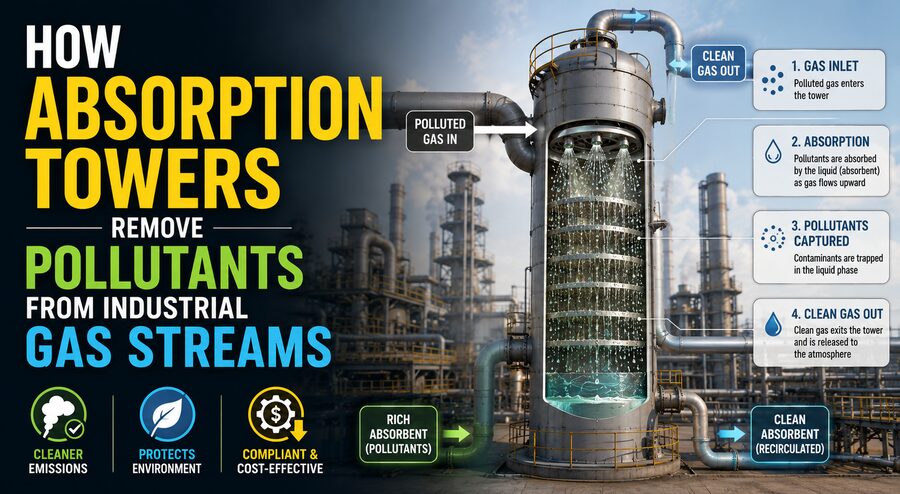
An absorption tower brings a polluted gas into close contact with a liquid that can selectively dissolve or chemically react with unwanted components. As the gas and liquid move through the tower, pollutants transfer from the gas phase into the liquid phase.
The cleaned gas then leaves the tower, while the contaminated liquid is collected for regeneration, treatment, recovery, or disposal.
Although the equipment may appear simple from the outside, absorption towers depend on carefully controlled principles of mass transfer, solubility, chemical equilibrium, fluid flow, and interfacial contact. ⚙️🧪
🌬️ What Is Gas Absorption?
Gas absorption is a separation process in which one or more components of a gas mixture are transferred into a liquid.
The unwanted gas component is called the solute, while the liquid that removes it is called the solvent or absorbent.
For example, imagine an industrial gas containing sulfur dioxide.
If that gas is contacted with a suitable liquid, sulfur dioxide molecules can move from the gas into the liquid. The concentration of sulfur dioxide in the exiting gas therefore decreases.
The basic process can be represented as:
Polluted Gas + Absorbent Liquid → Cleaner Gas + Pollutant-Rich Liquid
The success of the process depends heavily on choosing a liquid that absorbs the target pollutant effectively.
🏗️ What Does an Absorption Tower Look Like?
An absorption tower is typically a tall vertical vessel.
In many designs, polluted gas enters near the bottom of the tower and moves upward. The absorbing liquid enters near the top and flows downward.
This arrangement is called countercurrent flow. 🔄
Countercurrent operation is extremely effective because the cleanest liquid contacts the cleanest gas near the top of the tower, while the most contaminated liquid contacts the most polluted incoming gas near the bottom.
This maintains a strong driving force for pollutant transfer throughout much of the column.
A simplified tower might operate like this:
        Clean Gas Out
             ↑
      ┌─────────────┐
Liquid│ ↓ ↓ ↓ ↓ ↓   │
  In  │ Packing     │
      │ ↑ ↑ ↑ ↑ ↑   │
      │ Polluted Gas│
      └─────────────┘
             ↑
       Gas Feed In

      Pollutant-Rich
        Liquid Out
Inside the vessel, special equipment creates as much contact as possible between the rising gas and falling liquid.
💧 How Does the Pollutant Move Into the Liquid?
Pollutant removal occurs through mass transfer.
Gas molecules naturally move between phases depending on concentration, pressure, solubility, and chemical interactions.
When polluted gas contacts a liquid, molecules of the contaminant can travel from the gas phase to the gas-liquid interface and then dissolve into the liquid.
The overall process generally involves several steps:
- Pollutant molecules move through the gas toward the liquid surface.
- The molecules cross the gas-liquid interface.
- They dissolve in the liquid.
- They move away from the interface into the bulk liquid.
- In reactive absorption, they may chemically react with substances in the liquid.
The faster these steps occur, the more efficient the absorber becomes. ⚡🧪
🧲 Why Solubility Is So Important
A pollutant must have sufficient affinity for the absorbing liquid.
Some gases dissolve readily in water, while others require specialized solvents.
For example, water can effectively absorb certain highly soluble gases, but less soluble contaminants may require alkaline solutions, organic solvents, or chemically reactive absorbents.
The degree to which a gas dissolves in a liquid is influenced by several factors, including:
- gas composition,
- temperature,
- pressure,
- liquid composition,
- pollutant concentration,
- chemical reactions.
In general, many gases become more soluble in liquids at lower temperatures.
Higher pressure can also increase gas absorption in many systems.
Engineers use equilibrium relationships, including principles related to Henry’s law, to estimate how strongly a gas will partition between the gas and liquid phases. 📊
🧪 Physical Absorption vs. Chemical Absorption
Absorption towers can operate through either physical absorption or chemical absorption.
💧 Physical Absorption
In physical absorption, the pollutant simply dissolves in the liquid without undergoing a major chemical reaction.
The gas may later be released from the solvent through changes in pressure or temperature.
Physical absorption is useful when the pollutant is naturally soluble in the selected liquid.
⚗️ Chemical Absorption
In chemical absorption, the dissolved pollutant reacts with a chemical contained in the solvent.
This reaction can greatly increase the amount of pollutant that the liquid can remove.
For example, acidic gases may be absorbed using alkaline solutions.
The chemical reaction effectively consumes the pollutant in the liquid, helping maintain a strong concentration difference that encourages additional pollutant transfer from the gas. 🔬
Chemical absorption is frequently used when extremely high removal efficiency is required.
🧱 Why Packing Is Used Inside Absorption Towers
Many absorption towers contain materials known as packing.
Packing creates a very large surface area where gas and liquid can contact each other.
Instead of allowing the liquid to simply fall through an empty tower, packing spreads it across numerous surfaces as thin films or droplets.
The gas flows around and through these wetted surfaces.
More contact area means more opportunities for pollutant molecules to cross from the gas into the liquid. 🌊
Packing can consist of many shapes, including:
- rings,
- saddles,
- structured corrugated sheets,
- grids,
- specially designed plastic or metal elements.
Two common categories are random packing and structured packing.
Random packing consists of many individual pieces distributed throughout the column.
Structured packing is arranged in carefully designed geometric patterns that guide gas and liquid flow efficiently.
🪜 Tray Towers: Another Absorber Design
Not all absorption towers use packing.
Some use horizontal internal plates called trays.
Gas rises through openings in each tray and bubbles through the liquid held on the tray surface.
This creates intense gas-liquid contact. 🫧
Common tray designs include:
- sieve trays,
- valve trays,
- bubble-cap trays.
The liquid flows from one tray to the next through channels called downcomers.
Tray towers are especially useful when operators need good stage-by-stage contacting or when the process must handle certain ranges of liquid and gas flow.
🔄 Why Countercurrent Flow Improves Efficiency
Countercurrent flow is one of the most important design features of many absorption systems.
Suppose very polluted gas enters the bottom.
By the time the absorbent liquid reaches the bottom, it may already contain a significant amount of pollutant. However, the incoming gas contains an even higher pollutant concentration, so absorption can still occur.
Near the top of the column, the gas has already been partially cleaned.
It contacts fresh or relatively clean absorbent, which is still capable of removing the remaining pollutant.
This arrangement keeps a useful concentration difference throughout the column. 📈
That concentration difference acts as the driving force for mass transfer.
Without a sufficient driving force, pollutant transfer slows dramatically.
🧴 Choosing the Right Absorbent
The choice of absorbent is critical.
An ideal solvent should have several desirable characteristics:
- high solubility for the target pollutant,
- low volatility,
- chemical stability,
- low viscosity,
- minimal corrosion,
- low toxicity,
- reasonable cost,
- easy regeneration.
Water is attractive because it is inexpensive and widely available.
However, water does not efficiently absorb every industrial contaminant.
Engineers may therefore use solutions containing chemicals such as alkaline compounds, amines, oxidizing agents, or specialized solvents depending on the gas being treated.
The absorbent must also be compatible with equipment materials and downstream treatment systems. 🧪⚙️
🏭 Which Pollutants Can Absorption Towers Remove?
Absorption towers are used for a wide variety of industrial gas-cleaning applications.
Depending on the solvent and operating conditions, they may help remove gases such as:
- sulfur dioxide,
- hydrogen chloride,
- hydrogen fluoride,
- ammonia,
- hydrogen sulfide,
- chlorine,
- certain volatile compounds,
- acidic or basic vapors.
For example, an acidic pollutant may be scrubbed using an alkaline solution.
Similarly, ammonia may be absorbed effectively into acidic or aqueous solutions under appropriate conditions.
Different pollutants require different tower designs and absorbent chemistries.
🌫️ Example: Removing Sulfur Dioxide
Sulfur dioxide is an important industrial air pollutant that can be produced during the combustion of sulfur-containing fuels or during certain metallurgical operations.
An absorber can remove sulfur dioxide by contacting the gas with an alkaline liquid.
The pollutant first transfers into the liquid and then reacts chemically.
Because the dissolved sulfur dioxide is consumed by reaction, its effective concentration in the liquid remains relatively low.
That allows additional sulfur dioxide to continue transferring from the gas into the liquid. ⚗️
This type of process can achieve much better pollutant removal than physical dissolution alone.
⚙️ Factors That Affect Absorption Efficiency
Absorption tower performance depends on many interacting variables.
🌡️ Temperature
Lower temperatures often increase gas solubility.
However, temperature can also affect reaction rates, liquid viscosity, and operating costs.
📊 Pressure
Higher gas pressure can increase the amount of certain gases that dissolve in liquids.
High-pressure absorption is therefore useful in some chemical processing systems.
💦 Liquid Flow Rate
Providing more absorbent can increase pollutant removal.
However, excessive liquid flow can increase pumping costs and potentially create hydraulic problems.
🌬️ Gas Flow Rate
Higher gas flow increases the amount of pollutant entering the tower.
If gas velocity becomes too high, the column may lose efficiency or experience flooding.
🧱 Contact Area
More gas-liquid interfacial area generally improves mass transfer.
This is why well-designed packing is so valuable.
🧪 Chemical Reaction Rate
In reactive absorption, faster chemical reactions can significantly increase pollutant removal.
🌊 What Is Flooding in an Absorption Tower?
Absorption towers must operate within specific gas and liquid flow limits.
If the upward-moving gas becomes too fast, it can prevent liquid from flowing downward normally.
Liquid begins accumulating inside the tower.
This condition is called flooding. 🌊⚠️
Flooding can cause:
- high pressure drop,
- unstable operation,
- poor separation,
- liquid carryover,
- reduced capacity.
Engineers design towers so normal operating conditions remain safely below the flooding point.
💨 Pressure Drop and Energy Consumption
As gas flows through packing or trays, it experiences resistance.
This causes a pressure drop between the inlet and outlet of the tower.
Fans, blowers, or compressors may be required to overcome this resistance.
A large pressure drop increases energy consumption. ⚡
Therefore, absorber design involves a compromise.
Engineers want enough gas-liquid contact for strong pollutant removal, but they also want the gas to move through the system without excessive resistance.
Modern structured packing is often designed specifically to provide high surface area while maintaining relatively low pressure drop.
💧 What Happens to the Polluted Liquid?
The pollutant does not disappear when it leaves the gas.
It is transferred into the liquid.
This means the resulting liquid must be managed properly.
Depending on the process, the pollutant-rich absorbent may be:
- chemically treated,
- regenerated,
- sent to wastewater treatment,
- recycled,
- concentrated,
- used to recover a valuable chemical,
- disposed of according to environmental requirements.
In many industrial systems, solvent regeneration is economically important.
Instead of continuously replacing expensive absorbent, the plant removes the absorbed pollutant and recycles the liquid back to the absorber. ♻️
🔁 Absorption and Solvent Regeneration
Large gas-treatment plants often combine an absorber with another column known as a stripper or regenerator.
The absorber removes pollutant from the gas.
The stripper then removes the pollutant from the liquid so the solvent can be reused.
The cycle may look like:
Polluted Gas → Absorber → Clean Gas
and
Rich Solvent → Regenerator → Lean Solvent → Absorber
This closed-loop arrangement reduces solvent consumption and may allow valuable gases to be recovered.
Amine-based gas treatment in petroleum and natural-gas processing is a well-known example of absorption combined with solvent regeneration. 🔄🧪
🛡️ Mist Eliminators Protect the Gas Outlet
As gas rises through an absorption tower, small liquid droplets can become carried upward.
Allowing these droplets to leave the stack could create chemical emissions, corrosion, or visible mist.
Many towers therefore contain a mist eliminator near the gas outlet.
Mist eliminators capture entrained liquid droplets while allowing the cleaned gas to continue flowing. 💧🚫
Captured liquid falls back into the tower.
This seemingly small component can be important for maintaining both environmental performance and solvent recovery.
🧱 Corrosion Is an Important Design Challenge
Absorption processes may involve acidic, alkaline, or otherwise corrosive liquids.
Materials of construction must therefore be selected carefully.
Depending on operating conditions, towers may use:
- stainless steel,
- coated carbon steel,
- fiberglass-reinforced plastic,
- specialty alloys,
- corrosion-resistant plastics,
- protective linings.
Incorrect material selection can lead to equipment failure, leaks, contamination, and costly maintenance. 🔧
Chemical compatibility is therefore considered from the earliest stages of tower design.
🌍 Environmental Importance of Absorption Towers
Absorption towers play an important role in industrial air-pollution control.
Without gas-cleaning systems, some industrial processes could release significantly higher concentrations of harmful compounds into the atmosphere.
Scrubbing systems can help facilities meet emissions limits and reduce exposure to irritating, corrosive, or toxic gases. 🌱🏭
They may also help recover useful chemicals that would otherwise be wasted.
For example, an absorbed gas may be converted into a marketable by-product or returned to another section of a chemical plant.
This combination of pollution control and material recovery can improve both environmental and economic performance.
🧠 Absorption Is About Controlled Molecular Transfer
The underlying science of an absorption tower can be summarized with one central idea:
pollutant molecules are encouraged to leave the gas and enter a liquid where they are more stable, soluble, or chemically reactive.
Everything about the tower is designed to make that transfer happen efficiently.
Packing increases surface area.
Countercurrent flow maintains a concentration driving force.
The solvent provides chemical affinity.
Temperature and pressure influence solubility.
Reaction chemistry can lock pollutants into the liquid phase.
Hydraulic design keeps the gas and liquid flowing correctly. ⚙️🧪
🏭 From Polluted Gas to Cleaner Emissions
Absorption towers are among the most important pieces of equipment used for industrial gas purification.
They work by bringing contaminated gas into intimate contact with a carefully selected liquid. Pollutant molecules move from the gas into the liquid through mass transfer, and chemical reactions can further enhance removal.
Inside the tower, packing or trays create large contact areas, while countercurrent flow allows fresh absorbent to meet increasingly clean gas. 🌬️💧
The result is a cleaner gas stream leaving the top of the equipment and a pollutant-rich liquid leaving the bottom.
Although absorption towers may appear to be little more than tall industrial vessels, their effectiveness depends on sophisticated engineering involving thermodynamics, chemistry, fluid mechanics, and mass-transfer science.
From chemical factories and refineries to metal-processing plants and environmental control systems, absorption towers demonstrate a powerful industrial principle: pollution can often be controlled by transferring harmful molecules into a phase where they can be captured, treated, recovered, or safely managed. 🌍🏭♻️