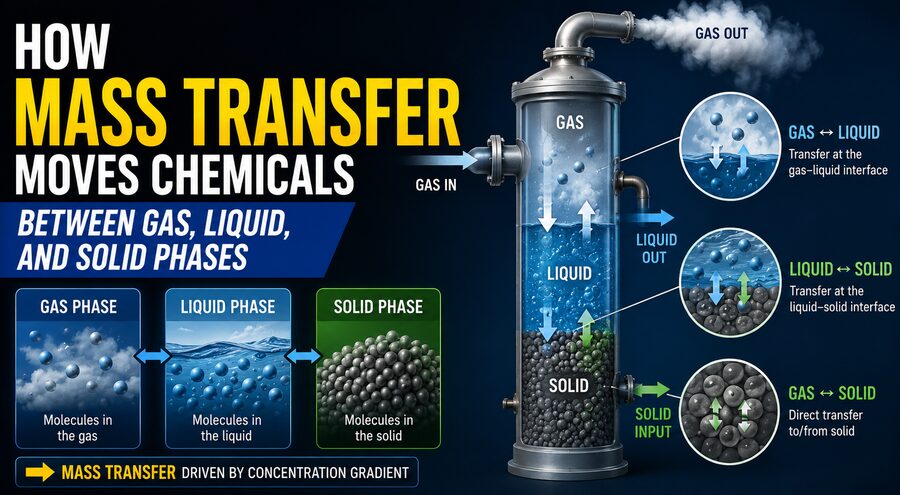

Many chemical and industrial processes depend on substances moving from one phase to another. A gas may dissolve into a liquid, a dissolved chemical may leave a liquid and enter the gas phase, or molecules may move from a liquid onto the surface of a solid. These movements are examples of mass transfer. 🌬️💧🪨
Mass transfer is the movement of chemical species from one location to another because of differences in concentration, pressure, chemical potential, or other driving forces. It is one of the fundamental transport processes studied in chemical engineering, alongside heat transfer and momentum transfer.
Mass transfer is essential in technologies such as:
- Distillation
- Gas absorption
- Drying
- Extraction
- Water purification
- Air pollution control
- Chemical reactors
- Pharmaceutical manufacturing
- Food processing
- Carbon capture
Understanding mass transfer helps engineers predict how quickly chemicals move and design equipment that performs these transfers efficiently.
🔬 What Is Mass Transfer?
Mass transfer occurs whenever molecules move from a region where their thermodynamic tendency is higher toward a region where it is lower.
A simple example is perfume sprayed into a room. 🌸
Immediately after spraying, perfume molecules are concentrated near the bottle. Over time, they spread through the surrounding air.
This spontaneous movement from a region of high concentration toward regions of lower concentration is called diffusion.
But industrial mass transfer often involves more than diffusion alone. Fluids may also flow, mix, bubble, or circulate, carrying chemicals with them.
Mass transfer can therefore involve two major mechanisms:
Diffusion – molecular movement caused by concentration or chemical-potential differences.
Convection – movement of chemicals because the fluid itself is moving.
In practical equipment, both often occur simultaneously.
⚛️ The Molecular Basis of Diffusion
Molecules in gases and liquids are constantly moving because of thermal energy.
Their motion is random.
If one region contains many molecules of a particular chemical and a nearby region contains fewer, random molecular movement statistically results in more molecules moving away from the high-concentration region than returning to it.
The net effect is movement toward lower concentration.
This idea is commonly described using Fick’s law of diffusion.
In simplified form:
Diffusive flux ∝ concentration gradient
A concentration gradient describes how rapidly concentration changes with distance.
A large concentration difference across a short distance produces a strong gradient and usually faster diffusion.
A small concentration difference produces a weaker driving force.
🌬️ Mass Transfer Between Gas and Liquid
One of the most common forms of mass transfer occurs between gases and liquids.
Consider carbon dioxide dissolving into water.
CO₂ molecules are present in the gas phase above the liquid. When they reach the gas-liquid interface, some enter the liquid and dissolve.
The transfer can be imagined as several steps:
Gas bulk ➡️ Gas film ➡️ Interface ➡️ Liquid film ➡️ Liquid bulk
Near the surface between the gas and liquid, fluid motion may be weaker than in the main body of either phase.
These thin regions are often treated as mass-transfer films.
A molecule must move through these films before reaching the other phase.
The resistance offered by these films can strongly influence the overall mass-transfer rate.
🫧 Gas Absorption
Gas absorption occurs when a component of a gas mixture dissolves into a liquid.
For example, industrial facilities may remove certain pollutants from exhaust gases by contacting them with a liquid capable of absorbing the unwanted chemical.
Suppose sulfur dioxide is present in a gas stream.
If the gas is contacted with a suitable liquid, sulfur dioxide can transfer:
Gas phase ➡️ Liquid phase
Engineers often use towers or columns that create a large contact area between gas and liquid.
Common equipment includes:
- Packed columns
- Tray columns
- Spray towers
- Bubble columns
- Scrubbers
A larger interfacial area generally allows more molecules to cross between phases at the same time. 🏭
🌫️ Stripping: Moving Chemicals From Liquid to Gas
Mass transfer can also occur in the opposite direction.
Stripping, sometimes called desorption, removes a dissolved chemical from a liquid by transferring it into a gas.
Imagine water containing a volatile organic compound.
Air or steam may be passed through the water.
The chemical transfers:
Liquid phase ➡️ Gas phase
The resulting gas can then be treated separately.
Air stripping is used in some water-treatment applications to remove volatile contaminants.
The direction of transfer therefore depends on the thermodynamic driving force, not simply on whether the chemical begins as a gas or liquid.
⚖️ Equilibrium Determines the Final Direction
Mass transfer tends to push a system toward phase equilibrium.
At equilibrium, molecules may still move in both directions across an interface, but there is no net transfer.
For gas-liquid systems, equilibrium relationships are often described using concepts such as Henry’s law.
Henry’s law relates the concentration of a dissolved gas in a liquid to its partial pressure in the gas phase under appropriate conditions.
Conceptually:
Higher gas partial pressure ➡️ Greater equilibrium dissolved concentration
If the liquid contains less dissolved gas than its equilibrium concentration, the gas tends to dissolve.
If it contains more, the gas may leave the liquid.
Thus, mass-transfer direction is determined by how far the current system is from equilibrium.
💧 Liquid-Liquid Mass Transfer
Mass transfer can also occur between two liquids that do not mix completely.
A familiar example is oil and water.
Certain chemicals may prefer one liquid over another.
If the chemical is initially dissolved in water but has a stronger affinity for an organic solvent, contacting the two liquids may cause the chemical to move into the solvent.
This process is called liquid-liquid extraction. 🧪
The transfer may be represented as:
Chemical in liquid A ➡️ Interface ➡️ Liquid B
After sufficient contact, the liquids are allowed to separate.
One phase becomes richer in the target chemical, while the other becomes depleted.
Liquid-liquid extraction is widely used in:
- Pharmaceutical processing
- Metal recovery
- Petrochemical production
- Food processing
- Specialty chemical manufacturing
🪨 Mass Transfer Between Fluids and Solids
Chemicals can also transfer between a gas or liquid and a solid.
One important example is adsorption.
Adsorption occurs when molecules accumulate on the surface of a solid.
Activated carbon is a common adsorbent because it has an enormous internal surface area.
If contaminated water flows through activated carbon, certain molecules may transfer:
Liquid bulk ➡️ Liquid film ➡️ Solid surface ➡️ Internal pores
The pollutant molecules then attach to the carbon surface.
This makes activated carbon useful for removing:
- Organic contaminants
- Odors
- Some solvents
- Certain pollutants
Adsorption is different from absorption.
Absorption usually means a substance penetrates into the bulk of another phase, while adsorption refers primarily to accumulation on a surface.
🧽 What Is Desorption From a Solid?
The reverse of adsorption is desorption.
During desorption, molecules previously attached to a solid leave its surface and enter a surrounding fluid.
This can occur if:
- Temperature increases
- Pressure decreases
- Fluid composition changes
- Another molecule competes for the surface
- The equilibrium condition changes
Desorption is important for regenerating adsorbent materials so they can be reused.
For example, certain industrial adsorption systems capture chemicals during one operating stage and release them during another.
🏜️ Drying: Mass Transfer From Solid to Gas
Drying is another important mass-transfer operation.
Consider wet clothes drying in air. 👕
Water contained in the fabric moves toward the surface and then evaporates into the surrounding air.
The sequence may involve:
Moisture inside solid ➡️ Solid surface ➡️ Gas phase
Industrial drying works similarly.
Heat often supplies the energy required for evaporation, while mass transfer removes the resulting vapor.
Drying therefore combines heat transfer and mass transfer.
Applications include:
- Food dehydration
- Pharmaceutical powder production
- Paper manufacturing
- Ceramics
- Textile processing
- Chemical manufacturing
🌡️ How Temperature Affects Mass Transfer
Temperature can strongly influence mass transfer.
Higher temperatures generally increase molecular motion and can increase diffusion rates.
Temperature may also change:
- Solubility
- Vapor pressure
- Viscosity
- Density
- Phase equilibrium
- Reaction rates
For example, warming a volatile liquid typically increases its vapor pressure, making evaporation easier.
However, the exact effect of temperature depends on the chemical system.
📏 Surface Area Matters
Mass transfer occurs across interfaces.
Therefore, increasing the contact area between two phases can dramatically increase the overall transfer rate.
Imagine dropping a single large chunk of sugar into water compared with adding the same mass as fine sugar crystals.
The fine particles expose much more surface area to the liquid, allowing them to dissolve more quickly.
Industrial equipment uses the same principle.
Gas-liquid columns may use packing materials that spread liquid into thin films.
Bubble columns break gases into many small bubbles.
Spray dryers break liquids into tiny droplets.
Smaller bubbles or droplets provide more interfacial area per unit volume, often improving mass transfer. 🫧
🌪️ Mixing Reduces Mass-Transfer Resistance
Mixing can also increase mass-transfer rates.
Near an interface, a stagnant or slowly moving fluid layer can develop.
Molecules must diffuse through this layer.
Strong mixing reduces its effective thickness, making it easier for chemicals to reach or leave the interface.
For example, sugar dissolves more quickly when tea is stirred. ☕
Stirring does not fundamentally change sugar’s equilibrium solubility under the same conditions, but it transports dissolved sugar away from the crystal surface and brings fresh liquid into contact with the solid.
This maintains a stronger concentration gradient and increases the dissolution rate.
📐 Mass-Transfer Coefficients
Engineers often describe mass-transfer performance using a mass-transfer coefficient.
A simplified relationship is:
Mass-transfer rate = coefficient × area × driving force
The coefficient represents how easily a chemical moves through a particular system.
Its value can depend on:
- Fluid velocity
- Turbulence
- Diffusivity
- Viscosity
- Equipment geometry
- Temperature
- Phase properties
Mass-transfer coefficients allow engineers to estimate the required size of equipment such as absorption towers and extraction columns.
🧱 The Two-Film Theory
A widely used conceptual model is the two-film theory.
Imagine a gas contacting a liquid.
The gas bulk may be well mixed.
The liquid bulk may also be well mixed.
But near the interface, thin regions of relatively slow-moving fluid exist on both sides.
These are treated as:
Gas film | Interface | Liquid film
A transferring molecule must diffuse through the gas film, cross the interface, and then diffuse through the liquid film.
Sometimes the gas-side resistance dominates.
Sometimes the liquid-side resistance dominates.
In other cases, both are important.
Identifying the largest resistance helps engineers determine how to improve the process.
🔥 Mass Transfer Can Occur With Chemical Reactions
Sometimes a chemical reacts after entering another phase.
Suppose a gas dissolves into a liquid and then immediately reacts with a dissolved substance.
The chemical reaction can reduce the concentration of the transferred gas in the liquid.
That maintains a strong driving force for additional gas to enter.
As a result, chemical reactions can significantly enhance mass transfer.
This principle is used in certain gas-treatment and carbon-capture processes.
Mass transfer and chemical reaction are therefore often closely coupled. ⚗️
🏭 Distillation and Mass Transfer
Distillation is one of the most important industrial separation processes.
It separates components according to differences in volatility.
Inside a distillation column, vapor rises while liquid flows downward.
More volatile chemicals tend to transfer:
Liquid ➡️ Vapor
Less volatile components tend to transfer:
Vapor ➡️ Liquid
Repeated contact between vapor and liquid gradually enriches the vapor in more volatile components and the liquid in less volatile ones.
Thousands of industrial plants rely on this type of phase-to-phase mass transfer to produce fuels, solvents, chemicals, and purified products.
💧 Membranes and Mass Transfer
Membrane processes also depend on mass transfer.
A membrane selectively allows certain molecules or ions to pass through while restricting others.
Examples include:
- Reverse osmosis
- Gas separation
- Dialysis
- Ultrafiltration
- Pervaporation
A chemical may dissolve into the membrane, diffuse through it, and emerge on the other side.
The membrane itself creates resistance, so engineers must consider diffusivity, membrane thickness, pressure differences, and chemical affinity.
🌍 Environmental Importance of Mass Transfer
Mass transfer occurs constantly in nature.
Oxygen moves from the atmosphere into lakes and rivers.
Carbon dioxide transfers between the ocean and atmosphere.
Pollutants may evaporate from soil into air.
Chemicals can adsorb onto sediment particles.
Plants exchange gases with the atmosphere.
These processes influence:
- Climate
- Water quality
- Ecosystems
- Pollution transport
- Atmospheric chemistry
Environmental engineers use mass-transfer models to understand and control these movements.
🫁 Mass Transfer in the Human Body
Biological systems also rely heavily on mass transfer.
Inside the lungs, oxygen moves from inhaled air across thin biological membranes into the bloodstream.
At the same time, carbon dioxide moves from the blood into the air and is exhaled.
The enormous surface area of the lung’s alveoli makes this transfer highly efficient. 🫁
Similar transport processes occur across cell membranes and within tissues.
Mass transfer is therefore not only an industrial concept—it is fundamental to life itself.
⚠️ What Limits Mass Transfer?
Mass transfer may become slow when resistance is high.
Possible limitations include:
- Thick stagnant fluid films
- Low molecular diffusivity
- Small interfacial area
- Poor mixing
- Low concentration differences
- Slow transport inside solid pores
- Unfavorable equilibrium conditions
Engineers attempt to identify the controlling resistance.
If liquid-film resistance is large, stronger mixing may help.
If surface area is too small, smaller droplets or packing may be used.
If equilibrium is unfavorable, pressure or temperature may be changed.
🧠 A Simple Example: Oxygen Dissolving Into Water
Imagine air bubbles rising through a tank of water.
Oxygen must travel through several stages:
- 🌬️ Oxygen moves through the gas inside a bubble.
- 🫧 It reaches the gas-liquid interface.
- 💧 Oxygen enters the water.
- 🔬 It diffuses through a thin liquid film surrounding the bubble.
- 🌊 Mixing carries dissolved oxygen into the bulk liquid.
If the water already contains almost as much oxygen as equilibrium allows, the driving force is small.
If the water contains very little oxygen, the driving force is much larger.
Engineers can increase oxygen transfer by producing smaller bubbles, increasing mixing, or increasing gas pressure.
This principle is widely used in wastewater treatment and fermentation.
🌟 The Bigger Picture
Mass transfer explains how chemicals move across and within gases, liquids, and solids.
At its core, the process is driven by differences in concentration, chemical potential, pressure, or equilibrium state.
A chemical may move:
Gas ➡️ Liquid through absorption.
Liquid ➡️ Gas through stripping or evaporation.
Liquid ➡️ Liquid through extraction.
Fluid ➡️ Solid through adsorption.
Solid ➡️ Fluid through desorption or dissolution.
Regardless of the particular phases involved, the same basic principles appear repeatedly: molecules move toward equilibrium, diffusion transports them through microscopic regions, fluid motion carries them over larger distances, and interfaces determine where one phase meets another.
By controlling surface area, mixing, temperature, pressure, concentration, and flow, engineers can dramatically change how quickly mass transfer occurs. ⚙️🧪
These principles make it possible to purify drinking water, refine petroleum, capture pollutants, dry foods, manufacture medicines, separate gases, operate chemical reactors, and perform countless other processes.
Mass transfer may be invisible at the molecular level, but it is one of the most important mechanisms controlling how chemicals move through both engineered systems and the natural world. 🌍🔬