
Industrial plants manufacture many of the materials modern society depends on, including fuels, medicines, fertilizers, plastics, food ingredients, cleaning products, and specialty chemicals. But these facilities may also handle flammable liquids, toxic gases, high pressures, extreme temperatures, and highly reactive substances. ⚗️🔥
Because of these hazards, safety cannot simply be added after a plant is built. It must be engineered into the process from the beginning.
This is where chemical engineers play a critical role.
Chemical engineers do much more than design reactors and pipelines. They study how materials behave, how pressure and temperature change during operation, how equipment can fail, and what safeguards are needed to prevent an abnormal condition from becoming a major accident.
Modern plant safety relies on a combination of inherently safer design, process control, hazard analysis, protective equipment, emergency systems, and human factors engineering.
⚗️ Understanding the Process Before Designing the Plant
Before engineers can make a plant safe, they must understand exactly what the process is supposed to do.
They study questions such as:
- What chemicals enter the plant?
- At what temperatures and pressures are they handled?
- Are any materials toxic or corrosive?
- Can the chemicals react unexpectedly?
- What happens if cooling fails?
- What happens if a valve becomes blocked?
- Could gas or vapor accumulate inside equipment?
- How much energy could be released during an accident?
Chemical engineers use mass balances and energy balances to calculate how materials and heat move through the process.
For example, if a reactor receives 1,000 kilograms of material per hour, engineers need to know where that material goes, how much reacts, how much leaves, and what could happen if the outlet becomes restricted.
These calculations form the foundation of safe plant design. 📊
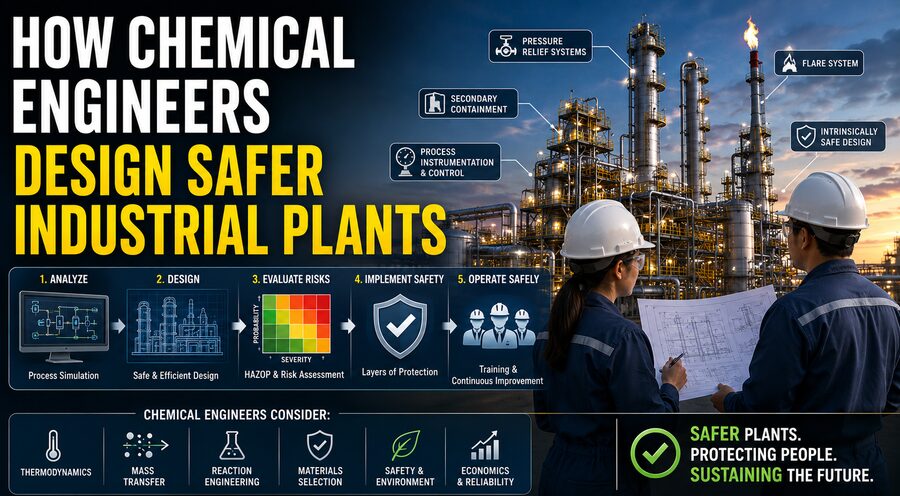
🛡️ Inherently Safer Design: Removing Hazards Before Controlling Them
One of the strongest safety principles in chemical engineering is called inherently safer design.
Instead of asking only, “How can we control this hazard?” engineers first ask:
“Can we eliminate or reduce the hazard itself?”
This approach generally includes four important ideas.
1. Minimize 📉
Use smaller quantities of hazardous substances whenever possible.
If a process only requires 500 kilograms of a dangerous chemical at a time, storing 50,000 kilograms nearby creates unnecessary risk.
Smaller inventories mean there is less material available to leak, burn, explode, or contaminate the environment.
2. Substitute 🔄
Replace a hazardous chemical or process with a less dangerous alternative when practical.
For example, engineers might replace a highly toxic solvent with a safer solvent that can perform the same function.
3. Moderate 🌡️
Operate under less hazardous conditions.
Reducing temperature, pressure, concentration, or chemical reactivity can sometimes dramatically reduce accident severity.
4. Simplify ⚙️
Complex systems can create opportunities for human error and equipment failure.
Simpler processes with fewer unnecessary valves, connections, and control steps can often be easier to operate safely.
Inherently safer design is especially powerful because the hazard is reduced at its source rather than relying entirely on protective devices.
🧪 Hazard Identification: What Could Go Wrong?
Once a process concept has been developed, engineers systematically search for possible failure scenarios.
One widely used technique is HAZOP, short for Hazard and Operability Study.
During a HAZOP, a multidisciplinary team examines sections of the process and asks what could happen if operating conditions deviate from normal.
They may consider situations such as:
- Too much pressure
- Too little flow
- Reverse flow
- Excessive temperature
- Incorrect chemical concentration
- Loss of cooling
- Equipment contamination
- Valve failure
For example, imagine a chemical reactor that requires continuous cooling.
The team might ask:
What happens if there is no cooling water?
Perhaps the reactor temperature would increase.
The team then asks:
What happens if the temperature increases?
The reaction might accelerate.
That could generate even more heat, potentially creating a runaway reaction.
By following these chains of events, engineers identify where additional safeguards are required. 🔍
🔥 Preventing Runaway Chemical Reactions
Some chemical reactions release large amounts of heat.
These are called exothermic reactions.
Under normal conditions, cooling equipment removes the heat as quickly as it is generated. But if cooling fails, the temperature may rise.
Many reactions become faster at higher temperatures.
This creates a dangerous feedback loop:
Higher temperature → faster reaction → more heat → even higher temperature
If this continues, pressure can rise rapidly and potentially rupture the reactor.
Chemical engineers prevent such events through measures including:
- Reliable cooling systems
- Emergency shutdown systems
- Temperature alarms
- Backup power
- Emergency quench systems
- Pressure-relief devices
- Careful control of reactant addition
Engineers may also conduct laboratory testing to measure how rapidly a reaction can release heat under abnormal conditions. 🧪🌡️
📈 Designing Equipment for Pressure
Industrial processes often operate under pressure.
Reactors, storage tanks, heat exchangers, and pipelines must therefore be designed to withstand the forces acting on them.
Chemical and mechanical engineers determine appropriate:
- Wall thickness
- Construction materials
- Welding requirements
- Operating pressure
- Maximum allowable pressure
- Corrosion allowance
But simply making a vessel strong is not enough.
Engineers must also consider what happens if pressure rises beyond the normal operating range.
This is where pressure-relief systems become essential.
💨 Relief Valves: Giving Excess Pressure Somewhere to Go
A pressure-relief valve is designed to open automatically when pressure exceeds a specified limit.
Imagine a vessel containing liquid that begins to overheat.
As temperature increases, vapor generation may cause pressure to rise.
Instead of allowing the vessel to rupture, a relief valve opens and directs material toward a safer location.
Possible destinations include:
- Flare systems 🔥
- Scrubbers
- Recovery systems
- Containment vessels
Engineers must calculate how large the relief valve needs to be.
A valve that is too small might not release material fast enough during an emergency.
Relief-system design therefore requires careful analysis of worst-case scenarios.
🔥 Flare Systems Safely Dispose of Flammable Gases
Many oil refineries and chemical plants have tall structures with visible flames at the top.
These are flare systems.
During certain emergencies or shutdown conditions, flammable gases may need to be removed quickly from processing equipment.
Instead of releasing those gases directly into the atmosphere, the flare system burns them in a controlled location.
Combustion converts many hydrocarbons primarily into carbon dioxide and water, although flare emissions can still have environmental impacts.
The key safety benefit is that large quantities of combustible vapor are prevented from accumulating inside process equipment or around plant areas.
🚨 Layers of Protection
Chemical engineers rarely depend on a single safety system.
Instead, modern plants are designed using multiple independent layers of protection.
Imagine a reactor that could overheat.
The first layer might be the normal temperature-control system.
If that fails, a high-temperature alarm may warn the operator.
If no action is taken, an automatic shutdown system may stop reactant flow.
If pressure still rises, a relief valve may open.
Finally, plant emergency-response systems can limit the consequences if earlier safeguards fail.
This philosophy is often called defense in depth.
A simplified sequence might look like:
Normal control → alarm → operator response → automatic trip → pressure relief → emergency response
The idea is that one failure should not automatically lead to disaster. 🛡️🛡️🛡️
🧠 Safety Instrumented Systems
Industrial plants use sensors to continuously monitor important variables such as:
- Pressure
- Temperature
- Flow rate
- Liquid level
- Gas concentration
Some safety systems operate separately from normal process controls.
These are known as Safety Instrumented Systems, or SIS.
A safety instrumented function may automatically shut down equipment if dangerous conditions develop.
For example:
If reactor temperature exceeds a critical limit → automatically close the reactant-feed valve.
Engineers evaluate how reliable these systems must be based on the level of risk.
The goal is to ensure that protective equipment will function when it is actually needed.
💥 Preventing Fires and Explosions
Many industrial chemicals can ignite if mixed with air in the correct concentration and exposed to an ignition source.
Chemical engineers therefore analyze three basic requirements for fire:
Fuel + oxygen + ignition source
Removing any one of these can prevent combustion.
Safety strategies may include:
- Preventing leaks
- Using closed processing systems
- Providing adequate ventilation
- Controlling ignition sources
- Grounding equipment against static electricity
- Using explosion-rated electrical equipment
Some storage tanks are filled with nitrogen gas above the liquid surface.
This technique, called inerting or nitrogen blanketing, reduces the oxygen concentration and makes ignition less likely. 🔥🚫
⚡ Static Electricity Can Be a Serious Hazard
Even a small static-electric spark can ignite certain flammable vapors.
Static charge may accumulate when liquids flow through pipes, when powders are transferred, or when materials move across surfaces.
Industrial plants therefore use techniques such as bonding and grounding.
Grounding provides electrical charge with a safe path to Earth.
Bonding electrically connects pieces of equipment so dangerous voltage differences cannot develop between them.
Something as ordinary as static electricity can become a major engineering concern when highly flammable materials are present. ⚡
☠️ Protecting Against Toxic Releases
Not every hazardous chemical burns.
Some may be dangerous because they are toxic.
Industrial facilities may therefore install gas detectors that continuously monitor the atmosphere.
If a toxic gas is detected, the system may:
- Sound alarms
- Shut valves
- Stop equipment
- Start ventilation
- Alert emergency-response personnel
Engineers also study how gases might disperse after a release.
Wind speed, atmospheric stability, terrain, building layout, and chemical properties can all affect where a toxic cloud travels. 🌬️
This information helps determine safe equipment spacing and emergency-response zones.
🧱 Plant Layout Is a Safety Tool
Where equipment is located can greatly influence accident consequences.
Engineers avoid placing every important system close together.
For example, control rooms, occupied buildings, storage tanks, and high-hazard processing units may be separated by carefully selected distances.
Plant layout may also provide:
- Emergency vehicle access
- Multiple evacuation routes
- Fire-resistant barriers
- Drainage systems
- Safe equipment spacing
If a fire occurs in one part of the facility, good spacing can help prevent the event from spreading to other units.
🌊 Containing Chemical Spills
Storage tanks can occasionally leak or rupture.
Chemical plants therefore often include secondary containment.
A large tank may be surrounded by a wall or embankment called a bund or dike.
If the tank leaks, the containment area prevents the liquid from spreading freely across the plant.
Drainage systems may also direct spills toward safe collection areas.
Engineers must ensure that incompatible chemicals cannot accidentally mix inside shared drainage or containment systems. 🧪
🧯 Fire Protection Systems
Plants handling combustible materials may use several fire-protection technologies.
These can include:
- Firewater networks
- Sprinklers
- Water-deluge systems
- Foam systems
- Fire extinguishers
- Hydrants
- Fire-resistant insulation
Some equipment may receive automatic water cooling during a nearby fire to prevent pressure buildup or structural failure.
Firewater pumps may have backup power sources so they remain available even if the plant loses electricity. 🚒
🔩 Choosing the Right Construction Materials
Industrial equipment must survive more than pressure and temperature.
Chemicals can attack metal through corrosion.
For example, a material that performs well with water might rapidly deteriorate when exposed to a strong acid.
Engineers therefore select materials based on chemical compatibility.
Possible materials include:
- Carbon steel
- Stainless steel
- Nickel alloys
- Titanium
- Plastics
- Glass-lined steel
Corrosion monitoring and regular inspection are also important because even well-selected equipment can deteriorate over years of operation.
🔧 Maintenance and Mechanical Integrity
A plant can be perfectly designed and still become unsafe if equipment is not maintained.
Pipes may corrode.
Valves may stick.
Sensors may drift.
Seals may leak.
Chemical facilities therefore use mechanical integrity programs to inspect, test, and maintain safety-critical equipment.
Techniques may include:
- Ultrasonic thickness measurements
- Pressure testing
- Valve testing
- Leak detection
- Instrument calibration
- Non-destructive examination of welds
The goal is to detect deterioration before it causes a failure. 🔍🔧
👷 Human Factors Matter Too
Not every industrial accident begins with broken equipment.
People interact with complex processes every day, so the plant must be designed around realistic human capabilities.
Chemical engineers and safety specialists consider human factors such as:
- Are alarms understandable?
- Are control-room displays clear?
- Are valves labeled correctly?
- Can operators reach emergency controls?
- Are procedures unnecessarily complicated?
- Could similar-looking controls be confused?
A control room containing hundreds of alarms is not necessarily safer if operators cannot determine which alarm matters most during an emergency.
Good engineering tries to make safe actions easier and mistakes harder.
🖥️ Automation Helps, but It Cannot Solve Everything
Modern chemical plants rely heavily on computerized control systems.
Automatic controllers can maintain temperatures, pressures, and flow rates with impressive precision.
Automation can also shut down equipment far faster than a human operator.
However, automation introduces its own risks.
Software can fail.
Sensors can provide incorrect readings.
Communication networks can malfunction.
Cybersecurity threats can also affect industrial control systems.
For this reason, critical safety systems are designed with careful independence, redundancy, testing, and cybersecurity measures. 💻🛡️
🔁 Learning From Previous Accidents
A major part of chemical safety engineering involves studying past incidents.
Industrial accidents have shown engineers how seemingly small problems can combine into catastrophic events.
Examples of lessons learned from historical incidents include the importance of:
- Preventing overpressure
- Controlling reactive chemicals
- Maintaining safety systems
- Managing equipment modifications
- Training operators
- Preventing flammable vapor clouds
- Providing reliable alarms
Accident investigation is not simply about assigning blame. Its engineering purpose is to understand how the system failed and prevent similar failures elsewhere.
📝 Management of Change
Even small changes to an operating plant can introduce unexpected hazards.
Suppose a pipe is replaced with a different diameter.
That could change flow rates.
Replacing one chemical with another could create corrosion problems.
Changing a software parameter could disable an important interlock.
Chemical plants therefore use formal Management of Change, or MOC, procedures.
Before a significant modification is made, engineers examine its potential impact on safety, equipment, procedures, and operator training.
This prevents seemingly minor changes from introducing major risks.
🚨 Emergency Planning
Engineers assume that no safety system can reduce risk to absolute zero.
Plants therefore need emergency-response plans.
These may include:
- Evacuation routes
- Emergency shutdown procedures
- Muster points
- Firefighting systems
- Medical response
- Communication procedures
- Coordination with local emergency services
Regular drills help ensure that personnel know how to respond during unusual events.
A good emergency plan is not a substitute for preventing accidents, but it can dramatically reduce consequences if an incident occurs. 🚑🚒
📊 Quantifying Risk
Chemical engineers often evaluate risk using the relationship:
Risk ≈ Probability × Consequence
An event with catastrophic consequences but extremely low probability may still require safeguards.
Likewise, a relatively minor event occurring very frequently can represent significant overall risk.
Engineers may use methods such as:
- Fault Tree Analysis
- Event Tree Analysis
- Layers of Protection Analysis
- Quantitative Risk Assessment
These tools help determine whether existing safeguards reduce risk to an acceptable level.
🌱 Safety and Environmental Protection Often Overlap
Many systems that improve plant safety also protect the environment.
Preventing leaks reduces pollution.
Containing spills prevents soil and groundwater contamination.
Reliable process control can reduce unwanted emissions.
Improved heat integration may reduce fuel consumption and greenhouse-gas emissions.
Chemical engineers increasingly consider safety, environmental performance, energy efficiency, and sustainability together when designing new facilities. 🌍
🏭 Why Safe Plant Design Is a Systems Problem
Perhaps the most important lesson is that industrial safety does not come from one device.
A plant cannot simply install an emergency valve and become “safe.”
Safety emerges from the interaction of many systems:
Chemical knowledge + safe process design + strong equipment + instrumentation + maintenance + trained people + emergency planning
Each layer supports the others.
If engineers understand how failures can interact, they can prevent small disturbances from escalating into major accidents.
🌟 Final Thoughts
Chemical engineers help transform hazardous industrial processes into systems that can operate safely and reliably every day. ⚗️🏭
They start by reducing hazards wherever possible. They then analyze what could go wrong, design equipment to withstand demanding conditions, install automatic protection systems, provide pressure relief and fire protection, and create multiple independent layers of safety.
But safe industrial design is never finished when construction ends.
Plants must be inspected, maintained, updated, and continually reviewed throughout their operating lives.
The most important principle is simple:
The safest accident is the one that engineering prevents from happening in the first place. 🛡️
Behind every safely operating refinery, pharmaceutical facility, fertilizer plant, food-processing factory, or chemical manufacturing site is an enormous amount of careful analysis.
Chemical engineers do not merely ask whether a process can work.
They also ask the much more important question:
“How can we make sure it keeps working safely—even when something goes wrong?”