
A bottle of detergent, a bag of fertilizer, a polymer pipe, and a tablet of medicine all look like finished objects. Yet each began as a set of raw materials with uncertain composition, variable quality, and a long path through equipment, controls, separations, and tests.
When a product is late, off-specification, too expensive, or unsafe to make, the cause is rarely “the reaction” alone. A temperature change in one vessel can overload a separator downstream; an impurity in a feed can affect product color, catalyst life, and wastewater treatment.
Learning to break a process into connected steps is therefore a core chemical engineering skill. It helps students turn a flowsheet into a physical story, and it helps working professionals ask better questions when troubleshooting, improving capacity, or evaluating a proposed change.
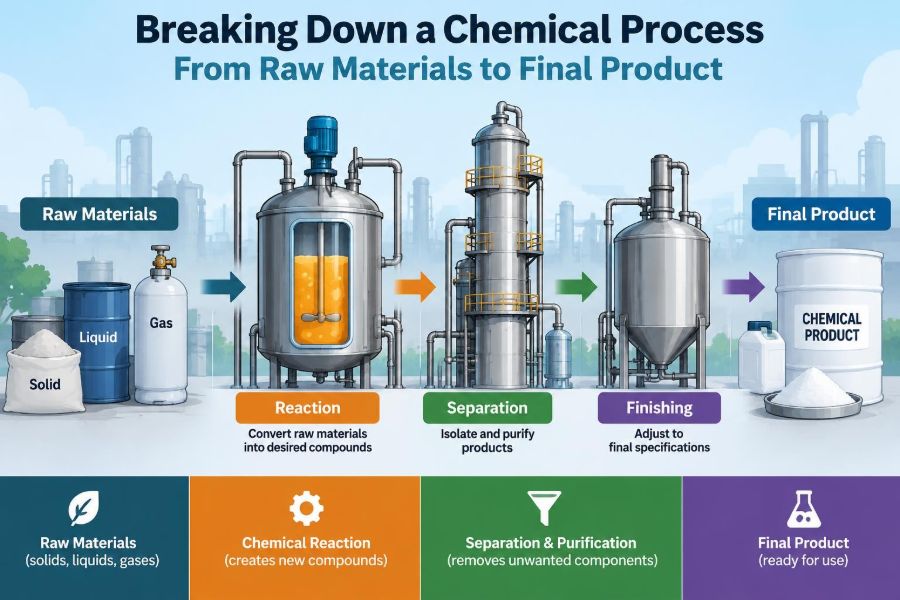
The product may be the visible result, but the process is the system that makes it reliably. Let’s follow that system from the moment materials arrive to the moment a final product leaves the site.
🧭 Start With the Product Specification
A chemical process is designed to make a product that meets a specification: a defined set of requirements for composition, purity, physical form, performance, and sometimes packaging. “Make ethanol,” for example, is incomplete. The customer may require a particular water content, low levels of specified contaminants, or a denatured grade unsuitable for consumption.
The specification determines much of the process route. A polymer customer may care about molecular-weight distribution and pellet moisture; a paint manufacturer may care about color, viscosity, and particle size. Engineers should begin by asking what the product must do, not merely what it is called.
🧱 Define the Process Boundaries
Before analyzing equipment, draw a boundary around the process. Inputs cross into that boundary as raw materials, utilities, packaging, and sometimes recycled streams. Products, emissions, wastewater, solid residues, and waste heat cross out.
This simple step prevents a common misunderstanding: treating an upstream or downstream operation as somebody else’s problem. A purchased feed may need storage and conditioning. A valuable product may still require blending, filling, and quality release before it can be sold.
🗺️ Read the Process as a Flow of Matter
A process flow diagram, or PFD, provides a high-level map of major equipment and streams. It shows where material enters, reacts, separates, recycles, and exits. It usually omits the detailed valves and instruments found on a piping and instrumentation diagram.
Follow each stream with four questions: What is in it? In what phase is it? Where does it go? Why does it go there? This approach turns a crowded drawing into a sequence of physical changes rather than a collection of symbols.
📦 Receive and Store Raw Materials
Raw materials arrive as gases, liquids, powders, crystals, slurries, or solids in bulk containers. Storage is not passive. Tanks may need nitrogen blanketing to limit oxidation or moisture pickup, while powders may require dry conditions and controlled unloading to avoid dust release.
Storage capacity also buffers supply interruptions and differences between delivery schedules and production rates. However, larger inventories increase working capital, potential degradation, and the consequences of a leak. The suitable storage time depends on material stability, demand variability, and safety requirements.
🔍 Verify Feed Quality Before Use
A raw material name does not guarantee a constant composition. A solvent can contain water; a mineral feed can vary in particle size and impurity level; a bio-based feed can change with season and source. Incoming sampling and testing establish whether a shipment fits the agreed acceptance limits.
Feed variation matters because impurities can consume reactants, poison catalysts, form unwanted by-products, or make separation harder. Testing is not simply a laboratory formality; it is an early control point that protects the entire process.
⚖️ Build a Material Balance
A material balance accounts for mass entering, leaving, accumulating, reacting, and being generated or consumed. For an overall steady-state process with no mass accumulation, the basic idea is straightforward: total mass in equals total mass out.
For individual chemical species, reactions must be included. A material balance exposes losses, clarifies recycle needs, and estimates product yield. It is also a powerful troubleshooting tool: if measured flows do not approximately balance, a meter, sample, assumption, or process condition may need examination.
🔥 Account for Energy and Utilities
Most plants transform energy as well as matter. Steam heats reboilers, cooling water removes heat, electricity drives pumps and compressors, and refrigeration supports low-temperature duties. An energy balance tracks these transfers.
Utilities are often treated as background services, but they can constrain production. Warm cooling water may reduce condenser performance; low steam pressure may limit evaporation; an electrical interruption can stop critical agitation. A viable process needs reliable utility capacity, not only correct chemistry.
🧹 Condition the Feed
Feed conditioning prepares material for the main conversion step. It may include filtration, drying, crushing, dissolving, heating, vaporization, pH adjustment, or removal of catalyst poisons. The aim is to supply a feed with properties the next operation can handle consistently.
Consider a liquid feed containing suspended solids before a fixed-bed catalyst. A filter can protect the catalyst bed from plugging. Skipping that apparently modest operation may shorten campaign length and create far more downtime than the filter costs.
🧪 Choose the Conversion Route
Conversion is the stage where desired molecules are created or transformed. It may be a chemical reaction, fermentation, polymerization, neutralization, electrochemical step, or extraction-based recovery rather than a reaction at all.
Route selection balances conversion, selectivity, feed availability, energy demand, equipment materials, safety, and waste generation. A route with high conversion is not automatically best if it makes a difficult-to-remove by-product or requires extreme operating conditions.
⚗️ Understand Reaction Stoichiometry and Selectivity
Stoichiometry describes the mole relationships imposed by a chemical equation. It indicates the theoretical amount of reactant needed and the maximum possible product from a given feed. Real plants must also consider excess reactant, side reactions, and incomplete conversion.
Selectivity describes how strongly the chemistry favors the desired product over undesired products. High selectivity can be more valuable than high conversion because unwanted compounds may consume feed and create expensive separation duties. Yield combines these ideas in a practical measure of useful product obtained.
🏭 Select the Right Reactor Environment
Reactors provide the environment in which conversion occurs: mixing, residence time, temperature, pressure, and contact between phases. A stirred tank suits many liquid reactions and offers relatively uniform conditions. A tubular reactor is often useful for continuous flow and can manage rapid reactions differently.
Gas-solid catalytic reactors, slurry reactors, and bioreactors each introduce their own transport challenges. The “right” reactor is not determined by reaction chemistry alone; heat removal, fouling tendency, scale, maintenance, and control needs matter too.
🌡️ Control Temperature, Pressure, and Residence Time
Operating variables influence both reaction rate and product distribution. Raising temperature often accelerates reactions, but it can also favor decomposition, increase vapor pressure, or create a faster heat release than the cooling system can remove.
Residence time is the average time material spends in a vessel or reactor. Too little may leave feed unreacted; too much may allow desired product to degrade. Pressure can shift phase behavior and affect equilibrium, especially in gas reactions.
🌀 Manage Mixing and Mass Transfer
Reactants must meet before they can react. In a liquid tank, poor agitation may create zones with different concentration or temperature. In gas-liquid systems, gas must dissolve into liquid; in gas-solid systems, molecules must reach active sites inside catalyst particles.
These limitations are called mass-transfer limitations. They can make a reaction appear slow even when its intrinsic chemistry is fast. Scale-up is particularly sensitive here: a laboratory stirrer does not automatically reproduce industrial mixing conditions.
♨️ Remove or Supply Reaction Heat Safely
Many reactions release heat, while others require continuous heating. Heat-transfer surfaces, jackets, coils, external exchangers, and staged feed addition help maintain the desired temperature.
An exothermic reaction needs special attention because rate and temperature can reinforce one another. If temperature rises, reaction may accelerate and release more heat. Good design considers normal control, loss of cooling, blocked outlets, emergency relief, and the safest response to abnormal conditions.
🧫 Protect and Regenerate Catalysts
Catalysts speed reactions without being consumed in the ideal chemical equation, but industrial catalysts can deactivate. Sulfur compounds, metals, water, coke deposits, sintering, or mechanical damage may reduce activity.
Protection begins upstream through feed treatment and careful operating limits. Some catalysts can be regenerated by removing deposits or restoring active sites; others require replacement. Catalyst management affects not only reaction performance but also shutdown planning, waste handling, and product consistency.
🔄 Separate Unreacted Material for Recycle
Leaving reactants in a reactor outlet is common, especially where equilibrium or selectivity limits full conversion. A downstream separator may recover these materials and return them to the reactor feed.
Recycle improves raw-material utilization, but it complicates control. Impurities and inert compounds can build up in the recycle loop, so plants often use a purge stream to remove a small portion. The purge sacrifices some valuable material to prevent a larger operating problem.
🧊 Separate Products From Mixtures
Reactor effluent is usually a mixture of product, unreacted feed, solvent, by-products, catalysts, and dissolved gases. Separation converts that mixture into useful streams by exploiting differences in volatility, solubility, density, particle size, charge, or affinity.
Separation can consume more energy and capital than the reaction itself. That is why process development should not optimize conversion in isolation: a new by-product may be chemically minor yet extremely difficult to separate from the desired product.
🌬️ Use Distillation, Absorption, and Stripping Wisely
Distillation separates volatile components through repeated vaporization and condensation. It is widely used, but its energy demand can be substantial when boiling points are close or large amounts of solvent are present.
Absorption transfers a gas component into a liquid, while stripping transfers a dissolved volatile component out of a liquid using gas or steam. These operations depend on phase equilibrium and contact area. Column pressure, solvent choice, and temperature can strongly affect performance.
🧲 Apply Mechanical and Membrane Separations
Filtration removes solids from fluids, centrifuges accelerate phase separation, and cyclones separate particles from gases. These methods often rely on particle size, density difference, or settling behavior rather than volatility.
Membranes can separate components selectively with lower thermal duty than evaporation in some applications. Their limitations include fouling, concentration polarization near the surface, pressure requirements, and eventual replacement. No separation technology is universally superior; the feed and target purity decide.
💎 Purify to the Required Grade
Purification is the final refinement needed to meet specification. It may involve crystallization, adsorption, ion exchange, polishing filtration, drying, or a final distillation step. The target is not necessarily maximum possible purity.
Over-purification wastes energy and product, while under-purification risks customer rejection or poor performance. The appropriate grade is defined by use. Industrial water, battery-grade chemicals, and pharmaceutical ingredients demand very different impurity controls.
🧪 Blend, Formulate, and Finish the Product
Some products reach value only after formulation. A lubricant may receive additives, a detergent may be blended with surfactants and fragrance, and a polymer melt may be extruded into pellets. These steps set practical properties such as viscosity, appearance, dissolution rate, or handling behavior.
Blending requires accurate dosing and good mixing. A small error in an additive can have an outsized effect, particularly when the additive controls color, stabilization, foaming, or final performance.
✅ Test Quality Throughout the Process
Quality assurance is not confined to a final sample. Plants use incoming checks, in-process measurements, laboratory analyses, and release testing. Some instruments measure variables continuously; others require a representative sample sent to a laboratory.
A final test can identify a bad batch, but earlier measurements can prevent one. For example, monitoring moisture before a sensitive operation may allow correction before material enters equipment where water would cause side reactions or processing difficulties.
📏 Distinguish Control Limits From Specifications
A product specification is a customer or internal acceptance requirement. A control limit is an operating range chosen to keep the process stable and likely to meet specification. They are related but not interchangeable.
If a quality result remains within specification but trends toward its edge, waiting for failure is poor practice. Process control should identify drift early, investigate the cause, and restore a robust operating margin.
🛡️ Design Safety Into Every Stage
Process safety addresses hazards with the potential for fires, toxic releases, explosions, pressure events, and other major consequences. It relies on multiple layers: inherently safer choices where possible, containment, alarms, interlocks, relief systems, procedures, training, and emergency preparedness.
Personal protective equipment remains necessary, but it is not the primary answer to a poorly controlled hazard. A sound approach asks what can be eliminated, substituted, minimized, or contained before relying on people to detect and avoid danger.
🌱 Treat Emissions, Water, and Solid Residues
Every process produces streams that need a destination. Off-gases may require recovery, scrubbing, adsorption, thermal treatment, or other controls. Wastewater may need neutralization, oil removal, biological treatment, or removal of dissolved contaminants before discharge or reuse.
Solid residues can include spent catalysts, filter cakes, salts, or contaminated packaging. Their handling depends on composition and applicable requirements. Waste prevention at the source is often preferable to adding a larger treatment system downstream.
♻️ Recover Value From By-products and Heat
A stream described as “waste” may contain recoverable solvent, fuel value, useful chemicals, or heat. Heat integration uses a hot stream to warm a cold stream, reducing utility demand while respecting temperature differences and operability.
Recovery has limits. Added exchangers can foul, recovery equipment costs money, and a by-product needs a stable use or disposal route. The best decision compares the full system, including reliability and environmental impact, rather than treating recovery as automatically beneficial.
📈 Measure Performance With the Right Metrics
Useful measures include yield, product purity, energy use per unit product, water use, waste generation, uptime, and rate of off-specification production. A single metric can mislead. Maximizing throughput may increase energy use or push a separator beyond its effective range.
Choose measures that reflect the actual objective and review trade-offs together. A process that produces slightly less per hour but runs steadily, safely, and within specification may outperform one with impressive short-term peaks and frequent disruptions.
🧰 Recognize Common Troubleshooting Patterns
When product quality changes, trace the process in the direction that fits the symptom. A sudden issue may point to a feed batch, instrument failure, or operating change. A gradual decline may suggest fouling, catalyst deactivation, heat-exchanger performance loss, or accumulation in a recycle loop.
- Compare current conditions with a stable reference period.
- Check data quality before explaining a trend with chemistry.
- Use material and energy balances to test possible causes.
- Change one well-justified variable at a time when safe and practical.
Quick fixes without a causal explanation can shift the problem elsewhere. Good troubleshooting documents what changed, what was observed, and what evidence ruled alternatives in or out.
👥 Connect Operations, Maintenance, and Engineering
A flowsheet becomes a real process through people who operate, maintain, sample, inspect, and improve it. Operators see day-to-day behavior; maintenance teams understand equipment condition; laboratory staff see quality patterns; engineers connect observations to process mechanisms.
Changes work best when these perspectives are brought together early. A theoretically efficient modification may be difficult to clean, impossible to maintain safely, or too sensitive to routine feed variation. Practical process design respects how equipment is actually used.
🔁 Use Change Management Rather Than Assumptions
Changing a raw-material supplier, control setting, equipment material, cleaning method, or software logic can alter hazards and product quality. Formal management of change evaluates these effects before implementation and ensures drawings, procedures, training, and safeguards remain appropriate.
The risk is not limited to large projects. Small, undocumented adjustments can accumulate until the plant no longer matches its design basis. Treating change as a technical and organizational process preserves knowledge as personnel and conditions evolve.
🧠 See the Process as One Connected System
The central lesson is that a chemical process is not a line of isolated unit operations. Feed quality affects reaction behavior; reaction behavior determines separation load; separation performance affects recycle composition; recycle composition influences the next reaction cycle.
Strong decisions follow material, energy, information, and risk across those connections. Engineers do not need to memorize every equipment detail at once. They need to ask clear questions, use balances and data, understand physical limits, and consider consequences beyond the nearest vessel.
From raw materials to final product, chemical engineering is the disciplined work of making interconnected transformations reliable, safe, economical, and fit for purpose. Once you can read a process as a connected story, diagrams, plant data, and operating problems become far easier to understand. 🧪⚙️🌱