
A plant buyer receives two quotations for the same solvent. One is attractive on paper; the other is higher, but promises a tighter specification, reliable delivery, and technical support. The decision is not really about choosing the lower number. It is about understanding what that number includes—and what it leaves exposed.
The same question appears throughout chemical engineering. Why does the cost of caustic soda shift even when demand seems steady? Why can a polymer grade cost far more than the underlying monomer? Why does a freight disruption suddenly affect a factory hundreds of kilometres from a port?
Industrial chemical prices influence process economics, product margins, capital decisions, inventory strategy, and even process design. For students, price formation turns abstract ideas such as energy balances, separation duties, and supply chains into practical engineering questions.
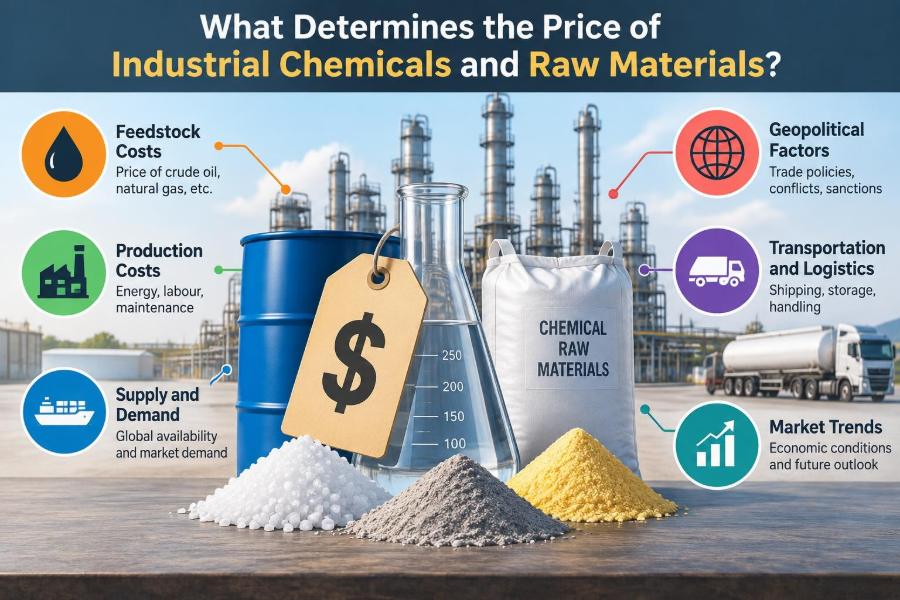
A chemical is never priced solely by its formula. Its market value reflects the feedstock it starts with, the energy and equipment required to make it, the quality expected, the route it travels, and the risks carried by everyone involved.
🧭 Price Is More Than the Supplier’s Quote
A quoted unit price is usually only one part of the total landed cost: the cost of having usable material available at the point and time of use. A low ex-works price may exclude packaging, transport, duties, insurance, unloading, storage, and losses in handling.
For a bulk commodity delivered by pipeline, these additions may be modest. For a corrosive reagent shipped in small drums to a remote site, they can be substantial. Comparing quotations without aligning delivery terms, quantity, specification, and payment conditions creates a misleading comparison.
🧪 Chemical Identity Sets the Starting Point
A molecule’s properties affect how difficult it is to produce, contain, and transport. Gases may require compression or liquefaction. Reactive monomers may need inhibitors and temperature control. Hazardous oxidizers demand compatible equipment and stricter handling procedures.
Two chemicals with similar molecular weights can therefore have very different costs. Molecular complexity matters, but so do volatility, corrosivity, toxicity, flammability, purity requirements, and stability. Chemistry sets the engineering problem that the supply chain must solve.
⛏️ Feedstock Costs Anchor Many Markets
Most industrial chemicals begin with a smaller set of upstream materials: natural gas, crude-oil fractions, coal-derived intermediates, salt, sulfur, limestone, biomass, air, and water. When a major feedstock becomes more expensive, downstream producers often face pressure to raise prices.
The connection is not always immediate or one-to-one. A producer may have inventory, long-term feedstock contracts, or integrated operations. Still, feedstock cost is often the main economic anchor for commodity chemicals.
🛢️ Crude Oil, Gas, and Petrochemical Links
Naphtha, ethane, propane, and other hydrocarbon streams feed crackers and reformers that produce key building blocks such as ethylene, propylene, benzene, and synthesis gas. These intermediates then flow into plastics, solvents, fibers, surfactants, and many other products.
Different regions can have different cost positions because their available feedstocks differ. An ethane-based cracking route and a naphtha-based route do not yield the same product mix, so changes in energy and co-product values can affect each route differently.
⚡ Energy Is Both a Utility and a Raw Material
Electricity, fuel, steam, refrigeration, and compressed air all add to manufacturing cost. Their importance varies sharply by process. Chlor-alkali production, for example, uses electrolysis and is particularly sensitive to electricity economics, while ammonia production depends heavily on natural gas as both fuel and hydrogen source.
Energy prices also affect mining, pumping, drying, distillation, and freight. A rise in energy cost can therefore move through several stages of a chemical value chain rather than appearing in one obvious line item.
🏭 Process Yield Determines Material Efficiency
Yield is the fraction of theoretical or input material that becomes the desired product. Lower yield means more feedstock is needed per tonne of saleable chemical, while unreacted material, by-products, and waste require recovery or treatment.
Selectivity matters too. A reaction can convert a large fraction of feed but still form too much unwanted product. Catalysts, operating conditions, and separation design all influence how much value is extracted from each unit of feedstock.
🔬 Separation Often Carries the Hidden Cost
Making a mixture is frequently easier than producing a specification-grade chemical. Distillation, crystallization, extraction, adsorption, filtration, drying, and membrane systems consume energy, equipment capacity, and operating attention.
Purifying close-boiling compounds or removing trace contaminants can be especially demanding. A higher-purity grade is not merely “the same product with less impurity”; it may require additional process stages, more careful storage, and more analytical verification.
📏 Grade, Purity, and Specification Create Different Products
Technical, industrial, food, pharmaceutical, electronic, and laboratory grades may share a chemical name but should not be treated as interchangeable. The allowable levels of water, metals, color, particles, residual solvents, and other impurities can differ greatly.
A specification also includes physical properties such as viscosity, particle-size distribution, pH, density, or assay. Tight limits reduce the material a producer can classify as on-specification, which can raise cost even when the chemistry itself is unchanged.
🧫 Quality Control Has a Real Economic Value
Sampling plans, retained samples, certificates of analysis, calibrated instruments, traceability, and batch-release procedures require people and systems. For critical applications, customers are paying partly for confidence that each delivery will perform consistently.
The value of this confidence depends on the consequence of failure. A minor variation in a cleaning formulation may be manageable. The same variation in a semiconductor process, coating line, or regulated manufacturing operation can cause costly rejects or downtime.
📦 Scale Changes the Cost Per Unit
Large continuous plants generally spread fixed costs—control rooms, laboratories, maintenance teams, permits, and depreciation—over more tonnes. This is one reason many commodity chemicals are made in large facilities near feedstocks, utilities, or transport hubs.
However, scale is not an automatic advantage at every level. Specialty chemicals may be made in smaller campaigns because demand is limited, recipes change, or equipment must be cleaned between products. Small lots usually carry more setup and scheduling cost per kilogram.
🔄 Plant Utilization Influences Market Pressure
A plant operating well below its practical capacity still carries many fixed expenses. Producers may accept lower margins to keep material moving, provided the selling price covers enough variable cost and supports broader commercial objectives.
Conversely, when operating rates are high and spare capacity is limited, buyers have fewer alternatives. Prices can strengthen before a shortage is physically visible because the market anticipates difficulty replacing an interrupted supply.
🧰 Maintenance, Reliability, and Unplanned Outages
Turnarounds are planned shutdowns for inspection, cleaning, repair, and upgrades. They temporarily reduce supply but can improve long-term reliability. Unplanned outages are more disruptive because customers and logistics networks have less time to prepare.
For chemicals with few producers or limited storage life, an outage can affect pricing beyond the site where it occurs. Buyers may seek substitute grades, draw down inventories, or compete for output from other regions.
🌊 Supply and Demand Set the Market Balance
Cost explains why a producer needs a certain price over time; supply and demand help explain why the market price can move above or below that level in the short term. Demand rises with construction, manufacturing, agriculture, consumer goods, and many other activities.
Supply responds more slowly when new capacity needs permits, engineering, equipment, and commissioning. This lag is why chemical markets can alternate between oversupply, where competition is intense, and tightness, where available tonnes command a premium.
🧱 The Value Chain Shares Margins Unevenly
A raw material passes through several businesses: extractor or refiner, chemical producer, distributor, transporter, packager, and sometimes a formulator. Each performs work, takes risk, and requires a margin to remain viable.
The share captured at each stage is not fixed. A scarce intermediate with few producers may have strong pricing power, while a widely available solvent may compete mainly on logistics and service. Market structure matters as much as molecule complexity.
⚖️ Commodity Chemicals and Specialty Chemicals
Commodity chemicals are generally standardized, high-volume materials traded against broad market conditions. Specialty chemicals are often sold for a particular function, performance target, or customer application. The boundary is not perfect, but it is economically useful.
| Feature | Commodity chemical | Specialty chemical |
|---|---|---|
| Primary basis of competition | Cost, availability, logistics | Performance, consistency, application support |
| Typical purchase volume | Large and recurring | Often smaller or application-specific |
| Price sensitivity | Often closely linked to market supply | May reflect value delivered to the customer |
| Switching difficulty | Lower when specifications match | Higher after qualification and formulation work |
Specialty pricing is not arbitrary. It often reflects development work, controlled production, testing, technical service, and the cost of maintaining reliable performance.
🚚 Logistics Can Outweigh the Factory Gate Price
Transport mode depends on volume, hazard, distance, and infrastructure. Pipelines suit certain continuous bulk flows; railcars, tank trucks, isotanks, ships, drums, and intermediate bulk containers serve different needs.
Freight cost is especially influential for low-value, bulky materials such as mineral products or dilute solutions. A nearby producer with a higher factory price can be cheaper overall than a distant supplier once transport, lead time, and unloading requirements are included.
🛳️ Geography and Trade Routes Matter
Coastal locations can access import and export markets efficiently, while inland sites may depend on rail or road links. A region with local feedstock but poor export access may price differently from one connected to major ports and industrial clusters.
Exchange rates, shipping availability, port congestion, border procedures, and trade measures can also change the delivered competitiveness of imported material. These effects vary by contract and country, so broad market headlines do not always predict a specific buyer’s invoice.
🛡️ Hazard Classification Raises Handling Costs
Dangerous goods may need approved packaging, trained carriers, documented shipments, segregation from incompatible materials, and emergency-response planning. Temperature-sensitive or highly pure chemicals can require additional controls even if they are not classified as highly hazardous.
These safeguards are not optional “extras.” They are part of delivering a chemical safely and legally. A purchasing decision that ignores them may simply move cost and risk from the supplier’s quote to the customer’s operation.
🏷️ Packaging Is a Design and Cost Decision
Bulk delivery minimizes packaging per kilogram, but it requires suitable receiving tanks, transfer equipment, cleaning procedures, and enough consumption to avoid long storage. Drums and smaller containers offer flexibility, though packaging, filling, inspection, and waste handling increase cost.
Packaging also protects quality. Moisture-sensitive powders, oxygen-sensitive reagents, and volatile liquids may need liners, seals, inert headspace, or specialized containers. The cheapest package can be expensive if it leads to contamination or unusable remnants.
🗃️ Inventory Carries Cost, Risk, and Insurance Value
Holding stock ties up working capital and requires storage space, inspection, and sometimes refrigeration, nitrogen blanketing, or fire protection. Materials can degrade, settle, absorb moisture, or reach their retest date before use.
Yet inventory provides resilience. A manufacturer that relies on one difficult-to-replace reagent may intentionally hold more safety stock than a simple financial model suggests. The right level balances the cost of storage against the cost of a production stoppage.
📜 Contracts Change How Price Volatility Is Shared
Spot purchases reflect current market conditions and can be useful when demand is uncertain or supply is abundant. Longer agreements may provide volume commitments, allocation rights, formula-based adjustments, or clearer planning assumptions.
A contract does not remove market risk; it allocates it. A price formula might reference a feedstock, an energy index, freight component, or currency movement. Both parties should understand the formula, timing, quality terms, and exceptional-event provisions before relying on it.
💱 Currency, Credit, and Payment Terms Affect the Real Price
An imported chemical may be quoted in a foreign currency, exposing buyer and seller to exchange-rate movement. Payment terms also have value: paying before shipment, at delivery, or after a credit period changes financing needs and risk.
Supplier creditworthiness matters during tight markets. A producer may prefer customers with reliable payment histories, while buyers need confidence that prepaid or contracted volumes will be delivered. The commercial terms around a transaction can be as meaningful as the listed price.
♻️ Regulation, Emissions, and Waste Management
Environmental controls can add costs for emissions treatment, wastewater management, waste disposal, monitoring, and reporting. These requirements can also affect which process routes are viable and where new plants are built.
Compliance cost is not identical everywhere, and it can change over time. At the same time, regulations may reduce certain external harms that would otherwise be shifted to communities or ecosystems. A fair cost comparison should recognize both the expense and the purpose of responsible operation.
🌱 Carbon Intensity Is Becoming a Commercial Variable
Some customers now ask for product carbon-footprint information or favor lower-emission supply routes. Electricity source, feedstock origin, process efficiency, transport distance, and allocation methods can all influence a reported footprint.
These comparisons need care. Different accounting boundaries and assumptions can produce different results for the same product. Lower-carbon material may command a premium in some markets, but buyers should ask what methodology supports the claim rather than treating labels as directly comparable.
🔁 Co-Products Can Support—or Distort—Economics
Many processes create more than one valuable output. Chlor-alkali operations produce chlorine, caustic soda, and hydrogen; cracking produces a range of olefins and co-products. Revenue from one stream can influence the acceptable price of another.
This creates an important complication: a chemical’s price may move because of demand for a related product. Engineers evaluating a process should avoid assuming that all output value belongs to the headline product alone.
🧩 Substitutes Put Limits on Pricing Power
Customers may switch solvent, resin, catalyst, packaging form, supplier region, or process conditions when a material becomes too costly or unreliable. Substitution is easier when the chemical is standardized and harder when it has been extensively qualified in a sensitive formulation.
A substitute rarely has to be identical. It only needs to meet the application’s critical requirements at an acceptable total cost and risk. Qualification time, safety review, regulatory implications, and rework costs determine whether a theoretical substitute is commercially realistic.
🧠 Product Value Can Exceed Input Cost
For specialty ingredients, a small dose may improve coating durability, manufacturing yield, battery performance, or product shelf life. In those cases, customers often assess cost per unit of performance rather than cost per kilogram alone.
This does not mean price is disconnected from cost. It means the supplier’s value proposition includes formulation know-how, consistency, application testing, and troubleshooting. Engineers should distinguish a high price from a high cost of use; the two are not necessarily the same.
🧾 Read Quotations on a Like-for-Like Basis
Before comparing suppliers, normalize the offer. Confirm the exact grade, concentration, delivery basis, package, minimum order quantity, lead time, validity period, and whether freight or surcharges are included.
- Calculate price per unit of active component when concentrations differ.
- Include expected unloading, storage, disposal, and quality-testing costs.
- Check batch size and annual volume assumptions behind the quote.
- Ask how price changes will be communicated and calculated.
A 50% solution and a 99% solid may have the same chemical name but are not comparable on a simple price-per-kilogram basis.
🔍 Evaluate Supplier Reliability Alongside Price
Supplier assessment should include manufacturing location, approved production capacity, quality history, technical response, emergency communication, and contingency arrangements. For critical raw materials, dual sourcing or qualified alternatives may be worth the effort.
The goal is not to select the most elaborate supplier for every purchase. It is to match the level of supply assurance to the consequence of interruption. A low-cost source may be suitable for a noncritical consumable and unsuitable for a material that stops an entire plant.
⚠️ Common Mistakes in Chemical Cost Comparisons
One common mistake is treating a market index as the final purchase price. Indices can be useful signals, but they may not reflect a particular grade, location, package, or contract structure.
Another is overlooking losses. Material left in drums, damaged during storage, rejected for specification, or consumed in cleaning lines raises effective cost. The final mistake is assuming past price behavior will continue unchanged; markets react to new capacity, demand patterns, regulations, and disruptions.
🧮 A Simple Total-Cost Example
Consider a hypothetical buyer choosing between two offers for a liquid additive. Supplier A has the lower price per kilogram but ships small containers from far away. Supplier B charges more at the plant gate but delivers bulk locally.
Supplier A may still win if usage is low and bulk storage would be underused. Supplier B may win when freight, packaging disposal, handling time, residual material, and reduced delivery risk are counted. The correct conclusion depends on the buyer’s process and consumption pattern, not on the first number shown.
🏗️ Process Design Decisions Can Lock In Future Cost
During design, engineers choose feedstock flexibility, utility integration, storage capacity, purification targets, equipment materials, and transport connections. Each choice affects operating cost and exposure to future market changes.
A plant designed for only one feedstock may operate efficiently under normal conditions but have less resilience when that feedstock becomes scarce. Flexibility costs capital, so it should be justified by realistic risk scenarios rather than added automatically.
📈 Build Better Price Forecasts With Scenarios
Forecasting should not pretend to identify one certain future price. A more useful approach is to create scenarios: stable feedstock conditions, higher energy costs, a logistics interruption, new capacity entering the market, or lower demand from a major downstream sector.
For each scenario, identify the most sensitive variables and the operational response. This helps procurement and engineering teams plan inventory, contract timing, alternative grades, and project economics without claiming false precision.
🤝 Procurement and Engineering Need Shared Language
Procurement teams understand supplier markets and contractual exposure; engineers understand specification limits, process consequences, and substitution risk. Better decisions occur when these perspectives meet early rather than after a price increase or supply failure.
An engineer can explain which impurity limit is truly critical and which is unnecessarily restrictive. A buyer can show the commercial cost of that requirement. Together, they may find a lower-cost acceptable grade—or confirm that the tighter specification protects far greater value.
🎯 The Core Principle: Price Reflects a System
Industrial chemical pricing is the visible result of an interconnected system: feedstocks, energy, conversion yield, separation, quality, capacity, logistics, regulation, financing, and customer value. No single factor explains every movement.
The most useful question is therefore not “Why did the price change?” in isolation. Ask which part of the system changed, how quickly that effect reaches the delivered product, and whether the change affects cost, availability, quality, or all three.
The best chemical purchasing and engineering decisions are based on total value and total risk, not the lowest quoted price alone. When teams understand the full system behind a material, they can make choices that are more resilient, technically sound, and economically realistic. 🧪🚚📊