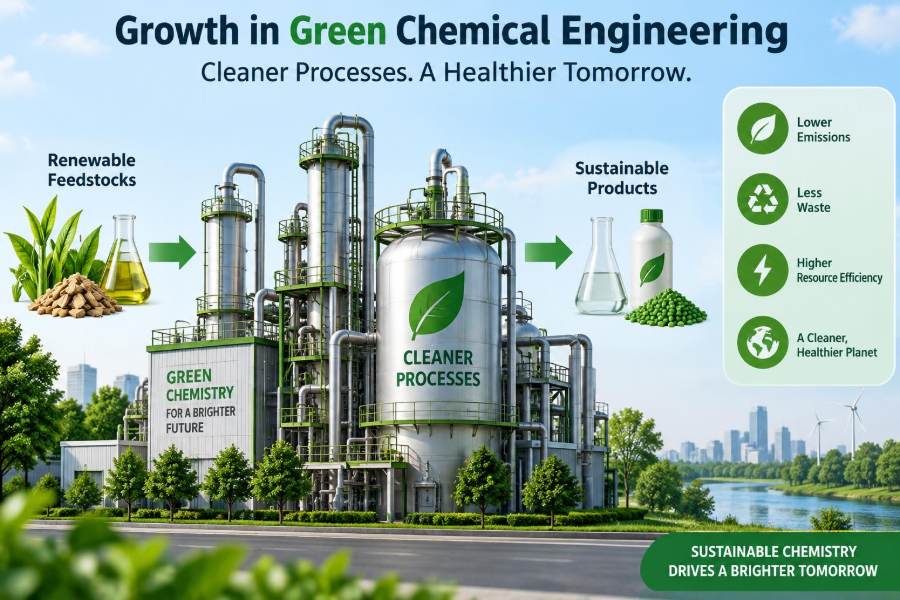

A shampoo bottle, a carton of paint, a package of medicine, and the fuel used to deliver them may look unrelated. Behind each is a chain of chemical decisions: what feedstocks to use, which reactions to run, how much heat to supply, and what happens to every stream leaving the plant.
For a long time, process design was judged mainly by throughput, product quality, reliability, and cost. Those priorities still matter. But engineers are increasingly asked a wider question: can the same useful product be made with less waste, lower energy demand, safer materials, and a smaller environmental burden?
That question is driving growth in green chemical engineering. It is not a separate branch concerned only with recycling bins or renewable labels. It is a practical design approach that changes reaction routes, separations, utilities, supply chains, and decisions made long before construction starts.
The momentum comes from a simple reality: inefficient use of atoms, heat, water, and materials creates costs as well as impacts. Cleaner processes can reduce both, although they also introduce real trade-offs that engineers must evaluate carefully.
🌱 What Green Chemical Engineering Means
Green chemical engineering applies chemistry and engineering to prevent pollution and resource losses at their source. It aims to deliver a required product or service while reducing hazards, emissions, waste, and lifecycle impacts.
It overlaps with green chemistry, but the scale is different. Green chemistry focuses strongly on molecular design and reaction choices; chemical engineering turns those choices into safe, controllable, economical systems operating at industrial scale.
🔄 Prevention Is Better Than Cleanup
A traditional plant may treat contaminated water after it is produced or capture pollutants after a reaction. Those controls are often necessary, but they consume equipment, energy, chemicals, and operating attention.
Prevention asks whether the unwanted stream can be avoided in the first place. A catalytic reaction that produces less salt waste, for example, is usually preferable to making large quantities of salt and then treating the resulting wastewater.
⚖️ The Triple Constraint: Performance, Cost, and Impact
No responsible engineer evaluates a greener option using a single metric. A solvent substitution may reduce toxicity but require more energy to recover. A bio-based feedstock may be renewable yet difficult to transport or seasonally variable.
The task is to compare options across product specifications, safety, capital cost, operating cost, reliability, and environmental consequences. Green design is therefore a discipline of better trade-offs, not a search for a universally perfect process.
🧭 Why Momentum Is Building Now
Several forces are moving in the same direction. Companies face pressure to manage energy exposure, waste-disposal costs, water availability, customer requirements, and changing environmental expectations.
At the same time, better catalysts, sensors, computational tools, electrified equipment, and renewable-energy systems are expanding what is technically feasible. The result is not that every facility can change overnight; it is that cleaner options are entering mainstream process decisions more often.
🧱 Feedstocks Shape the Whole Process
The environmental profile of a product begins before the first reactor. Conventional fossil feedstocks remain important because they are energy-dense, well characterized, and supported by extensive infrastructure. Their extraction and conversion, however, can carry significant greenhouse-gas and environmental burdens.
Alternative carbon sources include biomass residues, recycled plastics, captured carbon dioxide, and waste-derived gases. Each must be assessed for availability, contaminants, collection logistics, competing uses, and the energy needed for conversion.
🌾 Renewable Does Not Automatically Mean Sustainable
A material described as renewable is replenished on human timescales, but that label alone does not settle its sustainability. Growing or collecting it may require land, water, fertilizer, energy, and transport.
For example, using agricultural residues can sound attractive, but removing too much residue from fields may affect soil management. Engineers need to ask what resource is displaced, what inputs are required, and whether the supply can remain dependable at the intended scale.
🧬 Better Catalysts Improve Atom Efficiency
A catalyst speeds a reaction without being consumed in the idealized reaction cycle. In practice, catalyst selection can determine conversion, selectivity, temperature, pressure, separation difficulty, and by-product formation.
Selectivity describes how much of the consumed reactant becomes the desired product rather than unwanted products. A more selective catalytic route can reduce raw-material use and downstream purification because fewer unwanted molecules must be separated or destroyed.
🧪 Atom Economy Looks Inside the Reaction
Yield tells us how much desired product is obtained relative to the theoretical amount. Atom economy asks a complementary question: how many reactant atoms are incorporated into that product?
Reactions that produce large stoichiometric by-products can have a poor atom economy even when yield is high. This distinction helps engineers identify routes where waste is built into the chemistry rather than caused only by poor plant operation.
💧 Solvents Deserve Special Attention
Solvents dissolve, extract, wash, carry heat, and control viscosity. They are useful, but their volumes can exceed those of the desired product in some batch operations, making them a major source of emissions, waste, exposure risk, and recovery energy.
A greener strategy may eliminate a solvent, use a less hazardous alternative, increase recycling, or redesign the route so separation needs decline. The best choice depends on flammability, toxicity, material compatibility, recoverability, and process performance—not simply on whether a solvent has a “green” reputation.
🔥 Energy Use Is Often the Largest Lever
Heating, cooling, compression, pumping, distillation, drying, and refrigeration all require utilities. In many chemical plants, energy-related emissions dominate the operating footprint, especially where steam or electricity is generated from carbon-intensive sources.
Reducing demand is usually the first priority. Better heat recovery, lower-pressure operation, intensified separations, insulation, and improved control can cut utility use before a plant considers switching to lower-carbon energy supplies.
♨️ Heat Integration Finds Value in Hot Streams
One process stream often needs cooling while another needs heating. Heat integration matches these duties through heat exchangers, reducing the amount of external steam and cooling utility required.
Pinch analysis is a structured method for identifying realistic heat-recovery opportunities across a process. It does not eliminate every utility demand, because temperatures, fouling, controllability, and equipment layout impose limits, but it can reveal losses hidden in a flowsheet.
🏭 Distillation Is Effective but Energy-Hungry
Distillation separates substances using volatility differences and is exceptionally well established. It can also consume large amounts of heat, particularly when components have close boiling points or form azeotropes, mixtures that resist simple separation.
Alternatives may include membranes, adsorption, crystallization, extraction, or hybrid systems. None is automatically superior: membranes can foul, adsorbents need regeneration, and new equipment may be difficult to retrofit. The useful question is which combination meets purity and reliability targets with the lowest overall burden.
🧩 Process Intensification Shrinks the System
Process intensification seeks to achieve the same processing duty in less equipment, less space, or fewer steps. Examples include reactive distillation, where reaction and separation occur together, and compact heat exchangers with high heat-transfer area.
Fewer units can mean lower inventory, reduced heat loss, and simpler piping. However, highly integrated equipment can be harder to clean, maintain, control, or scale up. Simplification on a diagram should never be mistaken for simpler plant operation.
💦 Water Stewardship Goes Beyond Using Less
Water is used for cooling, steam generation, washing, reaction, and pollution control. A plant can reduce its intake yet still create difficult wastewater if contaminants become more concentrated.
Good water management maps quality as well as quantity. High-purity water should not be used where lower-quality reclaimed water is suitable, while streams containing incompatible contaminants should not be mixed merely because they are all called wastewater.
🗑️ Waste Is a Design Signal
Waste generation often indicates unused material value, incomplete conversion, excessive dilution, or a separation problem. Treating waste as an unavoidable end-of-pipe issue can hide opportunities upstream.
Engineers commonly use a hierarchy: prevent waste, reduce it, reuse it where safe, recycle or recover value, then treat and dispose of what remains. This hierarchy does not excuse unsafe reuse; quality control and contamination risks remain decisive.
🌬️ Emissions Need More Than a Carbon Lens
Climate impact matters, but it is not the only environmental concern. Volatile organic compounds, acid-forming gases, particulate emissions, persistent substances, and toxic releases can affect workers, communities, ecosystems, and local air quality.
A modification that lowers greenhouse-gas emissions but increases a hazardous air pollutant is not automatically an improvement. Multi-criteria assessment helps prevent one impact from being shifted to another place or category.
🧮 Life Cycle Thinking Prevents Burden Shifting
Life cycle assessment, often shortened to LCA, examines impacts associated with stages such as raw-material extraction, transport, manufacturing, use, and end-of-life. Its boundaries and assumptions strongly influence the result.
Consider a hypothetical lightweight package. It may use less material than a heavier alternative, but its recycling pathway could be more difficult. LCA does not supply an automatic answer; it makes the assumptions, data gaps, and trade-offs visible enough to discuss.
📏 Choosing the Right Metrics
Useful metrics translate broad goals into operating decisions. Examples include energy per unit product, water withdrawal per unit product, waste intensity, solvent recovery rate, product yield, and emissions per functional unit.
Metrics should be normalized sensibly. Comparing annual energy use without accounting for production volume can mislead, while focusing only on intensity can obscure a large increase in total production. Use both where relevant.
📊 A Practical Comparison Framework
| Question | What it reveals | Common blind spot |
|---|---|---|
| What enters the process? | Feedstock, solvent, water, and utility demands | Ignoring upstream extraction or purification |
| What leaves the process? | Product, by-products, emissions, and wastewater | Counting only regulated wastes |
| What energy is required? | Heating, cooling, compression, and separation loads | Assuming electricity has the same impact everywhere |
| Can it run reliably? | Safety, controllability, maintenance, and quality | Overlooking scale-up and fouling |
| What happens after use? | Reuse, recycling, degradation, or disposal pathways | Assuming a theoretical recycling route exists in practice |
🔁 Circularity Means Designing for Another Use
A circular approach keeps materials useful for longer through reuse, repair, recycling, recovery, or conversion into new feedstocks. Chemical engineers contribute by designing products that can be separated, depolymerized, purified, or processed without unacceptable quality loss.
Recycling is not a single technology. Mechanical recycling retains polymer structure but needs relatively clean streams; chemical recycling converts materials into smaller molecules or feedstocks and can require substantial energy. Appropriate routes depend on material quality and local collection systems.
🧱 Product Design Affects Plant Design
Choices made by product developers can simplify or complicate every downstream stage. Multi-material structures, strongly bonded additives, and difficult-to-identify formulations may perform well in use while creating serious end-of-life separation challenges.
Early collaboration between chemists, process engineers, product teams, and recycling specialists can avoid locking in a design that is efficient to manufacture but impractical to recover.
⚡ Electrification Changes the Utility Conversation
Some thermal duties can be supplied by electric boilers, heat pumps, resistance heating, or other electrically driven equipment. If electricity is low-carbon and reliably available, electrification can reduce combustion-related emissions.
Its suitability depends on temperature level, power capacity, local grid conditions, economics, and operational flexibility. A high-temperature continuous process may require a different solution than a low-temperature batch heating duty.
🖥️ Digital Tools Make Losses Visible
Mass balances, energy balances, process simulation, and plant data historians help engineers locate losses that are difficult to see from the control room. Advanced monitoring can identify fouling, steam leaks, off-spec production, or abnormal energy use earlier.
A digital twin is a model connected, to varying degrees, with real operating data. It can support scenario testing, but its recommendations are only as dependable as its assumptions, measurements, and validation.
🛡️ Safety Cannot Be Traded Away
Replacing a solvent or changing reaction conditions can alter flammability, pressure behavior, corrosion, runaway-reaction potential, and exposure routes. A lower environmental impact does not make a process safe by default.
Changes require disciplined management of change, hazard identification, relief-system review, materials compatibility checks, and operator training. The most sustainable design protects people as well as resources.
🏗️ Retrofitting Existing Plants Is Different from Starting Fresh
New facilities can incorporate heat integration, modular equipment, and alternative utilities from the earliest design stages. Existing plants must work around installed piping, plot space, production schedules, legacy controls, and investment constraints.
That does not make improvement impossible. Steam-trap maintenance, heat-exchanger cleaning, solvent recovery upgrades, variable-speed drives, and better operating procedures can provide meaningful gains with less disruption than a complete rebuild.
💰 Economics Decide Whether Good Ideas Spread
Environmental benefits alone may not justify a project in a competitive operation. Engineers need to express how a proposed change affects raw-material losses, utility bills, waste handling, downtime, product quality, compliance exposure, and capital requirements.
Payback calculations are useful but incomplete for long-lived assets. Sensitivity analysis can show whether a project remains attractive when energy prices, throughput, feedstock availability, or carbon-related costs change.
📜 Regulations and Customers Influence Design Choices
Permits, emissions limits, chemical restrictions, reporting requirements, and product specifications shape engineering priorities. Requirements vary by location and sector, so project teams must use current, site-specific information rather than broad assumptions.
Customers can also influence change by requesting lower-impact materials, recycled content, safer formulations, or clearer environmental data. These demands create opportunities, but claims must be supported by defensible boundaries and evidence.
🚫 Common Greenwashing Traps
Calling a process green because it uses one renewable input, recycles one stream, or has a lower visible waste volume can be misleading. A credible assessment considers the relevant system, not only the most favorable feature.
- Do not confuse a lower impact in one category with lower impact overall.
- Do not claim recyclability when collection and processing are unavailable for the intended market.
- Do not omit energy, transport, or disposal from comparisons without stating the boundary.
- Do not present pilot-scale results as proof of full-scale performance.
🧑🔬 Skills Students and Professionals Need
Green chemical engineering rewards strong fundamentals. Stoichiometry, thermodynamics, transport phenomena, reaction engineering, separations, process control, safety, and economics remain essential because sustainable choices are built from these tools.
Professionals also benefit from life-cycle thinking, data literacy, communication across disciplines, and the ability to state uncertainty clearly. The goal is not to memorize labels for technologies, but to ask sharper questions about system behavior.
🧰 Starting a Cleaner-Process Project
A useful first step is to define the problem precisely: excessive steam use, a hazardous solvent, difficult wastewater, yield loss, or an unstable feedstock. Broad ambitions become manageable when linked to a measurable process condition.
- Map mass, energy, water, and waste flows for the current operation.
- Identify the largest losses and the constraints that cause them.
- Generate options that prevent loss before considering treatment.
- Screen options for safety, quality, operability, cost, and lifecycle effects.
- Test promising ideas at an appropriate scale and monitor actual performance.
🔍 Pilot Results Need Careful Scale-Up
A lab reaction may use excellent mixing, pure feedstocks, and frequent manual attention. Industrial equipment must handle impurities, variable flow, heat removal, catalyst aging, maintenance, and continuous quality requirements.
Scale-up should therefore include realistic feed conditions and a plan for upset scenarios. A technically elegant result that cannot be controlled safely at production scale is not yet a viable green process.
🤝 Collaboration Makes Better Systems
Cleaner production rarely comes from one department working alone. Process engineers may identify heat recovery, chemists may improve selectivity, maintenance teams may detect leaks, procurement may qualify a new feedstock, and operators may know where a process actually loses time and material.
Listening across these roles improves both feasibility and adoption. It also reduces the risk of optimizing one unit while unintentionally causing problems elsewhere in the plant.
🌍 The Core Principle: Design Out the Burden
The deepest lesson is straightforward: the most effective environmental improvement is often made before waste, emissions, or excessive energy demand ever occur. It is embedded in reaction pathways, equipment selection, operating conditions, product design, and the boundaries used to judge success.
Green chemical engineering is gaining momentum because it connects environmental responsibility with the everyday work of making processes more efficient, resilient, and safe. It does not promise effortless solutions, but it gives engineers a rigorous way to make progress without hiding the trade-offs.
Cleaner chemical processes gain lasting value when they prevent problems at the source while still meeting the real demands of safety, performance, scale, and cost. That is the practical standard that turns a promising idea into credible engineering. 🌱🧪⚙️