
A chemical engineering student may picture the career as a row of reactors, distillation columns, and hard hats. Then a job board presents a far less tidy question: why do two roles with the same title have such different pay, schedules, and advancement paths?
A working engineer can face the same puzzle later. A stable manufacturing role may offer deep operational experience, while a position in a newer technology area may promise faster technical growth but carry more uncertainty. Neither choice is automatically better.
Salary is not simply a reward for having a chemical engineering degree. It reflects the economic value of the problem being solved, the consequences of mistakes, the work location, the skills that are scarce, and the conditions an employer needs someone to accept.
Understanding those forces makes career decisions more practical. It helps students choose electives and internships with purpose, and helps professionals compare opportunities beyond the number in an offer letter.
🧭 Start With What “Chemical Engineer Salary” Actually Means
Salary discussions often mix together base pay, overtime, annual bonuses, shift premiums, stock or long-term incentives, retirement contributions, and relocation support. Two jobs with identical base salaries can produce very different total compensation.
For a fair comparison, separate guaranteed pay from compensation that depends on plant performance, company profitability, market conditions, or staying with an employer for several years. Also consider hours worked: a higher salary attached to frequent nights, turnaround work, or extensive travel is not directly comparable with a predictable weekday role.
📍 Location Changes Both Pay and Purchasing Power
Chemical plants, refineries, mines, and large pharmaceutical sites are often concentrated in particular industrial regions. Employers in remote areas, high-cost metropolitan areas, or locations with difficult weather may pay more to attract and retain qualified people.
That premium does not always mean a better financial outcome. Housing, commuting, state and local taxes, insurance, and a partner’s career options can change the value of an offer. A sensible comparison asks what remains after living costs, not only which figure is largest.
🏭 Industry Economics Set the Ceiling
Industries with expensive assets, high product margins, strict reliability needs, or severe safety consequences often have more financial room for experienced engineers. A small process improvement at a large continuous plant can affect a significant amount of production.
Conversely, a business making lower-margin commodity products may operate under tighter cost pressure even when the engineering is demanding. Pay can still be solid, but advancement may depend more strongly on supervising operations or moving into commercial responsibilities.
⚙️ Process Engineering Remains the Broadest Route
Process engineers design, troubleshoot, optimize, and safely operate systems that transform raw materials into products. They may calculate material and energy balances, develop process flow diagrams, select equipment, support hazard reviews, and investigate process upsets.
This is one of the most transferable specializations because every process industry needs it. The strongest opportunities usually go to engineers who can connect simulation and design work with what actually happens on a plant floor: fouling, control limitations, maintenance constraints, and operator workload.
🛢️ Oil, Gas, Refining, and Petrochemicals Offer High-Stakes Work
Refineries, gas-processing facilities, and petrochemical complexes involve large equipment, continuous operation, combustible materials, and high production rates. Engineers may specialize in process units, technical services, reliability, capital projects, or process safety.
Compensation can be attractive where operations are profitable and expertise is hard to replace. The trade-offs may include coastal or remote sites, on-call responsibilities, turnaround periods, and exposure to commodity-market cycles. Demand for petroleum-related skills can shift as investment plans and energy policy evolve.
💊 Pharmaceuticals Reward Control and Documentation
Pharmaceutical manufacturing needs chemical engineers in process development, scale-up, validation, facilities engineering, drug-product manufacturing, and quality-related technical roles. The work is shaped by regulated practices and the need to demonstrate that a process consistently produces the intended result.
Engineers who understand good manufacturing practice, change control, cleaning validation, and statistical process control can be valuable because technical changes require careful evidence and documentation. This environment may suit people who enjoy rigorous systems as much as equipment design.
🧬 Biotechnology Adds Biological Complexity
Bioprocess engineering applies engineering principles to cell culture, fermentation, purification, and related operations. Unlike many conventional chemical processes, the production system may involve living cells that respond sensitively to temperature, nutrients, shear, contamination, and operating history.
Opportunities often favor engineers able to work across disciplines: biology, data analysis, automation, and downstream separations. The field can offer compelling work, but individual companies may be affected by clinical, financing, or product-development uncertainty. A large established manufacturer and an early-stage venture carry different risks.
🔬 Specialty Chemicals Favor Deep Product Knowledge
Specialty chemicals include products such as coatings, adhesives, electronic materials, catalysts, additives, and performance polymers. Value frequently comes from formulation, consistency, customer performance, and intellectual property rather than sheer production volume.
Engineers can build strong careers by becoming experts in a particular chemistry-platform or application. Roles may blend manufacturing with customer support, product stewardship, technical sales, or application development. This can create a useful path for engineers who like explaining technical trade-offs to non-engineers.
🌱 Water and Environmental Engineering Provide Essential Work
Water treatment, wastewater processing, air-emissions control, waste management, and remediation use core chemical engineering tools: separations, reaction engineering, hydraulics, control, and mass transfer. The work is tied to public health, operating permits, and environmental performance.
Compensation structures vary widely between municipalities, utilities, consulting firms, and private industrial operators. These roles may offer mission-driven work and stable demand, while the highest salaries are not always found in the same places as high-margin manufacturing.
🔋 Energy Transition Work Is Diverse, Not One Job Market
Hydrogen, carbon capture, battery materials, sustainable fuels, recycling, and electrified industrial processes are often grouped together, but they require different capabilities. Carbon capture may emphasize gas treatment and compression; battery materials can involve solids handling, solvent recovery, and quality control.
These areas can create excellent opportunities, especially for engineers with relevant plant, pilot-scale, or scale-up experience. Still, project timing may depend on financing, policy, infrastructure, and customer adoption. Evaluate the company’s actual facilities, customers, and engineering needs rather than relying on a broad “green” label.
🧱 Materials and Semiconductors Demand Precision
Engineers in advanced materials and semiconductor manufacturing may work with high-purity chemicals, thin films, clean environments, advanced process control, and tightly specified equipment. Small variations can affect yield, which is the fraction of acceptable product produced.
High capital intensity and exacting quality requirements can support strong demand for specialized skills. The learning curve is steep: contamination control, statistics, equipment behavior, and disciplined procedure-following matter as much as a general knowledge of reactions and separations.
🍞 Food and Consumer Products Combine Scale With Speed
Food, beverages, personal care products, household chemicals, and consumer goods need engineers for production, packaging, utilities, quality improvement, and product scale-up. The equipment may be less dramatic than a refinery, but sanitation, consistency, throughput, and packaging reliability create real engineering challenges.
These industries are useful training grounds for learning operations and cross-functional teamwork. Pay can be shaped by plant location, company scale, brand strength, and whether a role involves a large automated facility or a smaller local operation.
⚛️ Nuclear, Defense, and Government Work Have Their Own Rules
Chemical engineers can contribute to fuel-cycle processes, national laboratories, defense manufacturing, safety analysis, and public-sector environmental programs. These roles may emphasize formal procedures, security requirements, long project timelines, and specialized compliance knowledge.
Eligibility requirements can limit access for some applicants, and compensation may follow structured pay bands rather than a purely market-driven model. In return, the work can provide unusual technical depth, public-service purpose, and exposure to complex systems.
🏗️ EPC and Consulting Roles Build Breadth Quickly
Engineering, procurement, and construction firms turn process concepts into buildable facilities. A chemical engineer may prepare design documents, specify equipment, review vendor data, support construction, or commission a new unit.
Consulting can provide exposure to many clients and problems, from debottlenecking to incident investigation. The trade-off is that project schedules can drive intense periods of work, and workload may rise and fall with capital investment cycles. It is an excellent route for engineers who want broad design experience early.
🧯 Process Safety Is a High-Value Specialization
Process safety focuses on preventing releases, fires, explosions, and other major process incidents. It differs from everyday personal safety: hard hats and safe lifting matter, but process safety examines hazards embedded in pressure, flammability, chemical reactivity, controls, and equipment design.
Useful expertise includes hazard and operability studies, relief-system design, consequence analysis, management of change, and incident learning. Engineers who can communicate risk clearly without becoming vague or alarmist are valuable across many industrial sectors.
📊 Controls, Automation, and Data Skills Expand Your Leverage
Modern plants generate large volumes of operating data, but data alone does not improve a process. Chemical engineers create value when they understand the process physics and can use data to identify a controllable cause of poor performance.
Skills in distributed control systems, process control, dynamic simulation, data historians, programming, and statistical analysis can distinguish candidates. The best automation engineers also understand human factors: a technically clever alarm or control strategy fails if operators cannot use it reliably.
🧪 Research and Development Carries a Different Pay Logic
Research roles may involve catalyst discovery, formulation, reaction development, pilot plants, modeling, or new-product scale-up. They can be intellectually satisfying, particularly for engineers who enjoy experiments and uncertain technical questions.
Pay depends heavily on the employer, the commercial value of the research, and whether the role requires advanced credentials. A graduate degree can be especially useful in research-intensive settings, but it is not automatically a salary multiplier in every industry.
📈 Operations Experience Often Builds Earning Power
A manufacturing assignment teaches constraints that are easy to miss in a classroom: a valve that sticks, a heat exchanger that fouls, a product grade change that disrupts scheduling, or an operator procedure that is too complicated to execute during an upset.
Engineers who solve these problems safely and sustainably develop credibility. That credibility can lead to technical leadership, project work, reliability roles, or plant management. It also makes an engineer more effective when moving later into design or consulting.
👥 Management Can Raise Pay, but It Is Not the Only Path
Supervising people, budgets, production targets, and capital plans often brings greater responsibility and potentially higher compensation. It can be a good fit for engineers who enjoy coordinating people and making decisions with incomplete information.
However, management is not simply a promotion for the best technical contributor. A technical specialist path can be equally rewarding where employers recognize subject-matter experts in process safety, controls, modeling, or a critical technology. Choose based on the work you want to do every day.
🎓 Education Helps Most When It Matches the Role
A bachelor’s degree is the standard entry point for many chemical engineering roles. Internships, co-ops, laboratory work, and design projects often make an early candidate more competitive because they show applied judgment and professional habits.
A master’s degree or doctorate can be useful for research, advanced modeling, certain development roles, and specialized scientific fields. Before enrolling, ask whether the target jobs actually request the credential, whether funding is available, and what work experience you would postpone.
🪪 Licensure and Certifications Are Context-Dependent
A Professional Engineer license can be particularly relevant in consulting, public infrastructure, and roles where engineering documents must be reviewed or signed under applicable rules. It may matter less in a plant role where the employer’s internal engineering structure handles responsibility differently.
Certifications in safety, project management, quality, or data tools can signal commitment, but they do not replace demonstrated competence. Treat credentials as supporting evidence, not a substitute for learning how to solve real operational and design problems.
🔄 Job Hopping Has Benefits and Costs
Changing employers can expose an engineer to better pay, a different industry, or a new technical challenge. It can be reasonable when growth has stalled or when an offer meaningfully improves the overall package.
But frequent moves without a coherent story may prevent the depth needed to lead projects, see a process through multiple operating cycles, or build trusted professional relationships. A strong move usually adds a clear capability: larger-scale operations, a sought-after toolset, people leadership, or a harder technical problem.
💬 Negotiate the Whole Offer, Not Just Base Salary
Before negotiating, understand the role’s scope, work schedule, travel expectations, and local cost structure. Explain your value through evidence: relevant equipment experience, internship results, a scarce technical skill, or an ability to begin contributing with less training.
- Ask how bonus eligibility, shift differentials, overtime, and long-term incentives work in practice.
- Clarify relocation repayment clauses, on-call expectations, retirement contributions, and professional-development support.
- Request time to review a written offer rather than negotiating from memory during a phone call.
Professional negotiation is not confrontation. It is a structured discussion about responsibilities, market conditions, and the terms needed for a sustainable working relationship.
🧾 Compare Opportunities With a Simple Scorecard
A scorecard prevents a familiar mistake: accepting the highest visible number while overlooking a weak fit. Give each category a weight based on your own priorities, then record what you actually know and what still needs clarification.
| Category | Questions to ask | Why it affects opportunity |
|---|---|---|
| Compensation | What is guaranteed, variable, or conditional? | Shows the reliability of total pay. |
| Technical growth | Which equipment, processes, and tools will you own? | Builds future mobility. |
| Work pattern | Are nights, travel, callouts, or turnarounds routine? | Shapes quality of life and effective hourly pay. |
| Business outlook | Is the site investing, maintaining, shrinking, or scaling? | Affects project exposure and stability. |
| Manager and team | Who will teach, review, and sponsor your work? | Strong mentorship accelerates judgment. |
🧠 Build Skills That Travel Between Industries
The most durable career strategy is to develop capabilities that remain useful when a market changes. Core chemical engineering principles—thermodynamics, transport, reactions, separations, and process control—are the foundation, but employers pay for their application.
- Turn unclear problems into a structured calculation, test plan, or decision.
- Write concise technical documents that state assumptions and recommendations.
- Use process data without confusing correlation with cause.
- Lead safe troubleshooting across operations, maintenance, laboratory, and management teams.
These skills make a candidate credible in established industries and emerging ones alike.
🚧 Avoid Chasing a Salary Number Without Context
A high offer can reflect a demanding assignment: isolated location, difficult shift pattern, an urgent turnaround, limited local talent, or a role with substantial personal risk if not managed properly. None of these conditions is inherently unacceptable, but they should be understood before accepting.
Likewise, a lower initial offer may be worthwhile when it provides exceptional mentoring, formal training, and exposure to equipment or methods that improve future options. The key question is not “Which job pays the most now?” but “What does this job allow me to become?”
🤝 Network Through Technical Curiosity
Useful networking does not require performing a sales pitch at every event. Ask engineers about their process, the problems they solve, the skills their team struggles to hire, and what they wish they had learned earlier.
Professional society meetings, plant tours, alumni conversations, conferences, and project collaborations can reveal opportunities that a job title hides. Keep contact by sharing thoughtful updates or questions, not by asking strangers for favors without context.
🧭 Match Your Tolerance for Uncertainty to the Employer
A mature manufacturer may offer defined processes, large-scale assets, and established mentorship. A small company may offer broader ownership, rapid decisions, and a chance to shape systems from the beginning. Neither environment is universally superior.
Ask practical questions: Is revenue tied to a proven product? Is the facility operating, under construction, or still at pilot scale? How long is the project funding expected to last? Clear answers are more informative than ambitious language.
🗺️ A Practical Path for Students and Early-Career Engineers
Early choices do not lock in an entire career. A student interested in pharmaceuticals can still benefit from a refinery internship, because safety, mass balances, equipment behavior, and professional communication transfer well.
- Build a strong foundation in transport, separations, reaction engineering, and control.
- Seek hands-on exposure through internships, co-ops, undergraduate research, or plant-facing projects.
- Choose one complementary strength, such as programming, safety, statistics, materials, or business communication.
- After each role, record the problems you solved and the tools you used; this becomes the evidence for your next application.
🌟 The Core Takeaway: Opportunity Comes From Fit and Capability
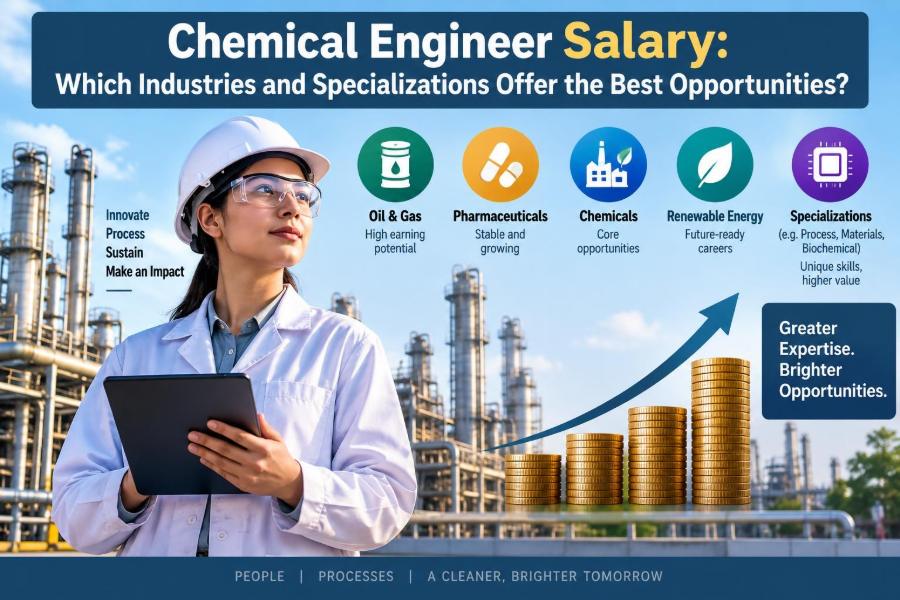
The industries that often offer strong chemical engineering compensation tend to combine valuable products, complex assets, scarce skills, and substantial consequences for poor performance. Petrochemicals, pharmaceuticals, biotechnology, advanced materials, energy systems, and specialized consulting can all be attractive, but conditions vary by employer, site, and economic cycle.
The more dependable advantage is becoming someone who can make a process safer, more reliable, more efficient, easier to control, or easier to scale. That contribution is valuable across sectors and gives you choices when one market slows down.
The best chemical engineering opportunity is not the role with the biggest headline salary, but the one where compensation, learning, work conditions, and long-term direction fit together. Build portable skills, examine offers carefully, and let real technical curiosity guide your next move. 🧪📈🏭