
A reaction vessel may be where new molecules are made, but it is rarely where a useful product is finished. When a batch ends, the vessel can contain unreacted raw materials, desired product, solvents, catalysts, salts, by-products, gases, and tiny solid particles—all mixed together.
Consider a familiar product such as a medicine, a detergent ingredient, or a fuel component. The chemical reaction may create the target compound successfully, yet that compound may be dissolved in a liquid, trapped in crystals, mixed with a similar impurity, or diluted to a concentration too low for sale.
This is why downstream processing matters. It turns a chemically successful reaction into a material that meets a required purity, concentration, physical form, and safety specification.
For chemical engineers, separation is not simply “cleaning up” after chemistry. It is a connected set of decisions about phase behavior, equipment, energy, safety, waste, and value recovery.
🧭 The Reaction Is the Start, Not the Finish
The material leaving a reactor is called the reaction mixture or reactor effluent. Its composition depends on reaction conversion, selectivity, feed purity, solvent choice, catalyst type, and operating conditions.
Conversion describes how much reactant has been consumed. Selectivity describes how much of that consumed reactant became the desired product rather than unwanted products. High conversion alone does not guarantee easy purification.
A reaction that produces one liquid product plus a volatile solvent calls for a very different recovery train than a fermentation broth containing dilute product, cells, proteins, and water.
🎯 What “Product Quality” Actually Means
Purity is only one product requirement. A customer may also specify moisture content, particle size, color, odor, viscosity, concentration, acidity, residual solvent level, or trace-metal content.
In pharmaceutical manufacturing, an impurity that is harmless in another industry may still require close control. In bulk chemicals, the dominant concern may be cost, consistency, and compatibility with a downstream user rather than extremely high purity.
Engineers therefore begin with a product specification: what must be removed, what may remain, and in what physical form the product must leave the plant.
🧩 Start with the Separation Problem
A sensible separation sequence starts with characterization, not equipment preference. Engineers identify every significant component and ask which properties differ enough to exploit.
- Is one component a solid while another is a liquid?
- Do components have very different boiling points or vapor pressures?
- Does the desired compound prefer one liquid phase over another?
- Can it crystallize while impurities remain dissolved?
- Is it sensitive to heat, oxygen, water, or shear?
This property-based approach prevents a common mistake: choosing distillation merely because it is familiar when the product would decompose at the required temperature.
⚖️ Separation Depends on Differences
Most separation methods do not create purity from nothing. They amplify an existing difference between materials: particle size, density, volatility, solubility, electrical charge, molecular size, or affinity for a surface.
A sieve separates coarse and fine particles because their sizes differ. Distillation separates liquids because their tendencies to enter the vapor phase differ. Chromatography separates molecules because they interact differently with a stationary material.
When the relevant property difference is small, separation becomes harder, larger, more energy-intensive, or less reliable. That is often where upstream reaction design and downstream recovery design must be improved together.
🧪 Phase Changes Create Opportunities
Engineers frequently create an easier separation by changing temperature, pressure, composition, or pH. These changes can form a vapor, precipitate a solid, split one liquid into two layers, or release a dissolved gas.
For example, cooling a saturated solution may cause the desired compound to crystallize. Adjusting pH can convert an acid or base into a less soluble form. Reducing pressure can remove a volatile solvent at a lower temperature.
These operations are useful because they change where a component prefers to be. The goal is not merely to alter the mixture, but to create phases that can be separated practically.
🛑 Quenching Stops the Chemistry at the Right Time
Before recovery begins, a reaction may need to be quenched: deliberately stopped or slowed. This can involve cooling, adding a neutralizing agent, diluting the mixture, removing a catalyst, or changing pH.
Quenching protects yield by preventing further reaction, decomposition, or formation of additional by-products. However, it must be designed carefully because rapid addition, gas evolution, heat release, or precipitation can create mixing and safety challenges.
A quench can also influence later separation. The chosen reagent may add salts or water, which can be useful for phase splitting but can increase wastewater or purification duties.
🌬️ Removing Gases and Vapors
Reaction mixtures often contain dissolved gases, entrained air, hydrogen, carbon dioxide, or volatile by-products. A flash drum is a common first step: lowering pressure or changing temperature allows part of a feed to vaporize, creating vapor and liquid streams.
Flashing is relatively simple and can remove light components before more demanding purification. It is not a precise separation, however; some desired product may leave with the vapor, and some volatile material may remain in the liquid.
Vapor streams may need condensation, recovery, treatment, or controlled venting. A vent is never automatically harmless simply because it is a gas stream.
🧹 Filtration Removes Suspended Solids
Filtration separates solids from a fluid by passing the fluid through a porous medium. It is widely used to remove catalyst particles, activated carbon, precipitated salts, or product crystals.
A filter works best when particles form a permeable cake. Very fine, sticky, or compressible solids can blind the filter medium and slow liquid flow. Filter aids may sometimes create a more open cake structure.
Common industrial choices include pressure filters, vacuum filters, filter presses, and cartridge filters. The choice depends on solids loading, particle behavior, containment needs, washing requirements, and desired throughput.
🌀 Centrifugation Speeds Up Solid-Liquid Separation
A centrifuge uses rotational motion to create a force much greater than gravity. Dense particles move outward while clarified liquid remains closer to the center, allowing separation when settling would be too slow.
Centrifugation is especially valuable for fine crystals, emulsions, and biological materials. It can provide rapid separation, but it usually has higher mechanical complexity and may damage shear-sensitive materials such as some cells or delicate crystals.
For a crystalline product, a centrifuge can also spin away mother liquor—the impurity-containing liquid left after crystallization—and allow a wash liquid to displace residual impurities.
🏖️ Settling and Decanting Use Gravity
If suspended solids are sufficiently large or dense, they can settle under gravity in a clarifier, thickener, or settling tank. The clearer liquid is removed from above, while concentrated solids leave below.
This method is low in energy and mechanically simple, but it requires time and vessel volume. Fine particles may settle extremely slowly, especially when the liquid is viscous.
Flocculants can sometimes encourage tiny particles to form larger aggregates. They must be selected with care, because an additive that improves settling may introduce contamination or complicate product approval.
💧 Liquid-Liquid Extraction Moves Molecules Between Phases
Liquid-liquid extraction transfers a solute from one liquid into another liquid that does not mix with the first. A classic example is moving an organic compound from water into an immiscible organic solvent.
The method relies on the solute’s relative preference for the two phases, often expressed through a distribution ratio. Multiple smaller extraction stages may outperform one large stage because fresh solvent repeatedly contacts the raffinate, the liquid left after extraction.
Extraction is useful for heat-sensitive compounds and dilute solutes. Its trade-off is that the extracting solvent must eventually be recovered or removed, adding another separation problem.
🧫 pH Adjustment Can Direct Extraction
Many organic acids and bases change charge state with pH. Their charged forms often favor water, while neutral forms may be more soluble in an organic liquid. Engineers use this behavior to selectively move compounds between phases.
For example, a hypothetical mixture containing an organic acid may be washed with a basic aqueous solution, converting the acid to a water-soluble salt. Re-acidifying that aqueous stream can regenerate the neutral acid for further recovery.
This approach is powerful but not universal. Strong pH changes can degrade sensitive products, create emulsions, and produce salt-containing wastewater that needs responsible treatment.
🌡️ Distillation Separates by Volatility
Distillation separates liquids through repeated vaporization and condensation. A more volatile component tends to enrich in the vapor, while a less volatile component tends to remain in the liquid.
In a distillation column, internal trays or packing create repeated vapor-liquid contact. Reflux—returning part of the condensed overhead liquid to the column—improves separation by providing liquid that contacts rising vapor.
Distillation is central to petroleum refining, solvent recovery, and many chemical plants. It is dependable at scale, but heating and condensing large streams can make it one of the most energy-demanding operations in industry.
📏 Relative Volatility Sets the Difficulty
Boiling point is a useful first clue, but the more relevant concept is relative volatility: how differently two components divide between vapor and liquid under the same conditions.
When relative volatility is high, a column can often achieve a separation with fewer stages and lower reflux. When it is close to one, the components behave similarly and distillation becomes more demanding.
Pressure changes can help. Vacuum distillation lowers boiling temperatures, protecting heat-sensitive materials. Pressure also changes vapor-liquid equilibrium, so the best operating pressure is a design decision rather than a default setting.
🔁 Azeotropes Can Block Ordinary Distillation
An azeotrope is a mixture whose vapor has the same composition as its liquid at a particular condition. At that point, ordinary distillation cannot enrich one component beyond the azeotropic composition.
The familiar challenge of separating certain solvent-water mixtures illustrates the issue. Engineers may use pressure-swing distillation, an entrainer, molecular sieves, membranes, or another dehydration method instead.
There is no universally best workaround. The right choice depends on product purity, solvent compatibility, energy use, safety, equipment availability, and the need to recover added materials.
💎 Crystallization Builds Purity into a Solid
Crystallization produces an ordered solid from a solution, melt, or vapor. As crystals grow, their structure may exclude many impurities, leaving those impurities in the remaining liquid.
Cooling, evaporation, reaction, or addition of an antisolvent can create supersaturation, the driving force for crystal formation. Too little supersaturation gives slow production; too much can cause uncontrolled nucleation and many small crystals.
Crystal size matters. Large, uniform crystals often filter and wash more easily, while fines can pass through filters, retain mother liquor, and make drying difficult.
🧊 Seeding Controls Crystal Growth
Seeding means adding small, carefully selected crystals to a supersaturated solution. The seeds provide surfaces for the desired crystal form to grow on.
This can reduce random nucleation and help control particle-size distribution. It is especially useful where crystal shape, filtration behavior, and downstream handling affect product quality.
Crystallization is not automatically a perfect purification step. Impurities can become trapped between crystals, adsorb on surfaces, or enter the crystal lattice. Cooling profile, mixing, solvent choice, and washing all influence the result.
🧽 Washing Solids Removes Mother Liquor
A wet filter cake carries some of its surrounding liquid into the next operation. Since that mother liquor often contains dissolved impurities, washing can substantially improve final purity.
An effective wash displaces contaminated liquid without dissolving too much product. The wash solvent should therefore have limited product solubility, appropriate safety properties, and a recovery route where possible.
Too little wash leaves contamination. Too much wash increases solvent use, drying duty, and sometimes product loss. Engineers balance these effects using laboratory data and plant measurements.
🔥 Drying Produces a Stable, Usable Material
Drying removes water or solvent from a wet solid. The target may be a free-flowing powder, a stable crystal form, or a material with a specified residual moisture level.
Dryers include tray dryers, rotary dryers, fluidized-bed dryers, vacuum dryers, and spray dryers. A vacuum dryer is often useful for heat-sensitive materials because reduced pressure lowers the temperature needed for evaporation.
Drying is more than heating. Internal diffusion, surface evaporation, airflow, particle agglomeration, and solvent flammability all affect performance. Removing solvent too aggressively can cause dust, attrition, or undesirable changes in particle form.
🧱 Adsorption Captures Selected Molecules
Adsorption occurs when molecules attach to the surface of a solid. Activated carbon can remove color bodies and trace organic contaminants, while other adsorbents can capture water, sulfur compounds, or specific molecular classes.
Unlike absorption, where a substance enters the bulk of another material, adsorption is primarily a surface phenomenon. Once the adsorbent becomes saturated, it must be regenerated, replaced, or disposed of appropriately.
Adsorption can be highly effective for polishing a stream, but it is not always economical for removing large amounts of a major component. Capacity, regeneration energy, pressure drop, and spent-media handling matter.
🧬 Membranes Separate Without Boiling
Membranes allow some components to pass through more readily than others. Depending on pore size and membrane chemistry, they can separate particles, macromolecules, salts, water, or selected gases.
Microfiltration and ultrafiltration are common for removing suspended matter and large molecules. Reverse osmosis is used when water passes while many dissolved salts are retained. Gas membranes can enrich one gas relative to another.
Membranes can avoid phase change and reduce thermal damage, but they are vulnerable to fouling: material accumulation that lowers flux and changes selectivity. Pretreatment, cleaning, and replacement planning are essential.
🧪 Chromatography Solves Difficult High-Value Separations
Chromatography separates components according to their different interactions with a stationary phase and a flowing mobile phase. Components move at different speeds, allowing collection of distinct fractions.
It is particularly useful when molecules are structurally similar and other properties offer little separation leverage. This can occur in pharmaceutical intermediates, specialty chemicals, and biotechnology products.
For large, low-value commodity streams, chromatography is often impractical because media, solvent, and equipment requirements can be substantial. Its strength is selectivity, not necessarily low cost.
🔄 Recycle Unreacted Materials Carefully
Recovering unreacted feed can improve material efficiency and reduce purchasing costs. A distillation column, separator, or membrane may return reactant or solvent to the reactor feed.
Recycling is not automatically beneficial. Impurities that are not consumed or removed can accumulate through repeated passes. This may change reaction selectivity, poison catalysts, or push the process outside its operating window.
A purge stream removes part of a recycle loop to prevent this buildup. The purge sacrifices some valuable material, so it is often treated further to recover value before disposal or treatment.
♻️ Solvent Recovery Reduces Both Cost and Waste
Solvents are frequently used as reaction media, extractants, wash liquids, and crystallization aids. Recovering them can reduce fresh solvent demand and lower the volume of material requiring treatment.
Distillation is a common solvent-recovery method, but not the only one. Adsorption, membranes, decanting, or evaporation may fit a particular system better.
Recovered solvent needs verification before reuse. Trace water, degradation products, or cross-contamination can affect the next reaction, so reuse specifications should be based on process performance rather than appearance alone.
⚡ Energy Use Shapes the Flowsheet
A flowsheet is the map of process operations and streams. A good flowsheet seeks product quality with reasonable energy, capital cost, operating complexity, and environmental burden.
Heat integration can lower utility demand by using a hot stream, such as a condenser outlet or reactor effluent, to preheat a colder stream. This does not eliminate energy requirements, but it can reduce avoidable heating and cooling.
Simple operations early in the train often reduce the burden on expensive operations later. Removing bulk solids before a membrane or concentrating a solution before a final dryer can make the entire process more efficient.
📊 Compare Methods by Their Real Trade-Offs
| Method | Property Used | Typical Strength | Key Limitation |
|---|---|---|---|
| Filtration | Particle size | Removes suspended solids | Fine or sticky solids can blind filters |
| Extraction | Solubility between liquids | Useful for dilute, heat-sensitive solutes | Creates solvent-recovery duty |
| Distillation | Volatility | Continuous, scalable liquid separation | Can require substantial energy |
| Crystallization | Solubility and crystal formation | Can purify and shape a solid product | Product loss remains in mother liquor |
| Membranes | Size or selective transport | Often avoids boiling | Fouling and limited selectivity |
The table is a starting point, not a selection rule. Real mixtures may require several operations because no single property difference is large enough to meet the specification alone.
🧱 Separation Trains Work in Stages
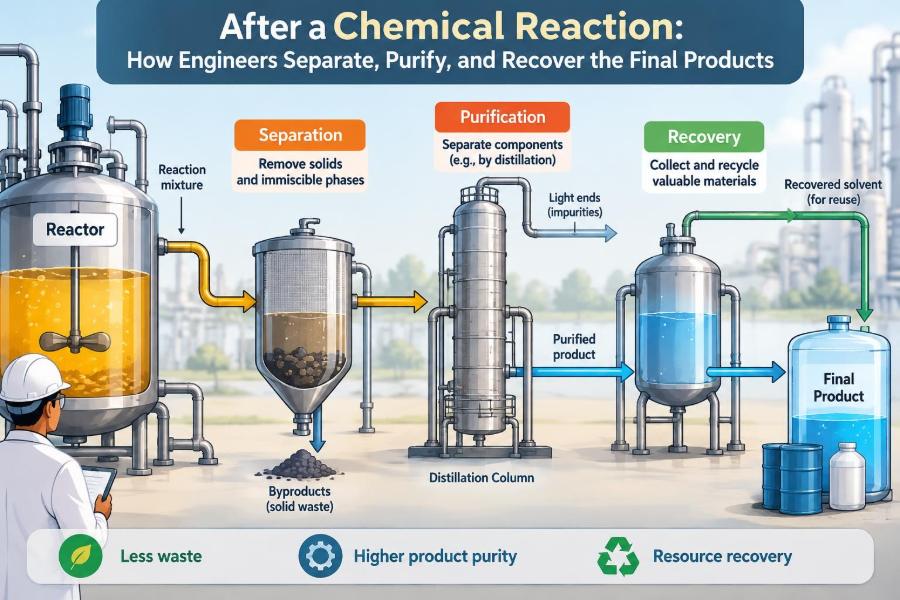
Industrial recovery usually uses a sequence rather than one “magic” unit. A plausible generic train might remove gas first, filter a catalyst, recover solvent, crystallize the product, wash the crystals, then dry and package them.
Each stage should prepare the feed for the next. Sending solids to a distillation column can cause fouling; sending a highly dilute solution to a dryer wastes energy; sending an emulsion to a decanter may give poor phase separation.
The best order depends on material properties and economics. Engineers test alternatives because a rearranged sequence can change both product recovery and utility consumption.
🧯 Safety Changes the Best Technical Choice
Separation equipment can handle flammable vapors, corrosive liquids, toxic compounds, high pressure, vacuum, hot surfaces, and combustible dust. These hazards must be designed into the process, not added as an afterthought.
For instance, evaporating a flammable solvent requires attention to ignition control, vapor containment, ventilation, and pressure relief. Drying powders may create dust hazards that require suitable equipment design and operating controls.
Compatibility also matters. A solvent that separates well may be unacceptable if it attacks seals, creates difficult emissions, or poses risks disproportionate to its process benefit.
🔍 Measure What the Process Is Actually Doing
Operators and engineers rely on measurements such as temperature, pressure, flow, level, pH, density, conductivity, turbidity, moisture, and composition. Some provide continuous process information; others require laboratory sampling.
Analytical methods verify whether a separation is achieving its purpose. A clear liquid is not necessarily pure, and a dry-looking solid may still contain residual solvent or moisture.
Sampling must represent the stream. Poorly mixed vessels, settling solids, vapor-liquid systems, and dead legs can produce misleading samples, leading to incorrect adjustments or false confidence.
🚫 Common Mistakes in Product Recovery
- Designing for average feed only: feed composition can vary, and a process needs workable limits.
- Ignoring impurities in recycle loops: small amounts can accumulate over time.
- Optimizing purity while neglecting yield: an ultra-pure product is not economical if too much product is discarded.
- Treating waste as someone else’s problem: salt, solvent, and concentrated impurity streams need defined handling routes.
- Scaling up without studying mixing and heat transfer: a successful flask separation may behave differently in plant equipment.
These failures are connected. Good process design considers mass balance, quality, operability, safety, and waste from the beginning.
🧮 Mass Balances Keep Recovery Honest
A mass balance accounts for what enters, leaves, accumulates, reacts, and is generated in a system. It is one of the most practical tools for finding lost product, unexpected water entry, solvent losses, and accumulating impurities.
If 100 units of a component enter a steady process, the accounted outputs should be consistent with that input after considering reaction and known losses. Large unexplained differences are signals to investigate measurements, leaks, sampling, or assumptions.
Recovery percentage is useful, but it should be interpreted with purity. A product stream can show high recovery while carrying excessive impurity, or excellent purity while leaving valuable product behind.
🌍 Waste Minimization Begins Upstream
The cleanest separation is often the one made easier by better reaction design. A selective catalyst, a less problematic solvent, or a reaction that avoids excess reagent can reduce the size and complexity of downstream equipment.
Engineers may compare options such as using a recoverable solvent, choosing a crystallizable product form, avoiding problematic salts, or operating at a concentration that reduces later evaporation.
Waste cannot always be eliminated. The practical aim is to prevent it where possible, recover useful material where justified, and treat remaining streams safely and responsibly.
🧠 The Core Principle: Design the Whole System
Product recovery succeeds when engineers view reaction and separation as one system. The chemistry determines what mixture exists; physical properties determine what separations are possible; specifications and constraints determine which route is sensible.
The strongest processes use simple, robust bulk separations first and reserve highly selective or energy-intensive operations for the duties that truly require them. They also account for recycle quality, solvent management, safety, and realistic operating variation.
Whether the final product is a clear solvent, a dry powder, a purified gas, or a concentrated solution, the central task is the same: move the desired molecules into the right stream and leave unwanted material somewhere it can be recovered, reused, treated, or safely managed.
After a chemical reaction, separation and purification are what transform a mixed reactor output into a dependable product—and thoughtful engineering makes that transformation efficient, safe, and practical. 🧪⚙️♻️