
A plant team needs to make a specialty resin for a customer order. The chemistry is well understood, but the order size changes often, raw-material delivery is uneven, and each grade requires a slightly different formulation. A continuously running line may sound efficient, yet it could be awkward for this situation.
Across the site, another unit makes a high-volume solvent used every day. Stopping, emptying, and restarting equipment for each lot would waste time, energy, and production capacity. Here, a continuous process may be the natural fit.
Between those examples sits a large share of industrial chemistry: reactions that begin with a charged vessel but require one reactant to be fed gradually to control heat, gas evolution, viscosity, or selectivity. That is semi-batch operation.
Choosing among batch, continuous, and semi-batch production is not a matter of picking the most modern-looking equipment. It is a process-design decision that affects safety, quality, economics, staffing, control strategy, and the ability to respond when real feedstocks and markets do not behave exactly as planned.
🧭 The production mode is part of process design
Production mode describes how material enters, moves through, and leaves a process. It should be selected alongside reaction chemistry, separation steps, heat transfer, storage, and control—not after the equipment layout is nearly fixed.
A poor match creates recurring operational pain: excessive cleaning, difficult temperature control, idle assets, off-spec inventory, or a system that is efficient only under one narrow production plan.
🧪 What batch production means
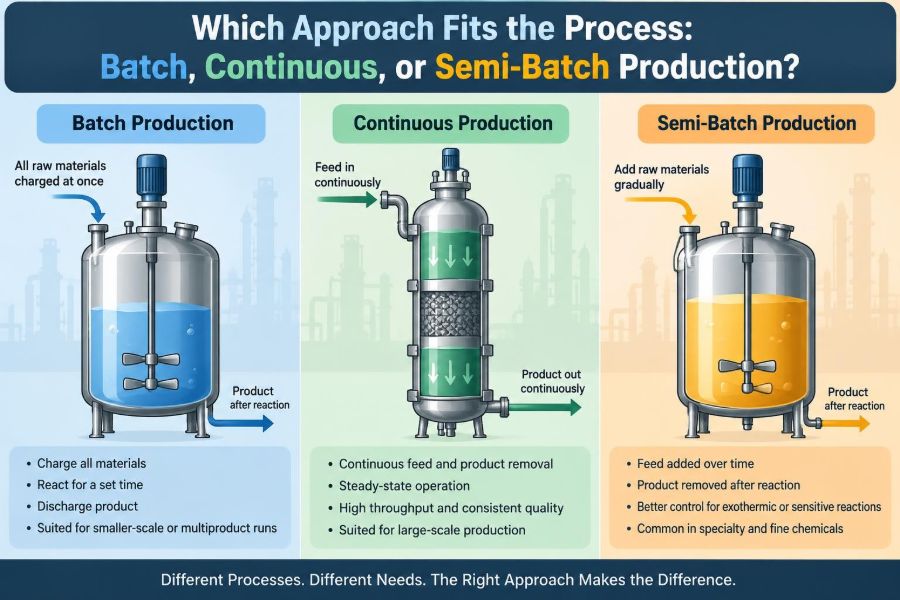
In a batch process, a defined quantity of ingredients is charged to equipment, processed for a set time, and discharged. The same vessel may then be cleaned, prepared, and used for the next batch.
A jacketed reactor making a formulated coating is a familiar example. Operators charge solvents and resins, mix, heat or cool as needed, test the material, then transfer the finished lot to a downstream tank or filling operation.
🌊 What continuous production means
In a continuous process, feed enters and product leaves on an ongoing basis. Once operating conditions stabilize, the unit aims to maintain a steady state: flows, temperatures, pressures, compositions, and inventories remain near their intended values.
Continuous operation does not mean the plant never stops. Grade changes, maintenance, cleaning, disturbances, and shutdowns still occur. It means the core production step is designed to operate as a flowing system rather than as repeated, separate lots.
➕ What semi-batch production means
A semi-batch process combines features of both modes. Usually, one or more materials are initially charged to a vessel, while another feed is added over time. Product may remain in the vessel until the operation ends, although some semi-batch arrangements also withdraw material during operation.
The most common reason for gradual addition is control. Feeding a reactive monomer slowly into an initiator solution, for example, can limit the instantaneous reaction rate and make released heat easier to remove.
🧠 Start with the physical behavior of the process
The chemistry and physical properties set the boundaries for a sensible choice. Ask what happens to reaction rate, heat release, mixing, phase behavior, solids content, gas generation, and viscosity as conversion rises.
A process that is calm at laboratory scale may become difficult at production scale because volume grows faster than heat-transfer area. The mode of operation can either amplify that difficulty or give engineers useful control levers.
⚗️ Reaction kinetics can favor one mode
Reaction kinetics describe how fast reactants are consumed under particular conditions. If a reaction is fast, strongly exothermic, or highly sensitive to concentration, holding all reactants together from the start may be undesirable.
Semi-batch feeding can keep the concentration of a hazardous or highly reactive component lower than it would be in a full initial charge. Conversely, a reaction with stable, predictable kinetics and large demand may be well suited to a continuous reactor with controlled residence time.
🔥 Heat removal is often the deciding constraint
Many reactions release heat. If heat is generated faster than it can be removed, temperature rises; higher temperature can accelerate some reactions, creating a potentially self-reinforcing situation.
Batch reactors offer time to cool before or after a reaction phase, but their peak heat-release period can still be demanding. Semi-batch operation reduces the heat-release rate by limiting feed rate. Continuous systems can provide excellent heat transfer when designed with high area-to-volume ratios, but they require reliable control and a clear response to interruptions.
🌀 Mixing is not merely a mechanical detail
Mixing determines whether concentration and temperature are uniform. Poor mixing can create local hot spots, zones of excess reactant, incomplete conversion, particle-size variation, or unwanted by-products.
As a batch thickens, an agitator that worked early in the cycle may no longer provide adequate circulation. In continuous processing, narrow residence-time distributions and uniform mixing may be essential, especially when product quality depends on every element of material receiving similar treatment.
⏱️ Residence time changes product behavior
Residence time is the time material spends in a process unit. In batch processing, every batch follows a scheduled hold period, though mixing imperfections can cause local variation. In a continuous system, different fluid elements may spend different times in the equipment.
That distribution matters for reactions, crystallization, drying, polymerization, and biological processes. A broad spread can mean some material is underprocessed while another fraction is overprocessed. Reactor selection and flow pattern must therefore support the quality requirement, not just the target throughput.
📦 Demand profile sets the economic context
High, stable demand often supports continuous production because capital-intensive equipment can operate near its intended utilization. The savings from lower labor per unit, less repeated handling, and steadier energy use can become meaningful at scale.
Low volume, seasonal demand, or a broad product portfolio often favors batch assets. A flexible reactor train can make several products, even though each product carries turnaround time between campaigns.
🔁 Product variety rewards flexibility
A facility making one commodity chemical and a facility making twenty specialty grades should not be judged by the same production logic. Batch vessels are adaptable: recipes, addition sequences, temperatures, and hold times can be adjusted from one grade to another.
Continuous lines can make multiple grades, but transitions may create intermediate material that must be reworked, downgraded, or managed separately. This is not an argument against continuous manufacture; it is a reminder to account for transition losses honestly.
🏭 Throughput is more than the size of a reactor
Batch capacity depends on working volume, cycle time, yield, availability, and downstream constraints. Cycle time includes charging, heating, reaction, cooling, sampling, discharge, cleaning, and preparation—not only the reaction hold.
Continuous capacity is tied to sustained feed rate and uptime. A line with a high nameplate rate but frequent trips or long grade transitions may deliver less useful annual output than expected.
💰 Compare total economics, not one cost line
Continuous facilities may require specialized feed systems, automation, inline analyzers, surge capacity, and carefully designed start-up and shutdown arrangements. These can raise initial complexity.
Batch plants may need more vessels, more operator intervention, more sampling, and more time between lots. Economic comparison should consider capital cost, utilities, labor, raw-material losses, cleaning, quality losses, maintenance, inventory, and the value of flexibility.
🧼 Cleaning and contamination shape real capacity
When products share equipment, cleaning validation and changeover effort can dominate scheduling. Sticky polymers, potent compounds, pigments, solids, and strongly colored materials can make a nominally short changeover much longer.
Continuous equipment can reduce repeated cleaning during a long campaign, but internal channels, filters, and dead legs may be difficult to clean if the design does not consider cleanability from the beginning.
✅ Quality assurance works differently in each mode
Batch manufacturing naturally produces discrete lots. Samples can be tied to a specific batch record, and a final release decision can be made before shipment. This traceability is especially useful where formulation and documentation are central to product acceptance.
Continuous manufacturing relies more heavily on process understanding and timely measurements. Online or at-line analysis can detect drift, while material diversion systems may isolate product made during a disturbance. The quality system must define how material is traced and segregated across time.
📈 Process control changes from recipe to regulation
Batch control commonly follows a recipe: charge material, mix, heat to a setpoint, hold, sample, cool, and discharge. Automation can make these steps repeatable, but the process has distinct phases.
Continuous control emphasizes maintaining conditions despite changing disturbances. Flow, composition, pressure, level, and temperature loops interact, so control design must account for dynamics and delays. Neither approach is automatically simpler; each has different failure modes.
🧪 Sampling must match the process clock
A laboratory sample from a batch may represent a well-mixed vessel at a known point in its recipe. In continuous production, a sample represents material passing a location at a particular time, not necessarily the material currently entering or leaving every downstream unit.
Engineers need to understand transport delays and holdup volumes. Otherwise, they may adjust a process in response to a measurement that reflects conditions from much earlier, causing unnecessary oscillation.
🛡️ Safety begins with credible scenarios
Safety assessment should consider loss of cooling, feed errors, blocked outlets, utility failure, contamination, instrument faults, and operator actions. The relevant question is not which mode has a safety label; it is how the specific process behaves when control is lost.
Semi-batch feeding can limit reactive inventory at a given moment, but an incorrect feed rate or failed agitation can still be serious. Continuous systems may hold smaller inventories in individual reactors, while connected equipment can propagate a disturbance rapidly if safeguards and shutdown logic are inadequate.
🚨 Relief, venting, and isolation need mode-specific design
Pressure relief design depends on credible overpressure scenarios, reaction behavior, physical properties, and the equipment configuration. It should be performed by qualified engineers using appropriate methods and site requirements.
Batch vessels need consideration of the maximum credible reacting inventory. Continuous systems require attention to blocked-flow cases, isolation during shutdown, thermal expansion of trapped liquid, and how upstream and downstream units behave when one section trips.
🌱 Energy and material efficiency are operational questions
Continuous operation can avoid repeated heat-up and cool-down cycles, and heat integration may be easier when streams flow steadily. That advantage is strongest when the plant operates for long campaigns at stable rates.
Batch operation may consume more energy per unit for repeated thermal cycling, yet it can prevent overproduction and obsolete inventory when demand is uncertain. Material efficiency also includes purge streams, start-up losses, off-spec product, and cleaning waste.
🧱 Solids, slurries, and viscosity complicate the decision
Solids handling can challenge every mode. In batch equipment, settling, poor suspension, filter plugging, and difficult discharge are common concerns. In continuous lines, feeders, pumps, valves, and narrow passages must tolerate the particle size and rheology.
Highly viscous products often benefit from equipment designed specifically for strong mixing and wall heat transfer. A conventional continuous-flow concept should not be assumed workable simply because the reaction itself appears suitable for steady operation.
🔗 Downstream steps may determine the best answer
A reactor is only one part of a production train. Distillation, filtration, drying, blending, packaging, wastewater treatment, and storage may impose the practical bottleneck.
For example, a continuous reactor feeding a batch filter or dryer needs buffer capacity and coordinated scheduling. A batch reactor feeding a continuous distillation column may need intermediate tanks to smooth flow. Interfaces between units deserve as much attention as the units themselves.
🧰 Scale-up is not a linear enlargement
Increasing vessel volume changes mixing time, heat-transfer area per unit volume, hydrostatic pressure, gas disengagement, and the consequences of a single error. A laboratory batch recipe cannot simply be multiplied by a larger mass.
Likewise, moving from a laboratory flow reactor to an industrial continuous line requires understanding plugging, start-up behavior, residence-time distribution, and control at larger throughputs. Pilot work and disciplined scale-up analysis reduce avoidable surprises.
🧭 A practical selection workflow
A useful decision starts with process facts rather than preferred equipment. Build a concise basis of design, then test each operating mode against it.
- Define product range, annual demand, campaign length, and required responsiveness.
- Characterize kinetics, heat release, mixing needs, solids behavior, and separation requirements.
- Identify hazards and operating limits, including upset and shutdown scenarios.
- Estimate complete cycle time or sustained operating rate, including transitions and cleaning.
- Compare capital, operating cost, quality strategy, staffing, waste, and flexibility.
- Use experiments, pilot trials, or dynamic models where uncertainty could change the decision.
📊 A compact comparison for early screening
| Decision factor | Batch | Continuous | Semi-batch |
|---|---|---|---|
| Typical strength | Flexible recipes and discrete lots | Stable, high-volume production | Controlled addition and heat management |
| Typical challenge | Turnaround time and variability between lots | Start-up, transitions, and control complexity | Long cycle times and feed-control dependence |
| Often suitable when | Demand or product mix changes frequently | Demand is sustained and process behavior is predictable | Reaction rate must be moderated by dosing |
| Quality emphasis | Lot testing and batch records | Time-based traceability and process monitoring | Recipe execution plus feed-profile control |
This table is an early-screening aid, not a design rule. A specialty product can be made continuously, and a commodity can be made in batch when site constraints or market conditions justify it.
❌ Mistake: treating batch as outdated
Batch technology remains the right answer for many formulated, low-volume, multi-product, and development-scale operations. Its ability to accommodate different recipes and discrete quality decisions can be commercially valuable.
The mistake is ignoring its true cycle time, cleaning burden, and scale-up limits. Flexibility has a cost, and that cost should be quantified rather than assumed away.
❌ Mistake: assuming continuous always lowers risk
Smaller in-process inventory can be an advantage in some continuous designs, but continuous operation introduces different hazards: rapid propagation of off-spec feed, control-loop interactions, unnoticed analyzer drift, and difficult transient behavior.
Safety improves when engineers understand the scenario, design independent layers of protection, train personnel, and verify operating procedures. The operating mode alone does not provide that protection.
❌ Mistake: designing only for normal operation
Plants spend meaningful time starting up, shutting down, changing grades, cleaning, responding to feed interruptions, and recovering from equipment trips. These periods can generate disproportionate waste and quality risk.
Design reviews should ask where material goes during transitions, which valves isolate it, what happens to residual reactants, and how operators know when the unit has reached acceptable conditions.
🤝 The hybrid answer is often the practical answer
Many successful facilities deliberately combine modes. A continuous unit may make a stable intermediate, followed by batch blending to create customer-specific grades. A semi-batch reactor may feed a continuous separation step through a surge tank.
Hybrid architecture can capture steady-production advantages while preserving flexibility where it matters most. It does add interfaces, scheduling needs, and control responsibilities, so the benefit must outweigh that added coordination.
🧾 Document the assumptions behind the choice
A selection decision is only as sound as its assumptions about demand, yield, feed quality, uptime, changeover time, utility availability, and acceptable inventory. Record these assumptions clearly.
When conditions change, the team can revisit the original basis rather than debate memory. This is particularly helpful when an initially batch-based process grows into a candidate for continuous intensification.
🎯 Choose the mode that serves the whole process
Batch, continuous, and semi-batch production are tools, not rankings. Batch emphasizes flexibility and lot control; continuous emphasizes sustained flow and consistent operating conditions; semi-batch provides a powerful way to control addition-sensitive chemistry.
The strongest choice fits the reaction, physical behavior, downstream train, product portfolio, safety case, and business reality at the same time. A technically elegant reactor that disrupts separation, scheduling, or quality release is not yet a good process design.
The best production mode is the one that manages the real constraints of the complete process—not simply the one with the highest theoretical throughput. When chemistry, operations, and commercial needs are evaluated together, the choice becomes far clearer. 🧪⚙️📈