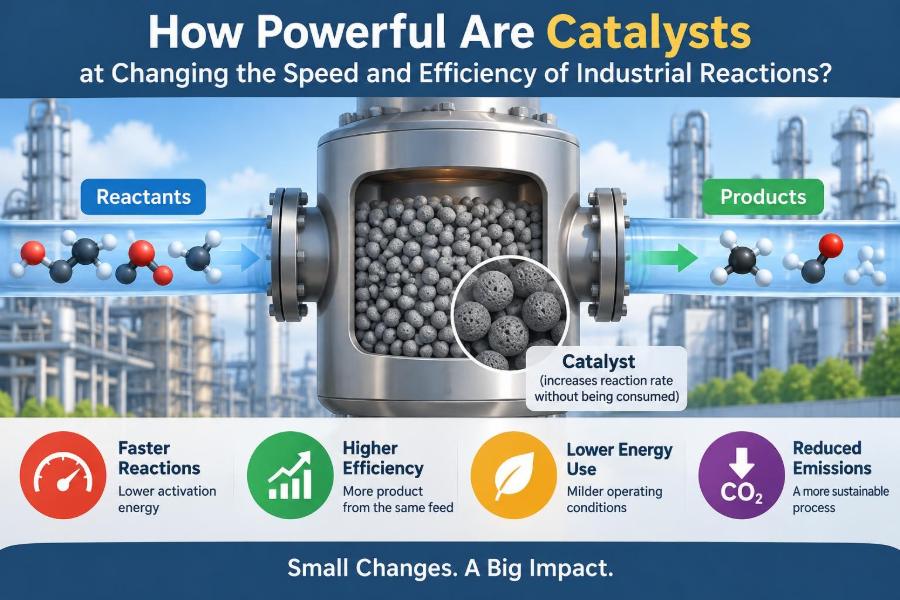

A refinery operator wants more fuel from the same barrel of crude oil. A fertilizer plant needs to make ammonia fast enough to supply farms without wasting enormous amounts of energy. A manufacturer wants a polymer resin with a precise molecular structure rather than a mixture that must be discarded or reprocessed.
In each case, the decisive piece of equipment may be surprisingly small: a bed of porous pellets, a fine powder suspended in liquid, or a dissolved metal complex measured in tiny concentration. That material is a catalyst.
Catalysts do not make impossible chemistry possible in a thermodynamic sense. Instead, they make useful chemistry happen on an industrial timescale, along a more selective route, and often at less severe operating conditions. Their effect can determine whether a process is economically practical or merely a reaction written in a textbook.
Understanding their power requires more than saying that catalysts “speed things up.” Their real value lies in the connected changes they can create: reaction rate, product distribution, energy demand, equipment size, emissions, safety margins, and the way an entire plant is designed.
⚗️ What a Catalyst Actually Does
A catalyst is a substance that increases the rate of a chemical reaction without being consumed in the overall reaction stoichiometry. It participates in intermediate steps, but is regenerated by the end of the catalytic cycle.
This does not mean a catalyst remains physically unchanged forever. It can sinter, foul, leach, poison, or lose active material over time. “Not consumed” describes the ideal reaction balance, not an unlimited service life.
In industry, catalysts may be solid materials, dissolved molecules, enzymes, or even engineered biological systems. The right choice depends on the feed, desired product, separation requirements, and operating environment.
🧗 Why Reactions Need an Easier Route
Many reactions are favorable overall but proceed slowly because reactant molecules must cross an energy barrier before bonds can break and form. This barrier is called the activation energy.
A useful analogy is a mountain pass between two valleys. The valleys represent reactants and products; their relative elevation reflects thermodynamics. A catalyst does not move either valley. It builds a lower pass, so more molecular encounters can cross it at a given temperature.
That alternative pathway may involve adsorption on a surface, temporary coordination to a metal center, proton transfer, radical formation, or a sequence of several lower-energy steps.
⚖️ Rate Is Not the Same as Equilibrium
A catalyst changes kinetics, the speed at which a system approaches equilibrium. It does not change the equilibrium constant, the reaction enthalpy, or the final equilibrium composition at a fixed temperature and pressure.
For a reversible reaction, a catalyst accelerates both forward and reverse reactions. It helps the system reach equilibrium faster, but it cannot shift equilibrium toward products by itself.
This distinction prevents a common misunderstanding. If an ammonia synthesis catalyst appears to “increase yield,” it may be because it permits practical operation at a chosen temperature, pressure, and residence time—not because it changes the underlying equilibrium limit.
🔍 The Three Measures of Catalytic Performance
Industrial chemists often separate catalytic performance into activity, selectivity, and stability. A catalyst that excels at only one of these may still be a poor industrial choice.
| Measure | Meaning | Why a plant cares |
|---|---|---|
| Activity | How rapidly the catalyst promotes reaction | Influences reactor size, throughput, and temperature |
| Selectivity | How strongly it favors the desired product over by-products | Controls yield, purification load, and waste |
| Stability | How well performance persists in service | Determines cycle length, reliability, and replacement cost |
High conversion alone is not enough. A fast catalyst that converts valuable feed into unwanted gases or tar can be less useful than a slower, more selective one.
🏭 How Catalysts Shrink Industrial Equipment
Reaction rate affects reactor volume directly. If a catalyst allows a reaction to reach its target conversion in minutes rather than hours, the same production rate may require a much smaller reactor or a lower inventory of hazardous material.
Smaller equipment can reduce capital cost, heat-loss area, structural requirements, and start-up inventory. It may also make temperature control easier, although fast reactions can create their own heat-removal challenges.
The relationship is not always simple. In a packed-bed reactor, lower kinetic resistance may expose limits in heat transfer, pressure drop, or reactant diffusion. Good catalyst performance therefore must be evaluated in the full reactor system.
🌡️ Lower Temperature Can Change the Whole Process
Because catalysts create faster pathways, they often enable useful reaction rates at lower temperature. This may reduce fuel use, protect heat-sensitive products, and reduce the formation of thermally driven by-products.
Lower temperature can also improve equilibrium yield for exothermic reversible reactions, where heat favors reactants. Yet it can slow mass transfer or increase viscosity, so the best operating temperature is a compromise rather than a minimum.
Conversely, some catalytic processes deliberately operate at high temperature because the feed is difficult to activate or because a fast rate and manageable reactor volume outweigh energy penalties.
🎯 Selectivity Is Often More Valuable Than Speed
Imagine two routes that consume the same starting material. One produces 95 units of desired product and 5 units of by-products; another produces 70 units of desired product plus materials that need expensive separation or disposal. Even if the second route is faster, it may be inferior.
Catalysts control selectivity by favoring particular intermediates and transition states. Their surface geometry, acidity, metal identity, pore size, and electronic structure can all influence which bonds react first.
Selective catalysis reduces raw-material loss and the downstream burden of distillation, extraction, crystallization, incineration, or wastewater treatment. For many mature chemical processes, incremental selectivity improvement is more valuable than a dramatic increase in rate.
🧱 Heterogeneous Catalysts and Their Active Surfaces
A heterogeneous catalyst is in a different phase from the reactants, commonly a solid catalyst with gas or liquid reactants. Refinery catalysts, supported metals, zeolites, and many oxidation catalysts fall into this category.
The reaction commonly follows an adsorption–reaction–desorption sequence. Reactants attach to active surface sites, react in an activated form, and products leave so that sites become available again.
Only a fraction of atoms in a catalyst particle may be exposed at accessible active sites. This is why high surface area, carefully distributed metal particles, and well-designed pore networks can matter as much as the bulk composition.
🧪 Homogeneous Catalysts and Molecular Precision
A homogeneous catalyst is in the same phase as the reactants, often a dissolved metal complex in a liquid reaction mixture. Because every catalyst molecule is dispersed at molecular scale, these systems can offer exceptional control over reaction pathways.
They are particularly valuable when stereochemistry matters—for example, when a process must favor one mirror-image form of a chiral molecule. Fine chemicals and pharmaceutical intermediates often benefit from this precision.
The central drawback is separation. Recovering a dissolved catalyst from product can be difficult, especially when the catalyst contains expensive or environmentally sensitive metals. Process designs may use biphasic systems, membrane recovery, immobilization, or recycling loops to address this challenge.
🧬 Biocatalysts Bring Enzyme-Level Selectivity
Enzymes are biological catalysts that operate through highly structured active sites. They can recognize specific molecules and discriminate between closely related functional groups or stereoisomers.
Industrial biocatalysis can be attractive for reactions that would otherwise require multiple protection, reaction, and deprotection steps. Operating conditions are often relatively mild, which may protect fragile molecules.
However, enzymes can be sensitive to temperature, pH, solvents, impurities, and shear. Their feasible operating window is not universal, and upstream feed preparation can be essential to reliable performance.
🪨 Supports Do More Than Hold a Metal
Many industrial catalysts place an active metal or oxide on a support such as alumina, silica, carbon, titania, or a mixed oxide. The support spreads active material across a large area and can improve mechanical strength and heat resistance.
It can also alter catalytic behavior. Strong interactions between a metal and support may change oxidation state, particle size, acidity, oxygen mobility, or resistance to sintering.
This means catalyst formulation is not simply a matter of adding more active metal. Beyond a certain loading, particles may agglomerate, pores may become blocked, and expensive material may become inaccessible.
🕳️ Pores Control Access to Active Sites
Catalyst pellets contain pores that carry reactants from the bulk fluid to internal active sites and carry products back out. Pore size and network structure shape both accessibility and selectivity.
Microporous materials such as zeolites can act as molecular sieves: their channels admit some molecules more readily than others. This shape selectivity can suppress unwanted reactions simply by restricting which species can enter or leave a catalytic environment.
But narrow pores can create diffusion limitations. A molecule may react rapidly once it reaches a site while the overall pellet performs slowly because transport through its pore network is the bottleneck.
🚚 Mass Transfer Can Hide True Catalyst Activity
Laboratory and plant measurements must distinguish chemical kinetics from transport effects. External mass transfer occurs between the bulk fluid and the particle surface; internal diffusion occurs inside pores.
If transport is slow, raising temperature may appear to have a weak effect on rate because diffusion, not chemistry, limits performance. Observed selectivity can also shift when products remain inside pores long enough to undergo secondary reactions.
Engineers investigate these effects by changing particle size, mixing intensity, flow rate, and dilution. A catalyst should not be judged solely by a single conversion result without checking whether the test reflects intrinsic chemistry.
🔥 Heat Transfer Matters in Fast Reactions
Many high-value catalytic reactions are exothermic. As heat is released, local temperature rises can accelerate reaction rate further, creating a feedback loop. In a packed bed, this may appear as a hot spot.
Hot spots can damage catalysts, reduce selectivity, accelerate coke formation, or create a safety concern. For reversible exothermic reactions, excessive temperature can also reduce equilibrium conversion.
Industrial solutions include staged reactant addition, interbed cooling, quench streams, dilution with inert solids, multitubular reactors, and careful feed distribution. Catalyst quality and reactor thermal design must be developed together.
🛢️ Refining Shows Catalysis at Process Scale
Petroleum refining relies heavily on catalysts because crude oil contains large, diverse hydrocarbon molecules that must be transformed into useful fuels and chemical feedstocks. Fluid catalytic cracking, hydroprocessing, reforming, and isomerization each use different catalytic functions.
For example, cracking catalysts help split larger molecules into smaller ones. Hydroprocessing catalysts, used with hydrogen, help remove sulfur and convert less desirable fractions into cleaner, more useful products.
These are not interchangeable tasks. Acidity, metal function, pore architecture, resistance to metals in the feed, and regenerability are tailored to the reaction family and feedstock quality.
🌾 Ammonia Synthesis Balances Kinetics and Equilibrium
The Haber–Bosch process combines nitrogen and hydrogen to produce ammonia. Nitrogen is abundant but difficult to react because its nitrogen–nitrogen triple bond is very strong.
A catalyst provides surface sites that help activate nitrogen and guide its conversion through surface-bound intermediates. Yet ammonia synthesis remains a balancing act: higher temperatures improve rate but can reduce equilibrium ammonia concentration, while high pressure favors ammonia formation but raises compression costs.
This process illustrates a core engineering lesson: catalysts enable the reaction, but they do not remove the need to optimize pressure, temperature, recycle, heat integration, and separation.
♻️ Catalytic Converters Turn Toxic Gases into Manageable Ones
Automotive catalytic converters use precious-metal-containing catalysts to promote reactions that convert carbon monoxide, unburned hydrocarbons, and nitrogen oxides into less harmful products under suitable exhaust conditions.
The application is demanding because exhaust composition and temperature change rapidly. The catalyst must light off quickly after a cold start, tolerate thermal cycling, and resist contaminants from fuel, oil, or engine wear.
It also shows why catalyst performance belongs to a system. Air–fuel ratio control, exhaust temperature, substrate design, and catalyst formulation all affect conversion.
🧴 Polymer Catalysts Shape Materials, Not Just Molecules
In polymer production, catalyst choice can influence molecular weight, molecular-weight distribution, branching, tacticity, and comonomer incorporation. Those molecular features then determine stiffness, toughness, melt behavior, transparency, and processing characteristics.
Two polymerization catalysts can consume monomer at similar rates but create polymers suited to entirely different applications. That is a deeper kind of catalytic power: directing material properties from the earliest reaction step.
Because polymer reactions can be highly exothermic and viscosity rises during production, mixing and heat removal are often as critical as catalyst activity.
🧼 Catalysis Can Reduce Separation and Waste
A selective route can replace a chain of less selective reactions and purification steps. Fewer by-products generally mean less solvent use, less energy for distillation, and fewer waste streams requiring treatment.
This is one reason catalysis is central to green chemistry. The goal is not merely to speed up a reaction; it is to improve atom economy, which describes how much of the reactant mass becomes the desired product.
Still, a catalyst is not automatically “green.” Its manufacture, use of scarce metals, solvent requirements, regeneration energy, and end-of-life handling all deserve consideration.
⚡ Energy Savings Depend on the Entire Flowsheet
It is tempting to assume that a catalyst always lowers total energy use. Often it does, particularly when it enables lower-temperature chemistry or reduces separations. But the full answer depends on the process flowsheet.
A highly active catalyst may require hydrogen, oxygen, a complex solvent, frequent regeneration, or intensive product separation. A lower-temperature reactor may still sit beside a distillation column that dominates the plant’s energy demand.
Engineers therefore evaluate energy at the process level using material and energy balances, heat integration opportunities, recycle requirements, and utility demands—not just reactor temperature.
☠️ Catalyst Poisoning Is a Major Operational Risk
Poisoning occurs when an impurity binds strongly to active sites or changes the catalyst’s chemical state, reducing activity or selectivity. Sulfur, chlorides, metals, water, and nitrogen-containing compounds can be problematic in particular systems.
The effect may be sudden or gradual. Even trace contaminants can matter when they accumulate over long operating periods, especially where active sites are scarce or highly specific.
Practical protection includes feed specifications, guard beds, filtration, drying, corrosion control, and analytical monitoring. Treating catalyst protection as an afterthought can turn a cheap feed impurity into a costly shutdown.
🧱 Deactivation Has Several Different Causes
Not all performance loss is poisoning. Catalysts may deactivate through sintering, where small active particles merge into larger ones; coking, where carbonaceous deposits block sites and pores; leaching; phase changes; attrition; or mechanical breakage.
Each mechanism requires a different response. Coke may be removed by controlled oxidation in suitable systems, while sintering is often irreversible. A catalyst that loses material by leaching may require changed chemistry rather than regeneration.
Diagnosing deactivation requires evidence: activity trends, product analysis, pressure-drop changes, spent-catalyst characterization, and a review of feed and temperature history.
🔄 Regeneration Extends Life but Has Limits
Some catalysts are designed for repeated regeneration. Fluid catalytic cracking is a well-known example in which coke deposited during reaction is burned off in a separate regenerator, restoring much of the catalyst’s activity while supplying heat to the process.
Regeneration must be carefully controlled. Overheating, uncontrolled oxidation, steam exposure, or thermal cycling can permanently damage surface area or active phases.
A realistic catalyst-management plan includes fresh catalyst addition, withdrawal of aged material, regeneration conditions, disposal or metal recovery, and safe handling of spent solids that may be pyrophoric or contaminated.
📏 How Engineers Compare Catalysts Fairly
A fair comparison starts with consistent feed composition, temperature, pressure, residence time, and catalyst mass or volume. Conversion, selectivity, and yield should be reported together, because any one number can mislead.
Useful measures may include turnover frequency, which relates reaction events to active sites per unit time, and space velocity, which describes feed flow relative to catalyst amount. These are powerful tools, but only if active-site counts and operating conditions are defined carefully.
Long-duration testing matters. A catalyst that looks excellent in the first hour may fail after days because of fouling, metal migration, support collapse, or sensitivity to realistic impurities.
🧭 Choosing a Catalyst Is a Multi-Objective Decision
Industrial selection is rarely a contest for the highest laboratory activity. Engineers weigh performance against cost, availability, pressure drop, pellet strength, safe handling, regeneration options, intellectual-property constraints, and compatibility with existing equipment.
A candidate catalyst should be tested against actual or representative feeds. Model compounds are valuable for understanding chemistry, but they may not capture contaminants, heavy fractions, trace water, or complex interactions found in production.
The best catalyst is the one that delivers the lowest-risk and most economical process outcome over its operating life—not necessarily the most impressive initial data point.
🧯 Safety Starts with Reaction Understanding
Catalysts can make a reaction so fast that heat release, gas evolution, or pressure rise becomes difficult to control. A reaction that is harmlessly slow without catalyst may require stringent safeguards once catalyzed.
Scale-up should consider calorimetry, mixing failures, loss of cooling, feed misrouting, catalyst loading errors, and emergency shutdown behavior. Catalyst beds can also retain heat and reactive species after feed stops.
Safe design relies on process-specific hazard assessment. There is no universal safe temperature or loading because risk depends on chemistry, reactor geometry, inventory, and the available heat-removal path.
🧫 Scale-Up Can Reveal Surprises
Small laboratory reactors often have excellent mixing and heat transfer, clean feeds, and nearly uniform temperature. Industrial units are larger, less ideal, and exposed to operational variation.
A catalyst that performs well in a gram-scale fixed bed can encounter channeling, maldistribution, pellet breakage, hot spots, or slow diffusion at plant scale. Conversely, a robust catalyst may tolerate these realities better than a slightly more active but fragile alternative.
Pilot testing, reactor modeling, and staged scale-up help bridge this gap. They cannot eliminate uncertainty, but they reveal constraints before a full-scale installation turns them into expensive problems.
🧠 Data and Modeling Improve Catalyst Development
Modern catalyst development combines experimental chemistry with characterization, kinetic modeling, transport analysis, and increasingly data-driven screening. The objective is not simply to find a material that works, but to understand why it works and where it will fail.
Kinetic models can help distinguish parallel and consecutive reactions, estimate sensitivity to temperature, and guide reactor sizing. Molecular simulations and spectroscopy can suggest likely active structures, though real catalyst surfaces under operating conditions are often complex.
Models are most useful when tied to sound measurements. A sophisticated calculation cannot compensate for unrepresentative feed data, unmeasured deactivation, or a test dominated by heat and mass transfer limitations.
🌍 Critical Materials Create Trade-Offs
Some highly effective catalysts rely on precious or critical metals. Their cost and supply risk can influence plant economics, while mining and refining impacts belong in a full sustainability assessment.
Researchers and manufacturers may reduce these concerns through lower metal loading, improved dispersion, recycling, alternative base-metal catalysts, or longer catalyst life. None of these approaches is automatically equivalent; performance, safety, and recovery practicality still matter.
The responsible question is broader than “Does this catalyst work?” It is also “What resources does it require, how long will it serve, and what happens when it leaves the reactor?”
🔮 What Future Catalysts May Change
Emerging priorities include catalysts for carbon dioxide utilization, lower-carbon hydrogen production, chemical recycling, selective electrified reactions, and conversion of renewable feedstocks. These areas are challenging because the molecules involved may be stable, dilute, impure, or expensive to separate.
New catalyst platforms may combine tailored pores, single-atom or nanoscale active sites, responsive materials, and improved control of local reaction environments. Promising laboratory results must still clear the practical hurdles of scale, durability, and manufacturing consistency.
Progress will likely come from matching materials and process design rather than searching for a single universal “super-catalyst.”
✅ The Core Principle: Catalysts Reshape Process Possibilities
Catalysts are powerful because they alter the pathway a reaction takes. By lowering kinetic barriers and steering intermediates, they can make production faster, more selective, less energy-intensive, and more manageable in equipment designed for continuous operation.
But catalytic power has boundaries. Catalysts do not overturn equilibrium, erase heat-transfer limits, prevent contamination, or guarantee a sustainable process. Their benefits appear fully only when catalyst chemistry, transport, reactor design, separation, feed quality, safety, and lifecycle management work together.
For chemical engineers, the lasting lesson is to view a catalyst not as a magical additive, but as an active part of the process system—one capable of changing both the chemistry and the economics of industrial production.
The most powerful catalyst is one that delivers the desired reaction pathway reliably, selectively, and safely under real industrial conditions. That is why catalyst choice remains one of the highest-leverage decisions in chemical engineering. 🧪⚙️🌍