
A detergent bottle, a tablet blister pack, a bag of fertilizer, and the paint on a wall may look unrelated. Yet each depends on chemical processing: the controlled conversion of raw materials into useful products at industrial scale.
That conversion has traditionally required large amounts of heat, pressure, water, separation equipment, and transport. It can also create off-spec material, wastewater, solvent emissions, and carbon dioxide. For plant teams, these are not abstract environmental problems; they appear as fuel bills, disposal costs, corrosion issues, permit constraints, and difficult operating decisions.
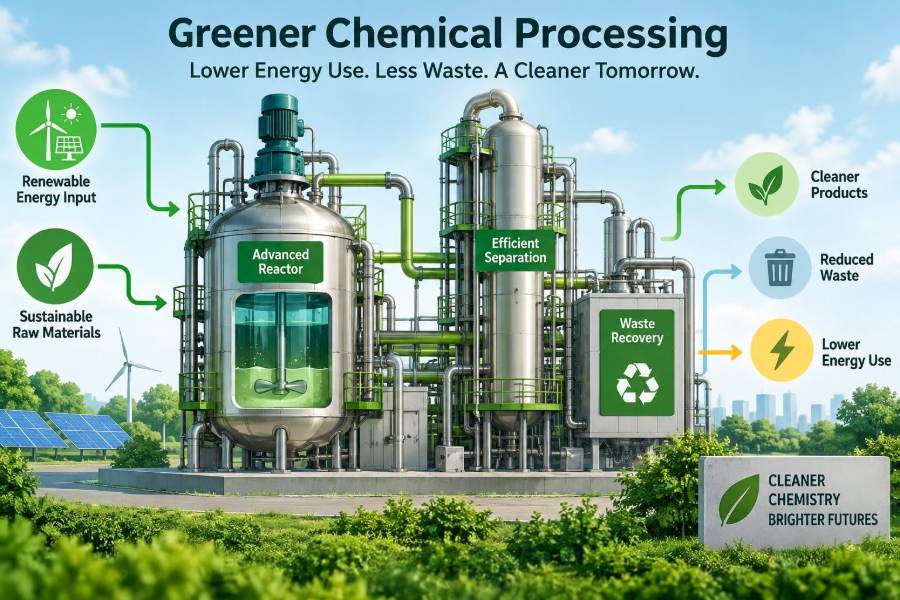
Greener processing does not mean simply attaching a treatment unit to the end of a pipe. The more powerful approach is to redesign reactions and operations so less energy and waste are generated in the first place.
For students, this shift changes what “good design” means. For working professionals, it expands the optimization target beyond throughput and yield to include lifecycle impacts, resilience, safety, and resource efficiency.
🌍 Why Chemical Processing Has a Large Footprint
Chemical plants transform matter, and transformations are rarely free. Separating mixtures can require evaporation, compression, refrigeration, or multiple columns; driving reactions may demand heat, hydrogen, catalysts, or carefully controlled conditions.
The largest impacts often come from utilities rather than the reaction vessel itself. Steam production, electrical motors, cooling systems, furnaces, and wastewater treatment can dominate a site’s energy demand. A greener process therefore starts by asking where energy and materials actually go.
🧭 Green Chemistry and Green Engineering Are Different
Green chemistry focuses on molecular and reaction design: safer reagents, less hazardous products, better atom use, and catalysts that reduce by-products. Green engineering applies those intentions to the whole industrial system, including equipment, controls, transport, maintenance, and end-of-life handling.
A reaction may use an excellent catalyst yet still have a poor overall footprint if its product must be purified with large solvent volumes. Conversely, a modest improvement to heat recovery can substantially lower the operating burden of an existing plant.
⚖️ Measure the Whole Process, Not One Metric
A process cannot be called greener solely because it uses a renewable feedstock or avoids one solvent. Engineers need to examine trade-offs across energy, emissions, water, toxicity, waste, land use, safety, and product performance.
Life-cycle assessment is a structured way to compare impacts from raw-material extraction through manufacture, use, and disposal. Its result depends on the system boundary and data quality, so it supports decisions rather than providing a universal verdict.
| Metric | Useful question | Potential blind spot |
|---|---|---|
| Yield | How much desired product forms? | Does not show utility demand. |
| Atom economy | How much reactant mass reaches the product? | Does not include solvents or energy. |
| Energy intensity | How much energy is used per unit product? | Energy source matters. |
| Waste intensity | How much waste is generated per unit product? | Waste hazards differ greatly. |
🧪 Atom Economy Prevents Waste at Its Source
Yield describes how effectively a reaction produces its intended compound. Atom economy asks a different question: what fraction of the reactants’ atoms ends up in that compound? A high-yield reaction can still create substantial salt or protecting-group waste.
Addition and rearrangement reactions can have favorable atom use, while routes involving stoichiometric activating agents may discard significant material. Route selection early in development is often more influential than later treatment upgrades.
🎯 Selective Catalysts Change the Reaction Path
A catalyst increases the rate of a reaction without being consumed in the idealized reaction cycle. More importantly, it can steer molecules toward the desired pathway, allowing lower temperature, lower pressure, and fewer side products.
Heterogeneous catalysts are solids used with fluid reactants and are often easier to separate. Homogeneous and biocatalysts can offer exceptional selectivity but may need more careful recovery, stability management, or impurity control.
🧬 Biocatalysis Works Under Milder Conditions
Enzymes are biological catalysts that can distinguish between very similar molecules. This selectivity is particularly useful in pharmaceutical and fine-chemical manufacture, where unwanted isomers can be difficult to separate.
Many enzymes operate near moderate temperatures and pressures, potentially avoiding harsh reagents. They are not automatically the best choice: feedstocks must be compatible, enzyme activity can decline, and aqueous operation may make product isolation more complex.
🌡️ Process Intensification Shrinks the Equipment Train
Process intensification means obtaining the same function with less equipment, less inventory, or less energy. Examples include reactive distillation, membrane reactors, compact heat exchangers, and high-shear mixing.
Reactive distillation combines reaction and separation in one column. Removing a product as it forms can shift equilibrium toward conversion, but the design couples reaction kinetics and vapor-liquid behavior tightly. It requires sound models and careful control.
🔁 Continuous Manufacturing Reduces Waiting and Inventory
Batch plants are flexible, but each batch may involve charging, heating, holding, sampling, cleaning, and transferring material. In continuous processing, material flows through equipment steadily, which can reduce residence time and equipment volume.
Smaller inventories can improve safety and reduce off-spec waste during a deviation. The trade-off is that disturbances propagate quickly, so reliable sensors, automation, and a clear startup and shutdown strategy are essential.
🌀 Flow Reactors Improve Heat and Mass Transfer
Flow reactors move reactants through channels or tubes rather than holding them in a large vessel. Their high surface-area-to-volume ratio can remove heat quickly, making fast or strongly exothermic reactions easier to manage.
They also offer precise residence-time control. However, solids, fouling, multiphase flow, and scale-up can be challenging. “Numbering up” parallel modules is sometimes preferable to making one channel much larger, but it introduces distribution and control questions.
💧 Solvent Selection Is a Major Design Decision
Solvents can make up most of the material used in a fine-chemical process, even though they do not appear in the final product. They affect reaction rate, selectivity, worker exposure, flammability, separation energy, and waste-treatment requirements.
Replacing a problematic solvent requires more than checking a hazard label. Engineers must test solubility, phase behavior, recoverability, compatibility with seals and equipment, and whether a substitution shifts a problem into a harder separation.
🌿 Alternative Solvents Need Careful Evaluation
Water, ethanol, ethyl acetate, supercritical carbon dioxide, deep eutectic mixtures, and some ionic liquids are discussed as alternatives in appropriate applications. Their benefits depend on context, not their names.
For example, water is nonflammable and widely available, but heating and evaporating it can be energy intensive. Ionic liquids have very low vapor pressure, yet their synthesis, persistence, recovery, and toxicological profile must be evaluated case by case.
🧱 Membranes Avoid Some Thermal Separations
Distillation is robust and familiar, but separating close-boiling compounds or removing dilute components can consume considerable energy. Membrane separation uses selective barriers to let certain molecules pass more readily than others.
Gas separations, solvent recovery, water purification, and concentration duties can benefit. Membranes generally need pressure or concentration driving force, and fouling or loss of selectivity can limit performance. They complement rather than replace conventional separations.
🔥 Heat Integration Reuses Energy Already Purchased
One stream leaving a process may be hot while another must be heated. Heat integration matches these duties through heat exchangers so that less external steam and cooling are needed.
Pinch analysis is a systematic method for locating practical limits to heat recovery across a network. It does not eliminate the need for utilities, but it helps designers avoid wasting a high-temperature heat source on a task that lower-grade heat could serve.
♨️ Low-Grade Heat Still Has Value
Not all waste heat can drive a reactor or generate useful steam. Warm streams may still preheat boiler feedwater, support washing, regenerate desiccants, or serve nearby low-temperature processes.
The key is temperature matching. Trying to recover every joule can create oversized exchanger networks, difficult control, and fouling risk. A sound design balances theoretical recovery with operability and maintenance.
⚡ Electrification Can Replace Combustion Duties
Electric boilers, resistance heating, induction, heat pumps, and electrochemical routes can reduce direct combustion at a facility. Their climate benefit depends on the electricity supply and on whether the technology can meet temperature, reliability, and response requirements.
Heat pumps are especially relevant when a process has a moderate-temperature heat source and a nearby heating demand. They upgrade heat using electricity rather than creating all required heat from fuel.
🔋 Electrochemistry Uses Electrons as Reagents
Electrochemical processing drives oxidation or reduction at electrodes. In favorable cases, it can avoid stoichiometric chemical oxidants or reductants that produce salt-laden waste streams.
Electrode material, current efficiency, electrolyte recovery, and power quality matter greatly. Scaling an electrochemical cell is not just a matter of adding current; mass transfer, heat removal, and uniform current distribution must remain controlled.
🌱 Renewable Feedstocks Bring New Constraints
Biomass-derived sugars, oils, residues, and captured carbon sources can reduce reliance on fossil carbon in some value chains. Yet renewable does not automatically mean low impact or sustainable at any scale.
Feedstock variability, seasonal supply, land competition, purification needs, and transport distance affect feasibility. A useful question is whether the feedstock is genuinely available without undermining food systems, ecosystems, or another essential use.
♻️ Circularity Keeps Molecules in Use
Circular chemical processing aims to recover value from products and by-products rather than treating all residual material as waste. Mechanical recycling preserves polymer structure when streams are clean enough; chemical recycling breaks materials into smaller molecules or feedstocks.
Neither approach is universal. Sorting, contamination, additives, energy use, and market demand for recovered materials determine whether recovery is practical. Designing products for separation can be as important as improving the recycling plant.
🚰 Water Minimization Starts with Segregation
Plants often use water for reaction, washing, cooling, steam, and cleaning. A common mistake is combining streams of very different quality, turning a manageable concentrated stream into a large dilute treatment problem.
Segregating high-strength, salty, oily, toxic, and relatively clean streams allows targeted treatment and possible reuse. Counter-current washing can also reduce fresh-water use by sending cleaner water to the final wash stage.
🧹 Prevent Waste Before Treating It
End-of-pipe treatment remains necessary for many operations, but it usually consumes energy and chemicals. Prevention may involve changing a reaction route, improving raw-material purity, recovering solvent, or controlling a process more tightly.
The hierarchy is practical: avoid waste first, reduce it next, reuse or recover material where justified, and treat what remains. Disposal is the last option, not a design strategy.
📈 Digital Tools Reveal Hidden Losses
Online analyzers, soft sensors, process historians, and material-balance models can expose losses that periodic laboratory samples miss. A drifting steam valve, degraded exchanger, or excessive purge stream may become visible as a pattern rather than a mystery.
Digital tools are only as useful as the measurements and engineering judgment behind them. Sensor calibration, data reconciliation, cybersecurity, and operator involvement are part of making data actionable.
🤖 Advanced Control Stabilizes Efficient Operation
Many units use more energy during transitions and disturbances than during steady operation. Advanced process control can coordinate multiple variables, keeping temperatures, pressures, and compositions closer to their economically efficient limits.
Control systems should not be pushed blindly toward minimum utility use. Safety margins, product specifications, equipment constraints, and disturbance handling must remain explicit in the control design.
🛠️ Maintenance Is an Environmental Strategy
Fouled heat exchangers raise fuel use. Steam leaks waste treated water and energy. Worn pump seals can release materials and create safety hazards. These are maintenance issues with direct environmental consequences.
Condition monitoring and disciplined inspection can prioritize repairs where they reduce loss most effectively. Small reliability improvements repeated across a large operating year can matter more than a one-time demonstration project.
🧯 Safer Design and Greener Design Often Reinforce Each Other
Lower inventories, milder conditions, safer solvents, and fewer transfers can reduce both environmental exposure and process hazards. This alignment is valuable, but it is not automatic: a flammable solvent may be readily recoverable, while a water-based process may require high pressure or generate contaminated wastewater.
Hazard assessment should therefore remain separate from environmental assessment, then be integrated into the final decision. One score cannot replace a full process safety review.
💰 Economics Must Include the Right Costs
A greener alternative can require capital for new exchangers, membranes, controls, or recovery systems. Its value may appear through lower utility demand, reduced waste handling, better product quality, lower raw-material losses, and reduced exposure to volatile fuel prices.
Projects should be evaluated over their operating life rather than only on immediate payback. At the same time, optimistic assumptions about recovery rates, downtime, or resale value can make a weak project look attractive.
🧩 Retrofitting Existing Plants Requires Priorities
Most emissions reductions will occur in facilities that already exist. A practical retrofit begins with validated mass and energy balances, utility mapping, and a ranked list of loss points.
- Fix leaks, insulation gaps, and obvious control problems first.
- Optimize existing heat-exchanger and distillation performance.
- Evaluate solvent recovery, water reuse, and heat integration.
- Consider larger changes such as electrification or route replacement after the baseline is sound.
This sequence avoids spending heavily on new technology while basic losses continue unchecked.
🎓 Skills Chemical Engineers Need Now
Core skills in thermodynamics, transport phenomena, kinetics, separations, and process control remain central. Greener design adds the ability to interpret lifecycle boundaries, collaborate with environmental and safety specialists, and compare competing metrics honestly.
Students can practice by including utility use, solvent recovery, and waste pathways in design calculations. Professionals can ask better questions during troubleshooting: is this loss caused by chemistry, separation, equipment condition, controls, or the way the process is operated?
⚠️ Common Claims That Deserve Scrutiny
“Zero waste,” “carbon neutral,” and “green solvent” can hide important assumptions. A credible claim specifies the boundary, the reference case, the energy source, and what happens to recovered or discarded materials.
Watch for burden shifting. Reducing air emissions while creating a difficult liquid waste, or cutting fuel use while increasing scarce-material demand, is not a complete solution. Transparent trade-offs are stronger than simple labels.
🧠 A Practical Framework for Better Decisions
When comparing options, define the product function first. Then map inputs, outputs, hazards, utilities, and operating constraints. Generate alternatives at the reaction, separation, utility, and site-integration levels before selecting one familiar technology.
- Prevent unnecessary material use and side reactions.
- Recover valuable materials and useful heat.
- Choose lower-impact utilities and feedstocks where feasible.
- Validate performance through pilots, monitoring, and updated balances.
This approach turns sustainability from a separate reporting task into part of routine process design.
🌟 The Core Principle: Design Out the Burden
The most effective greener technologies do not merely clean up after production. They use chemistry, equipment design, heat recovery, automation, and circular material flows to reduce the burden created per unit of useful product.
There is no single best technology for every plant. Catalysis may be decisive for one product, while heat integration, water segregation, or better controls may deliver the largest improvement elsewhere. The disciplined task is to identify the real constraint and avoid shifting impacts out of sight.
Greener chemical processing succeeds when efficiency, safety, product quality, and environmental responsibility are designed together rather than optimized one at a time. That is both a technical challenge and a practical opportunity for the profession. 🧪♻️🌍