
A pressure cooker on a stove gives a small glimpse of a difficult industrial problem. Add heat to a sealed vessel, and pressure rises. Block the heat removal or overfill the pot, and its safe operating margin quickly becomes smaller.
Now imagine the same basic physics in a reactor holding tonnes of flammable, toxic, corrosive, or highly reactive material. Some reactions generate heat faster as they get hotter. Others produce gases, change phase, form solids, or become unstable when mixing is lost.
Chemical plants are designed to make useful products, but they must also control energy, pressure, inventories, and chemical incompatibilities every minute they operate. Safety is not one valve, alarm, or emergency button. It is a layered system of chemistry, equipment, procedures, people, and organizational decisions.
Understanding those layers helps students see why process safety is a core engineering discipline, and helps working professionals recognize why small deviations deserve careful attention.
⚗️ What “Dangerous Reaction” Really Means
A dangerous reaction is not simply a reaction involving a hazardous chemical. The concern is whether the reaction can release energy or material in a way that exceeds the plant’s ability to contain, cool, control, or safely dispose of it.
A reaction may be hazardous because it is strongly exothermic, meaning it releases heat; because it creates gas and pressure; because reactants are toxic or flammable; or because an unintended reaction can occur after contamination, heating, or loss of control.
Hazard is the inherent potential for harm; risk depends on both that hazard and the circumstances that allow it to be realized. A highly exothermic reaction can be managed safely when its behavior is understood and the process is designed accordingly.
🔥 Why Heat Release Can Become a Runaway
Many reaction rates increase with temperature. In an exothermic reactor, that creates a feedback loop: reaction releases heat, the temperature rises, the reaction accelerates, and still more heat is released.
If heat removal keeps up, the temperature remains controlled. If cooling is inadequate, delayed, or interrupted, the balance can shift rapidly. This escalating event is called a thermal runaway.
The challenge is not merely the total heat of reaction. Engineers must understand how fast heat is generated, how quickly it can be removed, and whether side reactions become significant at higher temperatures.
📈 The Balance Between Heat Generation and Removal
Reactor control begins with an energy balance. Heat enters through reaction and perhaps hot feeds; heat leaves through jackets, coils, condensers, product streams, and heat loss to the surroundings.
At steady operation, generation and removal are balanced. But operating conditions can move the system away from that point. A higher feed concentration, warmer raw material, slower agitation, fouled heat-transfer surface, or incorrect charge sequence can all change the balance.
Engineers do not assume the normal operating point is the only one possible. They examine credible deviations and ask whether the system has a stable response or can move toward a high-temperature state.
🧪 Reaction Calorimetry Reveals Hidden Heat
Before scale-up, specialists use calorimetry to measure thermal behavior. A reaction calorimeter can estimate heat-release rate under controlled additions, while adiabatic calorimetry examines what may happen when little or no heat escapes.
These tests can reveal delayed reactions, decomposition onset, gas generation, or accumulation of unreacted feed. Such information is particularly valuable for batch processes, where conditions change throughout each charge.
Laboratory data are not automatically a full-scale answer. Mixing, heat transfer, impurities, vessel geometry, and operating sequence can differ substantially at plant scale. Still, sound data replace guesswork with a defensible design basis.
🧭 Safe Operating Limits Define the Boundaries
Plants define limits for variables such as temperature, pressure, level, feed rate, composition, agitation speed, and utility availability. These limits are derived from process knowledge, equipment ratings, control capability, and hazard analysis.
There is usually a difference between a normal target and an absolute boundary. Operators may adjust a process around its target, but crossing a critical limit may require an automatic shutdown, a controlled hold, or an emergency response.
Clear limits are useful only when they are accessible, understood, and linked to a practical action. A vague instruction to “watch reactor temperature” is much weaker than defined alarm and trip responses.
🧱 Inherently Safer Design Comes First
The strongest safety improvement often removes or reduces the hazard rather than adding another protective device. This philosophy is known as inherently safer design.
- Minimize: use less hazardous inventory where feasible.
- Substitute: choose a less hazardous reagent, solvent, or route when performance allows.
- Moderate: use milder conditions, dilution, lower temperature, or less energetic forms.
- Simplify: make equipment and procedures less prone to error.
These choices involve trade-offs. Dilution, for example, may reduce reaction severity but increase solvent handling and separation duty. The goal is not a universal rule; it is to reduce overall risk deliberately.
🏭 Why Reactor Type Changes the Safety Problem
A batch reactor is charged, reacted, and emptied in cycles. It is flexible, but changing composition and operator actions make sequencing especially important. A semi-batch reactor adds one reactant gradually, which can limit instantaneous heat release if the addition is controlled.
Continuous reactors maintain flowing input and output. Their smaller hold-up can reduce hazardous inventory, but they demand reliable control of flow, residence time, composition, and startup or shutdown transitions.
There is no inherently “safe” reactor type. The right choice depends on reaction kinetics, heat transfer, product needs, potential instability, and the plant’s ability to operate the system consistently.
🌊 Mixing Is a Safety Function, Not Just a Quality Feature
Agitation distributes heat and reactants. When mixing is poor, a temperature sensor may report an acceptable bulk value while a local hot spot near an injection point is much hotter.
Local concentration spikes can also trigger side reactions, polymer formation, decomposition, or gas evolution. Viscous systems and solid-containing slurries are especially challenging because mixing behavior can change during the batch.
Designers consider impeller type, baffles, feed location, viscosity range, liquid level, and motor reliability. Operators must treat loss of agitation as potentially serious whenever cooling or reaction control depends on mixing.
❄️ Cooling Systems Need Capacity and Reliability
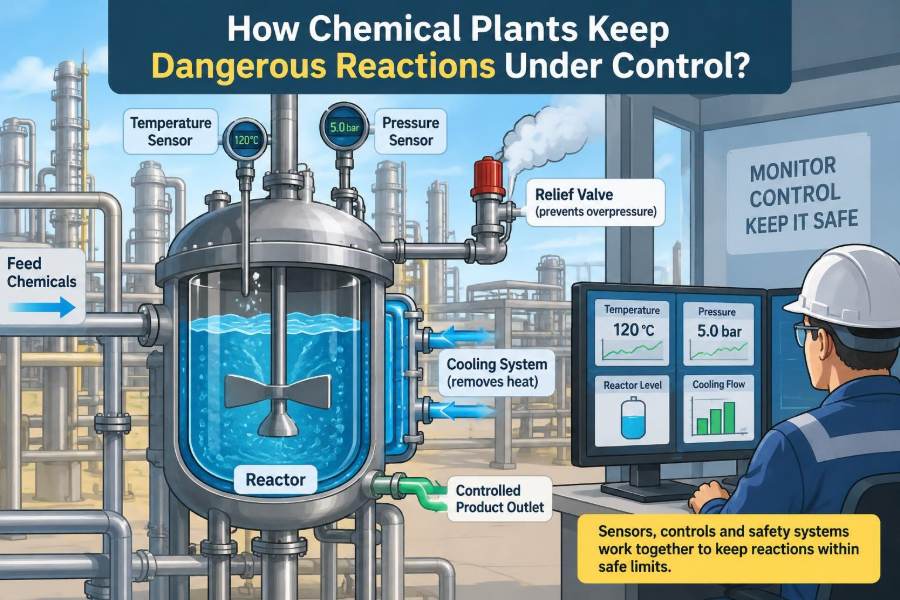
Reactor jackets and internal coils remove heat through a cooling medium such as water, brine, or another utility fluid. Condensers may remove heat by condensing vapor above a reactor.
Capacity alone is not enough. Cooling can be lost through a utility outage, pump failure, control-valve malfunction, fouling, low flow, or a temperature change in the cooling supply. A robust design considers the consequences of these failures.
In some processes, an independent emergency cooling arrangement or a planned quench is justified. In others, safely stopping reactant addition is the primary response. The appropriate safeguard follows from the reaction’s specific behavior.
🧯 Quenching Can Stop a Reaction, but It Must Be Designed
A quench introduces a material that slows, destroys, dilutes, or otherwise terminates reactive conditions. It might cool the mixture, consume a reactive intermediate, inhibit polymerization, or neutralize a reagent.
A quench can create hazards of its own. Adding cold liquid to a hot vessel may flash vapor; neutralization can release heat and gas; and a poorly mixed quench may not reach the reactive zone.
For that reason, quench design considers storage, availability, injection location, required quantity, mixing, reaction compatibility, and the fate of the resulting material. “Add water” is never an adequate emergency plan without chemistry and engineering behind it.
🔒 Controlling Feed Prevents Accumulation
In a semi-batch process, gradual addition is often a key safety control. The feed rate is selected so the reactor can remove heat while keeping the amount of unreacted material low.
If the reaction slows unexpectedly, feed may accumulate. A later temperature increase, improved mixing, or catalyst activation can then consume that inventory quickly. This is one pathway to a rapid temperature and pressure rise.
Feed control therefore may use flow measurement, temperature feedback, ratio control, maximum-rate limits, and automatic cutoff on abnormal conditions. The measurement must reflect the real process, not merely the controller’s requested position.
🎛️ Basic Process Control Handles Normal Variation
Control loops continuously compare a measured variable with a target and adjust an output. A reactor temperature controller, for example, may regulate cooling flow or jacket temperature.
Good control reduces routine variation, but it is not usually the final defense against a major upset. Controllers can fail, instruments can be wrong, and a severe disturbance may exceed their range or response speed.
Process control is best viewed as the first active layer that keeps the plant near normal conditions. Independent layers are needed for abnormal situations that could lead to significant consequences.
🚨 Alarms Give People Time to Intervene
An alarm should indicate a condition needing operator attention and provide enough time for a meaningful response. A high-temperature alarm may prompt an operator to stop feed, verify coolant flow, investigate mixing, and follow a defined procedure.
Too many alarms can be dangerous because they overwhelm attention and make critical signals harder to recognize. Alarm management focuses on rationalizing alarms so each one has a purpose, priority, and expected response.
Alarms are not substitutes for automatic protection when a deviation develops faster than a person can detect, diagnose, and act. Their value depends on realistic response time, workload, training, and clear operating guidance.
🛑 Safety Instrumented Systems Act Independently
A safety instrumented system, often called an SIS, detects a hazardous condition and takes a predefined action to move the process toward a safer state. For example, an independent high-high reactor temperature sensor may close feed valves and open emergency cooling.
Independence matters. If the same failed transmitter, controller, power source, or final valve can defeat both normal control and the shutdown function, the claimed protection may be weaker than it appears.
These systems require careful specification, testing, maintenance, and management of bypasses. A shutdown function that is never proof-tested may not be available when demanded.
🧩 Layers of Protection Work Together
Plants use the idea of layers of protection: multiple, diverse barriers prevent an initiating event from becoming a release or reduce its consequences if prevention fails.
| Layer | Typical purpose | Example |
|---|---|---|
| Inherent design | Reduce the hazard at its source | Lower hazardous inventory |
| Basic control | Maintain normal operation | Temperature-control loop |
| Alarm and response | Enable intervention | High-temperature alarm |
| Automatic shutdown | Stop escalation | Close reactant feed |
| Mechanical relief | Protect equipment from overpressure | Rupture disk or relief valve |
| Mitigation | Limit effects of a release | Containment or flare system |
No individual layer should be credited casually. Its effectiveness depends on independence, reliability, inspection, testing, and whether it can perform under the actual upset.
💨 Pressure Relief Is the Last Line for the Vessel
If pressure rises beyond a vessel’s allowable limit, a pressure-relief device provides a controlled opening so the vessel itself is less likely to rupture. Common devices include relief valves and rupture disks.
Relief design for reactive systems is specialized. The discharge may be vapor, liquid, foam, two-phase material, or a mixture carrying solids. The reaction may continue while material is venting, and a blocked outlet or undersized piping can undermine performance.
Relief devices protect equipment; they do not make an uncontrolled reaction acceptable. Their discharge must go somewhere designed to receive it, such as a closed collection system, scrubber, flare, or other suitable treatment arrangement.
🌬️ Vent Systems Must Handle What Actually Leaves
A vent route must be compatible with the expected temperature, pressure, chemistry, flow regime, and contaminants. A system intended for clean vapor may not safely handle corrosive liquid carryover, polymerizing material, or reactive solids.
Condensers, knock-out drums, scrubbers, flare headers, and emergency containment tanks each have defined duties and limitations. Their performance can be affected by temperature, backpressure, liquid accumulation, freezing, corrosion, or simultaneous demands from other equipment.
Understanding the complete discharge path is essential. A relief valve is only one component of a larger protective system.
🧊 Inerting Reduces Fire and Explosion Potential
Inerting replaces or dilutes oxygen in equipment with an inert gas, commonly nitrogen where compatible. This can reduce the chance that flammable vapor and air form an ignitable mixture.
It is not a cure-all. Air can enter through leaks, vacuum conditions, openings, or incorrect line-up. Purging must be designed for equipment geometry, and oxygen measurement may be needed where assumptions are not enough.
Inert gas also creates an asphyxiation hazard in enclosed spaces. Safe inerting includes vent handling, area awareness, access controls, and procedures that recognize both fire prevention and oxygen-displacement risks.
⚡ Ignition Control Complements Containment
Where flammable materials may be present, plants reduce ignition sources through electrical-area classification, grounded and bonded equipment, suitable tools, static-control practices, and hot-work controls.
Bonding connects conductive objects so they remain at similar electrical potential. Grounding provides a path for charge to dissipate. Both matter during transfer of low-conductivity liquids, powder handling, and operations where static can accumulate.
Ignition control does not eliminate the need to prevent releases. It is one part of managing a fire or explosion scenario, alongside containment, ventilation, inerting, and detection.
🧫 Contamination Can Change the Chemistry
A small amount of the wrong material can catalyze decomposition, neutralize an inhibitor, create a gas-forming reaction, or cause an unexpected phase change. Contamination may enter through shared hoses, misconnected lines, residues, poor cleaning, or incorrect raw material.
Compatibility reviews identify materials that must be segregated. Labeling, dedicated equipment, positive line identification, cleaning verification, and controlled connections all reduce opportunities for unintended contact.
This is why “close enough” is not an acceptable standard for chemical identity. In reactive service, a seemingly minor substitution or trace carryover may alter the safety basis.
🧾 Procedures Turn Design Intent into Repeatable Work
Written procedures translate engineering knowledge into field actions: charge order, maximum addition rate, sampling method, utility checks, alarm response, shutdown steps, and emergency actions.
Useful procedures are specific enough to guide decisions but practical enough to use under real operating conditions. They should match current equipment and include the reasons behind critical restrictions where that helps prevent shortcuts.
Operators often detect weak signals before instruments do: unusual sound, vibration, foam, delayed temperature response, or a pump behaving differently. Procedures should support—not replace—skilled observation and escalation.
👷 Training Builds Judgment, Not Just Compliance
Training must explain what actions are required and why they matter. A person who understands that continued feed can accumulate reactant during poor conversion is more likely to recognize the significance of an abnormal trend.
Competence develops through supervised practice, scenario discussion, drills, and exposure to normal and abnormal process behavior. It includes knowing when to stop work, hold a batch, call for support, or use emergency procedures.
Human performance is shaped by workload, interfaces, staffing, fatigue, communication, and production pressure. Treating errors as only an individual problem misses opportunities to improve the system around the person.
🔄 Management of Change Protects the Safety Basis
Changes in raw-material supplier, concentration, solvent, catalyst, control logic, vessel volume, cleaning chemical, or production rate can alter reaction behavior. Even a “temporary” modification can invalidate assumptions made during design.
Management of change is a structured review before a change is implemented. It asks what is changing, why, which hazards are affected, what documents and training need updating, and whether the modification has been properly verified.
Urgent changes may require accelerated decisions, but they still need defined authority and follow-up. Informal workarounds are particularly risky when they persist long enough to become normal practice.
🔍 Hazard Reviews Find Credible Deviations
Hazard reviews use structured questions to identify what could go wrong. A common approach asks prompts such as “more,” “less,” “none,” “reverse,” or “other than” for flow, temperature, pressure, composition, and other parameters.
For a reactant feed line, “more flow” might lead to heat accumulation; “no flow” could cause a ratio problem; “reverse flow” might contaminate a storage tank. The team then considers causes, consequences, existing safeguards, and needed actions.
The quality of a review depends on accurate process information and participation from people who understand design, operation, maintenance, controls, and chemistry. A checklist cannot replace informed challenge.
🧮 Scenario Analysis Tests the Uncomfortable Cases
Engineers analyze scenarios such as total loss of cooling, loss of agitation, blocked outlet, external fire exposure, wrong material addition, or delayed emergency response. The purpose is not to predict every accident precisely; it is to test whether the protection strategy is adequate.
Good scenarios include combined conditions when credible. For example, a loss of power may affect agitation, cooling circulation, instrumentation, and valve position at the same time, depending on the facility design.
Assumptions should be documented and revisited as the process changes. A calculation based on clean heat-transfer surfaces or a fully available quench system may not represent degraded real-world conditions.
🛠️ Inspection and Maintenance Keep Barriers Available
Valves can stick, relief devices can foul, instruments can drift, cooling channels can plug, and emergency pumps can fail silently. Mechanical integrity programs identify critical equipment and establish inspection, testing, calibration, and repair practices.
Maintenance also introduces risk. Opening equipment, defeating interlocks, isolating relief paths, and returning systems to service all require disciplined planning and verification.
A common mistake is focusing on visible production equipment while overlooking safeguards that operate only during an upset. Protective devices deserve the same seriousness as the process equipment they protect.
📊 Leading Indicators Reveal Weakening Defenses
Major incidents are rare, so waiting for an accident to judge safety performance is not enough. Plants also track signs that protective systems or work processes are degrading.
Examples include overdue safety-critical tests, repeated alarm floods, temporary bypasses, recurring near misses, delayed corrective actions, and unresolved process deviations. These are not proof that an event will occur, but they can point to weaknesses needing attention.
Near-miss reporting is most useful in a culture where people can raise concerns without automatic blame. The goal is to learn why a barrier was challenged and strengthen the system before consequences become severe.
🧠 Learning From Incidents Without Simplifying Them
Incident investigations should look beyond the last action or failed component. Why was the condition possible? Were limits unclear? Did design assumptions fail? Was equipment condition known? Did communication or decision-making create pressure to continue?
Complex events usually have multiple contributing factors. Identifying those factors does not remove personal accountability where it is warranted; it helps prevent recurrence through stronger design, procedures, training, and oversight.
Lessons must reach the people and units that can use them. A report stored in a database changes little unless it leads to specific, verified improvements.
🚧 Common Mistakes in Reactive Process Safety
Several patterns repeatedly weaken control of hazardous reactions:
- Assuming a familiar reaction is safe under all concentrations, scales, or operating modes.
- Using normal control loops as the only protection against rapid escalation.
- Crediting an alarm when operators have insufficient time or information to respond.
- Changing feed, raw materials, or equipment without reviewing the reaction safety basis.
- Designing a relief device without evaluating the full discharge path.
- Ignoring loss of mixing, utility degradation, fouling, or instrument failure because they seem routine.
Each mistake has a common theme: treating safety as a document or device instead of an operating system that must remain effective over time.
🧭 A Practical Way to Think Through a Reaction
For any reactive operation, ask a sequence of straightforward questions:
- What energy and hazardous materials are present?
- What deviations could accelerate reaction, generate pressure, or release material?
- How quickly could conditions worsen?
- Which safeguards prevent the deviation, and are they independent?
- What protects the vessel if prevention fails?
- Where does any emergency discharge go?
- How are safeguards tested, maintained, and kept current after changes?
This framework does not replace formal analysis, but it encourages the systems thinking that reactive chemical processes require.
🌐 Process Safety Extends Beyond the Reactor
A reactor may be well protected while risk remains elsewhere: raw-material unloading, storage tank venting, waste treatment, filtration, drying, packaging, cleaning, and maintenance can all involve reactive or flammable hazards.
For example, a filter cake may retain solvent and reactive material, while a dryer introduces heat and reduced pressure. A safe reactor recipe does not automatically make downstream handling safe.
Plant-wide safety requires following materials and energy through the entire lifecycle, including startup, shutdown, abnormal operation, sampling, transfer, and disposal.
🤝 Clear Communication Holds the System Together
Shift handovers, contractor coordination, laboratory-to-plant transfer, and maintenance planning all depend on accurate communication. Critical information includes current batch stage, equipment out of service, alarms bypassed, abnormal trends, and temporary controls.
Ambiguity is hazardous when timing matters. Closed-loop communication—where the receiver repeats or confirms a critical instruction—can reduce misunderstandings during complex or unusual work.
Good communication is not paperwork for its own sake. It preserves the shared mental picture needed for people to operate a changing process safely.
🏁 The Core Principle: Control Energy, Inventory, and Uncertainty
Chemical plants keep dangerous reactions under control by understanding what the chemistry can do, limiting hazardous inventory where practical, managing heat and pressure, and building multiple independent protections around credible failures.
The most reliable approach begins before construction with reaction data and safer design choices. It continues through careful operation, tested safeguards, change control, maintenance, learning, and respectful attention to abnormal signals.
Process safety is the disciplined practice of ensuring that a chemical reaction remains within conditions the plant can safely contain and control—even when equipment, utilities, or people do not behave exactly as planned.
Dangerous reactions are controlled not by one heroic safeguard, but by layers of sound chemistry, thoughtful engineering, reliable equipment, and informed human decisions working together. That mindset turns process safety from a checklist into a daily engineering responsibility. 🧪🛡️⚙️