
A separation problem can look straightforward on a process flow diagram: feed enters a vertical vessel, vapor rises, liquid falls, and two products leave at different compositions. Yet the choice of what goes inside that vessel—trays or packing—can shape energy use, product recovery, operating range, maintenance work, and even whether an existing tower can meet a new duty.
This decision commonly appears during revamps. A plant needs more throughput, a tighter separation, or lower pressure operation, but increasing tower height or diameter may be expensive or physically impossible. Packing often becomes an attractive answer, though it is not automatically the right one.
Tray columns and packed columns both create contact between vapor and liquid so mass transfer can occur. Their strengths emerge under different hydraulic, mechanical, fouling, and control conditions.
The useful question is not which internals are “better.” It is: which contactor best fits the fluids, pressure, capacity, turndown, layout, and maintenance realities of this specific service?
🔍 Start with the separation duty
Engineers first define what the column must accomplish. It may be distillation, absorption, stripping, liquid-liquid extraction, or a related gas–liquid contacting operation. The required product specifications determine the needed separation, while feed condition and operating pressure influence vapor and liquid traffic.
A column that must remove trace hydrogen sulfide from a gas stream presents a different design problem from a crude distillation fractionator. The first may favor low pressure drop and corrosion-resistant packing; the second may need robust handling of large liquid rates and difficult feed distribution.
🏗️ What a tray column does
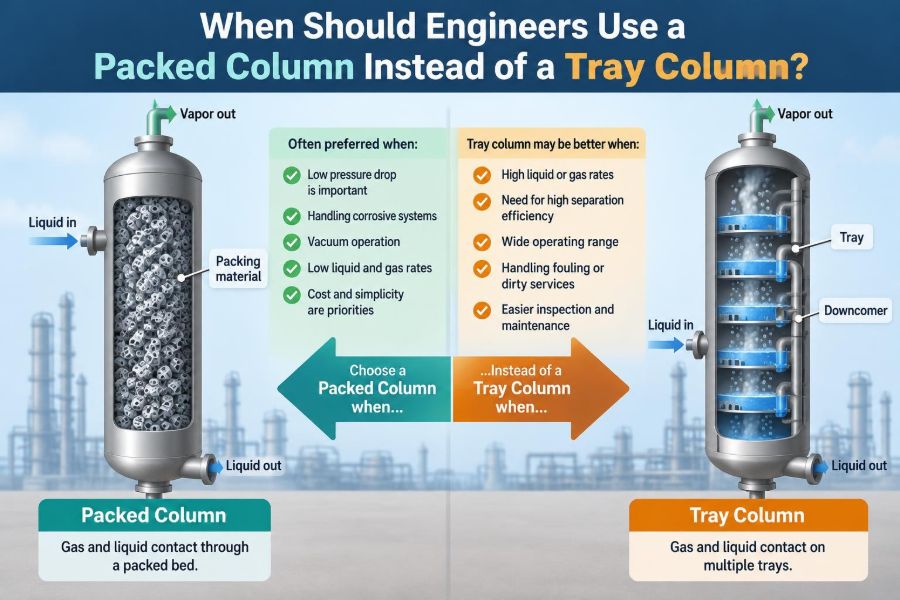
A tray column contains horizontal stages at intervals up the shell. Liquid flows across each tray and down through downcomers, while vapor rises through openings, valves, caps, or other devices. The vapor disperses through the liquid, generating interfacial area for mass transfer.
Each well-designed tray approximates a discrete contacting stage. Designers can therefore express the separation requirement in theoretical stages, then account for real tray efficiency to estimate the number of installed trays.
🧱 What a packed column does
A packed column contains a bed of small elements that create a large wetted surface. Liquid is distributed over the top of the bed and flows as films and rivulets over the packing, while vapor generally flows upward through the open voids.
Rather than distinct stages, packing is usually described by its height equivalent to a theoretical plate, or HETP. If a separation needs a certain number of theoretical stages, multiplying that requirement by HETP gives an initial estimate of packing height.
🔄 The common mass-transfer goal
Both designs move a component between phases because the actual compositions differ from equilibrium compositions. In distillation, the more volatile component tends to enrich the vapor; in absorption, a solute transfers from gas into an absorbing liquid.
The contact pattern differs, but the goal is shared: expose fresh vapor and liquid to enough interface for enough time. Internals must provide surface area and mixing without creating an impractical pressure drop or unstable flow regime.
📏 Why pressure drop often decides the issue
Packed columns are often selected when allowable pressure drop is very small. This is especially relevant in vacuum distillation, where every added pressure loss raises the pressure at the bottom of the column and can require a higher boiling temperature.
Higher temperature may harm heat-sensitive compounds, increase reboiler demand, or worsen degradation. Modern structured packing can provide substantial contacting performance with much lower pressure drop per theoretical stage than conventional trays in many services.
This is a tendency, not an absolute rule. The actual result depends on packing geometry, tray type, liquid and vapor rates, and the column’s operating point.
🌡️ Choose packing for vacuum service
Vacuum towers processing high-boiling or thermally sensitive materials are classic packed-column candidates. Lower pressure lets materials boil at lower temperatures, which can be essential for specialty chemicals, lubricating fractions, edible oils, and temperature-sensitive intermediates.
Structured packing is particularly useful here because its ordered channels offer low resistance to vapor flow. Good liquid distribution is critical: a low-pressure-drop packing bed cannot compensate for liquid that enters unevenly and leaves part of the surface dry.
⚡ Consider the energy consequence carefully
Pressure drop has energy consequences, but the connection is process-specific. In a vacuum system, reducing column pressure drop can reduce the burden imposed by vacuum equipment and permit lower-temperature separation. In a compressor-limited gas absorber, it can reduce compression requirements.
For an ordinary atmospheric distillation column, the energy case may be less direct. A packing choice should be evaluated with a full process model and realistic hydraulic correlations, rather than assuming that lower pressure drop always produces a large utility saving.
📦 Use packing to increase capacity in an existing shell
Revamps frequently favor packing because a packed bed can offer lower vapor-flow resistance than a tray deck. If an existing tower is constrained by pressure drop or tray flooding, replacing trays with suitable packing may allow more vapor throughput within the same shell diameter.
This is not guaranteed capacity. The new design must also check distributors, collectors, feed nozzles, reboiler and condenser limits, shell supports, and downstream equipment. A tower is a system, and its original bottleneck may lie outside the contacting internals.
🌊 Understand flooding before promising more throughput
Flooding occurs when rising vapor impedes falling liquid so severely that liquid accumulates, pressure drop rises sharply, and separation becomes unstable. Both trays and packing can flood, but the hydraulic mechanisms and warning signs differ.
With packing, high gas velocity can entrain liquid upward and restrict drainage through void spaces. With trays, excessive vapor can back up liquid in downcomers or cause intense entrainment between stages. A capacity claim must be based on the relevant flooding correlation and adequate design margin.
🪶 Select packing when liquid holdup must stay low
Packing generally holds less liquid than tray systems of comparable separation duty. Low liquid holdup can be helpful where long liquid residence time would promote thermal degradation, polymerization, or undesirable side reactions.
It can also reduce the inventory of hazardous or costly material within a column. However, lower holdup often means less natural damping of disturbances, so controls and distributors must be designed with the process dynamics in mind.
⏱️ Think about residence time and product quality
For reactive, heat-sensitive, or oxygen-sensitive liquids, residence time can matter as much as equilibrium-stage count. A shorter path through a packed section may limit exposure to heat or reactive contaminants.
For example, a hypothetical purification step for a monomer-forming intermediate might favor packing if prolonged residence encourages fouling polymer formation. The engineering team would still need compatibility data, inhibitor strategy, temperature limits, and a credible cleaning plan before deciding.
🧪 Match packing to corrosive environments
Packing is available in metal, ceramic, and plastic materials. This flexibility can be valuable when process chemistry attacks conventional carbon steel or when lightweight polymeric packing is suitable at modest temperatures and pressures.
Ceramic random packing can serve corrosive acid applications, while high-alloy metal or engineered plastic options may fit other chemical environments. Material selection remains a complete mechanical-integrity decision: corrosion rate, temperature, mechanical strength, fire risk, and contamination requirements all matter.
🧬 Favor packing for some foaming systems
Foaming liquids can create difficulties on tray decks. Persistent foam may increase entrainment, reduce effective vapor–liquid disengagement, and cause erratic operation. A properly selected packed bed can sometimes be gentler because it avoids repeated bubbling through deep tray liquid.
But packing is not a universal antifoam device. Foam can occupy packing voids, raise pressure drop, and impair drainage. Small-scale testing, operating history with related fluids, and conservative hydraulic design are far more useful than selecting packing based on the word “foaming” alone.
🧯 Know when solids make packing a poor choice
Suspended solids, sticky deposits, salts that crystallize, coke precursors, and polymerizing materials can plug packing passages or distributors. Once flow distribution deteriorates, the bed may lose efficiency long before complete plugging is visible.
Trays are often easier to inspect and mechanically clean through manways. For dirty service, robust tray designs—or a different separation scheme—may be more practical even if packing appears superior in a clean-fluid simulation.
🧹 Compare cleaning and inspection access
A tray deck gives maintenance personnel recognizable, accessible surfaces. Damaged valves, fouled areas, and downcomer problems can often be located during an outage. Packing may need to be removed from a bed, sometimes in significant volume, to access support grids or internal collectors.
Random packing can be unloaded and reloaded, but this still requires handling and disposal planning. Structured packing is installed in blocks; it may be more orderly to remove, yet it can be vulnerable to deformation if mishandled.
🎯 Distribution is the packed bed’s hidden requirement
Packing performs well only when liquid reaches its surface relatively uniformly. A liquid distributor divides incoming flow across the column cross-section, while redistributors restore uniformity after a certain bed height or after disturbances such as feeds and side draws.
Maldistribution creates dry zones and overloaded channels. Vapor then prefers low-resistance paths, reducing effective contact area and producing disappointing separation despite an apparently adequate packing height.
- Low liquid rate can make distributor holes or troughs operate unevenly.
- An off-center feed can bias liquid toward one side of the bed.
- A damaged distributor can turn a high-performance packing into an underperforming installation.
📐 Column diameter changes the distribution challenge
As column diameter increases, achieving uniform liquid distribution becomes more demanding. The distributor must cover a larger area, maintain levelness, resist fouling, and accommodate realistic turndown. Installation tolerances matter because a slightly tilted device can cause systematic liquid bias.
For large-diameter, high-liquid-rate towers, trays may offer a simpler and more forgiving contacting arrangement. Packing remains feasible in large columns, but it requires careful distributor, collector, support, and mechanical design rather than a simple scale-up from a pilot unit.
↕️ Compare turndown realistically
Turndown is the range between the lowest and highest flow rates at which a column performs acceptably. Tray behavior can deteriorate at low vapor flow because vapor no longer keeps liquid properly mixed on the deck; this is called weeping or dumping in some tray configurations.
Packed beds do not have tray weeping, but very low liquid rates can cause poor wetting and distributor malfunction. Either design can have excellent or poor turndown depending on internals and service. The correct comparison uses the expected operating envelope, including startup, reduced-rate production, and seasonal changes.
🛠️ Recognize where trays are more forgiving
Trays often tolerate imperfect liquid distribution better because each tray spreads liquid laterally across its deck before it enters the next downcomer. They also provide repeated mixing and redistribution from stage to stage.
That characteristic makes trays attractive where feeds vary substantially, side draws disturb internal flow, or field conditions make precise distribution difficult. “Forgiving” does not mean immune to poor design: tray levelness, downcomer clearance, inlet calming, and vapor distribution remain essential.
🧩 Distinguish random from structured packing
Random packing consists of individual pieces dumped into the vessel, such as rings or saddles. It is often robust, comparatively simple to install, and useful over a wide range of applications. Its irregular arrangement produces many flow paths but generally more resistance than highly open structured packing.
Structured packing is assembled from corrugated sheets arranged in ordered layers. It can deliver low pressure drop and high efficiency, especially in vacuum work, but relies heavily on good distribution and careful installation.
| Feature | Random packing | Structured packing |
|---|---|---|
| Arrangement | Individual dumped elements | Ordered blocks or elements |
| Typical strength | Practical, robust installation | Low pressure drop and high efficiency |
| Common concern | Higher resistance for a given duty | Distribution sensitivity and handling care |
🧮 Do not confuse HETP with a universal property
HETP is useful, but it is not a fixed value printed on packing forever. It changes with system properties, pressure, liquid and vapor loads, packing size, distribution quality, and the mass-transfer difficulty of the chemical system.
Reliable design uses appropriate correlations, vendor data interpreted within their valid range, and process simulation where suitable. For demanding separations, pilot data or operating experience may be warranted. Treating an optimistic HETP as a guarantee can lead to a tower that physically fits but misses purity targets.
🧭 Account for feeds, side draws, and redistributors
A packed section needs internal devices wherever liquid is introduced, removed, or allowed to travel far enough to become unevenly distributed. Feed devices should limit splashing and avoid sending a liquid jet directly into one part of the bed.
Collectors remove liquid between beds; redistributors then spread it again. Side draws and pumparounds can make this arrangement more complex. Tray columns often integrate such process features naturally at specific stages, which can make them attractive for intricate fractionation layouts.
🏭 Consider mechanical limits and vessel geometry
Packing needs a support plate that holds the bed without excessive pressure loss and a hold-down arrangement that prevents movement under upset vapor flow. The shell must accommodate distributor elevations, manways, supports, and installation access.
In a short vessel, packing can sometimes provide needed stages in less vertical space. In another vessel, existing nozzles, support rings, or access limitations may make a tray retrofit simpler. Mechanical design and process design should proceed together, not as separate handoffs.
🔊 Evaluate vibration, surges, and upsets
Severe pressure surges, abrupt vapor-rate changes, or mechanical vibration can damage delicate internals. Structured packing blocks can shift or deform if restraints are inadequate, while tray decks can suffer from uplift, warped panels, or damaged valves.
Engineers should ask what happens during compressor trips, steam interruptions, relief scenarios, and rapid feed changes. The preferred internal is the one that remains safe and recoverable under credible abnormal conditions, not merely the one with the best steady-state efficiency.
💧 Use liquid properties, not just flow rates
Viscosity, surface tension, density, wetting behavior, and contamination all influence column hydraulics and mass transfer. A viscous liquid may spread poorly over packing and create thick films that resist mass transfer. Low-surface-tension liquids can increase entrainment tendencies.
These effects are why a generic rule such as “packing is for low pressure” is incomplete. The same packing may perform very differently with a light hydrocarbon mixture, an aqueous amine solution, and a viscous organic liquid.
📊 Build a side-by-side decision basis
A practical decision is best made from a defined comparison rather than an informal preference. The table below summarizes common tendencies; the project’s actual hydraulic and economic evaluation must decide the result.
| Decision factor | Packing often has an advantage when… | Trays often have an advantage when… |
|---|---|---|
| Pressure drop | Vacuum or compression duty is sensitive to losses | Additional pressure drop is acceptable |
| Cleanliness | Fluids are clean and distributors can remain clear | Solids, deposits, or fouling require access |
| Capacity revamp | Existing shell is pressure-drop limited | Downcomer and liquid-handling needs dominate |
| Distribution | Good distributors and installation control are feasible | Feed conditions are highly variable or complex |
| Maintenance | Long clean runs are expected | Frequent inspection and cleaning are likely |
💰 Compare installed cost and lifecycle cost
Initial internals cost is only one part of the economic choice. A packing revamp may avoid a taller tower, reduce pressure drop, or increase throughput, but it may require sophisticated distributors, collectors, supports, and careful installation.
Tray systems may cost more or less depending on geometry and duty; there is no reliable universal ranking. Include outage duration, cleaning frequency, energy, replacement parts, expected reliability, and production value in the comparison. The cheapest internal purchase can be the costliest operating decision.
🧠 Avoid the “packing is more efficient” shortcut
Packing can offer excellent separation efficiency per unit height, particularly structured packing under favorable conditions. That does not mean it always produces a smaller, cheaper, or more reliable column.
Efficiency lost to poor liquid distribution, fouling, inadequate wetting, or off-design operation may outweigh the theoretical advantage. Conversely, a tray column with poor vapor distribution or damaged downcomers will not deliver its design performance either. Good internals require good integration.
🔎 Diagnose a struggling existing column
Before replacing internals, determine why the column is failing. Higher differential pressure may point toward flooding, fouling, or liquid accumulation. Off-spec products at normal pressure drop may suggest changes in feed composition, reflux, reboiler duty, distributor condition, tray damage, or instrumentation error.
Useful evidence includes operating trends, pressure profiles where available, laboratory data, turnaround inspection records, and a verified material balance. Replacing trays with packing without diagnosing the constraint can move the problem instead of solving it.
🧾 Ask the right questions during design
A disciplined selection review should address the complete operating case:
- What are the normal, minimum, maximum, startup, and upset vapor and liquid loads?
- What pressure drop can the process tolerate?
- Are solids, salts, polymers, or corrosive species present or credible?
- How stable are feed location, composition, temperature, and phase condition?
- Can distributors be inspected, cleaned, and installed level?
- What is the consequence if the column gradually loses efficiency?
Answers to these questions usually reveal whether the apparent advantage of packing is genuine.
✅ A practical rule for selecting packing
Choose a packed column when the service is sufficiently clean, liquid can be distributed well, and low pressure drop, low liquid holdup, compact height, or revamp capacity offers a meaningful process benefit. Vacuum distillation and certain absorption duties are especially strong candidates.
Keep trays in serious consideration when the service is dirty, maintenance access is central, liquid distribution will be unreliable, or complex feeds and side draws call for repeated stagewise redistribution. The best choice is rarely based on one criterion.
🏁 The core takeaway: fit the internals to the service
Packing and trays are tools, not competing ideologies. Packing excels when its open structure and large wetted area can be used without being undermined by fouling or maldistribution. Trays excel when discrete stages, robust liquid handling, and maintainability matter more than minimum pressure drop.
The strongest design combines process simulation, hydraulic design, mechanical review, operability analysis, and plant experience. That approach replaces simplistic rules with a contactor choice that can perform through real operating conditions.
Engineers should use a packed column instead of a tray column when low pressure drop and efficient clean-service contact outweigh the added demands of liquid distribution, fouling control, and maintenance access. A well-matched internal turns the column from a theoretical separator into a dependable process asset. 🧪🏭📈