
A bag of fertilizer, a bottle of detergent, a smartphone battery, and a glass of clean water may seem unrelated. Yet each depends on a carefully designed sequence of chemical and physical operations: reactions, separations, heat transfer, transport, measurement, and control.
Most people encounter the results of chemical engineering without seeing the systems behind them. Products arrive in reliable forms, at predictable quality, and at a scale that makes them useful beyond a laboratory bench.
That reliability was not created by chemistry alone. It emerged when people learned to turn chemical knowledge into repeatable industrial processes—processes that account for energy, materials, equipment limits, cost, safety, and environmental consequences.
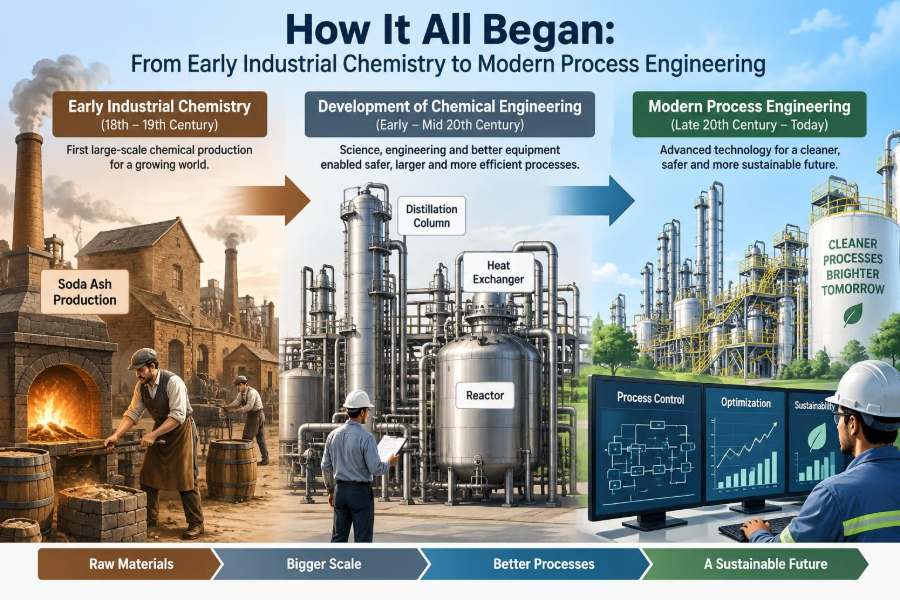
The history of chemical engineering is therefore more than a timeline of factories. It explains why modern engineers think in flows, balances, units, and whole systems rather than in isolated reactions.
🏭 Industry Came Before the Discipline
Humans practiced large-scale chemical production long before the phrase chemical engineering existed. Brewing, dyeing, tanning, soap making, glass production, metal extraction, and ceramics all required practical control of heating, mixing, evaporation, and material handling.
These crafts were often based on experience rather than formal theory. Skilled workers knew that a furnace needed a certain draft or that a dye bath behaved differently in hard water, even if the molecular explanation was unavailable.
🔥 Fire as an Early Processing Tool
Fire was one of the first ways people deliberately transformed materials. Heating drove moisture from clay, reduced metal ores, fused glass ingredients, and changed food, fuels, and pigments.
Early furnaces also introduced a problem that remains central today: heat must be delivered at the right rate and distributed as evenly as possible. Too little heat leaves a transformation incomplete; too much can damage product or equipment.
⚗️ Alchemy, Experiment, and Chemical Knowledge
Alchemy mixed philosophical aims with practical experimentation. Its practitioners developed apparatus and techniques for distillation, crystallization, filtration, calcination, and extraction—operations that later became familiar parts of chemical processing.
Alchemy was not chemical engineering, and many of its theories were incorrect. Still, its emphasis on handling materials and observing transformations helped establish a culture of experimental practice.
🧪 The Rise of Modern Chemistry
From the eighteenth century onward, chemistry increasingly described matter through measured mass, composition, and reaction relationships. This shift made it possible to ask not only whether a reaction worked, but how much feed was needed and what products could realistically be obtained.
Such measurement changed industrial decision-making. A manufacturer could begin to compare routes based on yield, raw-material use, purity, and waste rather than relying entirely on trial and error.
⚖️ Why Mass Conservation Changed Factories
The principle that matter is conserved in ordinary chemical processes leads directly to the material balance. Engineers account for what enters a system, what leaves it, what accumulates, and what reacts.
For a simple steady process, the idea is straightforward: material in must equal material out, after accounting for chemical conversion. In a real plant, the same logic helps locate losses, estimate emissions, and check whether operating data are believable.
🌡️ Energy Became a Design Variable
Industrial chemistry also depends on where energy goes. Heating a liquid, evaporating water, compressing a gas, cooling a reactor, and driving a separation all require energy transfers.
An energy balance tracks these transfers. It helps engineers size boilers, heat exchangers, furnaces, and refrigeration systems, while revealing opportunities to recover heat that would otherwise be discarded.
🧱 The Industrial Revolution Raised the Stakes
Mechanized production increased demand for chemicals used in textiles, bleaching, glass, metals, soap, paper, and other goods. Plants became larger, inputs moved farther, and inconsistent production became more costly.
At that point, a successful laboratory reaction was no longer enough. Producers needed equipment that could run for long periods, use affordable materials, and make similar product from one batch to the next.
🧂 Alkali Manufacturing Showed the Scale Problem
Alkali chemicals, including sodium carbonate and sodium hydroxide, became essential to soap, glass, textiles, and paper. Their production illustrated how demand for an apparently simple chemical could drive major changes in industrial practice.
Early routes often created difficult wastes and depended on available raw materials. Later improvements sought better recovery of reactants and by-products, demonstrating that industrial success depends on the complete process, not merely the main product.
🎨 Dyes Linked Chemistry to Manufacturing
The growth of synthetic dyes showed the commercial power of controlled organic chemistry. A colorant needed more than a promising shade: it had to be manufactured consistently, purified, formulated, and applied effectively to a fiber.
Dye manufacture also connected chemistry with supply chains and product performance. A compound’s value depended on fastness, safety, cost, and suitability for the customer’s process.
🌫️ Sulfuric Acid Became a Foundation Chemical
Sulfuric acid became widely used because it supports many other processes, from fertilizer production to petroleum refining and metal treatment. Its importance earned it a reputation as a marker of industrial capacity.
Producing it at scale required careful gas handling, catalytic reaction, absorption, corrosion-resistant equipment, and emission management. It is a useful reminder that a common chemical can demand sophisticated engineering.
💨 Pressure Opened New Chemical Pathways
Many reactions involving gases respond strongly to pressure. As industry developed stronger vessels, compressors, seals, and pumps, it gained access to operating conditions that were impractical in ordinary laboratory glassware.
Pressure can improve reaction rates or shift equilibrium toward desired products, but it also increases stored energy and mechanical risk. High-pressure technology therefore advanced alongside vessel design, inspection, and safety practice.
🌾 Ammonia and the Fertilizer Connection
The industrial synthesis of ammonia from nitrogen and hydrogen is one of the defining examples of process engineering. Nitrogen is abundant in air, but its molecular form is relatively unreactive and difficult to convert efficiently.
Large-scale ammonia manufacture combines purification, compression, catalytic reaction, cooling, separation, and recycle. Its products support fertilizers, but the process also illustrates the energy intensity and infrastructure behind globally important chemicals.
🔁 Recycle Loops Improved Conversion
In many reactions, converting every molecule of feed in one pass is inefficient or impossible. Rather than discard unreacted material, a process can separate it from products and return it to the reactor.
This recycle loop can improve feed use, but it makes the whole system more complex. Impurities may accumulate, so engineers may add a controlled purge stream to prevent them from reaching harmful concentrations.
🌀 Unit Operations Created a Shared Language
As chemical plants diversified, engineers recognized that many different industries used the same physical operations. Distillation separates volatile liquids; filtration removes solids from fluids; drying removes moisture; extraction transfers a component between phases.
These recurring tasks became known as unit operations. The insight was powerful: engineers could learn transferable principles instead of treating every product as an entirely new problem.
📏 Transport Phenomena Explained the Details
Unit operations work because mass, momentum, and energy move through equipment. These are studied as transport phenomena: mass transfer, fluid flow, and heat transfer.
For example, a distillation column depends on vapor and liquid contacting each other efficiently. A poor flow pattern or insufficient surface area can limit separation even when the chemistry itself is perfectly understood.
🧫 Reaction Engineering Connected Kinetics and Design
Chemical kinetics describes how fast reactions occur. Chemical reaction engineering uses that knowledge to select reactor type, temperature, pressure, mixing conditions, residence time, and catalyst arrangement.
A fast reaction is not automatically easy to run safely. If it releases heat faster than the cooling system can remove it, temperature may rise rapidly, accelerating the reaction further. This feedback is a central design concern.
🧩 From Batch Vessels to Continuous Plants
A batch process charges materials, runs through a sequence, and empties the vessel before the next batch. It is flexible and useful for smaller volumes, specialty chemicals, and products that require distinct stages.
A continuous process feeds and withdraws material steadily. It can deliver high output and consistent conditions, but it often needs greater capital investment and careful control. Neither approach is universally better.
| Process mode | Typical strength | Typical challenge |
|---|---|---|
| Batch | Flexible recipes and product changes | More handling between batches |
| Continuous | Stable high-volume production | Less tolerant of major disturbances |
🏗️ Scale-Up Is Not Just “Making It Bigger”
A reaction that performs well in a flask may behave differently in a large vessel. Mixing times increase, heat escapes less easily relative to volume, and flow may become uneven.
This is why scale-up requires models, pilot-scale work, and engineering judgment. The key question is not whether the vessel is larger, but whether the conditions controlling reaction, transfer, and safety remain acceptable.
📊 Process Control Made Consistency Possible
Industrial plants cannot rely on an operator adjusting every valve by intuition. Sensors measure variables such as temperature, pressure, flow, level, and composition, while controllers compare measurements with desired setpoints.
A basic feedback loop is much like a thermostat: it detects deviation and changes an input to reduce it. In a chemical plant, the controlled response may change steam flow, cooling-water flow, feed rate, or valve position.
🖥️ Automation Changed the Operator’s Role
Automation has moved many routine calculations and valve actions into control systems. This can improve repeatability and allow operators to supervise complex processes from centralized control rooms.
It does not eliminate the need for people. Operators and engineers must understand abnormal conditions, verify instrument behavior, manage startups and shutdowns, and avoid blindly trusting a display that may be wrong.
🛡️ Safety Became a Core Design Responsibility
Early industrial expansion brought fires, explosions, toxic exposures, and pollution. These harms made clear that production cannot be evaluated solely by output and profit.
Modern process safety aims to prevent hazardous scenarios through inherently safer choices, reliable equipment, operating procedures, alarms, relief systems, containment, training, and emergency planning. Each layer has limits; safety relies on understanding how failures can combine.
🚨 Learning from Process Hazards
A useful hazard review asks what could go wrong if a flow stops, a valve opens unexpectedly, cooling is lost, a tank is overfilled, or a wrong material enters the system. The purpose is to identify causes, consequences, and protective measures before an incident occurs.
A common mistake is treating safety as a checklist added after design. Safer outcomes are more likely when hazard reduction is built into chemistry, layout, equipment selection, and operating strategy from the beginning.
🌍 Environmental Engineering Reshaped Process Choices
Chemical plants can affect air, water, land, and ecosystems through emissions, wastewater, solid residues, resource extraction, and energy use. Managing these effects has become an integral part of process design.
Controls such as scrubbers, wastewater treatment, solvent recovery, and containment can reduce releases. Even better, where feasible, is preventing pollution by choosing cleaner reactions, reducing waste at the source, and recovering useful materials.
♻️ Green Chemistry and Engineering Work Together
Green chemistry focuses on designing chemicals and reactions that reduce hazardous substances and waste. Chemical engineering provides the practical tools to implement those ideas at meaningful scale.
The distinction matters. A reaction with fewer hazardous reagents may still consume excessive energy or require difficult separations. Conversely, an efficient plant cannot make an inherently problematic chemistry harmless. Better design considers both molecule and manufacturing route.
⚡ Energy Efficiency Is a System Question
Energy use is often governed by the connections between units rather than by a single machine. Hot streams may warm cold streams through heat exchangers, and pressure energy may sometimes be recovered instead of simply lost across a valve.
Engineers use approaches such as heat integration to examine these connections. The goal is not to eliminate all energy use, which is impossible, but to reduce avoidable losses while maintaining safe and controllable operation.
🧠 Process Systems Engineering Added Optimization
As plants generated more measurements and computing tools became more capable, chemical engineering expanded further into modeling, optimization, scheduling, and decision support. A process model links inputs, equipment behavior, and outputs mathematically.
Optimization can help choose operating conditions that balance competing goals, such as product quality, energy use, production rate, and emissions. Its result is only as trustworthy as the model, assumptions, and data behind it.
🧬 Bioprocessing Expanded the Field
Modern chemical engineering includes systems that use cells, enzymes, and biological materials. Fermentation can produce foods, pharmaceuticals, fuels, and specialized chemicals under conditions very different from those in high-temperature petrochemical plants.
Bioprocesses introduce concerns such as sterility, nutrient supply, oxygen transfer, and sensitivity to temperature or shear. Yet the underlying engineering questions—how material moves, how heat is managed, and how quality is controlled—remain familiar.
🔋 New Materials Need New Manufacturing Routes
Battery materials, advanced polymers, semiconductors, carbon-capture media, and recyclable composites require precise manufacturing. Small changes in particle size, coating thickness, impurity level, or drying conditions can strongly affect performance.
This pushes process engineers to connect microscopic material properties with plant-scale decisions. It also reinforces a long-standing lesson: product quality is created by the process, not inspected into existence at the end.
🤝 Chemical Engineering Is Inherently Collaborative
A modern project may involve chemists, mechanical engineers, electrical engineers, environmental specialists, data scientists, operators, maintenance teams, and supply-chain professionals. Chemical engineers often work at the interfaces between these groups.
Clear communication is therefore an engineering skill. A technically sound proposal must explain assumptions, risks, constraints, and trade-offs in terms that decision-makers and frontline teams can use.
🧭 What Students Can Learn from the History
The field did not develop as a list of equations waiting to be memorized. Balances, thermodynamics, fluid mechanics, separations, kinetics, and control emerged because industry needed ways to solve recurring, interconnected problems.
When studying a topic, ask where it appears in a process. A mass balance may check yield; heat transfer may protect a reactor; fluid mechanics may determine whether a pump can deliver feed reliably.
🔍 A Practical Way to Think Like a Process Engineer
When facing a technical problem, begin by defining the system boundary and its purpose. Identify feeds, products, energy inputs, constraints, hazards, and the variable that most directly indicates success.
- Draw a simple flow diagram before calculating.
- Check units and conservation laws.
- Ask what happens when conditions deviate from normal.
- Consider waste, energy, and operability alongside product yield.
- State assumptions clearly, especially when data are incomplete.
This approach applies whether the system is a water filter, a pilot reactor, or an integrated manufacturing site.
🌐 The Continuing Evolution of the Profession
Chemical engineering now reaches beyond traditional chemical plants. Its methods are used in food, medicine, electronics, clean water, sustainable materials, energy systems, and climate-related technologies.
New applications do not replace the field’s foundations. They make disciplined thinking about flows, transformations, scale, uncertainty, and responsible operation even more valuable.
✨ The Core Principle That Connects Past and Present
From an early furnace to a digitally monitored production line, the central challenge has remained remarkably consistent: turn material transformations into processes that are useful, repeatable, safe, and responsible.
Chemistry explains what substances can do. Chemical engineering asks how to make those transformations work outside the laboratory, under real constraints of scale, cost, energy, equipment, people, and the environment.
The history of chemical engineering is the history of learning to see a chemical reaction as part of a complete system—and designing that system with care. That perspective is why the discipline remains essential wherever society needs materials made reliably and responsibly. 🧪🏭🌍