
A technician needs to warm a storage tank before pumping begins. A process engineer must size a small exchanger for a new product line. A student is checking whether a proposed utility rate can cool a batch before the next shift. Although the equipment differs, each problem starts with the same question: how much heat must move?
That quantity is called heat duty. It connects a material’s flow rate, temperature change, phase behavior, and thermodynamic properties to a practical requirement for steam, hot oil, cooling water, refrigerant, electricity, or time.
The arithmetic for a simple case is often short. The engineering lies in choosing the right system boundary, property data, units, and assumptions. A result can look precise while being wrong by a factor of a thousand—or while omitting the energy needed for evaporation.
This guide develops a reliable method for calculating heat duty in sensible heating and cooling processes, then extends it to common real-world complications.
🔥 What Heat Duty Means
Heat duty, usually written as Q for a batch or Q̇ for a continuous process, is the rate or amount of thermal energy transferred to accomplish a specified temperature or phase change.
For example, heating 500 kg of water from 20°C to 60°C requires positive heat duty for the water. Cooling that same water from 60°C to 20°C requires the same magnitude of duty, but the water’s heat duty is negative because heat leaves it.
In practice, engineers often report the required magnitude and state the direction separately: “the cooler must remove 84 MJ” or “the heater requires 120 kW.”
🧭 Start with the System Boundary
Before selecting an equation, define what is included in the calculation. Is the system only the flowing liquid, or does it include the tank wall, agitator, pipework, and any accumulated liquid inside them?
A simple steady-flow exchanger calculation normally treats the process stream as the system. A batch tank calculation may need to include the vessel metal and internals if they start at a different temperature and undergo a meaningful temperature change.
A clear boundary prevents double counting. It also makes the answer easier to use in an energy balance around the actual equipment.
⚖️ Heat Is Not the Same as Temperature
Temperature indicates thermal state; it does not by itself tell us how much energy a material contains or needs. A large tank of mildly warm water can contain more transferable thermal energy than a cup of very hot water.
The energy requirement depends on mass and on the material’s heat capacity: the energy needed to raise one unit mass by one degree of temperature. Water has a relatively high heat capacity, which is why heating or cooling water-rich streams can demand substantial utility flow.
Temperature difference sets the driving change, but mass and heat capacity determine the scale of the duty.
📐 The Core Sensible-Heat Equation
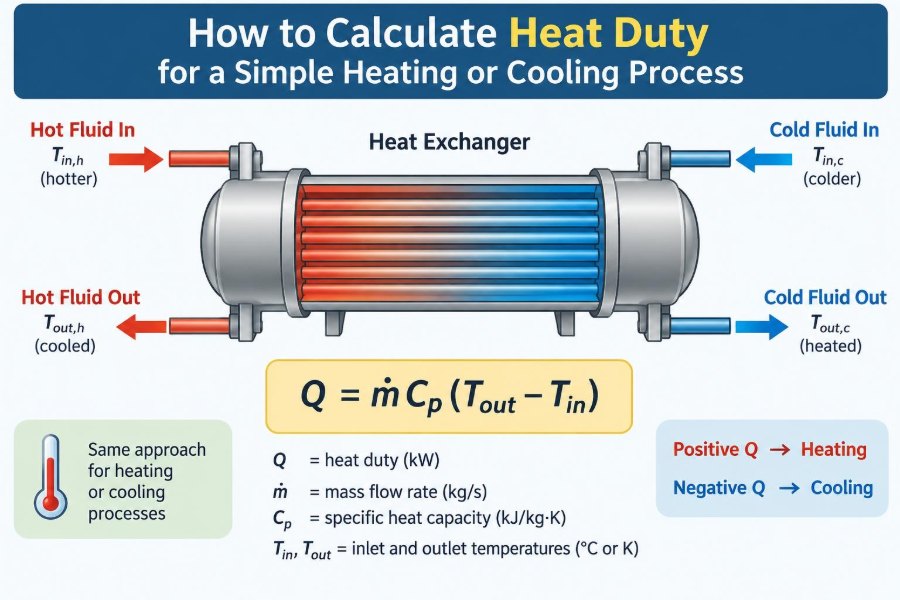
When a material remains in the same phase and its heat capacity can reasonably be treated as constant, calculate batch heat duty with:
Q = m Cp (Tfinal − Tinitial)For a continuous stream, use mass flow rate instead of total mass:
Q̇ = ṁ Cp (Tout − Tin)Here, m is mass, ṁ is mass flow rate, Cp is specific heat capacity at constant pressure, and the temperatures must be expressed on a consistent scale. A change of 1°C equals a change of 1 K, so either is suitable for a temperature difference.
➕ Read the Sign Convention Correctly
Using the equation exactly as written gives the duty of the process material. If outlet temperature is higher than inlet temperature, the result is positive: the material receives heat. If outlet temperature is lower, the result is negative: the material releases heat.
Utility calculations may use the opposite perspective. A cooling-water stream receiving heat has a positive duty, while the process stream being cooled has a negative duty. Both descriptions are correct if the system is stated clearly.
For equipment specification, report direction explicitly. Saying “duty = 250 kW” without identifying heating or cooling can create avoidable confusion.
🧩 Understand Each Variable Before Substituting
The sensible-heat equation is compact, but every term carries a physical meaning and a potential source of error.
| Term | Meaning | Common units |
|---|---|---|
| Q | Total heat transferred during a batch step | kJ, MJ |
| Q̇ | Rate of heat transfer | kW, kJ/s |
| m or ṁ | Mass or mass flow rate of the material | kg, kg/s, kg/h |
| Cp | Specific heat capacity at constant pressure | kJ/(kg·K) |
| ΔT | Final minus initial temperature | K or °C |
A useful dimensional check is that kg multiplied by kJ/(kg·K) multiplied by K leaves kJ. For a flowing stream, kg/s leaves kJ/s, which is kW.
🧮 Keep Units Consistent from Start to Finish
Unit mismatch is one of the most frequent heat-duty errors. If heat capacity is in kJ/(kg·K), use mass in kg and mass flow in kg/s to obtain kJ or kW directly.
Be especially careful with hourly flow rates. A flow of 3,600 kg/h is 1 kg/s, not 3,600 kg/s. Similarly, 1 kW equals 1 kJ/s, while 1 MW equals 1,000 kW.
Write units beside every number during the calculation. This habit catches mistakes earlier than a final numerical sanity check.
🌡️ Choose a Sensible Temperature Difference
For a single stream with no phase change, use the stream’s own inlet and outlet temperatures. In a batch, use the material’s initial and final temperatures.
Do not substitute the temperature difference between a process stream and its utility into ṁCpΔT for the process stream. That utility-to-process difference is relevant to exchanger driving force and heat-transfer area, not to the stream energy change.
The energy balance asks, “How much did this material’s enthalpy change?” The heat-transfer design asks, “How readily can that energy cross the exchanger wall?” Those are related but separate questions.
💧 Find a Suitable Heat Capacity
Heat capacity depends on composition, temperature, pressure, and phase. For a preliminary estimate over a modest temperature range, a representative average Cp is often adequate.
For pure substances, reliable property references or process-simulation databases can provide temperature-dependent values. For mixtures, use measured data when available, supplier information, validated correlations, or a carefully stated estimate based on composition.
Never assume that a solution has water’s heat capacity simply because it is liquid. Concentrated salts, hydrocarbons, glycols, oils, and slurries can differ substantially.
📈 When Heat Capacity Changes with Temperature
A constant Cp approximation becomes less dependable over a wide temperature range or when properties change strongly with temperature. In that case, the more general sensible-heat relation is:
Q = m ∫ Cp(T) dTIf a property table provides values at several temperatures, divide the range into intervals and use an average heat capacity for each interval. Add the resulting duties.
For an idealized linear variation in Cp, the average of the endpoint values can be used over that interval. For demanding design work, use the property method appropriate to the fluid and operating conditions rather than forcing a simple approximation.
🚰 Worked Example: Heating a Flowing Liquid
Consider a hypothetical aqueous process stream flowing at 2.0 kg/s. It enters a heater at 25°C and leaves at 75°C. Suppose its average heat capacity is estimated as 4.0 kJ/(kg·K), with no phase change or reaction.
Q̇ = ṁ Cp (Tout − Tin)
Q̇ = (2.0 kg/s)(4.0 kJ/(kg·K))(75 − 25 K)
Q̇ = 400 kJ/s = 400 kW
The process stream needs 400 kW of heating duty. This is the heat transferred into the stream under the stated assumptions. The utility supply must usually be larger once heat losses and equipment limitations are considered.
❄️ Worked Example: Cooling a Batch
Now consider a hypothetical batch containing 1,200 kg of liquid with a heat capacity of 3.5 kJ/(kg·K). It must cool from 70°C to 30°C.
Q = m Cp (Tfinal − Tinitial)
Q = (1,200 kg)(3.5 kJ/(kg·K))(30 − 70 K)
Q = −168,000 kJ = −168 MJ
The negative sign indicates heat leaves the batch. The cooling system must therefore remove 168 MJ, before allowing for vessel heat storage, environmental gains, or other process effects.
⏱️ Convert Batch Energy into Required Power
A batch duty in MJ does not yet tell you the required cooler or heater size. You also need the target heating or cooling time.
If the 168 MJ batch duty must be removed in two hours, the average ideal cooling rate is:
Q̇average = 168 MJ / 2 h = 84 MJ/h ≈ 23.3 kWThis is an average energy requirement. Actual heat-transfer rate usually changes during the batch because the temperature difference between the batch and utility changes. Equipment may need more area or a colder utility than this average number alone suggests.
🧱 Include the Vessel When It Actually Heats or Cools
In a batch operation, the tank shell, agitator, coils, and internal fittings can absorb or release energy. Their combined thermal mass may matter, especially for small batches in heavy metal vessels or when turnaround temperatures are large.
Estimate each solid contribution using the same form, mCpΔT, then add it to the fluid requirement with the correct sign. The vessel does not always follow the batch temperature exactly, so this remains an approximation unless its temperature history is known.
Ignoring vessel heat capacity is often acceptable for a large liquid inventory in a relatively light vessel. It is less safe to ignore when evaluating short heating cycles or laboratory-scale equipment.
💨 Recognize When Phase Change Dominates
The sensible-heat equation alone does not handle melting, boiling, condensation, freezing, or vaporization. During a phase change at nearly constant pressure, a substance can absorb or release a large amount of energy with little or no temperature change.
Add a latent-heat term:
Qphase = m ΔHphaseFor example, heating a liquid to its boiling point, vaporizing part of it, and then superheating the vapor requires separate sensible-heating, phase-change, and superheating terms. Missing the latent component can make a duty estimate dramatically too low.
🪜 Break Complex Temperature Paths into Steps
Many practical problems become straightforward when separated into physically distinct stages. A good energy balance follows the actual path rather than searching for one oversized formula.
- Heat or cool the initial phase to a transition temperature.
- Add or remove latent heat for any phase change.
- Heat or cool the new phase to the final temperature.
The same staged approach helps with streams that change composition, use different pressure levels, or contain components with different behavior. Clearly label each stage and sum the signed duties.
🧪 Account for Mixing and Dilution Carefully
When two streams at different temperatures are mixed, heat transfer occurs internally even without an external heater or cooler. For an insulated mixer with no reaction, the outlet temperature comes from an energy balance on both incoming streams.
A simplified constant-heat-capacity form is:
Σ(ṁ Cp Tin) = (Σṁ Cp) ToutSome mixtures also have a heat of mixing, meaning mixing itself absorbs or releases energy. Diluting concentrated acids, bases, or salts can involve significant thermal effects, so a simple weighted-temperature estimate may be unsafe for process or safety decisions.
⚗️ Separate Reaction Heat from Sensible Heat
A reacting system can heat or cool because of chemical transformation as well as because its temperature changes. Sensible heat describes the latter; heat of reaction describes the former.
A reactor energy balance may include feed enthalpy, product enthalpy, reaction heat, jacket duty, agitation, and heat losses. Applying only mCpΔT to a reactor is appropriate only if reaction effects are negligible or intentionally excluded.
For exothermic reactions, cooling duty can be highest while the reaction rate is greatest, not necessarily when the reactor temperature is highest. That distinction matters for safe utility and relief-system evaluations.
🔄 Use Enthalpy for Greater Generality
Heat duty is fundamentally linked to enthalpy change. For a steady-flow system with negligible kinetic and potential energy changes and no shaft work, the energy balance is commonly written as:
Q̇ = ṁ (hout − hin)For a single-phase fluid with nearly constant heat capacity, the enthalpy difference is approximated by Cp(Tout − Tin). The enthalpy approach is more general because property data can capture phase change, pressure effects, nonideal mixtures, and temperature-dependent heat capacity.
This is why process simulators report stream enthalpies. The simple equation is not a competing method; it is a useful special case.
🧰 Distinguish Process Duty from Utility Consumption
A process duty of 400 kW does not automatically mean a boiler consumes 400 kW of fuel or a chiller consumes 400 kW of electrical power. Utility generation has losses and performance limits.
For condensing steam, utility flow can be estimated from the heat released per unit mass of steam, adjusted for condensate conditions and any sensible cooling. For cooling water, calculate the required flow from its allowed temperature rise. Refrigeration systems require attention to evaporator load and coefficient of performance.
Keep these layers distinct: process duty is the thermal load at the process boundary; utility demand describes what the support system must provide.
🚿 Estimate Cooling-Water Flow
If cooling water absorbs a known duty and remains liquid, its required mass flow follows the same energy equation rearranged:
ṁwater = Q̇removed / [Cp,water (Tout − Tin)]Suppose a cooler must remove 400 kW, and water is permitted to rise by 10 K. Taking water’s heat capacity as approximately 4.18 kJ/(kg·K) over ordinary liquid-water conditions gives a flow near 9.6 kg/s.
A smaller permitted water temperature rise requires more water flow. But allowing a very large rise can reduce the temperature driving force near one end of the exchanger, making the required heat-transfer area larger. Utility flow and exchanger size must be considered together.
♨️ Understand What Steam Adds to the Calculation
Steam is often effective for heating because condensing steam releases latent heat at a nearly constant saturation temperature. The available heat per kilogram depends on steam pressure, condensate outlet condition, and whether subcooling or flash steam occurs.
Do not use a generic latent-heat value without checking pressure. Saturation properties vary with pressure, and plant steam may be wet, superheated, or mixed with noncondensable gases.
For preliminary work, steam tables or validated utility data provide the enthalpy difference between inlet steam and outlet condensate. That enthalpy drop, multiplied by steam flow, supplies the heater duty.
📏 Duty Alone Cannot Size a Heat Exchanger
Heat duty tells you energy per unit time, but exchanger area depends on how difficult it is to transfer that energy. A common design relation is:
Q̇ = U A ΔTlmHere, U is the overall heat-transfer coefficient, A is area, and ΔTlm is the log-mean temperature difference for the exchanger arrangement. Fouling, wall resistance, viscosity, flow regime, and exchanger configuration all influence the result.
Two exchangers can have the same duty but very different areas. Heating water with condensing steam is generally easier than heating a viscous liquid using warm water with only a small temperature approach.
🧊 Temperature Approach Creates a Practical Limit
A process stream cannot normally leave a cooler colder than the entering coolant in a simple exchanger, and it cannot leave a heater hotter than the entering heating utility without another energy source or configuration. Approaching those limits requires increasingly large area or special arrangements.
This is why an energy balance can be feasible on paper but difficult to implement. A calculated cooling-water flow may satisfy the duty, yet the selected water supply temperature may be too warm to reach the required process outlet temperature.
Check terminal temperature differences early. They are a fast screen for whether the proposed utility can realistically perform the task.
🌍 Add Heat Losses and Gains with Judgment
For a well-insulated, short-duration operation, environmental heat transfer may be small compared with the process duty. For long batch holds, uninsulated piping, outdoor equipment, or low-temperature refrigeration, it can be significant.
Heat loss or gain depends on surface area, insulation, ambient conditions, wind, radiation, and time. It is usually estimated separately from the product sensible heat and added with the proper sign.
Do not add an arbitrary percentage merely because “losses are expected.” A documented estimate, a conservative design margin, or measured plant data is more defensible than a vague allowance.
🌀 Consider Agitation, Pumps, and Mechanical Energy
Agitation and pumping can transfer mechanical energy into a fluid, ultimately appearing largely as heat. For many water-like systems this contribution is minor, but it can matter in viscous mixing, high-shear operations, recirculation loops, and insulated vessels.
Whether to include it depends on the accuracy required and the process scale. The key is consistency: if a motor’s input is materially heating the contents, excluding it from a tight temperature-control calculation biases the predicted jacket duty.
Electrical power is not automatically equal to heat entering the fluid; motor losses and heat paths to the surroundings need consideration.
🔍 Check the Assumptions Behind “Simple”
A simple heating or cooling calculation usually assumes:
- One identifiable material or a composition with known properties.
- No phase change across the stated temperature range.
- No substantial reaction, mixing heat, or dissolution heat.
- Negligible kinetic and potential energy changes.
- A representative heat capacity is available.
- Known inlet and outlet temperatures or batch start and finish temperatures.
These assumptions are not flaws; they define the problem. Write them down, particularly when the estimate will be passed to another engineer or used to select equipment.
🚫 Avoid These Common Calculation Mistakes
Several errors recur because they produce plausible-looking numbers. Watch for the following:
- Using volumetric flow without converting through density when the equation requires mass flow.
- Confusing a temperature difference between streams with the process stream’s temperature change.
- Using Celsius values directly in an absolute-temperature property equation when the property method requires kelvin.
- Forgetting latent heat during boiling, condensation, melting, or freezing.
- Applying water’s heat capacity to an unrelated fluid without stating the approximation.
- Mixing kJ, J, kW, MW, seconds, and hours without conversion.
- Calling an average batch duty the guaranteed instantaneous heat-transfer rate.
A unit check, a sign check, and a rough order-of-magnitude check eliminate many of these problems.
✅ Perform a Quick Reasonableness Check
Ask whether the answer follows physical intuition. Doubling the flow rate, heat capacity, or temperature change should double sensible duty. Cooling should give a negative process-stream duty under the stated sign convention.
Compare with familiar scales. A water-like stream requires roughly 4 kJ per kilogram for every 1 K temperature increase. Therefore, 1 kg/s heated by about 50 K needs on the order of 200 kW, not 200 W or 200 MW.
Also check feasibility: does the chosen heating utility start hotter than the desired outlet, and does the coolant start colder? If not, the energy number may be correct while the proposed operation is impossible.
📝 A Repeatable Calculation Workflow
Use this sequence for most simple heating or cooling estimates:
- Define the system, operating basis, and whether the answer is batch energy or continuous duty.
- List inlet and outlet temperatures, mass or mass flow, composition, phase, and pressure where relevant.
- Identify phase change, reaction, mixing, vessel thermal mass, and environmental effects.
- Select suitable property data and record its basis or temperature range.
- Calculate each sensible and latent contribution with consistent units.
- Sum signed terms to obtain the net process duty.
- Translate the result into utility flow, operating time, or exchanger design only after checking utility temperatures and losses.
This workflow is simple enough for hand calculations and structured enough to support later simulation or detailed design.
🛡️ Know When a Simple Duty Estimate Is Not Enough
Escalate beyond a basic calculation when the process involves reactive chemicals, pressure changes near saturation, flammable or toxic materials, crystallization, two-phase flow, highly viscous products, uncertain composition, or tight temperature-control requirements.
These situations may require detailed thermodynamic models, calorimetry, dynamic simulation, pilot data, or formal process-safety review. A simple calculation remains useful as an initial estimate, but it should not be treated as a complete design basis.
For operational changes, verify the calculation against actual utility temperatures, flow capacity, control-valve behavior, exchanger condition, and plant procedures.
🎯 The Core Principle to Remember
For a single-phase material undergoing no reaction, the heat duty is its mass or mass flow rate multiplied by its heat capacity and its own temperature change. That relationship turns a physical temperature target into an energy requirement.
Good engineering means knowing when that compact relationship applies and when to add other energy terms. Phase changes require latent heat; reactions require reaction enthalpy; batch hardware may require thermal-mass allowance; and exchanger design requires a heat-transfer driving-force analysis.
The best calculation is not the most complicated one. It is the simplest model that includes the effects large enough to influence the decision being made.
Calculate the material’s enthalpy change first, state every assumption, and then connect that duty to the utility and equipment that must deliver it. With that discipline, heating and cooling problems become both clearer and more trustworthy. 🧪🌡️⚙️