
A catalytic converter quietly cleans part of a car’s exhaust before it reaches the tailpipe. Enzymes in your digestive system help turn a meal into molecules your body can use. In a refinery, catalysts help transform crude-oil fractions into fuels and chemical feedstocks.
These situations look unrelated, but each depends on the same chemical idea: a substance can make a reaction happen faster without being used up in the overall reaction. That substance is a catalyst.
This is more than a clever laboratory detail. Many reactions that are thermodynamically possible are far too slow to be useful at ordinary conditions. Catalysts make them practical, often reducing energy demand, improving selectivity, and limiting unwanted by-products.
The phrase “not consumed” is useful but can be misleading if taken too literally. Catalysts participate in reaction steps, may temporarily change form, and can eventually lose activity. Understanding those distinctions is central to chemical engineering.
⚗️ What a Catalyst Actually Is
A catalyst is a material that changes the rate at which a chemical reaction approaches equilibrium without changing the equilibrium position itself. In most industrial contexts, it accelerates the forward and reverse reactions by providing an alternative reaction pathway.
At the end of a complete catalytic cycle, the catalyst is regenerated. It therefore does not appear in the net stoichiometric equation, even though it may appear in several elementary reaction steps.
For example, if reactants A and B form product P, a catalyst C might temporarily form AC, then ACP, before releasing P and returning to C. The net reaction remains A + B → P.
🏔️ The Energy Barrier Reactions Must Cross
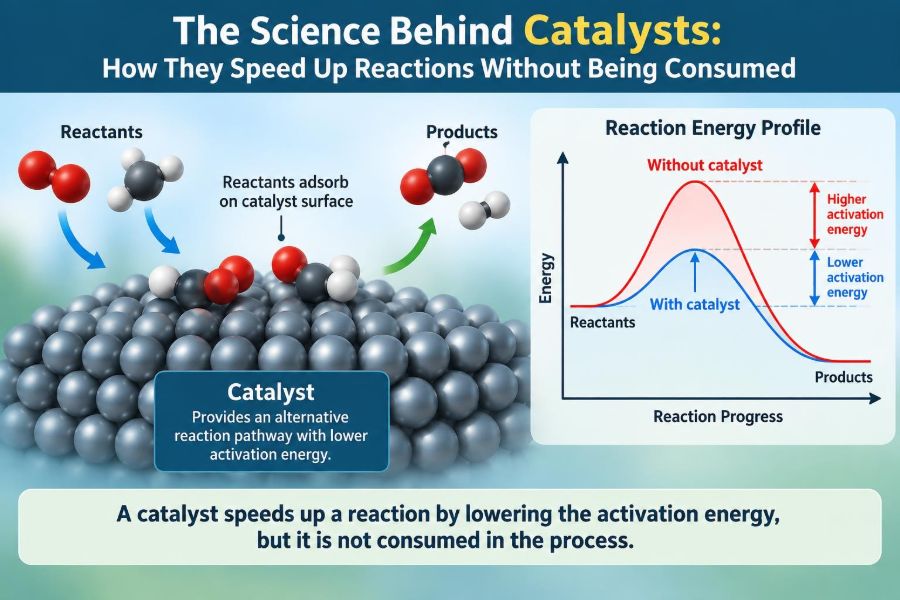
Reacting molecules do not become products simply because the products are energetically favorable. They must first reach a high-energy arrangement of atoms called the transition state.
The energy required to reach that arrangement is the activation energy. A useful analogy is a mountain pass: two valleys may lie at different elevations, but travelers still need enough energy to cross the ridge between them.
A catalyst creates a lower-energy route across that ridge. At a given temperature, more molecular encounters can then proceed to products, so the observed reaction rate rises.
🧭 Why Catalysts Do Not Change Equilibrium
A catalyst changes kinetics, not thermodynamics. It lowers the activation barrier for both the forward reaction and the reverse reaction, so equilibrium is reached sooner but is not shifted to a different final composition.
This distinction matters in process design. If equilibrium limits conversion, adding more catalyst cannot overcome that limit. Engineers may instead change temperature, pressure, feed composition, or remove a product to alter the equilibrium constraints.
A catalyst is therefore not a source of free energy. It does not make an unfavorable reaction favorable; it only helps an accessible reaction proceed more quickly.
🔄 The Catalytic Cycle in Simple Steps
Catalysis is best understood as a repeating molecular sequence rather than a single event. The exact chemistry varies, but many cycles follow a common pattern.
- Reactants approach and interact with the catalyst.
- The catalyst stabilizes reactive intermediates or aligns reactants in a favorable geometry.
- Bonds break and form through lower-energy elementary steps.
- Products detach or are released.
- The original active catalyst site is restored.
If the final restoration does not occur, the material is no longer acting as a true catalyst for that cycle. It may have been consumed, transformed, or deactivated.
🧱 Homogeneous and Heterogeneous Catalysis
Catalysts are often classified by whether they share a phase with the reactants. This affects reactor design, separation, heat transfer, and regeneration strategy.
| Type | Typical arrangement | Strength | Common challenge |
|---|---|---|---|
| Homogeneous | Catalyst and reactants in one fluid phase | Uniform molecular contact and often high selectivity | Separating and recovering catalyst |
| Heterogeneous | Usually gas or liquid reactants over a solid catalyst | Simple separation and practical continuous operation | Diffusion limits and surface deactivation |
| Biocatalytic | Enzyme in an aqueous or cellular environment | Exceptional selectivity under mild conditions | Sensitivity to temperature, pH, and impurities |
Industrial plants frequently favor solid, heterogeneous catalysts because gases and liquids can flow through a catalyst bed while the solid remains in place.
🪨 How Surface Catalysts Work
On a solid catalyst, much of the chemistry occurs at the surface rather than throughout the bulk material. Reactant molecules first reach a surface location called an active site.
They may adsorb, meaning they attach to the surface through relatively weak interactions or stronger chemical bonding. Adsorption can weaken a reactant bond, hold molecules close together, or orient them for a productive collision.
After reaction, products must desorb. A surface that binds reactants too weakly may not activate them; one that binds products too strongly may become blocked. Productive catalyst design balances these competing effects.
🧲 Active Sites Are Not All the Same
A catalyst particle may contain many surface atoms, but only some have the right local structure and electronic environment to be highly active. Corners, edges, defects, metal-support boundaries, and particular crystal faces can behave differently.
This is why surface area alone does not determine catalyst performance. Two materials with similar surface areas can give very different activity and selectivity if their active sites differ.
Engineers use characterization methods to connect structure and performance, but real working catalysts can change under operating conditions. A catalyst measured in air at room temperature may not have the same surface state inside a hot reactor.
🧪 Enzymes: Nature’s Precise Catalysts
Enzymes are biological catalysts, usually proteins, with shaped active sites that bind particular molecules called substrates. Their three-dimensional structures allow them to stabilize transition states and position functional groups with remarkable precision.
For instance, enzymes involved in digestion accelerate bond-breaking reactions that would otherwise be slow at body temperature. They do not violate thermodynamic limits; they make biologically necessary rates possible under mild conditions.
Enzymes are often highly selective, but that specialization comes with constraints. Changes in pH, excessive heat, solvents, or certain contaminants can alter the protein structure and reduce or eliminate activity.
🎯 Activity, Selectivity, and Stability
Calling a catalyst “good” is incomplete. Chemical engineers usually assess at least three interacting qualities.
- Activity is how rapidly the catalyst promotes reaction under stated conditions.
- Selectivity is its tendency to produce the desired product instead of unwanted alternatives.
- Stability is its ability to maintain useful performance over time.
A very active catalyst can be a poor industrial choice if it makes many by-products, deactivates quickly, or requires conditions that are unsafe or expensive. The best choice depends on the entire process, not a single laboratory rate measurement.
📏 Measuring Catalytic Performance
Reaction rate can be expressed in several ways: reactant disappearance, product formation, or conversion per amount of catalyst and time. The correct basis must be stated clearly, especially when comparing catalysts with different masses, surface areas, or active-metal contents.
Turnover frequency describes how many reactant molecules are converted per active site per unit time, when the number of active sites can be estimated. Turnover number reflects the cumulative number converted per site before deactivation.
These quantities are powerful but not always straightforward to determine. In complex solids, the number of genuinely accessible active sites may be uncertain, so reported values need careful interpretation.
🌡️ Temperature Changes More Than Rate
Raising temperature often increases reaction rates because molecules more frequently have enough energy to cross activation barriers. But catalyst behavior is rarely governed by this simple trend alone.
Higher temperature can favor undesired reactions, alter adsorption strength, shift equilibrium, sinter metal particles, or damage a support. In exothermic reactions, it can also create hot spots that accelerate local reaction and further raise temperature.
The practical objective is not the hottest possible reactor. It is a controlled operating window that delivers conversion and selectivity without sacrificing catalyst life or process safety.
ضغط Mass Transfer Can Hide the True Chemistry
Before a reactant can react on a porous solid, it must travel from the bulk fluid to the particle surface and often diffuse through pores to internal active sites. Products must make the return trip.
If transport is slow, the measured rate may reflect diffusion rather than intrinsic catalytic chemistry. A faster catalyst might then appear no better because reactant delivery is the bottleneck.
Engineers test for these limitations by changing flow, particle size, mixing, or dilution and examining whether the apparent rate changes in a transport-sensitive way. Reactor data should not automatically be treated as kinetic data.
🕳️ Pores Create Both Opportunity and Resistance
Porous supports provide large internal surface areas, allowing active material to be distributed across many accessible regions. This is one reason catalysts are commonly made as pellets, extrudates, monolith coatings, or structured supports rather than dense chunks.
Yet deep pores can slow diffusion, particularly for bulky molecules or viscous liquids. Reactants may be consumed near the outer surface before reaching the particle interior, leaving some active sites underused.
Pore size distribution, particle geometry, and operating conditions must be designed together. More surface area is useful only when reactants can reach it and products can leave it efficiently.
⚖️ Catalyst Amount Is Not an Unlimited Lever
Adding catalyst often increases the number of available active sites and can raise rate, especially when kinetics control the system. But the improvement eventually becomes limited by equilibrium, reactant supply, heat removal, or mass transfer.
In a packed-bed reactor, extra catalyst also increases bed length or density, which can raise pressure drop. In slurry systems, excessive solids can complicate mixing, pumping, filtration, and downstream separation.
The practical question is not “How much catalyst gives the fastest reaction?” but “What inventory achieves the required production rate with acceptable energy use, pressure drop, safety margin, and replacement cost?”
🏭 Catalysts in Major Chemical Processes
Catalysis underpins much of large-scale chemical manufacturing. In ammonia production, iron-based catalysts help nitrogen and hydrogen react at industrially relevant rates. In sulfuric acid manufacture, catalytic oxidation is a key step.
Refineries use catalysts for cracking, reforming, hydrotreating, and isomerization. These processes alter hydrocarbon structures to produce fuels and feedstocks with properties that markets and downstream units require.
Polymer manufacture also relies extensively on catalysts. They can influence not merely how quickly monomers react, but molecular weight, branching, stereochemistry, and therefore the properties of the final plastic.
🚗 Cleaning Emissions with Catalytic Converters
An automotive catalytic converter contains coated channels that expose exhaust gases to catalytic surfaces. Under suitable operating conditions, it promotes reactions that convert carbon monoxide, unburned hydrocarbons, and nitrogen oxides into less harmful products.
Its performance depends on exhaust temperature, air-to-fuel control, catalyst condition, and fuel quality. A cold engine produces exhaust before the converter has reached an effective operating temperature, which helps explain why emission-control strategies consider warm-up behavior.
The converter illustrates a broader engineering lesson: a catalyst must be integrated with the whole system. Material choice alone cannot compensate for unsuitable temperature, poor feed control, or physical damage.
🧼 Soap, Hydrogenation, and Everyday Chemistry
Many familiar products have catalytic histories. Nickel catalysts have been used for hydrogenation reactions that add hydrogen across unsaturated bonds, while acid and base catalysts help drive transformations in chemical synthesis and processing.
In household and consumer contexts, the catalyst is often absent from the finished product because it was filtered out, remains fixed in equipment, or was used only during manufacture. Its invisible role can make it easy to overlook.
A useful caution: “catalyst” does not automatically mean harmless or environmentally preferable. Safety depends on the specific material, its form, exposure route, containment, and the process in which it is used.
🧱 Supports, Promoters, and Catalyst Formulation
Many industrial catalysts are formulated systems rather than pure substances. An active metal or oxide may be dispersed on a support such as alumina, silica, carbon, or another engineered material.
The support can provide surface area, mechanical strength, thermal stability, and a particular chemical environment. A promoter is an added component that improves a useful property, such as dispersion, resistance to deactivation, or selectivity.
Small compositional changes can have large effects. However, more additives do not inherently produce a better catalyst; they may obstruct sites, change transport, introduce unwanted reactions, or make regeneration harder.
☠️ Poisoning: When Small Impurities Cause Big Problems
Catalyst poisoning occurs when substances bind to active sites or alter them in a way that reduces activity. Sulfur compounds, certain metals, halides, and strongly adsorbing species can be troublesome for particular catalysts.
Even low impurity levels can matter when vast quantities of feed pass through a reactor over long operating periods. Feed pretreatment is therefore often a core part of catalyst protection, not an optional cleanup step.
Poisoning may be reversible, partly reversible, or permanent. The appropriate response could include changing feed specifications, installing guard beds, adjusting conditions, or replacing the catalyst.
🧯 Fouling, Coking, and Physical Damage
Not all deactivation is chemical poisoning. Heavy deposits, polymers, salts, or carbon-rich material can cover active sites or block pores. In hydrocarbon processing, this carbonaceous buildup is commonly called coke.
Catalyst particles can also fracture, attrit, sinter, or lose their active component. Sintering occurs when small particles migrate and merge at elevated temperature, reducing exposed active surface area.
Deactivation mechanisms often overlap. A plant investigation should distinguish among them rather than assuming that every loss of performance is caused by “old catalyst.”
♻️ Regeneration Restores Some Catalysts
Some catalysts can be regenerated rather than discarded. Deposits may be removed by controlled oxidation, reduction, washing, or other treatments designed for the specific material and deactivation mechanism.
Regeneration is not automatically gentle or complete. Burning coke, for example, releases heat and must be carefully controlled to avoid damaging the catalyst structure or creating unsafe temperature excursions.
Repeated cycles can gradually reduce performance. Engineers consider regeneration frequency, downtime, emissions handling, and whether the restored activity justifies the operational complexity.
🔥 Heat Management Is a Catalytic Reactor Problem
Many catalytic reactions release or absorb substantial heat. If heat is generated faster than it can be removed, temperature rises may change selectivity, speed up side reactions, and reduce catalyst lifetime.
Fixed-bed reactors can be especially vulnerable to local hot spots because reaction is often strongest near the inlet, where reactant concentration is highest. Staged feed addition, interbed cooling, dilution, recycling, or alternative reactor configurations can help manage the profile.
For strongly exothermic systems, thermal behavior is also a safety issue. Kinetic data, heat-transfer capability, and credible upset scenarios all matter during design and operation.
🧰 Choosing the Right Reactor Configuration
A catalyst does not operate in isolation; it operates inside equipment. Fixed-bed reactors hold stationary solid particles, fluidized beds suspend and mix particles with flowing fluid, and slurry reactors disperse fine catalyst in a liquid.
Monolith reactors use structured channels with catalytic coatings and offer low pressure drop, making them useful in some gas-treatment applications. Each configuration creates different trade-offs in contact efficiency, heat transfer, catalyst handling, and regeneration.
Selection starts with the reaction network and physical properties of the system. It must also account for scale-up, maintenance access, solids management, and how reliably the unit can be controlled.
📈 Kinetics Must Include the Reaction Network
Real feeds rarely follow a single neat reaction. A desired product may react further, intermediates may branch into side products, and contaminants may participate in competing surface chemistry.
A rate expression that fits one narrow condition range can fail when temperature, pressure, concentration, or catalyst age changes. Robust models distinguish intrinsic reaction behavior from transport effects and include important parallel or sequential pathways.
This matters for optimization. Maximizing conversion is not always equivalent to maximizing valuable product yield, particularly when overreaction creates unwanted compounds.
🧑🔬 From Lab Discovery to Plant Scale
A catalyst that performs well in a small vial or microreactor may encounter different gradients and impurities at plant scale. Heat removal, distribution of flow, particle strength, catalyst loading procedures, and feed variability become much more significant.
Scale-up should therefore test more than initial activity. Useful questions include whether pellets survive handling, whether performance is reproducible across batches, how quickly deactivation occurs, and whether the catalyst can be safely regenerated or disposed of.
Careful pilot work reduces uncertainty, but it does not remove it entirely. Industrial catalysis is an iterative combination of chemistry, materials science, transport phenomena, reactor engineering, and operations.
🌱 Catalysis and More Efficient Manufacturing
Catalysts can lower the severity of chemical processing by enabling useful rates at lower temperatures or pressures than uncatalyzed routes. They can also direct reactants toward desired products, reducing separation duties and waste formation.
Those advantages are conditional. Producing catalyst materials, mining or refining scarce elements, regenerating spent solids, and controlling emissions all carry environmental and operational costs.
A sound assessment considers the full process: feedstocks, energy source, yield, lifetime, recovery of valuable metals, and fate of spent catalyst. “Catalytic” is a design feature, not a complete sustainability verdict.
🔬 Designing Better Catalysts
Modern catalyst development combines experiments with computational tools, advanced microscopy, spectroscopy, and reactor testing. Researchers seek relationships between composition, structure, operating environment, and observed performance.
Promising directions include more earth-abundant active materials, catalysts that resist deactivation, improved control of nanostructure, and routes that convert alternative feedstocks such as carbon dioxide, biomass-derived molecules, or renewable hydrogen.
Progress still requires caution. A material can be impressive under simplified laboratory conditions yet be difficult to manufacture, unstable in realistic feeds, or uneconomic at scale.
❌ Common Misunderstandings About Catalysts
Several shortcuts lead to incorrect conclusions about catalytic systems.
- “A catalyst makes products without energy input.” It lowers an activation barrier; it does not overturn energy balances or equilibrium.
- “The catalyst is never changed.” It is regenerated after each ideal cycle, but can deactivate, restructure, or be lost physically over time.
- “More catalyst always solves a low-conversion problem.” Equilibrium, transport, heat transfer, and feed limitations may be the real constraint.
- “The most active catalyst is automatically best.” Selectivity, stability, safety, separation, and cost can dominate the final decision.
🛡️ Safe Handling and Responsible Operation
Catalysts may be powders, corrosive acids or bases, reactive metals, or materials containing hazardous components. Fine particles can create inhalation hazards, and some catalysts can react strongly with air, water, hydrogen, or oxidizing agents.
Spent catalysts deserve equal attention. They may retain hydrocarbons, absorbed poisons, or pyrophoric deposits that can ignite when exposed to air. Procedures for unloading, passivation, storage, transport, and disposal should reflect the actual process history.
Safe practice relies on site-specific hazard assessment and operating procedures, not generic assumptions based only on a catalyst’s fresh-material label.
🧠 The Core Principle to Remember
Catalysts speed reactions by offering an alternative sequence of elementary steps with lower activation barriers. They participate in the mechanism, but are restored at the end of the ideal cycle, which is why they are absent from the net reaction equation.
In practice, performance depends on much more than this definition: active sites, adsorption, transport, temperature, reaction networks, deactivation, regeneration, and reactor design all shape what happens in a real process.
The most useful engineering perspective is to treat a catalyst as part of a system. Its chemistry, physical form, feed quality, operating conditions, and equipment must work together to turn molecular potential into reliable production.
A catalyst does not change what chemistry ultimately permits; it changes how efficiently and practically that chemistry can happen. That quiet role is why catalysts sit at the heart of so much modern industry, environmental control, and biology. 🧪⚙️🌿