
A bag of fertilizer on a farm, a cotton shirt, a tablet of medicine, and a refrigerated shipment of food may seem unrelated. Each depends, directly or indirectly, on a chemical supply chain built around one small molecule: ammonia.
Ammonia is made from nitrogen in the air and hydrogen, but those ingredients are not naturally eager to react. Turning them into a stable, transportable chemical at industrial scale required engineers to solve a problem involving pressure, temperature, catalysts, purification, machinery, and safety all at once.
The Haber-Bosch process is often introduced as a single chemical equation. Its greater lesson is that a successful industrial process is never just a reaction. It is an integrated system that makes a difficult reaction economical, repeatable, controllable, and safe.
That integration transformed chemical manufacturing in the twentieth century and still shapes how engineers approach large-scale production today.
🌬️ The chemical reaction at the center
The Haber-Bosch process synthesizes ammonia from nitrogen and hydrogen:
N2 + 3H2 ⇌ 2NH3
Nitrogen is abundant in air, but its two atoms are joined by a very strong triple bond. Hydrogen is reactive, yet producing it cleanly and delivering it at the correct purity is another major task. The reversible arrow matters: ammonia can also decompose back into nitrogen and hydrogen.
Industrial design must therefore promote ammonia formation while preventing the system from settling at an unhelpful equilibrium composition.
🌾 Why fixed nitrogen changed society
Plants require nitrogen to build proteins, nucleic acids, and chlorophyll. Although air is mostly nitrogen gas, most crops cannot use N2 directly. They depend on biologically available, or “fixed,” nitrogen such as ammonium and nitrate.
Before synthetic ammonia, fixed nitrogen came from biological activity, manure, crop rotation, deposits such as Chilean nitrate, and limited natural sources. These supplies were variable and geographically constrained.
Ammonia made it possible to manufacture nitrogen fertilizers near markets and at volumes suited to modern agriculture. That connection is why Haber-Bosch is frequently discussed alongside food production, even though ammonia has many industrial uses beyond fertilizer.
🧱 The nitrogen triple-bond barrier
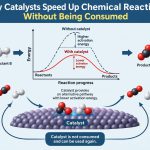
A useful analogy is a locked gate rather than an empty pathway. Nitrogen and hydrogen may be present together, but the nitrogen triple bond creates a high activation-energy barrier: molecules need a favorable route to rearrange their atoms.
Heating provides energy, but heat alone is inefficient because high temperature also favors the reverse, ammonia-decomposition direction at equilibrium. The process needs a catalyst to provide a lower-energy reaction pathway.
This distinction is fundamental: a catalyst changes the rate at which equilibrium is reached; it does not change the equilibrium position itself.
⚖️ Equilibrium creates an engineering trade-off
The reaction reduces the number of gas molecules from four reactant molecules to two product molecules. By Le Châtelier’s principle, higher pressure favors the ammonia side of the equilibrium.
Lower temperature also favors ammonia thermodynamically because the reaction is exothermic: it releases heat. But at low temperature, reaction rates become too slow for productive equipment.
Industrial operation therefore uses a compromise temperature, elevated pressure, and an active catalyst. This is a classic chemical-engineering trade-off: the condition that gives the best equilibrium conversion is not automatically the condition that gives the best production rate or lowest cost.
🔩 Fritz Haber’s laboratory breakthrough
In the early twentieth century, Fritz Haber demonstrated that ammonia could be synthesized from its elements under high pressure in the presence of a catalyst. The achievement established practical reaction conditions for a chemistry that had long resisted convenient direct synthesis.
A laboratory demonstration, however, does not automatically become industry. Small apparatus can use specialized materials and tolerate operating choices that would be impractical, dangerous, or expensive in a continuous plant.
Haber’s work solved a scientific and experimental problem. The next challenge was to make ammonia production durable at scale.
🏭 Carl Bosch and the scale-up challenge
Carl Bosch and the team at BASF turned high-pressure ammonia synthesis into an industrial enterprise. Their work involved metallurgy, reactor construction, gas purification, catalyst development, compression, and plant operation.
High-pressure equipment experiences substantial mechanical stress. Hydrogen can also damage certain metals through mechanisms broadly described as hydrogen embrittlement, while hot reacting gases create further materials challenges.
The industrial achievement was thus not one inventor adding a larger vessel. It was an early demonstration that chemical manufacturing depends on close coordination among chemistry, mechanical engineering, materials science, and operations.
🗓️ From concept to operating plants
Haber’s decisive ammonia-synthesis experiments occurred in the early 1900s, and BASF brought the first commercial Haber-Bosch ammonia plant into operation in 1913. That sequence is a helpful reminder that commercializing a process can take years even after the chemistry is known.
Early plants used operating pressures far above ordinary chemical equipment of the time. They also required reliable compressors and piping systems capable of sustained service.
Modern plants differ greatly in capacity, instrumentation, feedstocks, and energy integration, but they retain the central logic established during that period: prepare a clean synthesis gas, react it over catalyst at pressure, recover ammonia, and recycle what did not react.
🧭 A process, not a one-pass reaction
It is misleading to imagine all nitrogen and hydrogen becoming ammonia in one trip through a reactor. Even under favorable conditions, only part of the feed converts per pass.
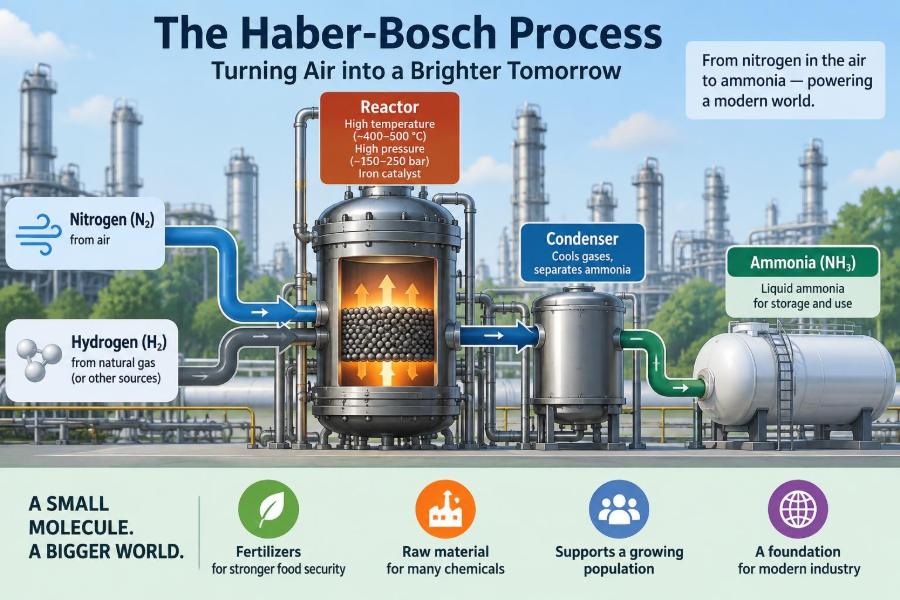
The solution is a synthesis loop. Gas flows through catalytic reactor beds, the hot effluent is cooled, ammonia is condensed and removed, and the unreacted nitrogen and hydrogen are compressed or circulated back to the reactor.
Recycle makes an equilibrium-limited reaction commercially viable. It also means that compression energy, pressure drops, heat exchange, and the buildup of unwanted inert gases become central design concerns.
💨 Preparing the synthesis gas
Ammonia synthesis requires nitrogen and hydrogen in approximately the reaction stoichiometric ratio of one part nitrogen to three parts hydrogen. Nitrogen is commonly separated from air, while hydrogen has historically been produced largely from hydrocarbon-based routes.
Natural-gas-based plants commonly use steam methane reforming to create a hydrogen-rich gas, followed by water-gas shift conversion and carbon dioxide removal. Air may be introduced in a secondary reforming step, providing nitrogen for the eventual synthesis mixture.
The exact front-end configuration varies by feedstock and plant age. Its purpose is consistent: supply the loop with the right gases at high purity and appropriate composition.
🧪 Why feed purification is non-negotiable
The iron-based catalyst used in conventional ammonia synthesis can be harmed by trace contaminants. Sulfur compounds, oxygen-containing species, carbon oxides, and moisture must be controlled because they can poison catalyst sites or create undesirable reactions.
Poisoning means an impurity reduces catalytic activity, sometimes reversibly and sometimes not. A tiny concentration can matter when enormous gas volumes pass over a catalyst continuously.
This is why upstream cleanup equipment is not peripheral. Guard beds, conversion units, separation systems, and analytical monitoring protect the reactor as surely as a pressure-relief device protects a vessel.
🧲 Iron catalysts make the reaction practical
Commercial Haber-Bosch plants traditionally use iron-based catalysts promoted with additional components that improve activity, stability, or physical structure. Iron is attractive because it is comparatively available and robust under demanding industrial conditions.
On the catalyst surface, nitrogen and hydrogen adsorb, bonds weaken and break, and nitrogen-hydrogen intermediates form before ammonia desorbs. This surface sequence is more useful than treating the catalyst as a mysterious black box.
Modern catalyst research seeks improved activity and lower-energy operation, but a catalyst must also survive years of thermal cycling, impurities, pressure changes, and mechanical stress.
🌡️ Managing heat in reactor beds
Because ammonia formation releases heat, the gas temperature rises as it passes through a catalyst bed. Too much temperature increase can reduce the equilibrium ammonia concentration and may expose catalyst or equipment to unfavorable conditions.
Industrial converters commonly use multiple catalyst beds with cooling between stages, either by heat exchange or by mixing cooler gas into the flow. This helps keep each bed within a productive temperature range.
Heat management illustrates a broader principle: reaction heat is not merely something to remove. Properly recovered, it can generate steam, preheat feeds, or reduce utility demand elsewhere in the plant.
❄️ Condensation separates the product
After reaction and cooling, ammonia can be condensed as a liquid at suitable pressure and temperature, while much of the unreacted nitrogen and hydrogen remains gaseous. This phase difference provides an efficient separation method.
Removing ammonia from the gas mixture also supports continued production. In equilibrium terms, taking product away discourages the reverse reaction and permits the recycled gases to make another pass.
Separation is often as consequential as reaction chemistry. A process route is commercially attractive only when the desired product can be recovered with manageable energy use and adequate purity.
🔁 Recycle loops raise overall conversion
Consider a simplified hypothetical loop: if a reactor converts only a fraction of its feed per pass, discarding the remaining gas would waste valuable nitrogen and hydrogen. Recycling it gives those molecules repeated opportunities to react.
Not every molecule can be recycled forever. Argon introduced with air and small quantities of methane or other nonreactive gases can accumulate. Plants use a controlled purge stream to prevent these inerts from diluting the reactants.
The purge contains recoverable hydrogen, so engineers balance inert control against reactant loss. This small stream represents a larger truth: recycle improves efficiency but introduces composition-control problems.
⚡ Compression is a major energy cost
Compressors bring synthesis gas to the high pressure required by the loop and overcome pressure losses through reactors, heat exchangers, piping, and separators. Their power demand is a significant part of the plant energy picture.
Compression is not simply “make the pressure high.” Engineers select stages, intercooling, machinery configuration, and control strategies to limit temperature rise and maintain stable operation.
Leaks also matter more at high pressure. Beyond product loss, hydrogen is flammable and ammonia is hazardous, so mechanical integrity and leak detection are core operational disciplines.
🔥 The hidden importance of heat integration
Large ammonia plants contain hot process streams, cooling duties, steam systems, and compression-related heat. Pinch analysis and heat-exchanger network design help engineers use available heat before importing additional fuel or electricity.
For example, hot reactor effluent can often preheat incoming synthesis gas or support steam generation before being cooled enough for ammonia condensation. The exact arrangement depends on temperatures, fouling risks, controllability, and economics.
Good heat integration lowers energy consumption, but it can make a plant more tightly coupled. Designers must preserve enough flexibility to start up, shut down, and respond safely when one unit is unavailable.
📊 The main units in an ammonia plant
| Plant function | Typical equipment or operation | Why it matters |
|---|---|---|
| Feed preparation | Desulfurization, reforming, air separation, gas treatment | Creates suitable nitrogen and hydrogen sources |
| Purification | Shift conversion, carbon dioxide removal, methanation or guard beds | Protects the synthesis catalyst from harmful impurities |
| Compression | Multi-stage compressors and drivers | Provides loop pressure and circulation |
| Synthesis | Multi-bed catalytic converter | Forms ammonia under controlled thermal conditions |
| Recovery and recycle | Heat exchangers, condensers, separators, recycle compressor | Separates ammonia and returns unreacted gases |
No unit operates independently. A disturbance in gas composition, for example, can affect catalyst performance, loop pressure, refrigeration duty, and ammonia purity downstream.
🧯 Process safety starts with the hazards
Ammonia is toxic, corrosive in the presence of moisture, and irritating to the eyes, skin, and respiratory system. Hydrogen is highly flammable, and high-pressure process equipment stores considerable mechanical energy.
Safe design uses multiple layers of protection rather than trusting a single instrument or procedure. These may include relief systems, isolation valves, gas detection, ventilation, emergency shutdown systems, alarms, operating procedures, and trained response teams.
Process safety is not limited to rare emergencies. It includes everyday control of operating envelopes, maintenance quality, change management, and prompt investigation of abnormal readings.
🛠️ Materials and mechanical integrity
Reactors, piping, welds, compressors, and valves must withstand pressure, temperature variation, vibration, and chemical exposure over long service periods. Materials selection therefore considers strength, toughness, corrosion behavior, weldability, and degradation mechanisms.
Inspection programs use methods appropriate to the equipment and expected damage. The aim is to find deterioration before it becomes a loss-of-containment event.
For chemical engineers, the practical lesson is to avoid treating materials as a final procurement detail. Chemistry determines what the equipment must survive; mechanical integrity determines whether the chemistry can be run reliably.
🌱 Fertilizer is ammonia’s largest legacy
Ammonia can be applied directly in some agricultural systems, but it is also converted into products such as urea, ammonium nitrate, ammonium phosphates, and other nitrogen fertilizers. These products differ in nutrient concentration, handling properties, soil behavior, and application method.
Fertilizer use can raise crop yields when matched to crop needs and sound agronomic practice. Excess or poorly timed nitrogen, however, can contribute to water pollution, air emissions, and nitrous oxide formation in soils.
Ammonia’s agricultural role is therefore neither a simple triumph nor a simple environmental failure. Its outcomes depend substantially on how fertilizer is produced, transported, applied, and managed.
🧵 Ammonia also feeds wider industries
Ammonia is a starting material for nitric acid, which supports production of many chemicals, including certain fertilizers and industrial intermediates. It is also used in refrigeration, water treatment, mining applications, pharmaceuticals, textiles, and specialty chemical synthesis.
Its value comes from carrying nitrogen in a reactive, transportable form. Once ammonia is available at scale, manufacturers can build downstream processes around it.
This “platform chemical” role is a hallmark of modern chemical industry. A few high-volume molecules create networks of products far larger than the original production plant.
⚔️ Wartime demand and ethical context
Ammonia and its derivatives have served both agricultural and military supply chains. Nitric acid made from ammonia can be used to manufacture fertilizers, but it is also an intermediate in explosives production.
That dual-use history is part of the process’s legacy. Chemical engineering provides capabilities; societies and institutions determine many of the uses to which those capabilities are put.
Understanding this history encourages a more complete professional ethic: engineers should consider not only technical feasibility and profit, but also foreseeable social consequences, worker safety, and environmental impacts.
🏗️ What Haber-Bosch taught chemical manufacturing
The process helped establish the model of high-pressure continuous chemical production. It showed that laboratory chemistry could be transformed by integrating catalysts, recycle, separations, heat recovery, automation, and disciplined maintenance.
It also reinforced the importance of scale-up knowledge. A catalyst that works in a small reactor may behave differently when heat removal, pressure drop, impurities, and long-term deactivation become significant.
Many later processes adopted the same systems mindset: optimize the entire flowsheet, not merely the reactor yield.
📈 Scale changes both economics and risk
Large plants can benefit from economies of scale because some equipment and staffing needs do not rise in direct proportion to throughput. But large scale also concentrates capital, energy demand, inventory, and operational consequence in one site.
A shutdown in a tightly integrated ammonia complex can affect multiple downstream units. Conversely, a small design improvement in energy use can matter greatly when applied continuously across high production volumes.
Engineers must assess scale honestly. Bigger equipment is not inherently superior if feedstock access, grid reliability, maintenance capability, logistics, or market demand do not support it.
🌍 Carbon emissions in conventional ammonia
Most established ammonia production relies on fossil-derived hydrogen, especially from natural gas or coal. Carbon dioxide arises from both feedstock conversion and, depending on the plant, fuel burned to supply heat and power.
The synthesis loop itself is not the sole climate issue; much of the emissions profile originates upstream in hydrogen generation. This distinction matters when comparing improvement options.
Energy efficiency, lower-carbon electricity, carbon capture, alternative hydrogen routes, and better fertilizer-use practices can each address different parts of the broader system. None should be evaluated by a label alone.
💧 Green hydrogen changes the front end
So-called green ammonia generally refers to ammonia made with hydrogen from water electrolysis powered by low-carbon electricity. Nitrogen may still come from air separation, while the familiar high-pressure synthesis loop remains central.
The potential advantage is avoiding fossil-based hydrogen production. The practical challenges include electricity availability, electrolyzer capital cost, water management, variable power, and matching the operation of hydrogen supply with equipment that often prefers steady conditions.
Green ammonia is therefore not a different reaction. It is primarily a different way of supplying hydrogen and energy to an established synthesis system.
🔵 Carbon capture and blue ammonia
Blue ammonia commonly describes ammonia produced from fossil feedstocks with carbon capture and storage or utilization included in the process chain. Capture performance, methane emissions from gas supply, transport, and the permanence of carbon storage all influence the resulting climate benefit.
It can be useful to distinguish process concepts from outcomes. A color label does not by itself reveal lifecycle emissions, operating reliability, or local environmental effects.
For project evaluation, engineers need transparent system boundaries: which emissions are counted, how electricity is supplied, what happens to captured carbon, and how upstream fuel leakage is treated.
🚢 Ammonia as an energy carrier
Ammonia is being considered as a carrier for hydrogen and as a possible low-carbon fuel in certain shipping and power applications. It is easier to liquefy and transport than hydrogen under some conditions, and existing ammonia handling experience is valuable.
Yet combustion or cracking introduces technical challenges. Ammonia can produce nitrogen oxides if combustion is poorly controlled, and unburned ammonia releases are hazardous. Cracking ammonia back to hydrogen also requires energy and purification.
Its energy role is promising in selected contexts, but it should not obscure ammonia’s established primary role as a chemical and fertilizer feedstock.
🧠 Control systems keep the loop stable
Ammonia plants rely on measurement and control of pressure, temperature, flow, composition, liquid level, and rotating-equipment condition. The synthesis loop is interconnected, so a change in one variable can propagate quickly.
For instance, inadequate cooling after a reactor can affect ammonia condensation, recycle-gas composition, loop pressure, and reactor inlet conditions. Good control design anticipates these interactions rather than correcting each symptom independently.
Digital tools can support monitoring and optimization, but they do not replace process understanding. Operators need to recognize when an apparently normal trend masks an emerging mechanical, catalyst, or instrument problem.
🎓 Lessons for chemical engineering students
Haber-Bosch is an unusually rich case study because it connects thermodynamics, kinetics, transport phenomena, reaction engineering, separations, process control, safety, economics, and sustainability.
- Thermodynamics: equilibrium favors high pressure and lower temperature.
- Kinetics: catalysts and adequate temperature are needed for useful rates.
- Process design: recycle and condensation make limited per-pass conversion workable.
- Safety: pressure, hydrogen, and ammonia demand layered protection.
- Sustainability: feedstock and energy choices can dominate lifecycle impacts.
When solving textbook problems, ask what the calculation leaves out. Real plants must cope with impurities, downtime, startup behavior, equipment limits, and changing economic conditions.
🧰 Practical questions for working professionals
Professionals evaluating an ammonia facility or improvement project should begin with the full system rather than a single performance number. A lower reactor temperature may sound favorable, for example, but it could reduce rate, require more catalyst volume, or affect heat recovery.
- What limits production: feed availability, compressor capacity, catalyst activity, refrigeration, or logistics?
- Which contaminants threaten the catalyst, and how is breakthrough detected?
- Where is energy imported, rejected, or recoverable?
- How do planned and unplanned shutdowns affect downstream users?
- Which safety barriers are independent, tested, and maintained?
These questions turn broad process knowledge into actionable engineering work.
⚠️ Common misconceptions to avoid
One misconception is that high pressure alone “forces” complete conversion. Pressure favors ammonia at equilibrium, but real conversion still depends on temperature, catalyst activity, composition, and recycle design.
Another is that catalysts alter thermodynamic equilibrium. They do not; they enable the system to approach equilibrium faster. A third is that ammonia production is automatically low-carbon because nitrogen comes from air. The hydrogen source and energy supply are decisive.
Finally, calling a process efficient without stating the boundary can mislead. A loop may be efficient while upstream hydrogen generation remains energy- or emissions-intensive.
🔮 Where the process may evolve
Future ammonia plants may combine improved catalysts, better heat integration, flexible operation, electrified equipment, carbon capture, and electrolytic hydrogen in different combinations. The best configuration will depend on regional electricity, feedstock, water, infrastructure, and product demand.
There is also continued interest in alternative nitrogen-reduction routes that could operate under milder conditions. Many are scientifically interesting, but replacing a mature global process requires more than demonstrating a reaction in a laboratory.
A viable alternative must show selectivity, energy performance, durability, scalability, safe operation, and credible economics across the whole process.
🧩 The enduring core principle
Haber-Bosch transformed manufacturing because it joined scientific insight with systems engineering. The reaction was difficult, but the industrial solution made every surrounding function serve the chemistry: purification protected the catalyst, pressure supported equilibrium, heat exchange managed energy, condensation recovered product, and recycle captured unreacted value.
That is the enduring lesson for modern process design. Progress rarely comes from optimizing one component in isolation. It comes from understanding interfaces, constraints, trade-offs, and consequences across the complete system.
As ammonia production adapts to climate and energy pressures, this same integrated perspective will determine whether new routes are merely novel or genuinely useful at industrial scale.
The Haber-Bosch process remains a defining example of chemical engineering: a demanding reaction became world-changing only when chemistry, equipment, energy, safety, and society were designed together. 🧪🌾⚙️