
A reactor can appear calm right up to the moment it is not. Temperatures drift a few degrees above target, a cooling valve opens wider, and an operator sees a trend that no longer looks routine. In an exothermic process, where the reaction releases heat, that small drift can be the beginning of a much faster change.
This is not simply a matter of “too much heat.” Industrial reactor overheating emerges when heat generation, heat removal, mixing, measurement, and control no longer stay in balance. The consequences can range from off-specification product and lost production to equipment damage, pressure release, or a serious loss-of-containment event.
Reactors are designed with many layers of protection, but those layers work best when engineers understand the physical mechanisms behind an upset. A cooling system is not a magic sink for heat, and a temperature transmitter is not a complete picture of what is happening inside a vessel.
The central question is therefore practical: why do industrial reactors overheat, and what do engineers do—during design, operation, and emergencies—to keep a manageable reaction from becoming an uncontrolled one?
⚗️ What “Overheating” Means in a Reactor
Reactor overheating means the process temperature rises above its intended operating range or rises faster than the control system and heat-removal equipment can safely manage. The precise concern depends on the chemistry: a few degrees may reduce selectivity in one reaction, while a much larger excursion may trigger decomposition or rapid gas formation in another.
A temperature excursion is an unintended departure from the planned temperature trajectory. It is not automatically a runaway reaction, but it deserves attention because elevated temperature often increases reaction rate and therefore heat release.
🔥 Exothermic Reactions Create Their Own Heat Source
Many industrial reactions are exothermic: forming chemical bonds releases energy as heat. Hydrogenation, oxidation, polymerization, neutralization, and many nitration or chlorination steps can fall into this broad category, although their hazards and operating windows differ greatly.
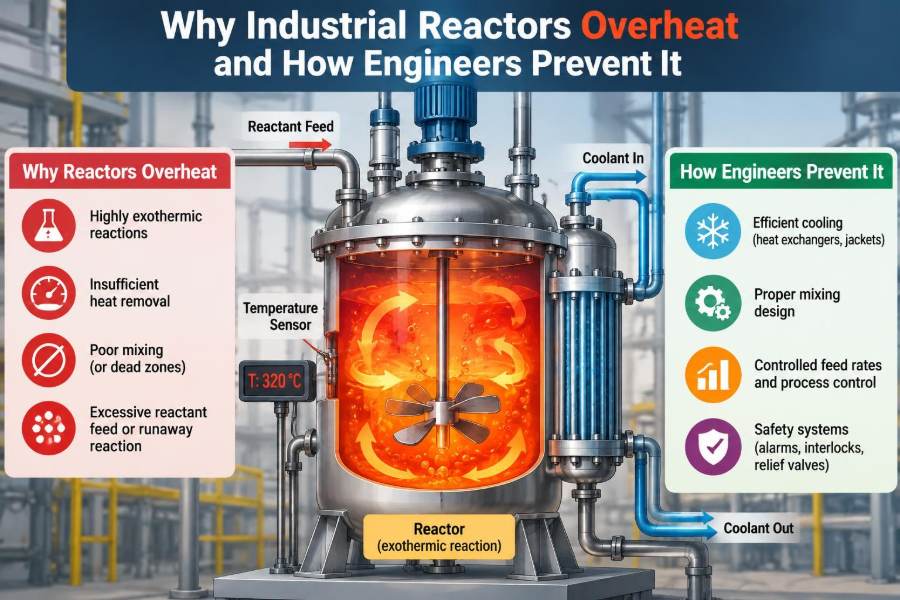
At steady operation, the cooling system removes roughly as much heat as the reaction and other sources generate. If generation exceeds removal, heat accumulates in the reactor contents. That stored heat raises temperature, which can change the reaction rate, physical properties, and pressure.
📈 Why Temperature Can Accelerate Reaction Rate
Most chemical reactions become faster as temperature rises. The Arrhenius relationship describes this general behavior: molecules at higher temperature have more energy, so a larger fraction can overcome the activation-energy barrier for reaction.
The relationship is often strongly nonlinear. A modest temperature increase can produce a disproportionately large increase in reaction rate for a temperature-sensitive system. If that faster reaction releases more heat, the system has formed a dangerous feedback loop: heat causes faster reaction, and faster reaction causes more heat.
🔄 The Difference Between an Excursion and a Runaway
An excursion may stabilize if cooling catches up, feed is stopped, or the reacting material is consumed. A thermal runaway occurs when self-accelerating heat generation dominates the available heat removal and the temperature rises rapidly without effective intervention.
Runaway behavior is especially concerning when side reactions or decomposition begin at elevated temperature. Those reactions may release additional heat, generate non-condensable gas, or both. The original intended reaction may no longer be the main hazard.
🧮 The Basic Heat-Balance View
Engineers begin with a heat balance: heat in, heat out, heat generated, and heat stored. For a batch reactor, heat storage is particularly important because the contents can warm over time before anyone sees a stable new condition.
A simplified expression is:
heat accumulation = heat generation - heat removalIf the right side is positive, the reactor temperature tends to rise. Real plants add complexity—feed enthalpy, evaporation, agitation heat, changing volume, and heat losses—but the simple balance remains the foundation for troubleshooting.
❄️ Cooling Capacity Is Not the Same as Cooling Availability
A utility system may have enough nominal refrigeration or cooling-water capacity on paper, yet the reactor may not receive it when needed. A partially closed valve, fouled heat-transfer surface, low coolant flow, high cooling-water supply temperature, or loss of agitation can sharply reduce actual heat removal.
Cooling also depends on the temperature driving force between reactor contents and coolant. As the coolant warms or the reaction temperature approaches the coolant temperature, heat transfer becomes less effective. This is why utility conditions must be considered at credible worst-case operating conditions, not only at average conditions.
🧊 Jackets, Coils, and External Heat Exchangers
Jackets transfer heat through the reactor wall, internal coils transfer it through immersed surfaces, and recirculation loops send reactor fluid through an external heat exchanger. Each arrangement has strengths and limitations.
| Configuration | Useful feature | Common limitation |
|---|---|---|
| External jacket | Simple and easy to isolate | Limited surface area on large vessels |
| Internal coils | More heat-transfer area | Can complicate cleaning and mixing |
| External loop exchanger | Potentially high duty and flexibility | Depends on circulation and can foul or plug |
No configuration is universally superior. The selection depends on viscosity, solids, cleanability, reaction speed, pressure, corrosion, and the needed emergency heat-removal strategy.
🌀 Mixing Determines Whether One Temperature Represents the Whole Vessel
A reactor temperature sensor measures conditions near its location, not everywhere in the vessel. Good mixing distributes reactants and heat, making that measurement more representative. Poor mixing can create hot spots: small regions where concentration and temperature are much higher than the bulk average.
Hot spots matter because reaction rate may be highest precisely where cooling is least effective. They can cause unwanted by-products, catalyst damage, local boiling, or polymer deposits even while the displayed bulk temperature appears acceptable.
🧪 Fast Feed Addition Can Overwhelm Local Cooling
Many batch reactions are controlled by adding one reactant gradually to another. The feed rate is therefore a heat-release control. Adding too quickly can create a concentrated reaction zone near the feed nozzle before mixing disperses the incoming material.
A well-designed recipe considers addition rate, feed location, agitator speed, reactor fill level, and coolant conditions together. “The batch temperature is below setpoint” is not by itself permission to increase feed rate; the relevant question is whether the reactor can safely absorb the next increment of reaction heat.
⏱️ Heat Release Can Arrive After the Feed Stops
Some reactions have an induction period, slow catalyst activation, delayed dissolution, or mass-transfer limitation. In those cases, material added during an apparently quiet period may react later in a concentrated burst.
This delayed response can mislead operators if they judge safety only from the immediate temperature trend. Calorimetry, development data, and conservative operating procedures help identify whether there is an accumulated-reactant hazard: unreacted feed that could release significant heat if conditions suddenly become more favorable.
🌡️ Cooling-System Failures Are Process Upsets
Loss of cooling water, chilled brine, refrigerant, or circulation can remove the main path for heat rejection. The result depends on reaction inventory, residual reaction rate, vessel heat capacity, and whether alternative cooling is available.
Failures are not always total. Gradual fouling, utility temperature changes during hot weather, a pump operating below its normal flow, or an air pocket in a jacket can quietly erode safety margin. Trend monitoring is valuable because it can reveal declining performance before an upset occurs.
⚡ Power Loss Can Remove Several Safeguards at Once
A power interruption may stop agitation, transfer pumps, control valves, refrigeration compressors, instrumentation, and automated feed systems. Some equipment may fail to a safe position, but that position must be verified for the actual installation.
For example, closing a reactant-feed valve on loss of power may be desirable, while losing cooling-water flow may not be. Emergency power, gravity-fed quench systems, stored cooling capacity, and passive relief protection are considered where the consequence and scenario justify them.
🧯 Unintended Reactions and Contamination
Contamination can change chemistry unexpectedly. A wrong raw material, residual cleaning agent, incompatible catalyst, oxygen ingress, moisture, or trace metal contamination may initiate side reactions or alter their rate.
Compatibility reviews and disciplined line clearance are not paperwork exercises. They reduce the chance that a vessel designed for one reaction is inadvertently exposed to a different and potentially less controllable one. When an upset occurs, engineers should consider contamination as a possible cause rather than assuming the normal chemistry is solely responsible.
🧱 Fouling and Polymer Deposits Reduce Heat Transfer
Deposits on jackets, coils, or external exchangers add thermal resistance between the hot process fluid and coolant. A reactor can then look normal early in a campaign but become progressively harder to cool after repeated batches.
Polymerizing systems are especially challenging because higher wall temperatures or stagnant zones can promote deposits, which then worsen cooling further. Cleaning frequency, surface inspection, pressure-drop trends, and thermal-performance tracking should be part of the operating strategy.
🫧 Boiling, Foaming, and Pressure Change the Problem
When temperature rises, volatile components may boil. Evaporation can temporarily remove heat, but it also increases vapor load and may raise vessel pressure. Foaming can carry liquid into vent lines or condensers, reducing their effectiveness and complicating pressure relief.
Pressure changes also affect boiling point. In a closed system, a rising pressure can suppress boiling while the liquid continues heating; in a vacuum process, loss of vacuum can abruptly change the temperature behavior. Thermal and pressure hazards must therefore be assessed together.
📊 Reaction Calorimetry Reveals the Real Thermal Load
Reaction calorimetry measures heat flow during a reaction under controlled conditions. It helps development teams estimate heat-release rate, total heat of reaction, accumulation, and sensitivity to operating variables.
Its value is not limited to producing one number. Useful testing investigates plausible deviations: higher feed rate, lower agitation, warmer coolant, delayed catalyst addition, or altered concentration. Scale-up requires judgment because mixing and heat-transfer behavior in a laboratory apparatus do not perfectly reproduce plant equipment.
🔬 Thermal Screening Looks Beyond the Intended Reaction
Thermal screening and decomposition testing examine whether reactants, intermediates, products, or residues release heat at elevated temperatures. These studies can identify temperatures where secondary decomposition begins or where materials become incompatible.
The results must be interpreted in context. Small-scale tests can indicate hazards, but plant behavior also depends on inventory, confinement, heat transfer, impurities, and time at temperature. Engineers use multiple lines of evidence rather than treating a single test as a complete safety case.
📏 Scale-Up Changes the Heat-Removal Challenge
As a vessel becomes larger, its volume grows faster than its surface area. Since reaction heat is often related to volume while jacket heat transfer is related to area, a process that is easy to control in a small vessel may be much harder to cool at production scale.
Mixing also does not scale automatically. Impeller geometry, power input, feed placement, fluid viscosity, and baffle design influence circulation patterns. A pilot-scale success is encouraging, but it does not replace a deliberate review of heat and mass transfer at the intended scale.
🎛️ Temperature Control Is More Than One PID Loop
A proportional-integral-derivative, or PID, controller adjusts a valve or utility flow in response to temperature error. Proper tuning can prevent oscillation and improve routine control, but a PID loop cannot create cooling capacity that does not exist.
Robust control may use cascade loops, where a reactor-temperature controller sets the target for a faster jacket-temperature or utility-flow controller. Feed-forward control can anticipate a known feed addition. These methods improve response, but they must be paired with independent protective layers for abnormal conditions.
🚨 Alarms Need Clear Meaning and Clear Action
An alarm should tell an operator that a meaningful condition needs attention. High-temperature and high-high-temperature alarms commonly have different purposes: one prompts investigation and corrective action, while the higher level may initiate an automatic protective response.
Alarm design should avoid both extremes. Too many nuisance alarms encourage alarm fatigue; too few leave insufficient time to respond. Procedures should specify what to check, which feeds to stop, when to verify cooling, and when escalation is required.
🛑 Interlocks Stop the Upset From Growing
An interlock automatically takes a predefined action when a hazardous condition is detected. Examples can include stopping reactant addition at high temperature, closing an isolation valve after loss of agitator speed, or opening emergency cooling when reactor temperature rises rapidly.
Interlocks must be designed around a credible cause-and-effect sequence. An automatic trip that stops feed is useful only if it acts quickly enough and if stored reactant or an ongoing secondary reaction cannot still drive the temperature upward.
💧 Quenching Can Stop Chemistry, but It Has Its Own Hazards
A quench introduces a material intended to terminate or slow the reaction, dilute reactants, neutralize an active species, or absorb heat. Water, solvent, inhibitor, or another reagent may be appropriate in some processes, but never by default.
A quench can itself be exothermic, cause gas evolution, increase volume, produce two liquid phases, or create a compatibility problem. It requires validated chemistry, sufficient receiving capacity, reliable delivery, and procedures that account for pressure and mixing behavior.
🌬️ Emergency Venting Protects the Vessel, Not the Process
If a reactor generates vapor or gas faster than it can safely contain it, a pressure-relief system may be needed to protect against vessel overpressure. Relief devices, rupture disks, vent headers, knock-out equipment, scrubbers, and flare systems are selected for the specific materials and credible scenarios.
Pressure relief does not prevent a thermal runaway. It is a last line of protection against overpressure and must be sized using appropriate engineering methods. Its discharge destination must also be able to handle the materials released without creating an unacceptable downstream hazard.
🏭 Inerting and Oxygen Control
Some reactive systems are sensitive to oxygen, either because oxygen enables an unwanted oxidation or because flammable vapors could form an ignitable mixture. Inert gas blanketing can reduce oxygen concentration and help control pressure, but it requires reliable supply, suitable vent handling, and verification.
Inerting is not a substitute for temperature control. It addresses particular fire, explosion, or oxidation pathways. The process hazards must be evaluated separately: a reactor can be well inerted and still overheat from an exothermic reaction.
🧠 Operators Need Process Understanding, Not Just Screens
Automation reduces routine workload, yet trained operators remain essential when the process departs from its expected behavior. They need to recognize leading indicators such as declining jacket temperature difference, unusual agitator load, slowing coolant flow, delayed temperature response, or an unexpected pressure rise.
Good training explains why actions matter. An operator who understands accumulated reactant, hot spots, and delayed heat release is better positioned to avoid a well-intended but unsafe response, such as resuming feed before the underlying cause is known.
📝 Operating Procedures Should Define Safe Boundaries
Strong procedures specify more than a target temperature. They define permitted feed rates, coolant requirements, agitation limits, hold points, confirmation steps, response to deviations, and conditions that require a stop.
They should also reflect the actual plant. A procedure copied from development notes may omit equipment-specific realities such as valve travel time, jacket volume, minimum pump flow, or a temperature sensor located far from the reaction zone. Periodic review after changes and near misses keeps procedures relevant.
🔧 Maintenance Preserves the Safety Margin
Heat removal and protective action depend on physical equipment: pumps, valves, agitators, instruments, exchangers, utilities, and relief devices. Preventive maintenance and functional testing help establish that these components perform as assumed in the design basis.
Particular attention is needed for hidden degradations. A control valve may stroke but not provide full flow; a temperature sensor may drift; an agitator may turn but deliver inadequate mixing because of a damaged impeller. Testing should examine function, not only electrical continuity or motion.
🔍 Investigating Near Misses Finds Weak Signals
A batch that needed unusually cold coolant, an unexplained rise in jacket differential, or a temperature overshoot that stayed below an alarm limit can all be useful warnings. Treating these events as learning opportunities often reveals fouling, recipe drift, inconsistent raw material, or a control problem before a more serious event develops.
A useful investigation asks what changed in the system, not merely who acted last. Process data, maintenance history, batch records, laboratory results, and operator observations can reveal interacting causes that no single trend would show alone.
⚖️ Safety Layers Must Be Independent Where Possible
Protection is stronger when multiple layers do not fail for the same reason. Normal temperature control, a high-temperature feed trip, emergency cooling, a validated quench, and pressure relief may all contribute, but their independence matters.
For example, two alarms reading the same faulty sensor are not fully independent. Likewise, an emergency cooling action may offer little protection if it relies on the same utility system that has already failed. Engineers identify common-cause failures during hazard reviews and seek practical alternatives.
🧩 A Hypothetical Batch-Reactor Upset
Consider a hypothetical polymerization batch in a jacketed reactor. Cooling performance has gradually declined because of fouling, but routine batches have remained within specification. During a new batch, the operator increases monomer feed to recover time after a delayed start.
The bulk temperature initially stays near target. Meanwhile, poor local mixing near the feed point allows unreacted monomer to accumulate. As the reaction rate increases, temperature rises, the controller demands more coolant, and the limited jacket performance becomes apparent.
Several protections may limit this event: a feed-rate limit, an agitator-speed permissive, high-temperature feed shutdown, independent confirmation of coolant flow, and a validated emergency response. The lesson is not that one device “solves” overheating; it is that design, operating discipline, and independent safeguards must work together.
🚫 Common Mistakes in Overheating Prevention
- Designing for normal conditions only: emergency cooling and relief decisions must consider credible deviations.
- Using bulk temperature as the only indicator: hot spots and delayed reactions can be missed.
- Assuming a quench is harmless: quench chemistry and vessel capacity require validation.
- Ignoring gradual performance loss: fouling and utility deterioration consume safety margin over time.
- Relying on one protective layer: a single sensor, valve, or procedure can fail or be bypassed.
These mistakes are often organizational as well as technical. Production pressure, incomplete handovers, and poorly managed changes can erode controls that originally made the process workable.
✅ The Core Principle: Balance Heat and Control the Deviations
Industrial reactors overheat when the rate of heat generation exceeds the rate at which heat can be removed or safely absorbed. The most difficult cases arise when rising temperature accelerates reaction rate, when heat release is delayed, or when secondary chemistry adds heat and gas.
Prevention starts with understanding the chemistry and heat balance, then extends through scalable equipment design, reliable mixing, conservative feed control, capable cooling, effective automation, trained people, and emergency measures sized for credible scenarios. Every barrier has limits, so the best systems avoid dependence on any single one.
For students, the useful mental model is simple: follow the energy and ask what happens if each control function becomes weaker, slower, or unavailable. For working engineers, that question belongs in design reviews, operating procedures, maintenance plans, and every meaningful process change.
Safe reactor operation depends on keeping heat generation, heat removal, and protective response in balance—especially when the process no longer behaves as planned. 🔥⚗️🛡️