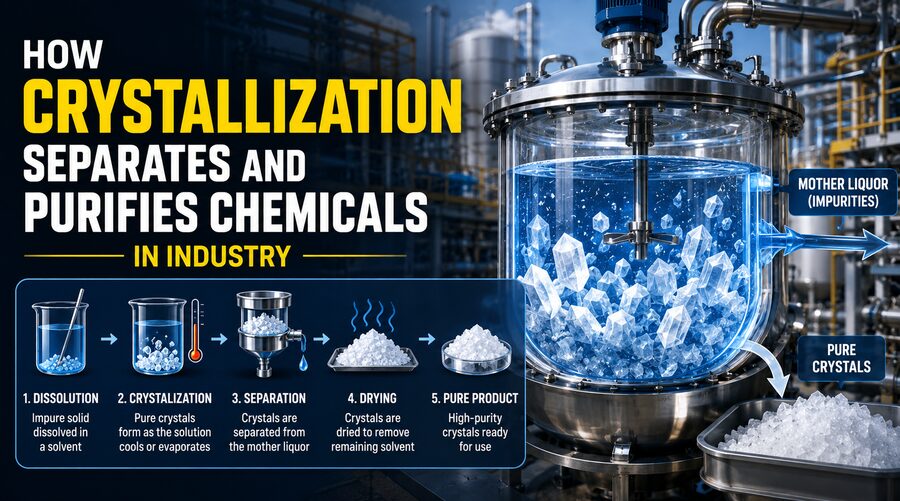

Crystallization is one of the most important separation and purification processes used in the chemical industry. From producing pharmaceutical ingredients and refined sugar to manufacturing fertilizers, specialty chemicals, food additives, and electronic materials, crystallization helps industries recover valuable substances in a highly pure solid form. ❄️⚗️
The basic idea is simple: a desired chemical is dissolved in a liquid, and operating conditions are changed until that chemical can no longer remain completely dissolved. Molecules or ions then organize themselves into an ordered solid structure called a crystal.
In practice, however, industrial crystallization is much more sophisticated. Engineers must carefully control temperature, concentration, solvent composition, mixing, cooling rate, and crystal growth to obtain the correct purity, particle size, shape, and production yield.
Because different chemicals have different solubilities, crystallization can selectively separate one substance from a mixture while leaving many impurities dissolved in the remaining liquid. This combination of separation and purification makes crystallization a powerful industrial technique.
🔬 What Is Crystallization?
Crystallization is the process in which atoms, molecules, or ions arrange themselves into a highly ordered solid structure.
In a solution, dissolved particles move freely throughout the liquid. Under the right conditions, however, the solution can become supersaturated.
A supersaturated solution contains more dissolved material than would normally remain stable under those conditions.
Once supersaturation reaches a sufficient level, dissolved molecules begin coming together to form tiny solid particles. These particles can then grow into larger crystals.
The process generally involves two major stages:
- Nucleation – the initial formation of tiny crystal particles.
- Crystal growth – the addition of more molecules to existing crystal surfaces.
Controlling these two stages is essential in industrial crystallization.
💧 Solubility: The Principle Behind Crystallization
Crystallization relies heavily on solubility, which describes how much of a substance can dissolve in a particular solvent.
For many solids, solubility increases as temperature rises.
Suppose 100 grams of water can dissolve a large amount of a particular chemical at 80°C but much less at 20°C.
Engineers can first prepare a concentrated solution at the higher temperature. When the solution is cooled, the solvent can no longer hold all of the dissolved material.
The excess material leaves the solution and forms crystals. ❄️
This is known as cooling crystallization.
The relationship between temperature and solubility is often represented using a solubility curve. Engineers use these curves to determine appropriate operating conditions and estimate how much material can theoretically be recovered.
⚖️ How Crystallization Separates Chemicals
Imagine a liquid containing a desired compound along with several impurities.
If the desired compound has different solubility behavior from the impurities, engineers can adjust conditions so that the desired compound crystallizes while the impurities remain dissolved.
For example, suppose Compound A becomes poorly soluble when the temperature drops, while Impurity B remains highly soluble.
Cooling the solution causes Compound A to form crystals.
The crystals can then be physically separated from the liquid using filtration or centrifugation.
Most of Impurity B stays behind in the remaining liquid.
The solid product is therefore much purer than the original solution.
This remaining liquid is commonly called the mother liquor.
🧼 Why Crystallization Produces High Purity
Crystal structures are highly organized.
When a crystal grows, its lattice tends to accept molecules or ions that fit the required structural arrangement. Many chemically different impurities do not fit easily into that structure.
As a result, impurities often remain in the surrounding liquid rather than becoming part of the crystal.
This gives crystallization a natural purification capability.
However, crystals are not automatically perfectly pure.
Impurities may become trapped:
- Between crystals
- Inside crystal defects
- In pockets of mother liquor
- On crystal surfaces
Industrial systems therefore use careful growth conditions, washing, and sometimes repeated crystallization to improve purity.
🌡️ Cooling Crystallization
Cooling crystallization is one of the most widely used methods.
The process begins with a hot, concentrated solution.
As the temperature decreases, solubility falls and supersaturation develops.
Crystals then begin forming.
A typical sequence is:
Concentrated solution → Cooling → Supersaturation → Nucleation → Crystal growth → Solid-liquid separation
The cooling rate must be controlled carefully.
If cooling occurs too rapidly, the solution may produce a very large number of tiny crystals.
If cooling occurs more gradually, fewer nuclei may form and those crystals can grow larger.
Industries often prefer specific crystal sizes because particle size affects filtration, drying, handling, dissolution, and final product performance.
💨 Evaporative Crystallization
Not every chemical becomes significantly less soluble when cooled.
In such cases, industries may use evaporative crystallization.
Instead of lowering temperature, part of the solvent is evaporated.
Removing solvent increases the concentration of the dissolved chemical until supersaturation is reached.
The chemical then crystallizes.
This technique is common in industries processing salts and inorganic chemicals.
For example, water can be evaporated from a salt solution until solid crystals begin forming.
Industrial evaporators may operate under reduced pressure, allowing evaporation to occur at lower temperatures and reducing energy requirements or protecting temperature-sensitive materials.
🧴 Antisolvent Crystallization
Another powerful method is antisolvent crystallization.
An antisolvent is a liquid in which the desired compound has poor solubility.
Suppose a chemical dissolves well in Solvent A.
Engineers can add Solvent B, which mixes with Solvent A but does not dissolve the chemical effectively.
As the antisolvent concentration increases, the chemical becomes less soluble and begins crystallizing.
This method is particularly useful when temperature changes alone do not provide enough difference in solubility.
Antisolvent crystallization is widely used in pharmaceutical and fine-chemical manufacturing. 💊
⚡ Reactive Crystallization
In reactive crystallization, a chemical reaction produces a compound that has low solubility in the reaction mixture.
The newly produced material therefore crystallizes as the reaction proceeds.
This process can combine chemical synthesis and product separation into a single operation.
Reactive crystallization is used in the manufacture of certain salts, pigments, minerals, and specialty compounds.
A related process is often called precipitation, particularly when very fine solid particles form quickly.
Although precipitation and crystallization overlap, crystallization typically emphasizes controlled formation of well-ordered solid particles.
🌱 What Is Crystal Nucleation?
Before a crystal can grow, a small stable cluster of molecules must form.
This process is called nucleation.
There are two major types.
🧬 Primary Nucleation
Primary nucleation occurs when crystals begin forming without existing crystals of the same substance being deliberately present.
It can happen spontaneously once supersaturation becomes high enough.
🔄 Secondary Nucleation
Secondary nucleation occurs because crystals are already present.
Collisions between crystals, mixing equipment, or crystal surfaces can generate new nuclei.
Industrial crystallizers often contain many crystals, so secondary nucleation can become very important.
Controlling nucleation determines how many crystals form and therefore strongly influences final particle size.
🌱 Seeding the Crystallizer
Manufacturers often do not want nucleation to begin randomly.
Instead, they introduce small crystals called seed crystals into the supersaturated solution.
This process is called seeding.
Seed crystals provide surfaces on which dissolved molecules can grow.
Seeding offers much greater control over crystallization because engineers can choose approximately when crystal growth begins.
It can help produce:
- More consistent particle size
- Better crystal shape
- Improved batch-to-batch repeatability
- Reduced unwanted spontaneous nucleation
- Easier downstream processing
In pharmaceutical manufacturing, precise control of crystallization can be especially important because the physical form of a drug substance may influence manufacturing and product performance.
📐 Crystal Size Matters
Purity is not the only objective of crystallization.
Industries also care greatly about crystal size distribution.
Very small crystals can be difficult to filter because they may block filter pores or remain suspended in liquid.
Extremely large crystals may create handling or processing problems.
An ideal product often requires a controlled range of particle sizes.
Crystal size affects:
- Filtration rate
- Centrifuge performance
- Drying time
- Powder flow
- Dissolution rate
- Packaging
- Product appearance
Engineers therefore design crystallization conditions not only to maximize yield but also to obtain useful physical properties.
🔷 Crystal Shape and Morphology
Crystals can grow into many different shapes.
Depending on molecular structure and operating conditions, they may appear as:
- Needles
- Plates
- Cubes
- Prisms
- Irregular particles
This external crystal shape is called morphology.
Crystal morphology matters because needle-shaped particles may behave very differently from compact crystals.
Long needles can interlock, creating filtration and powder-flow difficulties.
Changes in solvent, temperature, impurities, additives, and supersaturation can influence crystal shape.
Industrial crystallization therefore combines chemistry, thermodynamics, fluid mechanics, and particle engineering.
🧪 Crystallization in Pharmaceutical Manufacturing
The pharmaceutical industry relies heavily on crystallization.
After a drug molecule has been synthesized, it may exist in a solution containing solvents, reaction by-products, catalysts, and other impurities.
Crystallization can selectively recover the active pharmaceutical ingredient in solid form.
The crystals can then be:
- Filtered
- Washed
- Dried
- Tested
- Processed into the final dosage form
Pharmaceutical crystallization also introduces an additional challenge called polymorphism.
🔬 What Are Polymorphs?
Some chemicals can crystallize in more than one internal crystal structure.
These different structures are called polymorphs.
Although two polymorphs contain exactly the same chemical molecules, they may have different physical properties, including:
- Solubility
- Melting point
- Stability
- Density
- Dissolution behavior
For pharmaceuticals, controlling which polymorph forms can be extremely important.
Manufacturers carefully control solvents, cooling profiles, mixing, seeding, and temperature to consistently produce the required crystal form.
🍬 Crystallization in Sugar Production
One familiar industrial example is sugar manufacturing.
Sugar-rich juice is concentrated by evaporation until it becomes supersaturated.
Small sugar crystals are introduced, and additional sugar molecules deposit onto them.
As the crystals grow, they are separated from the syrup using centrifuges.
The remaining liquid contains water and other dissolved materials.
Repeated processing can recover additional sugar.
This is a large-scale example of how crystallization can simultaneously separate, purify, and shape a commercial product. 🍭
🌾 Fertilizer and Chemical Production
Crystallization is also important in fertilizer manufacturing.
Many fertilizers are inorganic salts that can be recovered as crystals from aqueous solutions.
Industrial crystallizers help produce compounds containing nutrients such as nitrogen, potassium, and phosphorus.
The process must provide crystals that are not only chemically pure but also suitable for transportation, storage, and later processing.
Good crystal size control helps prevent excessive dust, caking, and handling problems.
🧂 Salt Production
Salt production is perhaps the simplest everyday example of crystallization.
When seawater or concentrated brine loses water through evaporation, sodium chloride concentration increases.
Eventually, the solution becomes saturated.
Continued water removal produces salt crystals.
Large industrial operations may use solar evaporation, mechanical evaporators, or vacuum crystallizers depending on climate, purity requirements, and production scale.
🏭 Industrial Crystallizer Designs
Several types of crystallizers are used in chemical plants.
The appropriate design depends on the substance being processed and the required product characteristics.
Common designs include:
- Batch crystallizers
- Continuous crystallizers
- Draft-tube-baffle crystallizers
- Forced-circulation crystallizers
- Vacuum crystallizers
- Cooling crystallizers
Batch crystallizers process a defined quantity of solution at one time.
Continuous crystallizers receive feed and remove product continuously, making them attractive for large-scale production.
Mixing and fluid circulation are carefully designed to keep crystals suspended while controlling heat and mass transfer.
🌀 Why Mixing Is Important
Industrial crystallizers usually contain mixers or circulation systems.
Mixing helps distribute:
- Temperature
- Solute concentration
- Seed crystals
- Supersaturation
Without sufficient mixing, one region of a vessel could become highly supersaturated while another remains undersaturated.
This may produce inconsistent nucleation and crystal growth.
However, excessive agitation can also cause problems.
Strong collisions may break crystals into smaller fragments, increasing secondary nucleation.
Engineers therefore optimize mixing intensity carefully.
🧺 Separating the Crystals from the Liquid
Once crystals have reached the desired size, they must be removed from the mother liquor.
Two common methods are filtration and centrifugation.
Filtration passes the mixture through a porous material that retains crystals while allowing liquid to pass.
Centrifuges rotate the mixture rapidly, using centrifugal force to separate solids from liquid.
The crystals are often washed afterward.
Washing removes mother liquor that remains on crystal surfaces and may contain dissolved impurities.
This step can substantially improve product purity. 💧
🌬️ Drying the Final Crystals
After filtration or centrifugation, crystals still contain moisture or solvent.
They are therefore usually dried.
Industrial dryers may use:
- Heated air
- Vacuum
- Fluidized beds
- Rotating equipment
- Conductive heating
Drying must be carefully controlled because excessive temperature may damage heat-sensitive chemicals or change their crystal form.
Once dry, crystals may be milled, screened, packaged, or sent to another manufacturing stage.
📊 Yield Versus Purity
Industrial crystallization often requires a compromise between yield and purity.
If engineers try to recover nearly every molecule of the desired substance, very strong supersaturation may be required.
However, extreme conditions can increase rapid nucleation or cause more impurities to become trapped in the crystals.
Stopping crystallization earlier may produce purer crystals but leave valuable product dissolved in the mother liquor.
Manufacturers therefore optimize conditions to balance product recovery, purity, production time, and operating cost.
♻️ What Happens to the Mother Liquor?
The mother liquor remaining after crystal separation may still contain significant amounts of valuable material.
Industries often recycle it.
Possible strategies include:
- Returning it to an earlier process stage
- Concentrating it further
- Performing a second crystallization
- Recovering the solvent
- Separating additional by-products
Efficient recycling reduces chemical waste and improves economic performance.
It can also reduce the environmental footprint of chemical manufacturing. 🌍
🤖 Modern Crystallization Process Control
Modern crystallization plants increasingly use sensors and automated control systems.
Engineers may monitor:
- Temperature
- Concentration
- Turbidity
- Particle size
- Solution density
- Crystal shape
- Supersaturation
Advanced instruments can sometimes monitor crystal populations directly while crystallization is occurring.
Computer models can then adjust cooling rates, antisolvent addition, mixing speed, or feed rates.
This helps manufacturers produce crystals with much more consistent properties.
🧠 Why Crystallization Can Be Challenging
Although the basic concept is simple, industrial crystallization can be difficult to control.
A small change in temperature, impurity concentration, mixing rate, or solvent composition may affect nucleation and growth.
Problems can include:
- Too many tiny crystals
- Crystals that are too large
- Unwanted crystal shapes
- Product sticking to equipment
- Impurity inclusion
- Unexpected polymorph formation
- Poor filtration
This is why crystallization process development often includes laboratory experiments, thermodynamic measurements, pilot-scale testing, and detailed process modeling.
🌍 Advantages of Industrial Crystallization
Crystallization offers several important advantages.
It can achieve very high chemical purity while simultaneously producing a solid product that is easy to store and transport.
In suitable applications, it can also require less energy than some alternative separation technologies.
Major benefits include:
- 🧪 High product purity
- ♻️ Potential solvent recovery
- 📦 Direct production of solid particles
- ⚗️ Selective separation
- 📐 Control over particle characteristics
- 🏭 Suitability for large industrial scales
For these reasons, crystallization remains essential throughout the chemical processing industry.
✨ Conclusion
Crystallization separates and purifies chemicals by taking advantage of differences in solubility and the natural tendency of molecules or ions to form ordered crystal structures.
Engineers create supersaturation by cooling a solution, evaporating solvent, adding an antisolvent, or carrying out a chemical reaction. Once supersaturation develops, nucleation begins and crystals grow.
Because the desired substance fits into its own crystal lattice more readily than many impurities, the crystals can become significantly purer than the original solution. The solid crystals are then separated from the mother liquor, washed, and dried.
Successful industrial crystallization requires much more than simply making a solid appear. Engineers must control nucleation, crystal growth, temperature, supersaturation, mixing, particle size, morphology, and purity.
From medicines and fertilizer to sugar, salt, specialty chemicals, and advanced materials, crystallization quietly supports an enormous range of products used every day. 🧪🏭
Ultimately, industrial crystallization is a powerful example of how carefully controlled molecular behavior can be transformed into a practical manufacturing process—turning dissolved chemicals into purified, valuable, and precisely engineered solid products. 💎⚗️