
A refinery turns crude oil into useful fuel streams. A beverage plant recovers alcohol from a fermentation broth. A pharmaceutical facility removes solvent before the next reaction step. These operations look very different, yet many rely on the same piece of equipment: the distillation column.
From outside, a column can look like a tall steel cylinder surrounded by pipes, instruments, and insulation. Inside, it is a carefully controlled contactor where rising vapor and descending liquid repeatedly meet, exchange material, and move toward different compositions.
That repeated contact is what makes distillation far more capable than simply boiling a liquid in a pot. It can separate mixtures containing many components, but it also consumes substantial energy and demands disciplined operation.
Understanding what happens under the hood helps students connect phase-equilibrium diagrams to real equipment and helps practicing engineers diagnose why a column is missing its product targets.
🧭 The Separation Problem Distillation Solves
Distillation separates liquid mixtures because their components do not enter the vapor phase equally. A component that vaporizes more readily is called more volatile; it tends to become richer in the vapor. A less volatile component tends to remain richer in the liquid.
The objective is usually not perfectly pure material. A column may instead make a light product that meets a vapor-pressure limit, recover a valuable solvent, or send a heavy stream to another separation step at a specified composition.
🧪 A Mixture Is More Than Two Components
Textbook examples often begin with a binary mixture such as ethanol and water. Industrial feeds may contain dozens or hundreds of hydrocarbons, solvents, impurities, dissolved gases, and trace contaminants.
Engineers therefore group components into light keys and heavy keys. The light key is the more volatile component whose recovery matters, while the heavy key is the less volatile component that must be kept from escaping into the overhead product. Components lighter or heavier than these keys influence the design, but the key pair defines the central split.
🌡️ Boiling Point Is a Useful First Clue
At a given pressure, a lower-boiling pure component generally has a higher tendency to vaporize. This makes boiling-point data a helpful first intuition: propane is much easier to vaporize than a heavy oil fraction, for example.
But boiling points alone do not design a column. Mixture interactions, pressure, and composition all change vapor-liquid behavior. A chemical engineer uses phase-equilibrium information rather than treating a published normal boiling point as a complete answer.
⚖️ Vapor-Liquid Equilibrium Sets the Direction
When vapor and liquid contact long enough at a fixed temperature and pressure, they approach vapor-liquid equilibrium, often shortened to VLE. At equilibrium, the vapor composition and liquid composition differ, but neither phase has a net driving force to change composition further.
For a favorable separation, vapor in contact with a liquid becomes richer in the more volatile component. If that enriched vapor is condensed, it produces a liquid richer in the light component than the liquid from which the vapor originated.
📈 Relative Volatility Measures Difficulty
Relative volatility compares how strongly two components prefer the vapor phase. A larger difference in volatility generally means fewer vapor-liquid contacts are needed to achieve a specified split.
When relative volatility is near one, the two components behave similarly and separation becomes difficult. More stages, more reflux, different pressure, an entrainer, or a different technology may be required. Relative volatility is not always constant, so simulations often use a property model across the column’s temperature and composition range.
🏗️ The Column Is a Vertical Contacting Device
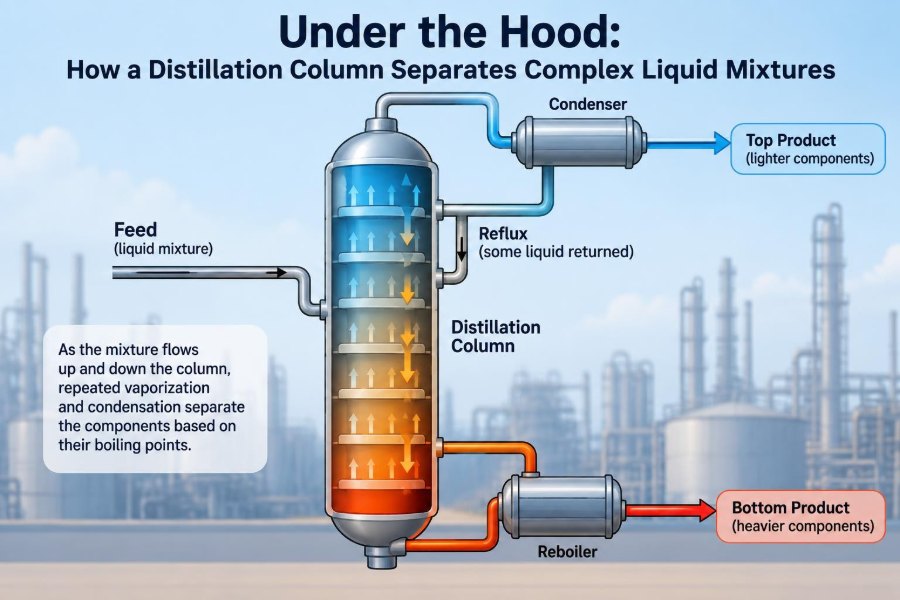
A conventional distillation system includes the column shell, internal contacting devices, a condenser at the top, a reflux drum, a reboiler at the bottom, pumps, piping, and controls. The shell supplies height and pressure containment; it does not by itself create high-quality separation.
Inside, liquid flows downward while vapor flows upward. Their countercurrent paths maximize repeated contact, allowing each phase to become progressively enriched in the direction it travels.
🪜 Trays Create Discrete Contacting Steps
Tray columns contain horizontal decks that hold a shallow liquid layer. Vapor bubbles through openings in each tray and contacts that liquid before continuing upward. The liquid then moves across the tray and down a downcomer to the tray below.
Common tray designs include sieve trays, valve trays, and bubble-cap trays. Each balances cost, capacity, pressure drop, operating range, fouling resistance, and liquid-vapor contacting behavior. A real tray is not automatically one ideal equilibrium stage; efficiency accounts for its imperfect approach to equilibrium.
🧶 Packing Provides Continuous Contact
Packed columns replace trays with structured sheets or random pieces that spread liquid into thin films while leaving passages for vapor. The phases contact continuously along the packing height rather than on separate decks.
Packing is often attractive where low pressure drop matters, particularly in vacuum distillation. It can also offer useful capacity and efficiency, but liquid distribution must be carefully designed. Poor distribution creates dry zones and channels that contribute little to separation.
🔄 Countercurrent Flow Builds a Composition Gradient
Near the top, descending liquid is relatively rich in light material because it has been condensed from light-rich overhead vapor. It strips some heavy material from the ascending vapor.
Near the bottom, rising vapor generated by the reboiler is relatively rich in light material. It strips light material from the descending liquid. This opposing exchange creates a composition gradient: lighter components concentrate upward and heavier components downward.
🔥 The Reboiler Supplies the Upward Push
The reboiler heats a portion of bottom liquid, creating vapor that returns to the column. This vapor is the internal lifting stream that carries volatile material toward the top.
Reboilers come in several configurations, including kettle and thermosiphon designs. Their selection depends on circulation behavior, fouling tendency, heat-transfer needs, available utilities, and the risk of damaging heat-sensitive compounds. Excessive heating is not a universal fix; it can raise pressure drop, worsen hydraulics, or degrade material.
❄️ The Condenser Captures the Overhead Vapor
Vapor leaving the column top is cooled in a condenser. A total condenser turns essentially all overhead vapor into liquid, while a partial condenser deliberately leaves a vapor phase and can act as an additional equilibrium contact.
The condensed liquid usually enters a reflux drum, where liquid product is withdrawn and another portion is returned to the column. If water and organic liquid separate into layers, the drum may also provide decanting service.
🔁 Reflux Is the Column’s Internal Recycling Tool
Reflux is the liquid sent back from the overhead system to the top of the column. It flows downward and supplies cool, light-rich liquid for contact with rising vapor.
Increasing reflux usually improves top-end separation because it creates more internal liquid flow and more opportunity for mass transfer. The trade-off is energy: more reflux normally means the reboiler and condenser must handle larger duties. The best operating point meets product requirements without routinely paying for unnecessary circulation.
📏 Reflux Ratio Explains the Energy Trade-Off
The reflux ratio is commonly expressed as reflux flow divided by distillate product flow. At very low reflux, a desired separation may be impossible with a practical number of stages. Near the minimum reflux condition, the required number of stages becomes extremely large.
At very high reflux, fewer stages can achieve the split, but internal flows and utility loads become large. Column design chooses a practical middle ground by considering capital cost, energy cost, controllability, and uncertainty in feed composition.
📥 The Feed Stage Must Match the Feed Condition
Feed enters at a selected location rather than automatically at the midpoint. A feed rich in lighter material belongs higher in the column, while a feed rich in heavier material belongs lower. The goal is to avoid forcing the column to undo an inefficient initial placement.
Its thermal condition matters too. A cold liquid feed condenses some rising vapor; a hot vapor feed can vaporize some descending liquid. Engineers describe this effect using feed quality, often represented by a q value in preliminary design methods.
⬆️ Rectifying and Stripping Sections Have Different Jobs
Above the feed, the rectifying section enriches the rising vapor in light components so the overhead product can meet specification. Reflux is especially influential in this section.
Below the feed, the stripping section removes remaining light components from the downward-flowing liquid. Reboiler vapor provides the stripping action. Thinking of these as distinct sections makes feed-stage location and operating changes easier to interpret.
🧾 Mass Balances Keep the Story Honest
Before sophisticated simulation, engineers apply overall and component material balances. In simple form, feed equals distillate plus bottoms, and the amount of each tracked component entering equals the amount leaving.
These balances are powerful troubleshooting tools. If measured flows and compositions imply that more of a component leaves than enters, the issue may be an analyzer bias, an unmeasured stream, a sampling problem, or inconsistent flow data—not a violation of chemistry.
💨 Energy Balances Reveal the Utility Demand
Distillation redistributes components by repeatedly vaporizing and condensing internal streams. That phase change requires heat in the reboiler and heat removal in the condenser.
An energy balance tracks feed enthalpy, reboiler duty, condenser duty, products, and heat losses. The latent heat associated with internal vapor traffic is often the dominant energy burden. This is why separation engineers look closely at heat integration, not merely at column diameter and height.
🧮 Theoretical Stages Are an Ideal Benchmark
A theoretical stage is an ideal contact where exiting vapor and liquid reach equilibrium. It is a conceptual benchmark used in design calculations, not a literal guarantee of hardware performance.
For a binary system, graphical methods such as McCabe-Thiele diagrams show how repeated equilibrium contacts move compositions toward the targets. For multicomponent systems, shortcut methods and rigorous process simulators are more common. Both still rely on sound phase-property data and realistic operating assumptions.
📐 Efficiency Converts Theory into Equipment
Actual trays and packing do not reach perfect equilibrium. Finite contact time, maldistribution, entrainment, foaming, and nonideal flow all reduce effectiveness. Therefore, an installation may need more physical trays or more packed height than its theoretical-stage calculation suggests.
Efficiency is not a universal constant to copy from one unit to another. It changes with system properties, vapor and liquid rates, internal design, pressure, and condition of the equipment.
🧪 A Hypothetical Solvent-Recovery Example
Imagine a reactor outlet containing a volatile solvent, a less volatile product, and small amounts of by-products. A downstream column sends a solvent-rich distillate overhead for recycle and withdraws a product-rich bottoms stream for further purification.
If solvent appears too high in the bottoms, plausible causes include insufficient reboiler duty, too little effective stripping area, an unfavorable feed condition, or a higher-than-expected feed rate. Raising heat may help, but it should be checked against overhead capacity, pressure constraints, product thermal stability, and hydraulic limits.
🧷 Product Specifications Drive the Operating Targets
Operators do not normally chase a temperature simply because it matches a historical value. They aim for product quality: impurity limits, recovery, volatility, water content, or downstream process requirements.
Temperature remains useful because, at roughly fixed pressure and composition range, it can indicate changes in composition. But temperature is an indirect signal. A shift in pressure can change boiling temperatures even when composition has not changed, so pressure context is essential.
🎛️ Pressure Changes Both Equilibrium and Equipment Needs
Lowering pressure lowers boiling temperatures, which can protect heat-sensitive materials and allow use of lower-temperature heating. Vacuum distillation is widely used when atmospheric boiling temperatures would cause degradation.
However, lower pressure also means larger vapor volumes for a given molar flow. That can require a larger-diameter column and makes air leakage more consequential. Raising pressure can make condensation easier with available cooling, but may worsen relative volatility or require higher reboiler temperatures.
🚧 Flooding Is a Capacity Limit, Not Better Contact
As vapor flow rises, it increasingly resists the downward liquid flow. At sufficiently high rates, liquid accumulates inside the column, pressure drop rises sharply, and the column can flood. Separation often deteriorates rather than improves.
Warning signs can include unstable differential pressure, changing level behavior, loss of product quality, and abnormal pressure trends. Reducing vapor or liquid traffic may be necessary, but the right response depends on identifying whether the cause is excess heat, excessive reflux, foaming, blockage, or an upset in feed conditions.
💧 Weeping and Dumping Occur at the Other Extreme
Tray columns also need enough vapor flow. If vapor pressure is too low to support liquid on a tray, liquid can leak through tray openings instead of flowing across the deck. This is called weeping; severe loss of liquid can become dumping.
Low vapor-liquid contact then reduces efficiency. A column must operate within a hydraulic window: not so low that trays weep, and not so high that the column floods.
🫧 Foaming, Entrainment, and Fouling Distort the Separation
Foaming creates a persistent gas-liquid dispersion that can occupy excessive volume. Entrainment carries liquid droplets upward with vapor, contaminating upper sections and potentially overwhelming the overhead system.
Fouling narrows passages, reduces heat transfer, disrupts liquid flow, and increases pressure drop. Surface-active contaminants, solids, corrosion products, or polymer-forming materials can contribute. The remedy may involve feed cleanup, chemical compatibility review, changed operating conditions, cleaning, or different internals—not simply more reboiler duty.
🔍 Instrument Data Need Process Interpretation
Differential pressure across the column can reveal changes in vapor-liquid traffic. Temperatures along the height can show movement of the composition profile. Reflux flow, reboiler steam, condenser duty, drum level, and online composition measurements complete the operating picture.
No single tag diagnoses every issue. For example, a top-temperature change might result from composition, pressure, reflux, cooling performance, or analyzer error. Good troubleshooting compares several measurements with mass-balance logic and recent operating changes.
🧠 Control Loops Keep the Column Near Its Target
Basic controls stabilize inventory and pressure: reflux-drum level influences distillate withdrawal, bottom level influences bottoms withdrawal, and condenser operation helps control pressure. Product quality is often managed indirectly through reflux, reboiler duty, temperature profiles, or composition analyzers.
Columns are strongly coupled systems. Increasing reflux can affect top composition, internal flow, pressure drop, and reboiler demand. Control design therefore favors clear objectives, reliable measurements, and changes made with enough time for the column to respond.
♻️ Energy Integration Can Change the Economics
Because reboilers and condensers move substantial heat, distillation is often a major energy user in process plants. Heat from one hot stream may preheat a feed, and suitable pressure levels can sometimes allow one column’s condenser to supply heat elsewhere.
Heat integration has constraints. Temperature driving force, fouling, operability during startup, and contamination risk all matter. A clever heat-recovery network that is difficult to control or cannot tolerate normal disturbances may not deliver its expected value in practice.
🧱 Some Mixtures Resist Ordinary Distillation
An azeotrope is a composition at which vapor and liquid have the same composition under a given pressure. Near an azeotrope, ordinary distillation cannot continue enriching one component beyond that limit at that pressure.
Other difficult cases include close-boiling components, heat-sensitive materials, and mixtures with very low relative volatility. Engineers may consider pressure-swing distillation, extractive distillation, azeotropic distillation, membranes, adsorption, crystallization, or liquid-liquid extraction. The best choice depends on purity, recovery, solvent handling, energy, safety, and scale.
🦺 Safety Begins with Containment and Relief
Columns handle hot fluids, pressure, flammable vapors, corrosive chemicals, and sometimes vacuum. Safe design includes appropriate materials, isolation, drainage, ventilation, instrumentation, and pressure-relief protection sized for credible scenarios.
Operating procedures must also account for startup, shutdown, loss of cooling, loss of heat, blocked outlets, and unexpected composition changes. Specific safeguards depend on the service and local design requirements; they should be established through formal process-safety work, not inferred from a generic diagram.
🧰 A Practical Troubleshooting Sequence
When a product goes off specification, rapid adjustments without diagnosis can create a second upset. A structured sequence is more reliable:
- Confirm the specification and verify that samples or analyzers are credible.
- Check feed rate, composition, temperature, and pressure against the expected operating basis.
- Review column pressure, differential pressure, reflux, reboiler duty, condenser performance, and inventory trends together.
- Look for hydraulic symptoms such as flooding, weeping, foaming, or restricted flow.
- Make a controlled change, allow appropriate settling time, and document the response.
This approach separates measurement problems from process problems and prevents a temporary quality deviation from becoming an energy or safety problem.
🎓 Reading a Column as a Connected System
A distillation column is not merely a vertical boiler. It is a network of equilibrium, heat transfer, mass transfer, hydraulics, and controls. Reflux, reboil, feed placement, pressure, and internal condition all influence one another.
The core principle is simple: repeated vapor-liquid contact enriches volatile components upward and less volatile components downward, while practical performance depends on how well the equipment and operating conditions support that contact. Once that idea is clear, phase diagrams, tray counts, temperature profiles, and troubleshooting data become parts of one coherent picture.
Distillation remains a foundational separation method because it is flexible, scalable, and well understood—but successful operation comes from respecting both the thermodynamics and the hardware that make each contact count. 🧪⚙️🌡️