
Many industrial processes depend on bringing gases and solid particles into close contact. This happens in applications such as fuel combustion, chemical production, catalytic reactions, mineral processing, waste treatment, and petroleum refining. The challenge is that ordinary piles or packed beds of solid particles do not always mix efficiently with gases.
A technology called the fluidized-bed reactor solves this problem in an elegant way. 🌬️⚙️
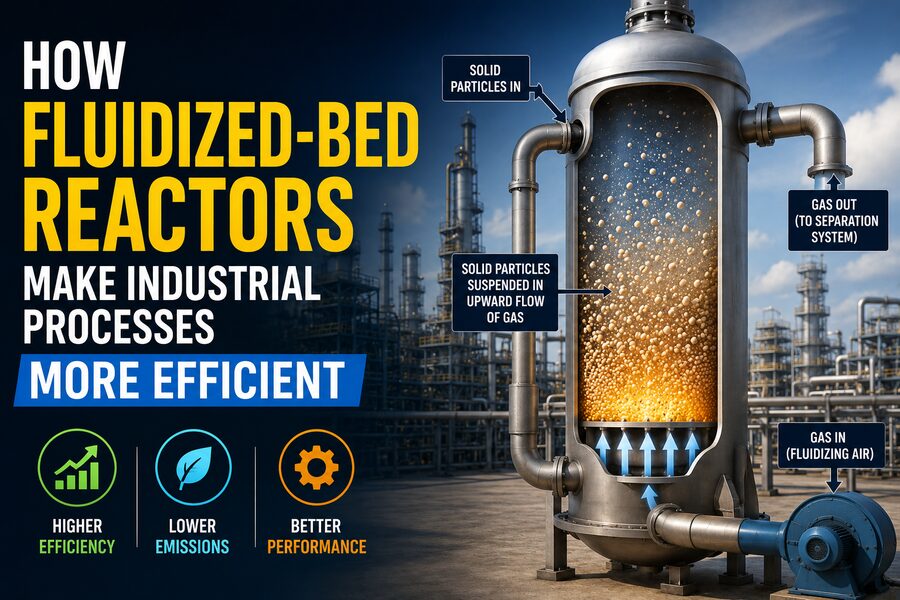
By forcing gas—or sometimes liquid—upward through a bed of solid particles at the right speed, engineers can make those particles behave almost like a boiling fluid. Once the particles become suspended and highly mobile, heat and mass transfer improve dramatically.
That unusual behavior allows fluidized-bed reactors to process large quantities of material efficiently, maintain relatively uniform temperatures, and achieve excellent contact between gases and solids.
As a result, fluidized beds have become important tools in modern industry.
🌪️ What Is a Fluidized Bed?
Imagine a container filled with fine sand.
If nothing is flowing through the sand, the grains sit together as a normal packed bed.
Now imagine blowing air upward from underneath.
At a very low airflow rate, the air simply moves through small gaps between the particles.
As the airflow increases, the upward force of the gas begins pushing against the weight of the particles.
Eventually, the gas moves fast enough to partially support the particles.
At this point, the bed expands and the particles begin moving freely around one another.
The solid material now starts behaving surprisingly like a liquid. 🌊
This condition is known as fluidization.
The particles can circulate, mix, bubble, and flow even though they remain solid.
A reactor that uses this behavior to carry out chemical or physical processes is called a fluidized-bed reactor, often abbreviated as FBR.
⚖️ The Minimum Fluidization Velocity
Fluidization does not occur at just any gas speed.
There is an important threshold called the minimum fluidization velocity.
Below this velocity, the particles remain mostly stationary.
At approximately the minimum fluidization velocity, the drag force created by the upward-moving fluid becomes sufficient to balance the effective weight of the particles.
The bed begins to expand.
If the velocity increases further, particles become more mobile and the bed enters various fluidized regimes.
The exact minimum fluidization velocity depends on factors such as:
- Particle diameter
- Particle density
- Gas density
- Gas viscosity
- Bed geometry
- Particle shape
Engineers carefully calculate and control these variables when designing industrial reactors.
🫧 Why Does a Fluidized Bed Look Like Boiling Liquid?
One of the most striking characteristics of many fluidized beds is their appearance.
Gas bubbles may form and rise through the particle bed, much like bubbles rising through boiling water.
Particles move upward around gas bubbles and circulate downward elsewhere.
This creates intense internal mixing. 🔄
The solids are not melting or becoming liquid.
Instead, the aerodynamic forces of the gas make the collection of particles behave collectively like a fluid.
Because of this behavior, fluidized particles can sometimes flow through pipes, overflow containers, and redistribute themselves throughout a vessel.
This fluid-like motion is central to the technology’s efficiency.
🔥 Excellent Heat Transfer
One of the greatest advantages of fluidized-bed reactors is very effective heat transfer.
In a stationary packed bed, hot and cold zones can form because solid particles do not move very much.
Fluidized beds constantly circulate particles throughout the reactor.
A particle that becomes hot in one region may quickly move into a cooler region.
This mixing helps distribute thermal energy throughout the bed.
As a result, fluidized-bed reactors often maintain much more uniform temperatures than conventional fixed-bed systems. 🌡️
Uniform temperatures are extremely valuable in chemical processing.
They can reduce unwanted side reactions, protect temperature-sensitive catalysts, and improve product quality.
🌡️ Why Temperature Uniformity Matters
Many chemical reactions are highly sensitive to temperature.
If one part of a reactor becomes significantly hotter than another, undesirable reactions may occur.
These localized high-temperature regions are often called hot spots.
Hot spots can:
- Damage catalysts
- Reduce product selectivity
- Accelerate equipment degradation
- Trigger unwanted chemical reactions
- Create safety concerns
The intense particle mixing inside a fluidized bed helps remove these hot spots.
Heat is distributed rapidly throughout the reactor, making it easier for engineers to maintain the desired operating temperature.
This is especially valuable for strongly exothermic reactions, which release large amounts of heat. 🔥
🧪 Improved Mass Transfer
Chemical reactions often depend on molecules moving from one phase to another.
For example, gas molecules may need to reach the surface of a solid catalyst.
If gas flows around large stationary regions of particles, some catalyst surfaces may not be used efficiently.
Fluidization helps solve this problem.
Because particles move continuously and gas flows through the entire bed, the contact between gas and solids can be extremely strong.
This improves mass transfer—the movement of chemical species from one location or phase to another.
Better mass transfer often leads to faster reaction rates and more efficient use of catalysts.
⚛️ Fluidized Beds as Catalytic Reactors
Many industrial reactions require catalysts.
A catalyst speeds up a chemical reaction without being consumed in the same way as the main reactants.
In fluidized-bed catalytic systems, catalyst particles are suspended by flowing gases.
Because the catalyst particles are small and mobile, they provide a large surface area for chemical reactions.
Large surface area is extremely valuable because many catalytic reactions occur on the surface of the catalyst.
The more accessible surface area available, the more opportunities reactant molecules have to encounter active catalytic sites. 🧬
Fluidization also ensures that catalyst particles continuously contact fresh reactant gases.
🛢️ Fluid Catalytic Cracking in Oil Refineries
One of the most famous applications of fluidized-bed technology is fluid catalytic cracking, commonly known as FCC.
FCC units are widely used in petroleum refineries.
Their purpose is to break large hydrocarbon molecules found in heavy petroleum fractions into smaller, more valuable molecules.
These products can be used to produce gasoline, diesel components, liquefied petroleum gases, and petrochemical feedstocks.
In an FCC unit, finely powdered catalyst particles circulate between major processing sections.
Hot catalyst contacts hydrocarbon feedstock, helping break large molecules into smaller ones.
During the reaction, carbon-rich deposits called coke gradually accumulate on the catalyst.
The catalyst is then transported to another section where the coke is burned away.
The regenerated hot catalyst returns to the cracking process.
This continuous circulation makes fluid catalytic cracking extremely productive. 🔄🛢️
🔥 Fluidized-Bed Combustion
Fluidized beds are also used for burning fuels.
In a fluidized-bed combustor, solid fuel particles can be mixed with materials such as sand or limestone while air flows upward through the bed.
The intense mixing creates highly efficient contact between the fuel and oxygen.
This can improve combustion efficiency.
Fluidized-bed combustion is especially useful because it can handle a wider variety of fuels than many conventional combustion systems.
Possible fuels may include:
- Coal
- Biomass
- Agricultural residues
- Waste-derived fuels
- Industrial by-products
This flexibility can be economically valuable when low-cost or difficult-to-burn fuels are available. 🌱🔥
🌿 Lower Combustion Temperatures Can Reduce Emissions
Conventional combustion systems sometimes operate at extremely high temperatures.
High temperatures can promote the formation of nitrogen oxides, commonly called NOx.
Fluidized-bed combustors can often operate effectively at lower temperatures because heat is distributed efficiently throughout the bed.
Lower peak temperatures can reduce thermal NOx formation.
Additionally, limestone or similar materials can sometimes be added directly to the fluidized bed.
The limestone can react with sulfur-containing compounds, helping reduce sulfur dioxide emissions. 🌍
This means certain forms of pollution control can occur directly inside the combustion process rather than relying entirely on downstream equipment.
🧱 Bubbling Fluidized Beds
There are several different forms of fluidized-bed reactor.
One common type is the bubbling fluidized bed.
In this system, gas flows upward fast enough to fluidize the particles while large quantities of solids remain inside the reactor.
Gas bubbles form and travel upward through the bed.
These bubbles contribute to the characteristic boiling appearance.
Bubbling fluidized beds are useful for applications requiring strong mixing, good temperature control, and relatively long solid residence times.
They are used in combustion, drying, chemical processing, and other industrial operations.
🌪️ Circulating Fluidized Beds
Another major design is the circulating fluidized bed, or CFB.
In a CFB system, gas velocities are much higher.
The gas carries substantial quantities of particles upward and out of the main reactor.
These particles are then captured—often using a cyclone separator—and returned to the reactor.
The solids therefore circulate continuously through the system. 🔁
Circulating fluidized beds can provide excellent gas-solid contact and are especially useful for large-scale combustion and chemical-processing applications.
They can also offer longer effective particle residence times because solids are repeatedly returned to the reactor.
🌀 How Cyclone Separators Recover Particles
Because some fluidized-bed systems intentionally carry particles out with the gas stream, they need a way to separate those particles from the gas.
A cyclone separator is commonly used.
The gas-particle mixture enters the cyclone and begins swirling rapidly.
Centrifugal effects push the heavier particles toward the outer walls.
The particles then fall downward while cleaner gas exits through another path.
Recovered particles can be returned to the fluidized bed.
Cyclones have no moving internal mechanical components in many designs, making them rugged and suitable for harsh industrial environments. 🌀
⏱️ Better Control of Residence Time
Residence time describes how long materials remain inside a reactor.
For some processes, reactants need only a fraction of a second to react.
Other processes may require minutes or longer.
Fluidized-bed designs allow engineers to control gas and solid residence times somewhat independently.
This can be especially valuable in catalytic processes.
Gas can move rapidly through the reactor while catalyst particles remain or circulate for much longer periods.
That flexibility gives engineers more control over reaction conversion, selectivity, and productivity.
📈 High Processing Capacity
Fluidized-bed reactors can process large volumes of gas and solids.
Because particles are constantly mixed and exposed to flowing reactants, much of the available reactor volume can be used productively.
Strong heat and mass transfer can also allow reactions to proceed more rapidly.
This may reduce the reactor size required for a particular production rate compared with less efficient contacting systems.
In high-throughput industries, such improvements can translate into major economic benefits. 💰
A relatively compact reactor capable of processing enormous quantities of material can reduce equipment costs and increase production capacity.
🔄 Continuous Operation
Many fluidized-bed systems are designed for continuous processing.
Reactants enter continuously.
Products leave continuously.
Catalyst or solid material may also be added, removed, regenerated, or recycled while the system remains operating.
Continuous operation is attractive in large-scale industry because shutting down and restarting major processing equipment can be expensive.
Fluidized beds can therefore support steady production over long operating campaigns.
♻️ Catalyst Regeneration
Catalysts gradually lose activity for various reasons.
One common cause is the accumulation of deposits on catalyst surfaces.
In some fluidized systems, inactive catalyst can be continuously removed from the reaction zone and sent to a separate regeneration unit.
After regeneration, it returns to the reactor.
This means the process does not necessarily need to stop each time the catalyst needs treatment.
Fluid catalytic cracking is a classic example of this concept.
The constant circulation of catalyst between reaction and regeneration zones helps maintain productive operation. ⚙️
🌾 Fluidized Beds for Biomass Processing
Fluidized-bed reactors are increasingly important in biomass conversion.
Agricultural waste, wood residues, and other biological materials can be processed using techniques such as:
- Combustion
- Gasification
- Pyrolysis
In biomass gasification, for example, organic material reacts under controlled conditions to produce combustible gases containing compounds such as hydrogen and carbon monoxide.
The excellent temperature distribution inside a fluidized bed can help produce consistent reaction conditions.
Because biomass materials can vary significantly in composition and particle shape, the fuel flexibility of fluidized systems is particularly useful. 🌱
🗑️ Waste Treatment Applications
Fluidized beds can also process certain forms of industrial or municipal waste.
Strong mixing and temperature control make them useful for thermal treatment processes.
Materials that might burn unevenly in ordinary furnaces can sometimes be processed more consistently when mixed with hot fluidized particles.
The bed material acts as a large thermal reservoir.
Fresh material entering the reactor quickly contacts hot particles, encouraging rapid heating.
This can improve destruction efficiency for combustible compounds while maintaining more stable reactor temperatures.
🧴 Fluidized Beds in Polymer Production
Fluidized-bed reactors are also used to manufacture important polymers.
For example, some industrial processes produce polyethylene using gas-phase fluidized-bed reactors.
Gaseous reactants flow through a bed containing growing polymer particles and catalysts.
Polymerization occurs on or around the catalyst particles.
The fluidized bed helps remove reaction heat while keeping particles suspended and well mixed.
Because polymerization can release significant heat, efficient cooling is essential.
Fluidization helps engineers maintain temperatures within the proper range and avoid particle agglomeration or runaway reactions.
🌡️ Efficient Cooling and Heating
Fluidized beds are excellent not only for reactions but also for physical processes involving heating or cooling.
Because particles constantly contact one another and the flowing fluid, thermal energy is transferred rapidly.
Heat exchanger tubes can also be installed directly inside the bed.
Fluidized particles repeatedly contact these surfaces, improving heat-transfer rates.
This makes fluidized beds useful in applications such as:
- Drying
- Roasting
- Calcination
- Heat recovery
- Particle cooling
Efficient heat transfer can reduce energy requirements and operating costs. ⚡
🏗️ Calcination and Mineral Processing
Industries involving cement, minerals, and metals can also use fluidized-bed technology.
Calcination is a thermal treatment in which materials are heated to cause chemical or physical changes.
For example, certain carbonate minerals release carbon dioxide when heated.
Fluidized beds can provide excellent temperature control during calcination.
The constant particle mixing means that each particle is exposed more uniformly to thermal conditions.
This can produce more consistent product quality than heating a large stationary mass.
⚠️ Fluidized Beds Also Have Challenges
Despite their advantages, fluidized-bed reactors are not perfect.
The constant movement of solid particles can cause erosion.
Particles repeatedly collide with reactor walls, pipes, heat exchangers, and internal structures.
Over time, these collisions can wear away equipment surfaces.
Engineers may use abrasion-resistant materials, protective coatings, and carefully designed flow patterns to reduce this damage.
Another challenge is particle attrition.
Particles can break into smaller fragments due to repeated impacts.
Very fine particles may eventually be carried out of the reactor and require collection.
🧲 Particle Agglomeration
Particles in a fluidized bed must remain sufficiently separate to move freely.
Under certain conditions, however, particles can become sticky.
They may begin attaching to one another and forming larger clumps.
This phenomenon is known as agglomeration.
If severe agglomeration occurs, fluidization quality can deteriorate.
In extreme cases, a bed can partially defluidize.
This is particularly important in processes involving materials that soften, melt, or produce sticky compounds at operating temperatures.
Engineers carefully manage temperature, particle properties, gas velocity, and chemical composition to minimize this risk.
📏 Particle Size Is Extremely Important
Fluidization depends strongly on particle size.
Very large or dense particles require higher gas velocities to become fluidized.
Extremely fine particles can behave differently because cohesive forces between particles become more important.
A reactor may therefore require particles within a carefully controlled size range.
Industrial systems sometimes use screens, classifiers, cyclones, or particle-processing equipment to maintain suitable particle distributions.
Choosing the correct bed material is an important part of fluidized-bed design. 📐
💻 Modern Process Control Makes Fluidized Beds Smarter
Today’s fluidized-bed reactors are supported by sophisticated control systems.
Sensors continuously monitor variables such as:
- Temperature
- Pressure
- Gas flow
- Oxygen concentration
- Particle circulation
- Pressure drop across the bed
The pressure difference between different levels of the bed can provide valuable information about fluidization behavior.
Computerized control systems can then adjust gas flow, fuel supply, reactant feed rates, or solids circulation.
Advanced models and simulations can also help predict how particles and gases will behave inside very large reactors. 🖥️
🔬 Why Computational Modeling Matters
The inside of a fluidized bed is extremely complex.
Millions or billions of particles may be interacting simultaneously with turbulent gas flows.
Directly observing every detail inside a large industrial reactor is impossible.
Engineers therefore use computational tools such as computational fluid dynamics, or CFD.
These models can predict gas velocity, particle movement, temperature distribution, and chemical reaction behavior.
Computer simulations help engineers optimize reactor shapes and operating conditions before expensive equipment is constructed.
📊 Fluidized Beds vs. Fixed-Bed Reactors
A fixed-bed reactor keeps catalyst or solid particles stationary while fluid moves through them.
Fixed beds are relatively simple and highly useful for many applications.
However, they can develop stronger temperature gradients and may experience larger pressure drops, especially when small particles are used.
Fluidized beds provide much greater particle motion and mixing.
They typically offer superior heat transfer and excellent temperature uniformity.
However, they also require more complex particle handling and can create erosion or separation challenges.
Neither design is universally superior.
Engineers select the reactor based on the specific reaction chemistry, economics, scale, and operating requirements.
🌍 Why Fluidized Beds Can Improve Sustainability
Industrial efficiency is increasingly connected to environmental performance.
A reactor that transfers heat efficiently can consume less energy.
A combustion system that operates effectively at controlled temperatures may produce fewer unwanted pollutants.
A system that can process biomass or waste-derived materials can reduce dependence on conventional fossil fuels.
Fluidized beds can also make it easier to integrate sorbents that capture sulfur or other contaminants directly during processing.
These benefits do not automatically make every fluidized-bed application environmentally friendly, but the technology provides engineers with useful tools for improving efficiency and reducing emissions. 🌱
🧠 The Engineering Principle Behind the Efficiency
The core advantage of a fluidized-bed reactor is simple:
It maximizes contact.
Instead of allowing particles to sit motionless, the reactor keeps them suspended and moving.
This improves contact between:
- Gas and solids
- Reactants and catalysts
- Hot and cold particles
- Particles and heat-transfer surfaces
Better contact means heat moves faster.
Molecules reach reaction surfaces more efficiently.
Temperatures become more uniform.
Reactions can proceed rapidly.
The same physical principle can therefore improve many completely different industrial operations.
✅ The Bottom Line
Fluidized-bed reactors make industrial processes more efficient by forcing gas or liquid through solid particles strongly enough to make the particles behave like a fluid.
The resulting motion creates intense mixing and remarkably effective heat transfer and mass transfer.
This allows fluidized beds to maintain uniform temperatures, improve catalytic reactions, process large quantities of material, support continuous operation, and handle a wide variety of fuels and feedstocks.
Technologies such as fluid catalytic cracking, circulating fluidized-bed combustion, biomass gasification, polymer manufacturing, drying, and mineral processing all benefit from these characteristics.
Fluidized beds do come with engineering challenges, including erosion, particle attrition, agglomeration, and complex solids handling.
Yet when properly designed and controlled, they are among industry’s most versatile reactor technologies. 🏭⚙️
What looks like a container of “boiling” sand or catalyst is actually an engineered environment in which billions of solid particles are moving continuously to improve chemical reactions and energy transfer.
By turning a bed of solids into something that behaves almost like a liquid, fluidized-bed reactors demonstrate how a clever use of basic physics can make enormous industrial processes faster, cleaner, and more efficient. 🌪️🔬