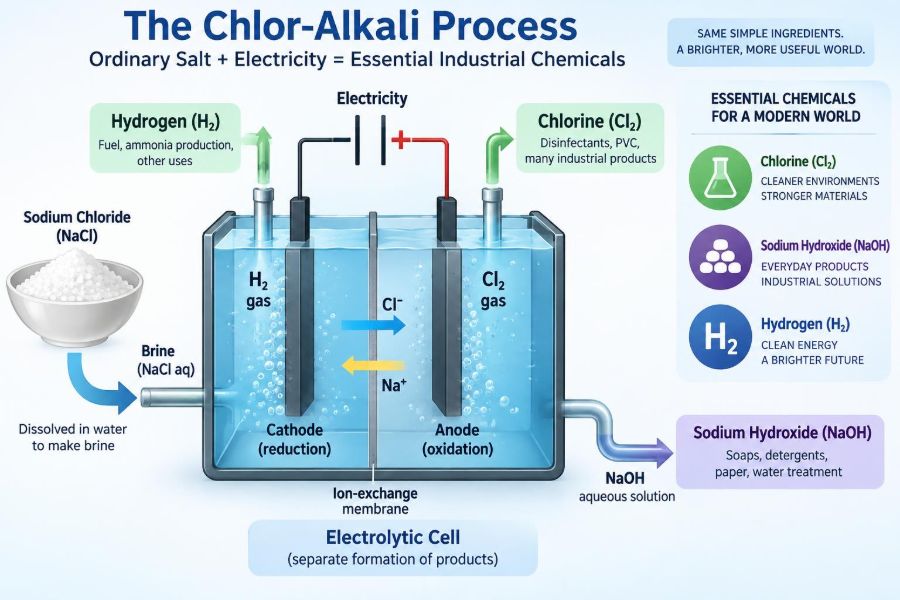

A bag of table salt seems like one of the least dramatic materials in a home. It seasons food, melts ice, and disappears into water almost instantly. Yet on an industrial scale, purified salt and electricity are the starting point for a family of chemicals that supports clean water, soap, paper, medicines, plastics, and many manufacturing operations.
That transformation happens through the chlor-alkali process, an electrochemical process that splits saltwater into chlorine, hydrogen, and sodium hydroxide. The chemistry is elegant, but operating it safely and efficiently requires careful control of purity, electrical current, gas separation, and corrosive materials.
For chemical engineers, it is a useful example of how a familiar reaction becomes a major industrial system. The process connects thermodynamics, transport phenomena, materials selection, process safety, energy management, and supply-chain planning in one production train.
The products may begin with ordinary sodium chloride, but their value comes from separating and controlling reactive substances that must never be casually mixed.
🧂 The simple feedstock: salt brine
The principal raw material is brine: water containing dissolved sodium chloride, NaCl. Plants may prepare brine by dissolving solid salt, or obtain it from underground salt deposits through solution mining, where water dissolves halite and the resulting brine is brought to the surface.
At the molecular level, dissolved salt separates into sodium ions, Na+, and chloride ions, Cl−. These mobile ions allow the solution to conduct electricity, which is the essential first requirement for electrolysis.
Water is not merely a solvent here. It supplies hydrogen and oxygen-containing species to the electrode reactions, while the sodium ions ultimately remain paired with hydroxide ions in the caustic soda product.
⚡ Electrolysis turns electrical energy into chemical change
Electrolysis uses direct electrical current to drive a reaction that would not proceed in the desired direction on its own. A chlor-alkali cell contains two electrodes: an anode, where oxidation occurs, and a cathode, where reduction occurs.
At the anode, chloride ions give up electrons and form chlorine gas. At the cathode, water accepts electrons and forms hydrogen gas and hydroxide ions. Sodium ions migrate through the cell arrangement to balance charge and become associated with the hydroxide ions.
The overall idealized reaction is:
2 NaCl + 2 H₂O → Cl₂ + H₂ + 2 NaOH
Electrical energy is therefore stored, in part, in the chemical products. This is why electricity cost, reliability, and carbon intensity are central concerns for chlor-alkali producers.
🧪 The three primary products
A chlor-alkali plant is best understood as a tightly linked producer of three outputs rather than a plant making just one chemical. For every stoichiometric quantity of chlorine made, corresponding quantities of hydrogen and sodium hydroxide are also generated.
| Product | Where it forms | Common industrial role |
|---|---|---|
| Chlorine, Cl₂ | Anode | Disinfection, chemical synthesis, bleaching chemistry |
| Hydrogen, H₂ | Cathode | Fuel, hydrochloric acid production, chemical feedstock |
| Sodium hydroxide, NaOH | Cathode-side liquor | Pulping, cleaning, alumina refining, pH control |
This linked production creates a practical constraint: demand for one product affects decisions about all three. A producer cannot increase chlorine output without also managing additional caustic soda and hydrogen.
🔴 What happens at the anode
The anode is the positive electrode in an electrolytic cell. Chloride ions arrive at its surface and undergo oxidation:
2 Cl⁻ → Cl₂ + 2 e⁻
The released electrons travel through the external circuit toward the cathode. Chlorine leaves the anode compartment as a gas, usually warm and containing moisture and traces of other materials that must be removed before storage, transport, or downstream use.
In chloride-containing water, oxygen evolution can compete with chlorine formation under some conditions. Good electrode design, suitable operating conditions, and clean brine help favor the intended chlorine reaction.
🔵 What happens at the cathode
At the cathode, electrons reduce water rather than sodium ions. Producing metallic sodium from water would be incompatible with an aqueous cell because sodium reacts vigorously with water.
2 H₂O + 2 e⁻ → H₂ + 2 OH⁻
Hydrogen gas bubbles away from the cathode, while hydroxide ions remain in solution. Sodium ions transported toward the cathode side combine electrically with hydroxide ions, producing sodium hydroxide solution.
This distinction is a frequent learning hurdle: the process does not electrolyze aqueous NaCl into sodium metal. The presence of water determines which cathode reaction is favored.
🧱 Why product separation is non-negotiable
Chlorine and sodium hydroxide must be kept apart. If chlorine contacts caustic soda, it reacts to form chloride and hypochlorite under suitable conditions; at other temperatures and concentrations, chlorate can form. Those reactions are useful when deliberately controlled, but they reduce the yield of separate chlorine and caustic products.
Hydrogen and chlorine require even more caution. Mixtures can react energetically, particularly with an ignition source or light. The cell design, gas handling system, ventilation, instrumentation, and operating procedures all work to prevent their mixing.
Separation is therefore not an optional purification step. It is built into the fundamental architecture of a commercial cell.
🧫 Membrane cells: the modern dominant design
Most modern chlor-alkali production uses membrane cells. A selectively permeable ion-exchange membrane separates anode and cathode compartments. It allows sodium ions to pass while strongly limiting the movement of chloride ions and hydroxide ions in the wrong direction.
Purified brine enters the anode compartment. Chlorine is released there, while sodium ions move across the membrane. Water is supplied on the cathode side, where hydrogen and sodium hydroxide solution are produced.
This arrangement produces relatively pure caustic soda and avoids the mercury used in an older technology. It also reflects a broader engineering principle: a thin functional material can determine the performance of an entire large-scale plant.
🕰️ Diaphragm cells and their trade-offs
Diaphragm cells use a porous barrier rather than a highly selective ion-exchange membrane. Brine flows from the anode side through the diaphragm toward the cathode, helping limit direct mixing of chlorine and hydrogen.
The catholyte commonly contains sodium hydroxide along with appreciable dissolved sodium chloride. It therefore needs evaporation and, where appropriate, further treatment to make a more concentrated or purer caustic product.
Diaphragm technology can still be encountered, but its product quality and energy implications differ from membrane-cell operation. Historical diaphragms also included asbestos in some installations, creating occupational and environmental concerns that require specialized management during operation or decommissioning.
⚙️ Mercury cells: historically significant, heavily constrained
Mercury-cell technology once produced high-purity sodium hydroxide through a sodium-mercury amalgam intermediate. The amalgam reacted with water in a separate decomposer, yielding caustic soda and hydrogen.
Its central drawback is evident: mercury is toxic, persistent, and difficult to control once released into the environment. Concerns over emissions, waste, worker exposure, and long-term contamination have driven widespread replacement with membrane technology.
For engineers, the lesson is larger than one process choice. A system can be commercially successful for decades while still carrying environmental liabilities that later make an alternative technology clearly preferable.
💧 Brine purification protects the cell
Raw brine is rarely clean enough to feed directly into a membrane cell. Calcium, magnesium, sulfate, iron, suspended solids, and certain organic contaminants can impair membranes, foul equipment, or trigger unwanted reactions.
Plants commonly remove hardness ions by chemical precipitation and solids separation. Filtration, polishing treatment, and analytical monitoring then reduce remaining contaminants to levels appropriate for the particular cell technology.
A simple way to view brine treatment is as protection for a high-value electrochemical separator. Sending impure feed to a membrane is comparable to running abrasive particles through precision equipment: failure may not be immediate, but performance and lifetime will suffer.
🧬 The membrane is a selective gatekeeper
Chlor-alkali membranes are typically cation-exchange materials. Their fixed negatively charged groups permit positively charged sodium ions to migrate while resisting anions such as chloride and hydroxide.
That selectivity is never perfectly independent of operating conditions. Temperature, current density, pressure balance, brine composition, water quality, and membrane age can all influence transport and product quality.
Engineers must also maintain the correct pressure relationship between compartments. A damaging pressure imbalance can deform the membrane or drive unwanted liquid crossover, reducing efficiency and increasing safety or corrosion risks.
🔌 Current density shapes cell performance
Current density is electrical current per unit electrode area. Raising it can increase production from a given cell footprint, but it may also increase voltage losses, heat generation, gas-bubble effects, and stress on electrodes and membranes.
A low current density may waste installed capital by underusing the cell area. An excessively aggressive value can raise electricity consumption per tonne of product or shorten component life. The practical target is an optimization, not simply the highest possible rate.
This is a recurring theme in electrochemical engineering: productivity, selectivity, energy use, and equipment durability must be balanced together.
📉 Cell voltage reveals where energy is lost
The theoretical decomposition voltage is only part of the power requirement. An operating cell needs additional voltage because of electrode overpotentials, resistance in the electrolyte and membrane, electrical contact losses, and the effects of gas bubbles.
Since electrical power is voltage multiplied by current, a modest increase in cell voltage can have major economic significance when a plant runs continuously at high current. Operators therefore track voltage cell by cell and across entire electrolyzer trains.
A rising voltage can signal issues such as membrane fouling, poor brine quality, electrode degradation, inadequate flow, deposits, or electrical connection problems. It is a diagnostic clue, not a diagnosis by itself.
🌡️ Temperature control supports efficiency and materials life
Temperature affects electrolyte conductivity, reaction kinetics, membrane behavior, gas solubility, and corrosion rates. A warmer cell may conduct better, but excessive temperature can damage materials, accelerate degradation, or alter product specifications.
Heat is generated by electrical resistance and electrochemical inefficiency. Cooling loops, controlled feed temperatures, and circulation systems remove or redistribute that heat while keeping the cell within its intended operating window.
The correct temperature is technology-specific. It should be established from the cell supplier’s design basis and operating procedures rather than guessed from a general chemistry rule.
🌊 Managing flows on both sides of the cell
Stable flow distribution matters because every cell compartment needs the right supply of brine or water and a reliable path for products to leave. Uneven distribution can produce local concentration differences, temperature variations, poor gas removal, and uneven current loading.
On the anode side, depleted brine must be removed and treated or recycled appropriately. On the cathode side, caustic solution and hydrogen must be separated and routed without allowing gas pockets or pressure excursions to disrupt operation.
Piping design is part of electrochemical performance. Headers, control valves, separators, elevation changes, and drainability all influence what happens at the electrode surface.
💨 Chlorine handling starts at the cell outlet
Fresh chlorine gas is commonly wet and hot. Downstream equipment cools it, separates entrained liquid, and dries it where dry chlorine is required. Moist chlorine is particularly corrosive, so material selection and moisture control are closely connected.
Depending on site needs, chlorine may be compressed, liquefied, sent by pipeline to a nearby consumer, converted immediately into another chemical, or absorbed to make products such as sodium hypochlorite. Minimizing unnecessary storage can reduce inventory, but it requires dependable coordination with downstream users.
Because chlorine is toxic and reactive, systems typically use contained equipment, leak detection, emergency absorption or scrubbing arrangements, and carefully designed ventilation. Specific safeguards depend on the site and applicable regulations.
🔥 Hydrogen is valuable, but it is not harmless
Hydrogen is sometimes used as fuel to provide heat or steam, but it can also be a feedstock for hydrochloric acid, hydrogen peroxide-related supply chains, hydrogenation, or other chemical operations. The best use depends on purity, volume, local demand, and plant integration.
Its small molecules can leak through gaps that may retain larger gases, and hydrogen-air mixtures can be flammable over a broad composition range. Good ventilation, gas detection where appropriate, ignition-source control, purging procedures, and segregation from chlorine systems are essential.
Treating hydrogen as a “free by-product” is a mistake. It is a co-product that needs a defined destination and a robust safety basis.
🧼 Caustic soda has unusually broad reach
Sodium hydroxide, often called caustic soda, is a strong base sold as aqueous solution or, after further processing, in solid forms. It is used to control pH, neutralize acids, make soaps and detergents, process textiles, and regenerate some ion-exchange systems.
In pulp and paper manufacturing, NaOH participates in chemical recovery and delignification operations. In alumina refining, it dissolves aluminum-bearing minerals under controlled high-temperature conditions. It is also used in many cleaning and water-treatment applications.
These uses explain why caustic demand is geographically important. Shipping concentrated corrosive liquid is possible, but local consumption and transport infrastructure influence where chlor-alkali capacity is built.
🚰 Chlorine chemistry helps protect water supplies
Chlorine and chlorine-derived chemicals are widely used for disinfection because they can inactivate many microorganisms when applied and monitored correctly. Water utilities may use chlorine gas, sodium hypochlorite, or other disinfectants depending on their treatment design and risk assessment.
Disinfection is not as simple as adding a fixed dose. Water chemistry, contact time, pH, temperature, turbidity, and organic matter affect performance and by-product formation. Utilities balance microbial control with chemical-quality objectives.
The chlor-alkali process sits upstream of this public-health application, supplying either chlorine directly or the caustic and chlorine chemistry needed to manufacture hypochlorite solutions.
🧴 Bleach is related chemistry, not chlorine gas in a bottle
Household bleach is commonly an aqueous sodium hypochlorite solution. It can be made by reacting chlorine with dilute sodium hydroxide under controlled conditions:
Cl₂ + 2 NaOH → NaCl + NaOCl + H₂O
This reaction illustrates why separating cell products matters: the same materials that must be isolated in a chlor-alkali cell can be deliberately combined later to make a different product. Conditions determine whether the intended product is hypochlorite and whether unwanted side reactions are minimized.
Bleach solutions degrade over time, especially with heat, light, and contamination. Their handling instructions should be followed, and they should never be mixed casually with acids or incompatible cleaners.
🏭 Chlorine supports a large downstream chemical network
Much chlorine is consumed as an intermediate rather than sold for final use. It enters the manufacture of chlorinated intermediates, inorganic chemicals, pharmaceuticals, crop-protection chemicals, and materials including polyvinyl chloride, or PVC.
One major route involves converting chlorine and ethylene into intermediates that ultimately lead to vinyl chloride monomer, the precursor to PVC. This connects salt production and electrical power to pipes, cable insulation, flooring, medical devices, and construction materials.
Not every chlorine application has the same environmental profile. Responsible assessment looks at the specific chemistry, emissions controls, product life cycle, and end-of-life pathway rather than treating all chlorine chemistry as identical.
⚖️ Co-product economics can constrain production
Chlorine and caustic soda markets do not always grow at the same rate. Yet the electrolyzer produces them in a fixed chemical relationship. A plant facing weak demand for one co-product may need to limit production even if the other product sells well.
Hydrogen adds a third planning variable. If it cannot be used productively, it may require controlled handling or be used as low-value fuel, depending on site capabilities and permissions.
This is why chlor-alkali facilities are often integrated with major consumers. A PVC complex, pulp mill, alumina refinery, or water-treatment chemical producer can provide a steadier outlet for one or more products.
🛠️ Materials selection is dictated by corrosion
Chlorine, wet brine, caustic soda, hydrochloric acid, and high-purity water can each create different corrosion challenges. A material that performs well in dry chlorine may fail rapidly in wet chlorine; a metal suitable for caustic service may not suit an acidic chloride environment.
Engineers consider concentration, temperature, impurities, stress, flow velocity, moisture, and upset conditions when selecting equipment materials. Nonmetallic linings, polymers, titanium components, nickel-containing alloys, and specialized steels may appear in different parts of a plant.
Choosing materials based only on initial cost is risky. Inspection access, repairability, contamination risk, and consequence of leakage must be part of the decision.
🦺 Process safety focuses on containment and incompatibility
The most serious hazards include chlorine exposure, hydrogen ignition, corrosive caustic contact, electrical hazards, pressure release, and unintended reactions caused by mixing incompatible streams. Prevention begins with design, but it depends on disciplined operation and maintenance.
- Keep chlorine, hydrogen, acids, caustics, and organic materials segregated where required.
- Use clearly identified piping, isolation procedures, and verified line-up checks before transfers.
- Maintain gas detection, ventilation, emergency response equipment, and containment systems according to the site safety program.
- Train personnel for normal operation, start-up, shutdown, maintenance, and abnormal events—not just routine production.
No short list replaces a facility-specific hazard study. Actual safeguards must reflect the process design, local requirements, and credible failure scenarios.
🌍 Environmental performance extends beyond the cell room
Electricity use is often the largest environmental consideration because chlor-alkali electrolysis operates continuously and at high current. The climate impact associated with production depends substantially on the source of electrical power.
Other environmental responsibilities include controlling chlorine-containing vents, managing brine treatment residues, preventing releases of caustic or acidic liquids, and handling spent membranes or legacy materials appropriately. Water use and wastewater composition also deserve attention.
Membrane-cell conversion has reduced certain historical concerns, but modern operation still requires rigorous emission control and resource management. Better technology changes the risk profile; it does not eliminate the need for engineering oversight.
📊 Key measurements operators watch
Reliable production relies on trends rather than occasional observations. Operators and engineers watch electrical, chemical, hydraulic, and mechanical indicators to identify drift before it becomes a shutdown or safety event.
- Cell and electrolyzer voltage, current, and electrical efficiency indicators
- Brine concentration and impurity levels
- Caustic concentration, chloride content, and product quality
- Chlorine and hydrogen purity, moisture, pressure, and flow
- Temperatures, differential pressures, liquid levels, and cooling performance
Interpretation matters as much as measurement. For example, a voltage increase coupled with changing pressure drop and declining caustic quality points to a different set of possible causes than a voltage increase alone.
🔧 Maintenance preserves electrochemical performance
Electrolyzers contain components that gradually age: membranes lose performance, electrodes can deactivate or develop coating damage, seals can degrade, and deposits can accumulate in flow paths. Planned maintenance is usually far less disruptive than responding to a leak, contamination event, or sudden decline in efficiency.
Condition monitoring can help prioritize intervention. Trending voltage, product purity, pressure behavior, and brine-treatment performance may reveal deterioration before a component reaches a critical state.
Maintenance work also creates special hazards because equipment may contain residual chlorine, hydrogen, caustic, or electrical energy. Isolation, decontamination, gas testing, lockout procedures, and permit systems are core controls—not paperwork after the real work is done.
🎓 Common misconceptions worth correcting
Several oversimplifications make the process harder to understand correctly:
- “Salt is converted only into chlorine.” The process simultaneously makes chlorine, hydrogen, and sodium hydroxide.
- “The cathode makes sodium metal.” In aqueous brine electrolysis, water is reduced to hydrogen and hydroxide ions.
- “Any saltwater will work.” Commercial cells require carefully controlled brine, especially membrane cells.
- “Electrolysis is just chemistry in a tank.” It is also a high-current electrical system with demanding separation, heat-transfer, and safety requirements.
- “Chlorine is only a disinfectant.” Disinfection is important, but much chlorine is used as a chemical intermediate.
🧠 A useful mental model for students
Imagine the cell as a two-room apartment separated by a highly selective doorway. The anode room receives chloride-rich brine and releases chlorine. The cathode room receives water, releases hydrogen, and accumulates hydroxide.
The membrane doorway lets sodium ions cross, but blocks most unwanted traffic. The electrical circuit supplies electrons to the cathode and removes them from the anode. Pumps, separators, and control systems keep both rooms operating under compatible conditions.
This analogy is incomplete—real ion transport and fluid behavior are more complex—but it captures the core design objective: move the desired ion while preventing product crossover.
🔭 Where improvement efforts are directed
Plants seek lower energy consumption through improved membranes, electrode coatings, power electronics, process control, and heat integration. Because electricity is such a large operating input, small efficiency gains can matter when sustained over long operating periods.
Digital monitoring can support earlier detection of abnormal cell behavior, but models must be grounded in reliable instrumentation and chemical understanding. A predictive tool is useful only when personnel can verify its signals and act safely on them.
Integration with lower-carbon electricity and better use of co-produced hydrogen are also active strategic questions. Their value varies by location, power availability, infrastructure, and the needs of nearby chemical users.
✅ The core principle: controlled separation creates value
The chlor-alkali process is not simply “salt plus electricity.” Its industrial success depends on making three reactive products at the same time while preventing them from meeting in the wrong place, at the wrong concentration, or under uncontrolled conditions.
Pure brine protects the membrane. Selective ion transport preserves product quality. Electrical and thermal control manage energy use. Careful materials selection contains corrosive streams. Safe gas handling protects people and equipment. Each layer supports the same central outcome: reliable conversion with controlled separation.
For chemical engineers, the process is a compact lesson in systems thinking. The electrode reactions may fit on two short equations, but the working plant is an integrated network of chemistry, equipment, utilities, controls, maintenance, and risk management.
Ordinary salt becomes essential industrial chemistry only when electrochemical reactions and precise separation are engineered to work together safely. That is the enduring logic behind the chlor-alkali process. ⚡🧂🏭