
A storage tank can look quiet from the outside: a steel shell, a roof, a few pipes, and an instrument panel. But every time liquid is pumped out, ambient air may try to enter the vapor space above it. Every temperature swing can make that vapor space breathe.
For many materials, that air is not harmless. Oxygen can degrade a product, moisture can trigger contamination or reaction, and a flammable vapor mixed with air can create an ignitable atmosphere. The problem is often invisible until quality, corrosion, emissions, or safety consequences appear.
This is why many chemical plants connect storage tanks to a controlled supply of nitrogen. The practice is called nitrogen blanketing, nitrogen padding, or inert-gas blanketing. It is used in facilities handling chemicals, fuels, solvents, oils, resins, pharmaceuticals, and many moisture-sensitive intermediates.
Nitrogen blanketing is not simply “putting gas in a tank.” It is a pressure-control and risk-management system whose value depends on the material, tank design, operating conditions, safeguards, and maintenance. Understanding those connections is central to using it well.
🧪 What Nitrogen Blanketing Means
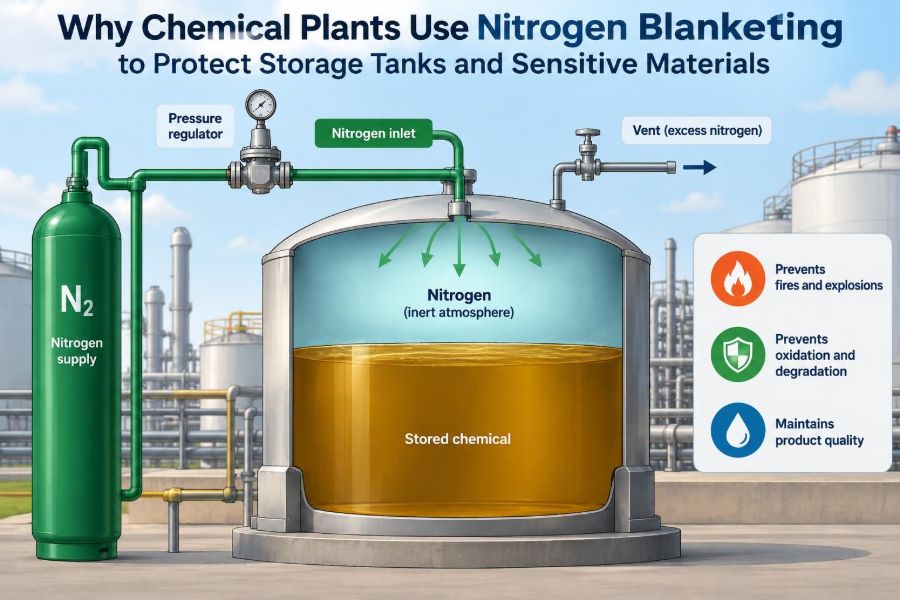
Nitrogen blanketing maintains a layer of nitrogen-rich gas in the empty volume above a stored liquid or solid. This empty volume is commonly called the vapor space or ullage.
When liquid leaves the tank, nitrogen enters to replace the lost volume. When the liquid expands or the tank is filled, excess gas may leave through a controlled vent path. The aim is usually a slight positive pressure rather than a sealed, high-pressure vessel.
🌬️ The Tank Is Constantly Breathing
Atmospheric tanks experience inbreathing and outbreathing. Inbreathing occurs when product is withdrawn or vapor cools and contracts. Outbreathing occurs during filling or when vapor warms and expands.
Without a blanketing system, these changes are commonly balanced by air entering and vapor leaving through vents. A nitrogen blanket changes what enters during inbreathing: dry inert gas replaces ordinary air.
⚗️ Why Nitrogen Is the Usual Choice
Nitrogen is widely used because it is relatively unreactive with many industrial materials, is available at large scale, and does not support ordinary combustion. It can be supplied from cylinders, liquid-nitrogen vaporizers, or site nitrogen-generation systems.
“Inert” is a practical description, not an absolute promise of chemical compatibility. Nitrogen is unsuitable for certain specialized reactions and can be unacceptable where extremely low impurity levels are required. The stored material and process chemistry always determine whether it is appropriate.
🔥 Reducing the Chance of a Flammable Mixture
Many liquid chemicals produce flammable vapors. For combustion to occur, fuel vapor, oxygen, and an ignition source must come together in a suitable concentration range.
Blanketing lowers the oxygen concentration in the vapor space and reduces air ingress. It therefore helps prevent formation of a flammable vapor-air mixture. It does not eliminate the need to control static electricity, hot work, electrical ignition sources, leaks, and hazardous vapor releases.
📏 Oxygen Control Is a Design Requirement
The oxygen concentration needed for safe inerting depends on the specific material and its operating conditions. Engineers use chemical data, hazard assessments, and applicable design practices to set an oxygen target with an appropriate margin.
A tank cannot be assumed safe merely because a nitrogen line is installed. Initial air may remain after commissioning, leaks may admit air, and low nitrogen pressure may fail to protect the vapor space. Measurement and verification matter.
🛢️ Protecting Products From Oxidation
Oxygen can slowly change susceptible products even when there is no fire risk. Oxidation may cause discoloration, off-odors, viscosity changes, acidity increases, loss of performance, or formation of insoluble material.
Examples can include some edible oils, lubricants, monomers, specialty chemicals, and fragrance ingredients. The exact outcome depends on the chemistry, storage temperature, light exposure, residence time, and trace contaminants such as metals.
💧 Keeping Moisture Out of Sensitive Materials
Ambient air carries water vapor. When humid air enters a tank, moisture can dissolve into a liquid, condense on cool surfaces, or react with a moisture-sensitive material.
Dry nitrogen provides a barrier against that route of contamination. This is useful for materials that hydrolyze, materials whose water specification is tight, and powders or intermediates that can cake or lose quality after moisture exposure.
🧫 Preventing Contamination Without Overclaiming
Nitrogen blanketing reduces exposure to air, but it does not make a tank sterile or perfectly clean. Contamination can still arrive through transfer hoses, manways, sampling ports, valves, poor cleaning practices, or the nitrogen supply itself.
For high-purity service, plants may specify nitrogen purity, dew point, filtration, and gas-quality testing. Blanketing is one layer in a broader contamination-control strategy, not a substitute for hygienic or validated handling procedures.
🧱 Slowing Corrosion Above the Liquid Level
The vapor space can be a corrosion-prone zone. Oxygen and moisture promote corrosion of carbon-steel surfaces, particularly where condensation forms under the roof or on internal fittings.
Dry nitrogen can reduce these drivers, helping protect the tank’s upper internal surfaces. It will not correct existing coating failure, trapped water, incompatible materials of construction, or corrosion occurring on the external surface.
🧯 Managing Vapor Emissions During Breathing
When a tank outbreathes, the gas leaving may contain volatile organic compounds or other hazardous vapors. A blanket system can be integrated with a vapor recovery unit, carbon treatment system, flare header, or other controlled disposal route.
The nitrogen itself does not capture emissions. In fact, a poorly designed system can send nitrogen-diluted vapor to downstream equipment that was not designed for the changed flow or composition. Vent handling must be evaluated as part of the whole system.
🔄 What Happens During Product Withdrawal
Imagine a pump removing solvent from a fixed-roof tank. The liquid level falls, increasing vapor-space volume. If replacement gas does not enter, internal pressure drops.
A blanketing valve senses this pressure decrease and opens to admit nitrogen. The valve should supply enough gas to meet the expected withdrawal rate while holding the tank near its intended pressure range.
🌡️ Why Temperature Changes Matter
Even with no transfer, cooling vapor contracts and can create vacuum conditions. A sudden rainstorm on a warm tank roof, a cold night, or a drop in product temperature can all contribute to inbreathing demand.
Heating and solar exposure can have the opposite effect, producing outbreathing. Designing only for pump-out flow and ignoring thermal effects is a common way to underestimate the required protection.
⚙️ The Main Components of a Blanketing System
A typical arrangement includes a nitrogen supply, isolation valves, pressure regulation, a blanketing valve, pressure indication, venting protection, and piping to the tank vapor space. Larger or more critical systems may add oxygen analyzers, alarms, flow measurement, and automated shutdown logic.
Each component has a distinct job. The regulator reduces supply pressure; the blanketing valve responds to tank pressure; and relief devices protect the tank if the normal controls cannot handle an abnormal condition.
🎛️ The Blanketing Valve and Its Setpoint
A blanketing valve opens when tank pressure falls below a selected setpoint and closes as pressure recovers. It is designed for sensitive low-pressure control, unlike many general-purpose pressure regulators.
Setpoints must coordinate with the tank’s allowable pressure and vacuum limits, normal vent settings, and emergency-relief philosophy. Setting the valve too high can waste nitrogen and increase vent losses; setting it too low can allow unwanted air entry or vacuum damage.
🛡️ Pressure Relief and Vacuum Protection
A nitrogen blanket is not a replacement for pressure and vacuum relief protection. A blocked vent, blanketing-valve failure, overfilling event, fire exposure, or an unexpectedly high nitrogen supply pressure can raise tank pressure beyond normal operation.
Likewise, a supply interruption or undersized blanketing line can leave a tank vulnerable to vacuum during withdrawal. Tanks can deform under vacuum, sometimes dramatically, so independent and correctly sized safeguards are essential.
📐 Sizing for Real Operating Cases
Blanketing capacity is selected from credible demand cases, not from tank volume alone. Product withdrawal, cooling, filling, vapor generation, line losses, supply pressure, and control response all affect the required flow.
A system may work during slow routine transfer yet fail during the highest planned pumping rate. Engineers also consider whether multiple tanks can demand nitrogen at the same time, especially when they share a common header.
📊 Key Design Questions at a Glance
| Question | Why it changes the design |
|---|---|
| Is the material flammable or oxygen-sensitive? | Determines inerting objective, oxygen target, and verification needs. |
| What is the maximum withdrawal rate? | Sets a major portion of nitrogen inbreathing capacity. |
| Can the tank cool rapidly? | May create thermal inbreathing demand even without pumping. |
| Where does displaced vapor go? | Determines vent, recovery, treatment, or flare requirements. |
| What happens if nitrogen is lost? | Defines alarms, operating response, and independent protection needed. |
🧰 Nitrogen Supply Quality and Reliability
Supply pressure, flow capacity, purity, and dryness must match the service. A central plant header may be economical, while a dedicated liquid-nitrogen system may provide useful resilience for a critical tank farm.
Low supply pressure can silently reduce valve capacity. Moisture or oxygen in the nitrogen may defeat a quality objective. Facilities therefore need clear specifications and a practical way to recognize supply upset conditions.
🧪 Purging Before Normal Blanketing Begins
Installing a nitrogen blanket on an air-filled tank does not immediately create an inert atmosphere. The initial air must be reduced by a controlled purging procedure when inerting is required.
Purging may use displacement, where nitrogen pushes air out in a deliberate direction, or dilution, where repeated additions and venting progressively lower oxygen concentration. The appropriate method depends on tank geometry, gas behavior, vent routing, and the required result.
📍 Where the Nitrogen Enters Matters
Inlet location influences how effectively nitrogen displaces or mixes with existing gas. During commissioning, poor arrangement can leave pockets of air, especially in complex vessels or tanks with internal structures.
For normal blanketing, the inlet should also avoid creating undesirable pressure drops, liquid backflow, or direct contamination pathways. Piping details that seem minor on a diagram can matter greatly in field operation.
🏭 Fixed Roofs, Floating Roofs, and Other Tank Types
Fixed-roof tanks have a comparatively large vapor space and are common candidates for blanketing. Internal or external floating-roof tanks reduce vapor-space volume and emissions, but they still have rim seals, deck fittings, and operational considerations that may require vapor management.
Blanketing is also used on smaller process vessels, day tanks, and intermediate bulk storage systems. The method must suit the vessel’s pressure rating; an atmospheric tank is not designed like a pressurized receiver.
🧴 Materials That Commonly Benefit
Applications often include flammable solvents, hydrocarbons, reactive monomers, oxidation-sensitive oils, water-reactive materials, specialty additives, and high-value products with strict moisture or color requirements.
That list is not a rule that every such material needs nitrogen. A low-volatility, stable liquid in an appropriate closed system may gain little from continuous blanketing. The decision should follow a material-specific hazard and quality review.
⚠️ Nitrogen Has a Serious Human Hazard
Nitrogen is not toxic in the usual chemical sense, but it can displace oxygen in the air. In enclosed or poorly ventilated areas, an undetected nitrogen release can create an oxygen-deficient atmosphere and cause rapid incapacitation.
This risk applies around tank roofs, pits, buildings, enclosed loading areas, and confined spaces. Vent discharge locations, oxygen monitoring where warranted, access control, ventilation, and confined-space procedures must address the asphyxiation hazard.
🚧 Do Not Treat a Tank as Safe to Enter
A nitrogen-blanketed tank may contain too little oxygen for life, along with toxic or flammable residual vapors. Opening a manway does not automatically make it safe; ventilation and testing must be planned and verified.
Tank entry requires the facility’s confined-space process, atmospheric testing, isolation, cleaning where necessary, rescue preparation, and authorization. Blanketing protects stored material, but it adds a crucial consideration for people who service the equipment.
🔍 Monitoring What the System Is Actually Doing
Tank pressure is a basic operating indicator. A tank that repeatedly sits at unusually low pressure, vents continuously, or uses unexpectedly high nitrogen flow deserves investigation.
For critical inerting service, oxygen measurement may be used to confirm the vapor-space condition. Instruments need suitable sampling arrangements, calibration, and interpretation; a single reading may not represent every part of a poorly mixed space.
🧑🔧 Routine Inspection and Maintenance
Small failures can erode blanketing performance gradually. Sticky valves, plugged sensing lines, leaking flanges, damaged pressure gauges, frozen regulators, and incorrectly positioned isolation valves are common practical concerns.
- Verify valve response and setpoints using approved maintenance procedures.
- Inspect vents and flame-arresting devices where fitted for blockage or fouling.
- Check nitrogen supply pressure and investigate abnormal consumption.
- Confirm that relief devices are maintained and not isolated from the tank.
- Keep operating lineups, labels, and response instructions current.
❌ Common Mistake: Using Nitrogen to Mask a Leak
A high nitrogen consumption rate may be dismissed as the cost of protection. Sometimes it is instead evidence of leaking seals, vents, valves, roof fittings, or a valve that fails to close.
More nitrogen is not a durable answer. It can raise operating cost, increase vented gas flow, conceal degraded equipment, and in some cases affect downstream vapor-control equipment. Find the cause rather than simply increasing supply.
❌ Common Mistake: Ignoring the Vent Path
Normal venting and emergency relief must remain available even when nitrogen is connected. Closing, plugging, icing, or fouling a vent can turn ordinary filling or thermal expansion into an overpressure event.
Conversely, an open path that admits unrestricted air can defeat the quality or inerting purpose. Good design balances controlled blanketing with independent protection against both pressure and vacuum.
🧠 Operating Procedures Make the Hardware Effective
Operators need to know normal pressure ranges, expected nitrogen use, valve positions, alarm meanings, and what to do during a supply loss. These details are especially important during startup, tank switching, maintenance, and unusual transfer operations.
A useful procedure distinguishes between a routine low-pressure demand and a genuine malfunction. It also defines when to stop transfer, notify technical support, verify gas supply, or place equipment in a safe condition.
📋 Management of Change Cannot Be Skipped
Changes to product, tank use, pumping rate, vent routing, nitrogen source, control setpoint, or downstream emissions equipment can alter the risk picture. A tank that was adequate for one solvent may not be suitable for a more volatile or reactive one.
Formal management-of-change review helps ensure that sizing, compatibility, relief protection, procedures, and training remain aligned with actual service. This is particularly valuable when a “temporary” operating change becomes routine.
💡 When Blanketing May Not Be the Best Answer
Blanketing consumes gas and adds controls, maintenance, and asphyxiation considerations. For some products, a tightly sealed system, desiccant breather, vapor-recovery arrangement, refrigerated storage, or a different tank design may better address the actual problem.
There are also applications where another inert gas is selected for compatibility or process reasons. The best option depends on the hazard being controlled rather than on a default preference for nitrogen.
🔗 Thinking in Layers Rather Than Single Solutions
Nitrogen blanketing works best as one layer among several: compatible tank construction, pressure and vacuum relief, ignition control, transfer procedures, vapor handling, gas detection where appropriate, maintenance, and emergency planning.
No individual layer is flawless. A sound design asks what happens if the blanketing valve sticks, the nitrogen supply fails, a vent blocks, or an operator starts a rapid transfer. Those questions turn a component into a resilient system.
✅ The Core Principle Behind Nitrogen Blanketing
The underlying idea is simple: replace uncontrolled contact with ambient air by controlled contact with a suitable inert, dry gas. That can reduce oxidation, moisture pickup, corrosion drivers, and the likelihood of flammable vapor-air mixtures.
Its success, however, rests on details: correct sizing, compatible materials, verified oxygen control where needed, reliable pressure protection, maintained equipment, and respect for nitrogen’s oxygen-displacement hazard. The nitrogen line is only the visible part of the safeguard.
Nitrogen blanketing protects tanks and sensitive materials when it is designed and operated as a complete pressure, purity, and safety system—not as a stand-alone gas connection. That perspective helps engineers and operators protect both product integrity and people. 🧪🛢️🌬️