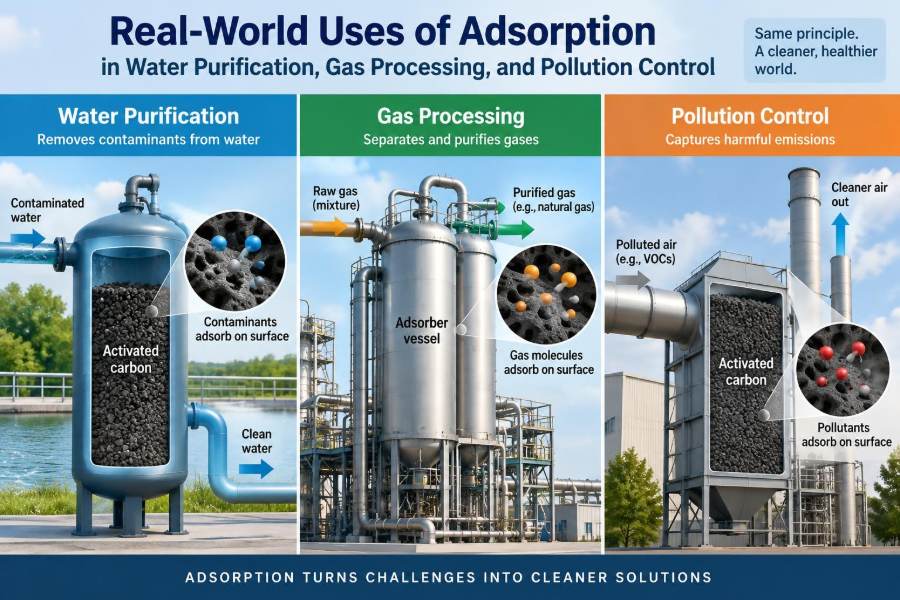

A household water filter removes an unpleasant taste. A respirator cartridge protects a worker from solvent vapour. A natural-gas plant dries gas before it enters a pipeline. These seem like separate problems, but many rely on the same separation principle: adsorption.
Adsorption is often invisible when it works well. Contaminants are captured inside a bed of solid material, while the cleaned water or gas continues downstream. Yet the choice of adsorbent, operating conditions, and regeneration method can determine whether a process is reliable, expensive, wasteful, or unsafe.
For chemical engineers, adsorption connects surface science to full-scale equipment design. For operators and environmental professionals, it is a practical tool for meeting quality targets when filtration, settling, or conventional biological treatment cannot remove dissolved or gaseous pollutants.
The key is to see adsorption not as a universal “filter,” but as a selective, finite-capacity separation process. Its real-world value comes from matching the right surface to the right contaminant and managing that surface over its working life.
🧲 What Adsorption Actually Means
Adsorption occurs when molecules from a fluid accumulate at the surface of a solid. The fluid may be water, air, natural gas, or another liquid or gas; the solid is the adsorbent; and the captured substance is the adsorbate.
It differs from absorption, in which a substance enters the bulk of another material. A sponge taking up water is mainly absorption. Odour molecules attaching to the immense internal surface of activated carbon are adsorption.
🔬 Why Surface Area Controls Performance
Useful adsorbents contain pores ranging from very small channels to larger transport pathways. These pores create an internal surface area far larger than the outside of a particle suggests.
A granular carbon bed may look like ordinary black grains, but its pore network offers many sites where compatible molecules can attach. Surface area alone is not enough: pore size, surface chemistry, and access to those pores all affect performance.
⚛️ Physical Adsorption and Chemical Adsorption
Physisorption is driven mainly by relatively weak intermolecular attractions. It is common in activated carbon systems and is often reversible, especially when temperature or pressure changes.
Chemisorption involves stronger, more specific chemical interactions. It can provide high selectivity, but regeneration may require more energy or may be impractical. Industrial systems sometimes use materials that combine both types of interaction.
🎯 Selectivity Is More Useful Than Capacity Alone
An adsorbent can have a large total capacity yet perform poorly if it prefers harmless background compounds over the target contaminant. In real streams, water, carbon dioxide, hydrocarbons, salts, and natural organic matter compete for adsorption sites.
Engineers therefore ask two questions: how much can the material hold, and what will it hold first? The second question often decides whether a process succeeds.
📈 Reading an Adsorption Isotherm
An adsorption isotherm relates the amount held by an adsorbent to the concentration or partial pressure remaining in the fluid at a fixed temperature. It is a laboratory tool, but it directly informs process sizing.
A favourable isotherm means the adsorbent captures substantial contaminant even when the remaining concentration is low. This is particularly valuable when treatment targets are stringent, such as polishing trace organic compounds from water.
⏱️ Equilibrium Is Not the Same as Operating Reality
Equilibrium tells engineers the eventual distribution between fluid and solid. Actual equipment must also achieve that result quickly enough while fluid flows through it.
Mass transfer can be limited by movement through the liquid or gas film around a particle, diffusion through pores, or slow attachment at the surface. A material with excellent equilibrium capacity may still need a large bed if adsorption kinetics are slow.
🌊 The Moving Adsorption Zone
In a packed bed, fresh adsorbent near the inlet captures contaminant first. Over time, that region becomes loaded and the active region moves downstream as a mass-transfer zone.
Breakthrough begins when contaminant appears at the outlet above the chosen limit. Operators must switch, regenerate, or replace the bed before breakthrough rises to an unacceptable level.
📏 Bed Depth, Flow Rate, and Contact Time
More bed depth generally gives the mass-transfer zone more space before it reaches the outlet. Lower flow rates increase contact time, which can improve removal when diffusion is limiting.
Neither adjustment is free. A deeper bed costs more and increases pressure drop; a lower flow rate may require more parallel vessels. Design is an economic and operational balance, not simply a search for the biggest vessel.
💧 Activated Carbon in Drinking-Water Treatment
Activated carbon is widely used to remove taste- and odour-causing compounds, many organic contaminants, and residual disinfectants. It is especially useful after upstream clarification and filtration have removed suspended solids that would otherwise foul the bed.
Powdered activated carbon is commonly dosed into water for temporary or seasonal treatment needs, then removed with solids. Granular activated carbon stays in a fixed bed and provides continuous polishing over a longer service period.
🍃 Taste, Odour, and Seasonal Water Challenges
Algal activity and decaying plant material can produce compounds that are detectable by taste or smell at very low concentrations. Conventional settling may remove particles but not the dissolved molecules responsible for earthy or musty odours.
Carbon adsorption provides a practical barrier because many of these organic molecules have enough affinity for its surface. Performance still varies with source-water quality, temperature, and competing natural organic matter.
🧪 Trace Organics and the Limits of a Carbon Bed
Activated carbon can reduce a wide range of trace organic compounds, but “wide range” does not mean every compound is removed equally. Molecular size, charge, polarity, and competition from other dissolved organics all matter.
Routine sampling is therefore essential where a treatment objective concerns a specific chemical. A bed cannot be assumed effective solely because it is fresh or because it has worked well for a different compound.
🚰 Point-of-Use Filters Need Realistic Expectations
Small household cartridges often use activated carbon to improve taste, reduce chlorine, and capture selected organic compounds. Their performance depends on cartridge design, flow rate, water chemistry, and replacement on schedule.
A consumer filter is not automatically a complete solution for microbiological contamination, dissolved salts, or every trace contaminant. Claims should be evaluated against the particular contaminant and the conditions for which the device was tested.
♻️ Biological Activated Carbon Extends Carbon’s Role
After granular carbon has operated for some time, microorganisms may colonize the bed and consume certain biodegradable organics. This arrangement is called biological activated carbon, or BAC.
Adsorption and biodegradation can then work together: carbon concentrates organics near biofilms, while biological activity may restore some adsorption capacity indirectly. BAC operation requires attention to dissolved oxygen, nutrient conditions, backwashing, and biological stability.
🏭 Industrial Wastewater Polishing
Industrial wastewater may contain dyes, solvents, phenolic compounds, surfactants, or process-specific organics that remain after primary treatment. Adsorption is frequently positioned as a polishing step because sending heavily contaminated water straight to carbon can consume capacity rapidly.
For example, a plant might first equalize flow, adjust pH, remove oils and solids, and use biological treatment where suitable. Adsorption then targets the residual dissolved compounds that are difficult to remove by the earlier steps.
🎨 Dye Removal Shows the Importance of Chemistry
Dyes are not one uniform class. Some are hydrophobic and readily adsorb to carbon; others are ionic and may require modified carbon, ion-exchange resins, tailored mineral adsorbents, or a different treatment route.
pH can change both dye charge and adsorbent surface charge. Treating “colour” as one design parameter without identifying its chemical source is a common route to disappointing results.
🧂 Ion Exchange and Adsorption: Related but Distinct
Ion-exchange resins remove charged species by exchanging ions on fixed functional groups. They are often grouped loosely with adsorption technologies because contaminants bind to a solid, but their mechanism is more specific than ordinary physical adsorption.
Ion exchange is valuable for hardness, selected metals, nitrate, and other ionic contaminants. Its regeneration produces a concentrated waste stream, so the fate of regenerant chemicals must be part of the process design.
🪨 Zeolites for Water and Gas Applications
Zeolites are crystalline aluminosilicate materials with uniform molecular-scale pores and exchangeable ions. Their ordered structure gives them strong selectivity for particular molecules or ions.
In water treatment, natural or engineered zeolites can assist with certain ammonium and metal-removal duties. In gas processing, synthetic zeolites are widely used as molecular sieves because pore size can exclude larger molecules while admitting smaller ones.
🔥 Drying Natural Gas Before Transport
Water vapour in natural gas can condense, accelerate corrosion in some systems, and contribute to hydrate formation under appropriate temperature and pressure conditions. Gas dehydration is therefore a critical conditioning step.
Molecular sieves can lower water content to very low levels when required. They are especially useful when downstream processes need dry gas or when conventional liquid dehydration does not achieve the necessary specification.
🧊 Preventing Hydrates Is a Process-Safety Task
Gas hydrates are crystalline solids formed from water and small gas molecules under suitable conditions. They can restrict or block pipelines, valves, and equipment.
Removing water by adsorption is one preventive strategy, alongside temperature management, pressure control, and chemical inhibitors. The appropriate method depends on the operating envelope and the consequences of a restriction.
🧯 Removing Sulfur Compounds from Fuels and Gas
Hydrogen sulfide and some sulfur-containing organic compounds create safety, corrosion, emissions, and product-quality concerns. Adsorption-based guard beds can capture particular sulfur species, often protecting downstream catalysts or polishing a stream after bulk sulfur removal.
Because sulfur chemistry is diverse, a guard bed should be selected for the actual species, concentration range, temperature, and contaminants present. Moisture and hydrocarbons can alter the capacity of many sorbents.
🌬️ Volatile Organic Compounds in Air Emissions
Volatile organic compounds, often called VOCs, are emitted from activities such as solvent handling, coating, printing, storage, and chemical manufacturing. Activated carbon beds can capture VOC vapours from ventilation or process exhaust streams.
They are particularly suited to relatively low-concentration streams where recovery or destruction by other methods may be less practical. Very humid streams or streams containing heavy aerosols usually need pretreatment to protect the adsorbent.
🏗️ Solvent Recovery Can Turn Pollution Control into Reuse
When the captured vapour has enough value and can be separated after desorption, adsorption can support solvent recovery rather than simple disposal. Beds may be regenerated using steam, hot inert gas, vacuum, or pressure changes, depending on the solvent and adsorbent.
Recovered material must still meet reuse specifications. A system that captures a solvent effectively may produce a mixed condensate requiring further separation before it can return to a process.
😷 Respirator Cartridges Use the Same Principle on a Small Scale
Many air-purifying respirator cartridges contain activated carbon or chemically treated sorbents. The media adsorb certain gases or vapours while air passes through.
Cartridges have finite capacity, and service life depends strongly on contaminant concentration, breathing rate, humidity, temperature, and cartridge type. They are not interchangeable protection for every airborne hazard, and oxygen-deficient or unknown atmospheres require different safety decisions.
🚗 Vehicle Emission Control Uses Surface Chemistry Too
Catalytic converters are primarily catalytic reactors rather than conventional adsorbers, but adsorption is part of how reactant molecules reach catalyst surfaces. Some emission-control systems also use materials that temporarily store oxygen or adsorb certain species during changing engine conditions.
This illustrates a broader engineering point: adsorption often works alongside catalysis. A surface can first concentrate a molecule and then promote its chemical conversion.
🌡️ Temperature, Pressure, and Humidity Change the Result
Physical adsorption of gases is commonly stronger at lower temperatures and higher partial pressures. Heating can help desorb captured molecules during regeneration, but excessive temperature can damage adsorbent structure or create unwanted reactions.
Water vapour is a frequent competitor in gas treatment. It may occupy sites intended for VOCs or other gases, especially on hydrophilic materials such as many zeolites. Feed conditioning is often as important as adsorbent selection.
🔄 Regeneration Determines Lifecycle Cost
Once a bed approaches exhaustion, operators may replace the adsorbent, regenerate it on site, or send it to an external facility. Regeneration can use heat, reduced pressure, purge gas, steam, chemical treatment, or combinations of these methods.
The best choice depends on contaminant value, hazard, bed size, energy availability, and whether the adsorbent can tolerate repeated cycles. Regeneration transfers contaminants into another stream; it does not make them disappear.
🗑️ Spent Adsorbent Must Be Characterized
Used carbon, resin, or mineral media may contain concentrated organic chemicals, metals, sulfur compounds, or other hazardous constituents. Its handling and disposal route should be based on characterization and applicable local requirements.
For some carbons, thermal reactivation can restore useful capacity. For other media, irreversible fouling or the nature of the captured contaminant makes replacement and controlled disposal the safer option.
⚠️ Fire, Heat, and Breakthrough Risks
Adsorption systems are not passive containers. Some adsorption events release heat, and carbon beds handling organic vapours can present fire risks under certain operating or regeneration conditions.
Practical safeguards may include temperature monitoring, suitable inlet filtration, control of oxygen where relevant, safe isolation procedures, and a planned response to abnormal temperature rise. Breakthrough monitoring also matters: a clean-looking outlet gas or water stream is not evidence of continued capacity.
🧰 Designing a Reliable Adsorption System
A sound design starts with a representative feed characterization, including concentration variation, flow, temperature, pressure, pH for liquids, humidity for gases, and likely competing compounds. Pilot testing or vendor-supported testing can be valuable when the feed is complex.
Key decisions include:
- adsorbent chemistry, particle size, and form;
- bed configuration, allowable pressure drop, and contact time;
- breakthrough criterion and monitoring method;
- pretreatment to remove particulates, oils, or moisture;
- regeneration, replacement, and spent-media management.
Designing only for average conditions is risky. Short contaminant spikes can consume capacity far faster than a smooth average-flow calculation suggests.
📊 Choosing Among Common Adsorbent Families
| Adsorbent family | Typical strengths | Common limitations |
|---|---|---|
| Activated carbon | Broad removal of many organic compounds, odours, and VOCs | Competition from natural organics or humidity; finite capacity |
| Zeolites and molecular sieves | Strong size and polarity selectivity; deep gas drying | Can be highly sensitive to water and fouling |
| Ion-exchange resins | Selective removal of charged contaminants | Regenerant waste and sensitivity to fouling |
| Specialty impregnated media | Targeted capture or reaction with specific gases | Limited versatility; replacement may be required |
No row in this table is a universal recommendation. Media selection should follow the separation objective and feed chemistry, not familiarity or purchase price alone.
🧭 The Core Lesson: Match Surface, Stream, and Strategy
Adsorption is most effective when it is treated as an engineered system rather than a box of “filter media.” The adsorbent must have affinity and accessible pores; the stream must be conditioned to avoid avoidable competition or fouling; and the bed must be monitored before breakthrough.
From drinking-water polishing to molecular-sieve dehydration and VOC control, the same principle applies: a solid surface selectively captures molecules until its useful capacity is consumed. Good engineering plans for that moment from the start.
Adsorption succeeds in the real world when the material, operating conditions, and end-of-life plan are designed together—not when a generic filter is expected to solve every contamination problem. That perspective turns a familiar material like carbon into a dependable separation tool across water, gas, and environmental systems. 🧪💧🌬️