
A battery that charges faster, a coating that resists corrosion, a catalyst that lowers energy use, or a safer solvent for a manufacturing line may begin with the same frustrating question: among an enormous number of possible chemicals, where should an engineer look first?
Traditionally, discovery has depended on chemical intuition, published literature, laboratory screening, and many rounds of synthesis and testing. Those methods remain essential, but they can be slow when each experimental run uses scarce reagents, specialized equipment, and skilled time.
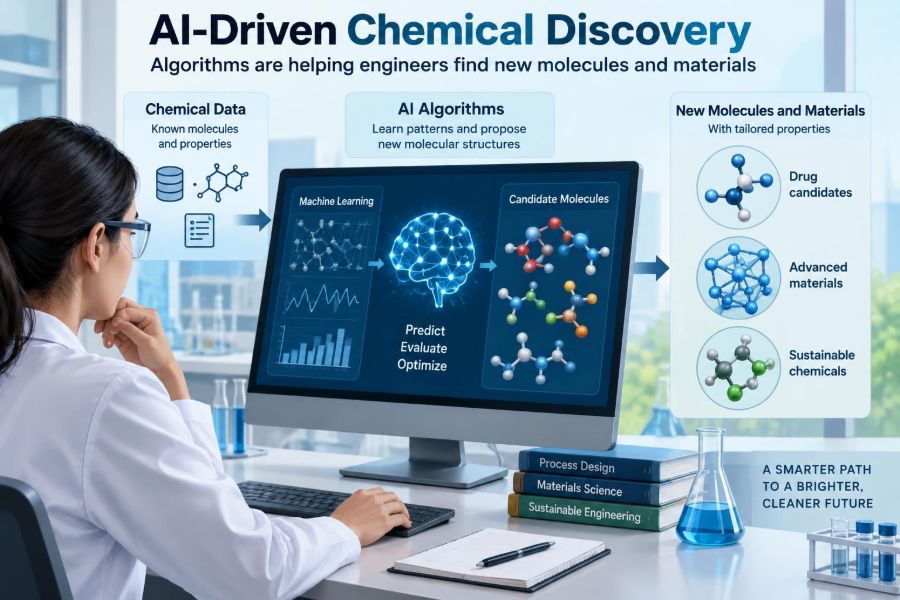
Artificial intelligence is changing the front end of this process. Instead of replacing experiments, algorithms can help researchers narrow a vast chemical search space to a shorter, more defensible list of candidates.
For chemical engineers, the opportunity is broader than finding a molecule with an appealing property. The real goal is to identify materials that can be made, separated, scaled, operated safely, and used responsibly in an actual process.
🧭 The Discovery Problem Is a Search Problem
A chemical structure can vary in atom type, connectivity, stereochemistry, molecular weight, and functional groups. Small changes can substantially alter solubility, reactivity, toxicity, conductivity, or phase behavior.
This creates a search space far larger than any laboratory can examine directly. AI-assisted chemical discovery treats that challenge as a structured search problem: predict useful candidates, test the most informative ones, then learn from the results.
🔬 Why Conventional Screening Takes Time
High-throughput experiments can test many samples, but “many” is still tiny compared with the number of conceivable molecules and material formulations. Screening also needs reliable synthesis, sample preparation, characterization, and data handling.
Some properties are especially slow to measure. Long-term degradation, fouling, corrosion, catalyst lifetime, and full process performance may require extended tests under realistic conditions.
🤖 What AI Means in Chemical Discovery
AI is an umbrella term for computational methods that detect patterns, make predictions, generate options, or select actions from data. In discovery work, it usually includes machine learning, statistical models, optimization algorithms, and increasingly, generative models.
A useful distinction is that AI does not “understand” chemistry in the human sense. It learns relationships present in its training data and mathematical representation. Good engineering judgment is needed to decide whether those relationships apply to a new system.
🧱 Molecules Must Become Machine-Readable
Algorithms cannot work directly with a drawing on a whiteboard. A molecule must first be represented in a numerical or structured form.
Common representations include chemical strings, molecular graphs in which atoms are nodes and bonds are edges, and descriptors such as molecular mass, ring count, polarity-related measures, or calculated surface area. Materials may also be represented by composition, crystal structure, processing conditions, microstructure, or spectra.
🕸️ Graph Models Capture Connectivity
Graph neural networks are designed for connected data. For a molecular graph, the model passes information among neighboring atoms and bonds to construct a learned representation of the whole molecule.
This is useful because connectivity matters: the same elemental formula can produce very different behavior when atoms are arranged differently. Still, a graph alone may not capture every relevant feature, such as three-dimensional conformation or solid-state packing.
📊 Descriptors Still Have a Place
Engineered descriptors remain valuable, particularly when datasets are modest and the target property has recognizable physical drivers. A simple model based on interpretable descriptors can sometimes be easier to audit than a complex neural network.
For example, a model for solvent selection might combine polarity-related descriptors, boiling range, viscosity, and structural alerts. The point is not to choose the most fashionable method, but the method that matches the data and decision.
🎯 Prediction Models Rank Promising Candidates
A predictive model estimates a property from a structure or formulation. Depending on the task, it may predict melting point, adsorption capacity, reaction yield, ionic conductivity, selectivity, or a qualitative class such as “likely stable” versus “unlikely stable.”
Predictions are most useful when they support a specific choice. An engineer may ask: which candidates are likely to meet a minimum requirement, and which should be tested next?
🧮 Regression and Classification Answer Different Questions
Regression predicts a numerical value, such as a viscosity or band gap. Classification assigns a category, such as whether a compound is likely to be soluble in a specified solvent under stated conditions.
The distinction matters because uncertainty and error have different meanings. A model that estimates a property reasonably well on average may still be poor at deciding whether a candidate crosses a tight operating threshold.
🧪 Property Labels Need Experimental Context
A reported property is not always a universal truth about a molecule. Solubility depends on temperature, solvent composition, pH, solid form, and measurement protocol. Catalyst performance depends on feed impurities, support properties, reactor conditions, and time on stream.
When training data merge unlike conditions without careful labeling, a model can learn noise or misleading averages. Chemical data need metadata: units, conditions, methods, material state, and where possible, uncertainty.
🧠 Generative Models Propose New Structures
Generative AI can create candidate molecules, polymers, or material compositions instead of only scoring a fixed library. It may modify a known scaffold, build structures token by token, or search a learned latent space.
That capability is powerful, but it introduces a practical problem: a structurally valid output is not automatically a useful or synthesizable chemical. Generation must be coupled to filters, prediction models, and human review.
🧩 Inverse Design Starts With the Target
In conventional design, an engineer proposes a material and then asks what it will do. Inverse design reverses the direction: specify desired properties, then search for structures that may deliver them.
A membrane example might seek high permeability, useful selectivity, mechanical robustness, and resistance to plasticization. These goals can conflict, so inverse design usually produces a set of trade-off candidates rather than one perfect answer.
⚖️ Multi-Objective Optimization Reflects Real Engineering
Industrial materials are rarely selected on a single number. A solvent may perform well in extraction but be too volatile, expensive, difficult to recover, or incompatible with seals. A catalyst may be active yet deactivate quickly.
Multi-objective optimization evaluates competing goals together. The result is often a Pareto front: candidates for which improving one objective would worsen at least one other objective.
| Discovery objective | Useful engineering constraint |
|---|---|
| High predicted activity | Stability over operating time |
| High separation selectivity | Flux, regeneration energy, and fouling resistance |
| Low-cost feedstock | Purification burden and supply consistency |
| Novel structure | Synthetic accessibility and safe handling |
🔁 Active Learning Chooses the Next Experiment
Active learning creates a loop between model and laboratory. Rather than selecting experiments only by the highest predicted score, it chooses tests expected to improve the decision most.
A candidate can be valuable because it looks excellent, because the model is uncertain about it, or because it helps distinguish between competing chemical hypotheses. This is often more efficient than repeatedly testing similar high-scoring molecules.
📉 Uncertainty Is a Decision Tool
A prediction without uncertainty can look more reliable than it is. Models are generally safer when they can flag that a new candidate lies outside the chemical territory represented in training data.
Uncertainty estimates are imperfect, but they support better triage. A team may prioritize candidates with high predicted value and manageable uncertainty, while reserving very uncertain candidates for exploratory experiments.
🗺️ Domain of Applicability Prevents Overreach
The domain of applicability is the region of chemical space where a model has relevant experience. A model trained on small neutral organic molecules should not automatically be trusted for organometallic complexes, salts, polymers, or strongly charged species.
Similarity checks, distance measures in descriptor space, and inspection of nearest known examples can reveal when an output is extrapolation rather than interpolation. Extrapolation is not forbidden; it simply needs stronger experimental caution.
⚗️ Catalysts Are a Major Use Case
Catalyst discovery involves composition, support, morphology, preparation route, and operating conditions. AI can help connect these variables to activity, selectivity, or stability and identify productive regions for experimental exploration.
Yet catalytic systems are challenging because measured performance can reflect mass transfer limits, heat transfer, deactivation, and reactor configuration rather than intrinsic chemistry alone. Models should be built around carefully designed experiments, not treated as substitutes for kinetics.
🔋 Battery and Electrochemical Materials Need Systems Thinking
AI can screen electrode compositions, electrolyte additives, solid electrolytes, and interfacial materials. Relevant targets may include conductivity, voltage window, ion transport, thermal behavior, or predicted stability.
A promising calculation or model score is only an early filter. Cell assembly, electrode architecture, impurity sensitivity, cycling protocol, and interfacial reactions determine whether the material succeeds in a device.
🧱 Polymers Add Formulation Complexity
Polymer properties depend not only on repeat-unit chemistry but also on molecular-weight distribution, branching, tacticity, additives, curing, processing history, and morphology. This makes clean datasets harder to assemble.
For polymer design, AI is most credible when its predictions are linked to a defined grade and processing window. A model that ignores processing may confuse chemistry-driven effects with manufacturing-driven effects.
💧 Solvents and Separations Offer Practical Opportunities
Solvent selection is well suited to data-driven methods because engineers often balance solubility, selectivity, safety, recyclability, and environmental profile. Algorithms can rank candidates or identify formulations worth phase-equilibrium testing.
For separations, models may support adsorbent, membrane, extractant, or crystallization-aid discovery. They should be evaluated with realistic mixtures, not only idealized single-component properties.
🧫 Formulations Are Not Just Collections of Ingredients
Coatings, detergents, inks, pharmaceuticals, and specialty products are mixtures. Ingredient interactions can be nonlinear: two acceptable components may create instability, poor rheology, or unexpected phase separation together.
Design-of-experiments methods and machine learning can work together here. Statistical experiment plans expose interactions efficiently, while models help prioritize regions of formulation space for the next round.
🏭 Process Constraints Must Enter Early
A molecule with attractive lab properties can fail because its route needs hazardous reagents, difficult purification, extreme conditions, or a costly separation. These concerns should not be saved for the handoff to process development.
Early screens can include approximate synthetic accessibility, precursor availability, likely impurity risks, thermal behavior, and separation implications. Such estimates are not final process design, but they prevent a discovery program from optimizing the wrong target.
🛠️ Retrosynthesis Connects Ideas to Routes
Retrosynthesis software works backward from a target structure to suggest possible precursor disconnections and reaction steps. It can broaden the routes considered by a chemist and help compare route complexity early.
Suggested routes require scrutiny. Literature precedent may not translate to a desired scale, feed purity, equipment set, or safety standard. A route recommendation is a hypothesis for development, not a manufacturing recipe.
🧯 Safety Cannot Be an Afterthought
Discovery systems can inadvertently prioritize high-energy, reactive, persistent, or toxic candidates if those risks are absent from the objective function. Engineers should include known hazard information and structural alerts where appropriate.
Models cannot replace hazard testing, process safety analysis, exposure assessment, or regulatory review. They can, however, help flag concerns early enough to redirect effort before a candidate becomes deeply embedded in a project.
🌱 Sustainability Requires More Than a Green Label
A lower-hazard ingredient is not automatically lower impact overall. Energy demand, yield, solvent use, recovery requirements, feedstock source, persistence, and end-of-life behavior all shape a material’s footprint.
AI can help compare alternatives when relevant life-cycle data exist, but incomplete inventories create uncertainty. The responsible approach is to state assumptions clearly and avoid treating a single proxy, such as bio-based content, as a complete sustainability verdict.
🗃️ Data Quality Often Limits the Model
Chemical datasets may contain transcription errors, inconsistent names, missing units, duplicate structures, failed experiments that were never recorded, or values measured under incompatible protocols. A sophisticated model cannot fully repair a poorly defined target.
Data curation is therefore engineering work. It includes checking identities, standardizing units, preserving conditions, documenting transformations, and separating measured values from calculated estimates.
🧪 Negative Results Are Valuable Training Data
Failed syntheses, inactive catalysts, unstable formulations, and unsuccessful separations contain information about where a strategy does not work. If only successful outcomes are stored, a model may develop an unrealistically optimistic view of chemical space.
Capturing negative results requires clear definitions. “Failure” might mean no reaction, low isolated yield, poor reproducibility, unacceptable selectivity, or inability to operate safely. Those outcomes should not be collapsed carelessly.
📏 Validation Must Match the Intended Use
Randomly splitting a dataset into training and test sets can produce overly favorable results when close analogues appear on both sides. A stricter test may separate chemical families, time periods, laboratories, or formulation groups.
Validation should answer the actual deployment question: can this model prioritize genuinely new candidates under the conditions where the team will use it? Performance metrics should be interpreted alongside error patterns and failures.
👩🔧 Human Expertise Remains Central
Chemists contribute mechanistic reasoning, synthetic judgment, and awareness of literature context. Chemical engineers contribute process integration, scale-up awareness, transport phenomena, safety, economics, and operability.
The strongest workflow combines these perspectives. An algorithm may identify an unusual candidate; experts determine whether the apparent opportunity survives chemical realism and plant-level constraints.
🔄 A Practical Discovery Workflow
- Define a measurable product or process need and its operating conditions.
- Set performance, safety, cost, manufacturability, and sustainability constraints.
- Assemble curated data with metadata and identify important gaps.
- Choose transparent baselines before moving to more complex models.
- Generate or screen candidates, including uncertainty and applicability checks.
- Select a diverse experimental batch, not only the top-ranked structures.
- Measure results carefully, record failures, and update the model.
- Introduce route, scale-up, and life-cycle questions before committing heavily.
🚫 Common Mistakes in AI-Assisted Discovery
One mistake is optimizing a convenient proxy rather than the real decision. Maximizing a predicted molecular property may not improve plant performance if recovery energy or material lifetime dominates the economics.
Another is treating a ranked list as a validated answer. Ranking helps allocate experiments; it does not establish reproducibility, safety, or commercial viability.
- Do not confuse novelty with usefulness. Unfamiliar structures may be difficult to make or characterize.
- Do not hide data limitations. Missing conditions and biased sampling should be visible.
- Do not automate without a stopping rule. Decide when evidence is sufficient to advance, pause, or abandon a candidate.
📚 Skills Chemical Engineers Can Build
Useful skills include data cleaning, visualization, statistical experimental design, basic programming, and the ability to interpret model outputs critically. Familiarity with thermodynamics, reaction engineering, separations, and transport remains the foundation for asking good questions.
You do not need to become a specialist in every algorithm. Start by learning to frame a chemical problem as inputs, outputs, constraints, uncertainty, and an experimental decision.
🔮 Where the Field Is Heading
Discovery platforms are increasingly linking literature data, simulation, automation, and laboratory measurements in closed loops. Better integration may reduce time spent on low-value experiments and create more traceable development records.
Progress will not be uniform across all fields. Areas with standardized measurements and abundant data may advance faster than systems involving complex mixtures, rare failures, or long-duration performance. That difference is a data reality, not a reason to ignore difficult problems.
🌟 The Core Principle: Better Decisions, Not Magic Molecules
AI-driven chemical discovery is most valuable when it improves the quality and speed of decisions under uncertainty. It can organize evidence, expose patterns, propose options, and direct experiments toward candidates that are both promising and informative.
The winning approach is not “AI versus laboratory work.” It is a disciplined loop in which models, measurements, chemical knowledge, and engineering constraints continually correct one another.
Algorithms can make chemical discovery more purposeful, but experiments and engineering judgment determine whether a molecule becomes a useful material or process. When those pieces work together, teams can explore more intelligently without losing sight of safety, scale, and real-world performance. 🧪⚙️🌱