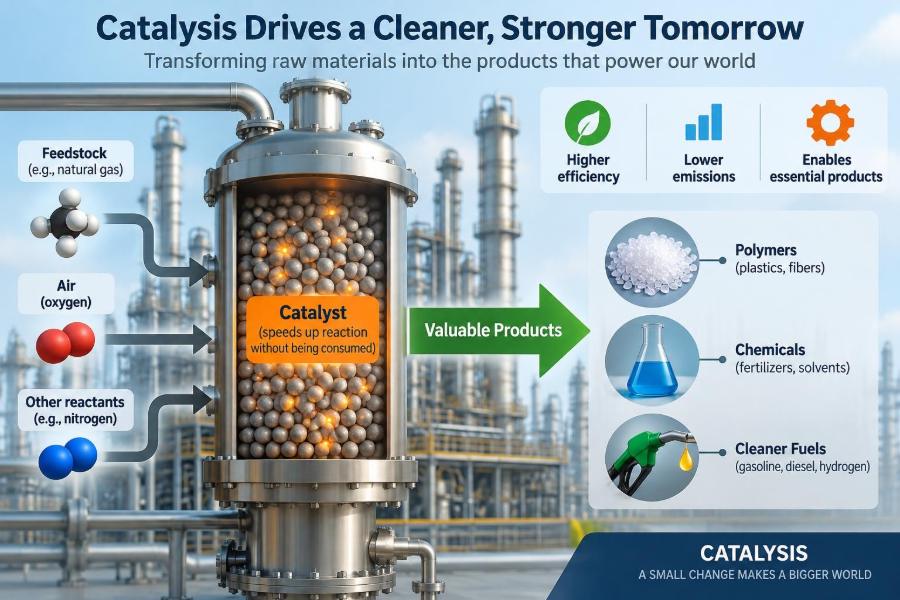

A fertilizer bag, a plastic bottle, a vehicle fuel tank, and a bottle of pain-relief tablets seem to have little in common. Yet each depends on chemical reactions that would be too slow, too energy-intensive, too wasteful, or too selective to run economically without catalysts.
A catalyst is often described as a substance that speeds up a reaction without being consumed. That concise definition is correct, but it hides an enormous industrial story. Catalysts make it possible to manufacture essential chemicals at scale while controlling which molecules form, how much energy is used, and how much unwanted material must be separated or destroyed.
For chemical engineers, catalysis sits at the intersection of chemistry, materials science, reactor design, heat transfer, separation, safety, and economics. A breakthrough in one catalyst can reshape an entire process flowsheet.
The most consequential discoveries were not simply new substances in a laboratory flask. They revealed ways to manage molecules at reactive surfaces, inside pores, or around metal centers—and then translate that control into reliable plants that operate for years.
🔬 Catalysis: The Molecular Shortcut
A chemical reaction proceeds when molecules overcome an energy barrier on the path from reactants to products. A catalyst provides an alternative pathway with a lower barrier. At a given temperature, more molecular encounters can therefore become successful reactions.
A catalyst does not change the overall thermodynamic equilibrium position of a reversible reaction. It changes how quickly the system approaches equilibrium. This distinction matters when choosing between a more active catalyst, a higher pressure, product removal, or a different reactor configuration.
⚙️ Why Manufacturing Needed Catalysts
Early industrial chemistry could often rely on high temperatures, strong acids, or long residence times. Those approaches may work chemically, but they consume fuel, corrode equipment, create difficult separations, and can generate large streams of by-products.
Catalysts offered a more precise route. They allowed manufacturers to direct feed molecules toward desired products under conditions compatible with practical metallurgy, manageable heat release, and continuous operation. Modern bulk chemical production is largely a history of learning to make reactions fast and controllable.
🧱 Homogeneous and Heterogeneous Catalysts
In homogeneous catalysis, catalyst and reactants occupy the same phase, commonly a dissolved metal complex in a liquid reaction mixture. Molecular design can give exceptional selectivity, but separating and recovering the catalyst may be challenging.
In heterogeneous catalysis, the catalyst is a separate solid while gases or liquids flow around it. This arrangement is usually easier to operate continuously and separate from products. Much of commodity manufacturing uses solids packed into fixed-bed reactors, although slurry and fluidized systems are also important.
| Feature | Homogeneous catalysis | Heterogeneous catalysis |
|---|---|---|
| Typical catalyst form | Dissolved molecular complex | Solid metal, oxide, zeolite, or supported material |
| Strength | Fine molecular selectivity | Recovery and continuous processing |
| Common challenge | Catalyst-product separation | Diffusion limits and deactivation |
🧲 Active Sites Are Where Chemistry Happens
Only particular locations on a catalyst carry out the desired transformation. These active sites may be metal atoms on a surface, acidic groups in a porous framework, or a defined metal center surrounded by ligands.
Industrial catalyst development is not merely about adding more active material. The active sites must be accessible, stable, selective, and supplied with reactants. A catalyst with remarkable intrinsic activity can still perform poorly if pore diffusion, heat removal, or poisoning prevents molecules from reaching those sites.
🧠 The Haber–Bosch Breakthrough
The synthesis of ammonia from nitrogen and hydrogen became a foundational catalytic achievement because nitrogen gas is unusually unreactive. Its atoms are connected by a very strong triple bond, so ordinary conditions do not produce ammonia at useful rates.
The Haber–Bosch process combined a catalyst with elevated temperature and pressure to make ammonia production practical on a large scale. Iron-based catalysts became central to the mature process. The achievement was not one isolated discovery: it required catalyst formulation, gas purification, high-pressure equipment, recycle loops, and heat integration.
🌾 Ammonia Changed Agriculture—and Industry
Ammonia is the starting point for many nitrogen fertilizers, allowing fixed nitrogen to be supplied to crops rather than relying only on natural nitrogen cycles. It is also a feedstock for nitric acid, explosives, refrigerants, resins, and numerous intermediates.
The process illustrates a recurring catalytic lesson: the feed purity is part of the reaction design. Sulfur compounds, carbon oxides, water, and other impurities can damage catalyst performance or disturb synthesis-loop operation. Upstream cleanup is therefore not optional housekeeping; it protects the process core.
🔥 Contact Process Catalysis and Sulfuric Acid
Sulfuric acid is widely used in fertilizer production, mineral processing, petroleum refining, batteries, and chemical synthesis. Its manufacture depends on catalytic oxidation of sulfur dioxide to sulfur trioxide, a key step in the contact process.
Vanadium-based catalysts made this oxidation effective under industrially workable conditions. The reaction is exothermic and equilibrium-limited, so plants use staged catalyst beds with interstage cooling. That design keeps temperature in a useful range rather than treating the reactor as a single black box.
🚗 Catalytic Cracking Remade Refining
Crude oil contains many hydrocarbons larger than the molecules most valuable for transportation fuels and petrochemical feedstocks. Thermal cracking can break them, but it tends to demand harsher conditions and offers less control over product distribution.
Catalytic cracking uses acidic solid catalysts to cleave and rearrange hydrocarbons. Fluid catalytic cracking, commonly called FCC, continuously circulates a fine catalyst between a reactor and regenerator. Coke deposited during reaction is burned from the catalyst in the regenerator, restoring activity and supplying much of the process heat.
🌀 Zeolites Brought Shape Selectivity
Zeolites are crystalline aluminosilicate materials containing pores of molecular dimensions. Their pore structure can favor certain molecules based on size and shape, an effect known as shape selectivity.
In refining and petrochemicals, zeolites improved control of cracking and related reactions. They can favor desired pathways while restricting bulky transition states that lead to less valuable products. Their significance extends beyond acidity: their ordered pore networks create a physical environment in which reaction chemistry and molecular transport are tightly coupled.
🛢️ Hydroprocessing Made Fuels Cleaner
Petroleum fractions often contain sulfur-, nitrogen-, and metal-containing compounds. These components can impair fuel quality, contribute to emissions after combustion, and poison downstream catalysts.
Hydrodesulfurization and related hydroprocessing reactions use hydrogen with supported metal sulfide catalysts to remove sulfur and upgrade heavy streams. They demonstrate that catalytic choices are linked to fuel specifications, hydrogen availability, pressure rating, and sulfur-handling systems. Cleaner products can require substantial infrastructure upstream of the final blending tank.
💨 Steam Reforming Built the Hydrogen Economy
Steam methane reforming converts natural gas and steam into synthesis gas, a mixture primarily containing hydrogen, carbon monoxide, and carbon dioxide. Nickel-based catalysts have long been central because they activate hydrocarbons and support high-throughput operation.
The process is strongly endothermic, meaning it needs a continuous heat supply. In a fired tubular reformer, catalyst-filled tubes receive heat through their walls while reacting gas flows inside. This arrangement makes temperature gradients, tube metallurgy, burner operation, and carbon formation as important as the catalyst recipe.
🔄 Water-Gas Shift Adjusts Synthesis Gas
After reforming, the carbon monoxide-to-hydrogen ratio may not fit the next process. The water-gas shift reaction converts carbon monoxide and steam into carbon dioxide and additional hydrogen.
Different catalyst families are used in different temperature ranges because reaction rate, equilibrium, and catalyst stability pull the design in different directions. A higher-temperature stage can handle faster kinetics, while a lower-temperature stage can help reduce residual carbon monoxide. This staged approach is a classic example of matching catalyst function to thermodynamic reality.
🧪 Methanol Synthesis Created a Platform Molecule
Methanol is made catalytically from synthesis gas and is used directly as a solvent and fuel component, as well as a building block for formaldehyde, acetic acid, olefins, and other chemicals. Copper-based catalysts enabled highly productive low-temperature methanol synthesis compared with earlier high-pressure approaches.
Methanol plants show why feed composition matters. Hydrogen, carbon oxides, and inert gases must be balanced with the catalyst and recycle loop. Too much of an inert gas reduces partial pressures; an unsuitable carbon balance can complicate conversion and separation.
🧴 Ziegler–Natta Catalysts Changed Plastics
The discovery of Ziegler–Natta catalysts transformed polymer manufacturing by allowing ethylene and propylene to be converted into high-molecular-weight polymers under comparatively mild conditions. These catalysts did more than increase polymerization rate: they helped control polymer architecture.
For polypropylene in particular, the arrangement of side groups along the chain influences crystallinity, strength, and processing behavior. Catalysts that control this arrangement made materials possible for fibers, packaging, automotive parts, and consumer goods. A polymer reactor is therefore also a factory for molecular structure.
📐 Metallocenes Improved Polymer Precision
Metallocene catalysts are molecular organometallic catalysts, often activated to form highly controlled polymerization sites. Their well-defined structures can produce narrower or deliberately tailored distributions of chain properties than many traditional systems.
They are not a universal replacement for older catalysts. Cost, robustness, process compatibility, licensing, and desired resin properties all affect selection. Their larger contribution was conceptual: catalyst design could be used to tune comonomer incorporation, stereochemistry, and molecular-weight distribution with greater intentionality.
🧩 Polymer Properties Begin at the Catalyst
Two polyethylene grades may look similar as pellets yet behave very differently in a film line or blow-molding operation. Chain length, branching, comonomer placement, and residual catalyst species affect stiffness, toughness, sealing, clarity, and melt flow.
This is why polymer catalyst development must involve product engineers, not only reaction chemists. The useful question is not simply “Which catalyst gives the highest conversion?” It is “Which catalyst produces a polymer that performs reliably in the customer’s process and final application?”
🧫 Selective Oxidation Became a Fine Balancing Act
Oxidation is among the most useful and difficult classes of industrial chemistry. Oxygen is inexpensive and abundant, but organic molecules can be oxidized too far, producing carbon oxides, water, and lost value rather than the intended intermediate.
Catalysts enable controlled routes to products such as aldehydes, acids, epoxides, and anhydrides. The best catalyst is often not the one that converts feed fastest. It is the one that sustains high selectivity, meaning a large fraction of converted feed appears as the desired product rather than as by-products.
🎨 Titanium Dioxide and the Chloride Process
Titanium dioxide is an important white pigment used in coatings, plastics, paper, and many other products. Catalytic oxidation is involved in the chloride route, where titanium tetrachloride is converted to pigment-grade titanium dioxide.
This example broadens the usual definition of chemical manufacturing. Catalysis is not limited to fuels and small organic molecules; it supports materials whose value comes from optical behavior, particle size, purity, and surface treatment. Process conditions influence these physical attributes as much as reaction conversion.
💊 Asymmetric Catalysis Advanced Fine Chemicals
Some molecules exist as mirror-image forms called enantiomers. In pharmaceuticals and specialty chemicals, those forms can have different biological or functional behavior. Asymmetric catalysis uses a chiral catalyst environment to preferentially form one enantiomer.
This capability can reduce dependence on separating a racemic mixture after reaction, although downstream purification is still often necessary. Homogeneous chiral catalysts are especially valuable in high-value applications where selectivity justifies careful catalyst recovery, stringent impurity control, and more complex operating procedures.
🔗 Carbonylation Made Carbon Monoxide Useful
Carbonylation reactions insert carbon monoxide into an organic molecule, forming products such as acids, esters, and aldehydes. Transition-metal catalysts made these reactions powerful routes to carbonyl-containing intermediates.
Acetic acid production is a prominent industrial example. Carbonylation illustrates the advantages of molecular catalysts: a carefully designed coordination environment can guide a sequence of bond-breaking and bond-forming steps with high selectivity. The engineering challenge is safely containing toxic carbon monoxide while managing corrosion, catalyst retention, and purification.
🌡️ Catalyst Discovery Is Only the First Step
A catalyst that excels in a small, well-mixed laboratory reactor can fail when formed into pellets, loaded into a large bed, and exposed to real feeds. Industrialization asks additional questions: Can it be manufactured consistently? Does it survive startup and shutdown? Can it be regenerated? What happens when feed composition drifts?
Scale-up also introduces heat and mass transfer limits. If heat cannot leave a catalyst particle or reactor quickly enough, local hot spots can accelerate undesired reactions and catalyst damage. Engineers must distinguish true kinetic behavior from limitations caused by transport.
📏 Activity, Selectivity, and Yield Are Different Measures
These terms are sometimes used casually, but they answer different process questions. Conversion tells how much reactant has disappeared. Selectivity tells how the converted reactant is distributed among products. Yield combines conversion and selectivity for a chosen product.
- High conversion can be undesirable if most feed becomes unwanted material.
- High selectivity at very low conversion may not provide enough production rate.
- High yield is valuable, but separation cost, catalyst lifetime, and energy demand still determine whether a process is attractive.
Good catalyst evaluation therefore requires a full material balance, not a single impressive performance number.
🪨 Supports Turn Active Metals into Practical Catalysts
Many active metals are dispersed on supports such as alumina, silica, carbon, or structured ceramic materials. The support can spread metal into small particles, provide mechanical strength, conduct or retain heat, and sometimes participate chemically through acidity or oxygen mobility.
Metal-support interactions can improve stability, but they can also alter activity in unexpected ways. A support should be selected for the entire operating environment: feed contaminants, steam exposure, temperature cycling, mechanical abrasion, and regeneration conditions all matter.
☠️ Poisoning and Fouling Limit Catalyst Life
Catalysts gradually lose performance through several routes. Poisons bind strongly to active sites; coke blocks pores or covers surfaces; sintering causes small particles to merge at high temperature; and physical attrition can remove material from a circulating system.
Common operational defenses include feed pretreatment, temperature control, guard beds, periodic regeneration, and online monitoring of pressure drop and product quality. No universal lifetime exists. A catalyst’s useful service interval depends on its chemistry, feed history, operating severity, and the plant’s tolerance for declining performance.
🧯 Hot Spots Are a Catalyst and Safety Concern
Exothermic reactions can release heat faster than a packed bed can remove it. The result may be a temperature front or local hot spot. Higher temperature can increase reaction rates, creating a feedback loop that shifts selectivity, damages catalyst, or exceeds equipment limits.
Engineers manage this risk with staged beds, quench streams, dilution, recycle, interstage cooling, temperature sensors, and conservative operating procedures. Catalyst activity is not automatically a benefit: an extremely active material may demand a more sophisticated reactor design to remain safe and selective.
🏭 Reactor Choice Shapes Catalyst Performance
Fixed beds are simple and common for gas-phase reactions, but they can develop pressure drop and temperature gradients. Fluidized beds improve mixing and heat transfer, yet require particles that resist attrition. Slurry reactors can help remove heat and handle fine catalysts but add separation complexity.
Structured catalysts, including monoliths and coated channels, reduce pressure drop and can offer improved heat transfer in suitable services. Selecting a reactor is therefore inseparable from selecting a catalyst. The pair must be optimized together rather than in separate project stages.
♻️ Catalysis Can Reduce Waste, Not Eliminate It
Selective catalytic routes often generate less waste than stoichiometric methods that require large quantities of reagents and produce salt by-products. Catalysts may also lower energy use by permitting milder conditions or reducing separation loads.
However, catalysis is not inherently “green” in every case. Catalyst manufacture can require energy-intensive metals or complex preparation, regenerations can emit gases, and a high-pressure hydrogen process has its own energy and carbon implications. Environmental assessment must consider the full process, including utilities, feeds, recovery, and end-of-life handling.
🌱 Electrocatalysis Points to New Manufacturing Routes
Electrocatalysis uses electrical energy to drive chemical transformations at electrode surfaces. It is attracting interest for hydrogen production, carbon dioxide conversion, nitrogen-related chemistry, and selective organic synthesis, particularly where low-carbon electricity is available.
Its promise should be evaluated carefully. A good laboratory current efficiency does not automatically translate into a competitive industrial process. Cell voltage, electrode lifetime, product separation, electrolyte management, and electricity supply determine the real performance of an electrochemical plant.
🌞 Photocatalysis Offers Another Energy Input
Photocatalysts absorb light and use that energy to create reactive charge carriers that can drive chemical transformations. The concept is appealing because sunlight is abundant, and photocatalysis may enable chemistry under conditions different from thermal reactors.
Practical scale-up remains demanding. Light penetration decreases in dense or opaque reaction media, photon delivery must be uniform, and catalyst stability under illumination matters. Photocatalysis is best viewed as a developing tool with strong niche potential rather than a blanket substitute for established thermal catalysis.
🧮 Computation Speeds Up, but Does Not Replace, Testing
Computational chemistry, data analysis, and high-throughput experiments can help researchers screen compositions and understand possible reaction pathways. These tools reduce the number of unpromising candidates that must be made and tested in depth.
Models still rely on assumptions and available data. Real catalysts contain defects, changing surfaces, mixed phases, impurities, and transport effects that are difficult to represent fully. The strongest workflow links prediction with characterization, realistic testing, and process-scale validation.
🔍 Characterization Reveals What a Catalyst Really Is
A catalyst is not defined only by its nominal chemical formula. Surface area, pore size, crystal phase, particle size, oxidation state, acidity, and metal dispersion can all influence performance.
Characterization before and after use helps engineers identify why performance changed. Whenever possible, researchers also use methods that observe catalysts under reaction-like conditions. A material can restructure when exposed to heat, pressure, reactants, or water, so its resting state may not be its working state.
🧰 Practical Questions for Evaluating a Catalytic Process
When assessing a catalytic technology, avoid focusing only on a reported conversion or a headline product. Ask questions that connect the chemistry to the plant.
- What impurities reach the catalyst, and which are reversible or irreversible poisons?
- How is reaction heat added or removed at the intended scale?
- What products and by-products determine separation duty?
- How quickly does activity decline, and can the catalyst be regenerated safely?
- What happens during feed interruptions, startup, shutdown, and emergency depressurization?
- Does catalyst replacement require extended downtime or specialized handling?
These questions often uncover the difference between an elegant reaction and a workable manufacturing process.
🎓 Lessons from the Major Catalytic Discoveries
The catalytic breakthroughs behind ammonia, sulfuric acid, fuels, hydrogen, methanol, polymers, and fine chemicals share a common pattern. They paired a molecular insight with an engineering system capable of maintaining that chemistry at scale.
The central lesson is that a catalyst creates value not merely by accelerating a reaction, but by making selectivity, energy management, feed preparation, reactor operation, and product quality work together. That systems perspective explains why catalytic innovation continues to transform manufacturing even when the underlying reaction has been known for decades.
Catalysis remains one of chemical engineering’s clearest demonstrations that tiny changes at an active site can determine the design of an entire plant. Understanding the reaction is essential; understanding how to sustain it safely, selectively, and economically is what turns discovery into modern manufacturing. ⚗️🏭🌿