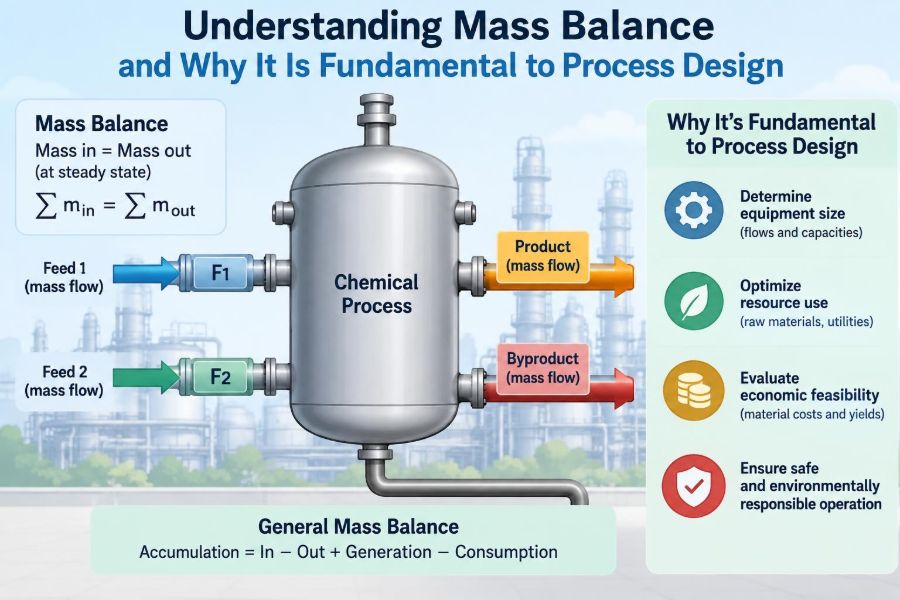

A tank is being filled from one pipe while another pipe drains it. A technician needs to know whether the liquid level will rise, fall, or remain steady. The answer may seem obvious, but it becomes much less so when the liquid is reacting, evaporating, separating into phases, or moving through several interconnected vessels.
The same accounting question appears throughout chemical engineering. How much raw material is needed? Where did an impurity go? Can a reactor produce the required amount of product? Is a wastewater treatment unit actually removing a contaminant, or simply transferring it somewhere else?
Mass balance gives engineers a disciplined way to answer those questions. It converts an unfamiliar process into a statement of what crosses a boundary, what is created or consumed by reaction, and what accumulates inside.
Before selecting equipment, estimating costs, or optimizing energy use, engineers need to know where the material goes. That is why mass balance is not merely an academic exercise; it is the starting framework for process design.
⚖️ The central idea: account for every mass stream
A mass balance is an accounting relationship based on conservation of mass. For a chosen system, the amount of material entering and generated must equal the amount leaving, consumed, and accumulated.
In its most general form:
Accumulation = Input − Output + Generation − Consumption
“Generation” and “consumption” refer to material changes caused by chemical reaction. For an individual chemical species, a reaction may generate or consume it. For total mass in ordinary chemical processes, reaction does not create or destroy mass; atoms are rearranged.
The equation is simple. The engineering skill lies in defining the system properly, identifying all streams, and using data that describe the same basis.
🧱 Conservation of mass is the physical foundation
Mass balance rests on a physical principle: in conventional chemical engineering operations, mass is conserved. Combustion, fermentation, crystallization, distillation, and neutralization can radically change composition, temperature, and volume, but the total mass of atoms is retained.
This distinction matters because volume is not generally conserved. Mixing ethanol and water, compressing a gas, or heating a liquid can change volume without changing total mass. A process calculation that treats liters as though they behave like kilograms can produce a convincing but incorrect result.
At the nuclear scale, mass and energy have a deeper relationship. That is outside the assumptions of almost all process-design mass balances, where changes in rest mass are negligible.
🎯 Choosing the system boundary
A mass balance begins by drawing a system boundary, an imaginary surface separating the part being analyzed from its surroundings. Material crossing the boundary is an input or output. Material inside may accumulate or react.
The boundary can surround a single pump, a reactor, a separator, an entire plant, or even a regional water-treatment network. There is no universally correct boundary; the best one matches the question being asked.
- For pump sizing, the boundary may enclose one pump and its inlet and outlet.
- For conversion calculations, it may enclose the reactor.
- For raw-material purchasing, it may surround the complete production facility.
A clear boundary prevents a common error: counting an internal recycle stream as if it were fresh material entering the overall process.
🗺️ Process flow diagrams make balances visible
A process flow diagram or simplified flowsheet turns a written problem into a physical map. It shows equipment blocks, stream directions, known flow rates, compositions, and relevant operating information.
Start with the minimum detail needed to support the balance. Label each external and internal stream consistently, such as Stream 1 for fresh feed and Stream 2 for reactor effluent. Add units beside every number.
Even a hand-drawn diagram catches omissions. A vent line, purge, condensate stream, filter cake, sampling stream, or solvent makeup line can materially affect a balance. If it crosses the chosen boundary, it belongs on the diagram.
🔢 Total balances and component balances
A total mass balance tracks the total mass of all substances combined. A component balance tracks one selected substance, such as water, sodium chloride, methane, or a pollutant.
Total balances are useful for checking overall throughput and solving simple mixing or splitting problems. Component balances are needed when composition changes, which is the usual case in chemical processes.
| Balance type | What it tracks | Typical use |
|---|---|---|
| Total mass balance | All material together | Overall feed and product rates |
| Component balance | One chemical species or component | Mixing, separation, composition control |
| Element balance | Atoms of an element | Reactive systems and combustion |
Component balances must add up to the total balance when all components have been included. That agreement is one of the most useful calculation checks.
⏱️ Steady state versus unsteady state
At steady state, conditions within the chosen system do not change with time. For a nonreacting vessel, the mass entering equals the mass leaving, so accumulation is zero.
At unsteady state, also called transient operation, inventory changes with time. Startup, shutdown, batch processing, tank filling, upset recovery, and changes in feed rate are all unsteady situations.
Steady state does not mean nothing is moving. A distillation column can have continuous feed, vapor, reflux, distillate, and bottoms flows while its internal holdup remains approximately constant. It simply means those flows and inventories are stable over the period considered.
🪣 A tank-filling example
Consider a hypothetical water tank with one inlet and one outlet. If the inlet is 12 kg/min and the outlet is 9 kg/min, the total-mass accumulation is 3 kg/min, assuming no leaks or reaction.
If the liquid density remains nearly constant, the liquid level rises. If the outlet later becomes 12 kg/min, the inventory is constant and the tank operates at steady state.
This basic example introduces a pattern that scales upward: identify rates, write one balance around a boundary, state assumptions, and interpret the result physically. A large industrial process is often a network of this same accounting logic.
🧪 Reactions require species-aware accounting
In a reactor, total mass entering and leaving still balances, but individual components change because they participate in reaction. A reactant balance may include a consumption term, while a product balance includes a generation term.
Suppose reactant A becomes product B. A balance on A reveals how much A remains; a balance on B reveals product formation. To relate them correctly, engineers use the balanced chemical equation and its stoichiometric coefficients.
Writing a balance on total mass alone cannot reveal conversion or selectivity. It may show that the reactor processes 1,000 kg/h, while saying nothing about whether valuable product is being made or unwanted by-products dominate.
🔗 Stoichiometry connects reaction and flow rates
Stoichiometry describes the fixed molar relationships among species in a balanced reaction. For example, if one mole of A reacts with two moles of B, the consumption rates must follow that ratio for the reaction pathway considered.
Moles are usually more convenient than mass for reaction balances because chemical equations are written on a molar basis. Molecular weights then convert between molar flow rates and mass flow rates.
Real reactors may involve several reactions, incomplete conversion, or nonstoichiometric feed ratios. The balanced equations remain essential, but the calculation must include enough independent information—such as conversion, yield, selectivity, or measured outlet composition—to determine the unknowns.
📈 Conversion, yield, and selectivity answer different questions
Conversion tells how much of a chosen reactant has been consumed. Yield relates desired product obtained to a defined theoretical or reactant-based amount. Selectivity compares formation of desired product with formation or consumption associated with undesired products.
These terms are often used casually, but they are not interchangeable. High conversion can coexist with poor yield when a reactant forms unwanted by-products. High selectivity can coexist with low production rate if only a small fraction reacts.
A careful calculation states the denominator explicitly. For example, “single-pass conversion of A” is more precise than simply “conversion,” particularly when a recycle loop is present.
🔄 Recycle streams complicate the picture
A recycle stream returns material from downstream equipment to an upstream point. It can recover unreacted feed, reuse solvent, improve overall recovery, or help manage temperature and concentration.
However, recycle makes stream flow rates interdependent. The reactor feed may be much larger than the fresh feed because it includes returned material. Balancing only the reactor can therefore give a misleading impression of fresh-material demand.
A useful strategy is to first draw an overall boundary around the recycle loop. Internal recycle streams disappear from that overall balance. Then analyze individual units once the process-level relationships are clear.
🚪 Purges prevent impurity buildup
Recycle loops often need a purge: a deliberate small outlet stream that removes material from the loop. Without it, inert gases, contaminants, or side products that enter with fresh feed may accumulate.
For instance, an inert gas entering a recycled reactor system does not react and may not leave with the desired product. If it is repeatedly returned, its concentration can rise until it affects pressure, separation performance, or reaction conditions.
A purge reduces buildup but also carries away valuable reactants or solvents. Its design is a trade-off between inventory control and material loss, and a component balance identifies that trade-off quantitatively.
💨 Phase changes do not violate the balance
Evaporation, condensation, drying, and flashing move material between liquid and vapor phases. They can make a process look more complicated because an outlet may split into streams with very different compositions.
The material has not disappeared when water evaporates from a dryer; it leaves in the humid exhaust gas. Likewise, condensed solvent may be recovered as liquid from a condenser while noncondensable gases continue to a vent.
For phase-equilibrium equipment, mass balances are combined with equilibrium relationships and energy balances. The balance establishes how much must be distributed; thermodynamics helps determine how that distribution occurs.
🧂 Separations are composition problems
Distillation, extraction, filtration, adsorption, membrane separation, and centrifugation generally do not change the identity of components. Their purpose is to redistribute components among streams.
That makes component balances central. A filter may send solids mainly to a cake and liquid mainly to filtrate, but neither stream is perfectly pure in most real operations. Entrained liquid in cake and fine particles in filtrate can matter greatly for recovery and waste calculations.
Balance equations reveal what purity targets imply. If a separator must recover nearly all of a valuable component, the remaining fraction must appear somewhere else—often in a stream that requires further treatment or recycling.
📦 Batch processes use amounts, not only rates
Continuous processes are commonly described in mass flow rates such as kg/h. Batch processes are often easier to analyze using total masses or moles charged and removed during one batch.
For a batch reactor with no inlet or outlet during reaction, accumulation is the changing inventory in the vessel. The reaction terms determine how reactants decrease and products increase over time.
Batch operations still need boundaries and component balances. The time basis simply changes. A practical batch record may track kilograms of each charge, samples withdrawn, vapor lost to a condenser, and product discharged at the end.
🧮 Degrees of freedom prevent premature solving
Before solving a set of balance equations, engineers often perform a degrees-of-freedom analysis. In plain language, it asks whether there are enough independent equations and specifications to determine the unknown variables.
Degrees of freedom are commonly found by subtracting the number of independent equations from the number of unknowns. A result of zero suggests the problem is specified appropriately. A positive result means more information is needed; a negative result may indicate redundant or inconsistent specifications.
Not every written equation is independent. For example, if all component balances are included, the total mass balance may be their sum. Counting it again can make a problem appear more constrained than it really is.
📏 Select a calculation basis early
A calculation basis is a convenient reference quantity used to express every stream consistently. Examples include 100 kg of feed, 1 kmol/h of fresh feed, or one production batch.
The basis does not alter the physical result. It makes fractions tangible and lets an engineer translate composition data into actual quantities. If a feed contains 20 mass percent solute, a 100 kg basis immediately gives 20 kg solute and 80 kg carrier.
Choose a basis that fits the information given. Use 100 units for percentage compositions, one hour for continuous flow data, and one batch for batch recipes. State it clearly so another person can audit the work.
🔤 Keep mass fractions, mole fractions, and concentrations distinct
Many balance mistakes arise from mixing composition units. A mass fraction is mass of a component divided by total mass. A mole fraction uses moles. Concentration may be mass or moles per volume, and its meaning must be stated.
Mass fractions can be added directly to total mass flow. Mole fractions can be added directly to total molar flow. Moving between the two requires molecular weights.
Concentration requires special care because volume can change with temperature, pressure, mixing, and phase behavior. When using concentrations in a balance, identify the volumetric flow rate and the conditions at which it was measured.
🧷 Units are part of the equation
Units should cancel correctly at every step. A mass flow rate might be kg/h, while a composition is kg component/kg mixture. Multiplying them gives kg component/h, which is suitable for a component balance.
Unit checks are more than a final formatting step. They expose errors such as multiplying a molar flow by a mass fraction, treating ppm on an unstated basis as a simple fraction, or combining daily production with hourly loss without conversion.
Use a consistent unit system where possible. If conversion is necessary, show it explicitly. Hidden conversions are difficult to review and are frequent sources of errors in spreadsheets.
🧠 Independent equations matter more than equation count
A complex flowsheet can produce many possible balances, but solving it efficiently depends on choosing equations that add new information. Balances around units, groups of units, and the whole process can all be valid, yet some are algebraic combinations of others.
Start with subsystems that have relatively few unknowns. Mixers, splitters, and simple separators often provide useful early results. Then move toward units linked by recycle or reaction.
For difficult systems, write an equation list before inserting numbers. This separates model construction from arithmetic and makes it easier to see whether an unknown requires a process specification, a measured composition, or a physical relation.
🛠️ A dependable workflow for solving balances
A consistent workflow reduces mistakes and makes calculations easier to communicate to colleagues.
- Draw and label the process boundary and all streams.
- Choose a time basis or quantity basis.
- List known flow rates, compositions, and operating assumptions.
- Identify whether operation is steady or unsteady and whether reaction occurs.
- Perform a degrees-of-freedom check.
- Write total and component balances before substituting values.
- Solve systematically, then check totals, compositions, signs, and units.
The final check should include physical judgment. A calculated negative flow, a composition above one, or a product stream larger than the available feed without a plausible source signals that the model or data need attention.
🚫 Common mistakes and what causes them
Most mass-balance errors are modeling errors rather than difficult mathematics. They happen when an unmarked assumption quietly replaces an actual process feature.
- Forgetting a stream: vents, drains, samples, and moisture losses are easy to omit.
- Ignoring accumulation: a tank level or vessel pressure may be changing during the data period.
- Using inconsistent composition bases: mass percent and mole percent are not interchangeable.
- Double-counting recycles: internal material should not be treated as new material in an overall balance.
- Assuming perfect separation: real outlet streams often contain entrainment or residual material.
- Rounding too early: small discrepancies can grow through multiple linked calculations.
Clear diagrams, stated assumptions, and independent checks are more reliable safeguards than trying to memorize special-case formulas.
🔍 Reconciliation turns measurements into a coherent picture
Plant measurements rarely satisfy balances exactly. Flow meters have uncertainty, laboratory samples may not represent the full stream, and instruments can drift. A mismatch is not automatically evidence of a leak or a bad calculation.
Data reconciliation is a structured method for adjusting measured values within their expected uncertainty so that conservation relationships are satisfied. It can produce a more internally consistent estimate of unmeasured flows or compositions.
This method requires sound instrumentation knowledge and statistical assumptions. It should not be used to hide a persistent discrepancy; a repeated imbalance may point to an unmeasured stream, a faulty meter, an incorrect composition analysis, or a process change.
🏭 Mass balance guides equipment sizing
Process design begins with required material rates. A balance determines the feed rate needed for a target production rate, the reactor effluent load sent to downstream separation, and the quantity of by-product or wastewater requiring management.
Those values influence equipment dimensions. A vessel needs enough working volume for its expected holdup. A filter needs capacity for solids production. A distillation system must handle vapor and liquid traffic generated by its feed and separation targets.
Mass balance alone does not size equipment completely. Residence time, hydraulics, heat transfer, equilibrium, mechanical design, safety margins, and controllability also matter. But each of those calculations depends on credible flow and composition data.
💰 Material balances reveal economic consequences
Every kilogram of valuable reactant that leaves in a waste stream is a potential cost. Every kilogram of recoverable solvent that is recycled can reduce fresh makeup demand, though recovery itself requires equipment and energy.
Balances make these trade-offs visible. They quantify raw-material use, product recovery, by-product formation, disposal loads, and inventory tied up inside the process. This supports decisions about adding a recovery step, improving conversion, or changing feed purity.
The best material outcome is not always the lowest apparent loss. A highly complex recovery system may create operational burden or energy use that outweighs the value recovered. Good design considers the whole process rather than one isolated number.
🌿 Environmental performance starts with where material goes
Environmental questions are often mass-balance questions: how much material leaves through air emissions, wastewater, solid residues, product, or recycling? An apparent disappearance inside one unit is usually transfer to another stream unless reaction changes the species.
For contaminants, a component balance can distinguish removal from relocation. An adsorption bed may remove a compound from water, but the compound remains in the spent adsorbent until regeneration, destruction, or disposal.
This perspective supports responsible process design. It helps engineers identify emissions sources, estimate treatment loads, track losses of hazardous substances, and avoid claiming a benefit before examining all relevant outlets.
🛡️ Safety depends on knowing inventories
Mass balances provide estimates of material inventory in vessels, pipelines, storage systems, and process units. Inventory affects the potential scale of a release, the capacity needed for containment, and the time available for operators to respond to an upset.
During abnormal operation, an unexpected accumulation can indicate a blocked outlet, valve misalignment, foaming, failed level control, or changing reaction behavior. A developing imbalance is therefore useful diagnostic information.
Mass balance is only one part of process safety work. Hazard assessment also requires information about pressure, temperature, chemical reactivity, toxicity, ignition sources, relief systems, and operating procedures. Still, accurate inventories are a critical input to those evaluations.
💻 Spreadsheets and simulation extend, not replace, reasoning
Spreadsheets are useful for linked calculations, scenario comparisons, and reconciliation checks. Process simulators add thermodynamic models, equipment relationships, and iterative solution methods for complex systems such as distillation columns and recycle networks.
These tools can create false confidence when inputs or assumptions are wrong. A simulator will still return values if a stream composition was entered on the wrong basis or a reaction set was omitted.
Build the balance logic by hand first, at least conceptually. Then use software to manage complexity. Check whether the displayed streams satisfy conservation, whether the assumptions match the real process, and whether the result makes physical sense.
📚 A practical learning path for students and professionals
Begin with nonreacting, steady-state mixing and splitting problems. Then add component balances, separation units, recycle loops, reactive systems, and finally transient behavior. Each new topic adds one layer without abandoning the same core equation.
For professionals, revisit balances whenever a process changes: a new feed supplier, altered operating target, debottlenecking project, unexpected waste increase, or recurring production discrepancy. Old balances may no longer represent current operation.
Useful habits include drawing boundaries before opening a spreadsheet, recording assumptions next to calculations, retaining raw data, and asking where every component exits. These habits improve both classroom solutions and plant decisions.
✅ The core takeaway: every design begins with material accountability
Mass balance is fundamental because it ties physical reality to every major process-design decision. It establishes what enters a process, what leaves, what changes by reaction, and what remains inside.
Once that account is reliable, engineers can evaluate energy needs, separation duty, equipment capacity, economics, environmental releases, and operational risks on a common foundation. When it is unreliable, sophisticated downstream calculations inherit the same uncertainty.
The most valuable habit is simple: define the boundary, state the basis, track each relevant component, and test whether the answer respects conservation. That discipline makes complex processes understandable.
Mass balance is the engineer’s first proof that a proposed process can account for its material reality. From a small mixing tank to an integrated production plant, that proof guides better questions and better design decisions. 🧪⚖️🏭