
A bottle of detergent, a painted wall, a smartphone screen, and a medicine cabinet may seem unrelated. Yet each depends on chemical production: raw materials are transformed, separated, purified, formulated, packaged, and transported before the finished product reaches daily life.
For a long time, industrial success was often judged mainly by output, product quality, and cost. Waste treatment was frequently considered a separate task at the end of the process. That approach can leave manufacturers managing hazardous by-products, high solvent use, energy demand, and complex emissions after they have already been created.
Green chemistry changes the order of thinking. Instead of asking only how to clean up pollution, it asks whether the chemistry can be designed so that less pollution, hazard, and waste arise in the first place.
This shift matters to chemical engineers because process design turns molecular ideas into industrial reality. A safer reaction on paper is valuable, but its real environmental benefit depends on reactors, separations, heat integration, controls, supply chains, and decisions made across a plant.
🌱 What Green Chemistry Actually Means
Green chemistry is the design of chemical products and processes that reduce or eliminate the use and generation of hazardous substances. It is sometimes called sustainable chemistry, although sustainability is broader: it also considers economic feasibility, social impacts, resource availability, and the full life cycle of a product.
Green chemistry is not simply “chemistry using natural ingredients.” A bio-based material can still require harmful processing, while a synthetic substance can be designed for low toxicity, efficient manufacture, and safe end-of-life behavior.
🧭 Prevention Comes Before Treatment
The central idea is prevention. Capturing a pollutant in a scrubber or treating wastewater can be necessary and responsible, but both approaches manage a problem after it exists.
A green chemistry approach asks whether a different reaction route, catalyst, reagent, or solvent can prevent that pollutant from being formed. This is analogous to fixing a leaking pipe rather than continually placing buckets beneath it.
📜 The Design Principles Behind the Movement
The familiar framework of twelve green chemistry principles gives practitioners a practical set of design questions. The principles cover waste prevention, atom economy, less hazardous synthesis, safer products, safer solvents, energy efficiency, renewable feedstocks, reduced derivatization, catalysis, design for degradation, real-time analysis, and inherently safer chemistry.
These principles can conflict in individual projects. A renewable feedstock may require more energy to refine; a highly reactive reagent may reduce waste but create handling concerns. Green chemistry is therefore not a checklist where every box must be ticked. It is a disciplined effort to improve the overall design while recognizing trade-offs.
⚖️ Hazard Is Not the Same as Risk
Hazard describes an inherent ability to cause harm, such as toxicity, flammability, corrosivity, or persistence. Risk depends on hazard together with exposure: how much material is present, how people or ecosystems can contact it, and how long that contact lasts.
A hazardous substance in a tightly controlled closed system may pose lower operational risk than the same substance used openly. Still, reducing intrinsic hazard is often preferable because it adds a layer of protection when equipment fails, procedures drift, or unexpected exposure occurs.
🧮 Atom Economy Reveals Hidden Waste
Reaction yield measures how much desired product is obtained compared with the theoretical amount. It is useful, but it does not show where the atoms in unused portions of reactants go.
Atom economy asks what fraction of reactant atoms becomes part of the desired product. A reaction that produces a large salt by-product for every product molecule can have a respectable yield but poor atom economy.
Addition reactions often have favorable atom economy because reactants combine directly. In contrast, routes relying on stoichiometric activating agents or protecting groups may generate substantial side streams. This distinction is especially important when production is scaled from grams in a laboratory to tonnes in a plant.
🗑️ Measuring Waste Beyond the Main Product
Mass-based indicators help engineers see process burdens that can otherwise disappear into a flowsheet. One common concept is the ratio of total waste generated to product made, often called an E-factor. Another is process mass intensity, which accounts for all material inputs per unit of product.
Neither metric alone determines whether a process is green. Water may dominate a mass metric while posing little hazard, whereas a small quantity of persistent toxic material may deserve urgent attention. The metrics are most useful when paired with toxicity, energy, emissions, and recovery information.
🧪 Why Solvents Deserve Special Attention
Solvents dissolve reactants, control viscosity, transfer heat, enable mixing, and assist purification. They can also represent a large share of material used in batch chemical and pharmaceutical operations.
Some conventional solvents present concerns related to worker exposure, volatile organic compound emissions, flammability, or difficult disposal. Replacing a solvent is not just a purchasing decision: it can change reaction rate, selectivity, crystallization behavior, equipment compatibility, and separation energy.
💧 Water Is Useful, Not Automatically Green
Water is nonflammable, widely available, and often attractive as a reaction medium. However, low toxicity does not mean zero environmental burden. Heating and drying aqueous streams can consume significant energy, and dissolved contaminants may make wastewater treatment complex.
Water is a good choice when it supports an efficient reaction and manageable separation. It is not a universal substitute for every organic solvent. A credible evaluation considers the entire process rather than treating one favorable property as a final verdict.
🌾 Bio-Based Feedstocks Need a Full Accounting
Renewable feedstocks can include sugars, plant oils, agricultural residues, forestry by-products, and materials derived from waste biomass. They can reduce dependence on fossil carbon and, in some cases, provide useful new molecular building blocks.
But “bio-based” is not synonymous with low impact. Land use, fertilizer demand, water use, transport, seasonal supply, and competition with food systems may all matter. Residues and waste-derived sources can be promising, yet their collection, consistency, and contamination must be managed at industrial scale.
♻️ Circularity Starts With Molecular Design
A circular economy aims to retain value by reuse, repair, remanufacture, and recycling. Green chemistry contributes by designing materials that can be disassembled, recycled, composted where appropriate, or converted safely at end of life.
For polymers, this may mean choosing monomers and additives that do not interfere with recycling. It may also mean avoiding mixtures that are difficult to separate. A material cannot be called circular merely because it carries a recycling symbol; collection systems, sorting, economics, and actual recovery routes also determine the outcome.
⚗️ Catalysis Changes the Process Equation
A catalyst increases reaction rate or directs selectivity without being consumed in the overall reaction. Catalysts can reduce the need for excess reagents, lower reaction temperatures, minimize unwanted by-products, and simplify downstream purification.
Industrial catalysis is central to cleaner production, from hydrogenation and oxidation to polymer manufacture and emissions control. The best catalyst is not always the one with the highest laboratory activity. It must remain selective and stable under real feeds, tolerate impurities, be recoverable where needed, and fit safely into plant operation.
🧬 Selectivity Is a Powerful Form of Prevention
Reactions can be selective toward a desired product, a particular position in a molecule, or one three-dimensional arrangement. Better selectivity means fewer unwanted molecules enter the separation train.
That matters because separations often consume large amounts of energy and solvent. If a reaction creates a complex mixture, the plant may need repeated extraction, distillation, crystallization, or chromatography. Improving chemistry upstream can eliminate several downstream burdens at once.
🌡️ Energy Efficiency Includes Reaction and Separation
Lower-temperature and lower-pressure reactions can reduce utility demand and may improve safety. Yet the reaction vessel is only part of the energy picture.
Distillation, evaporation, drying, refrigeration, compression, and solvent recovery can dominate energy use in many processes. Heat integration—using heat released by one stream to warm another—often complements green chemistry by reducing the external fuel or electricity needed to run the process.
🔄 Process Intensification Shrinks Footprints
Process intensification means achieving the same production objective with smaller, more efficient, or more integrated equipment. Examples include continuous-flow reactors, reactive distillation, membrane separations, and compact heat exchangers.
These approaches can improve heat and mass transfer, reduce inventories of hazardous materials, and shorten residence times. They are not automatically superior: fouling, maintenance, operator training, and control complexity must be addressed before an intensified design is deployed widely.
🏭 Batch and Continuous Manufacturing Make Different Trade-Offs
Batch processing is flexible and well suited to multiproduct plants, variable demand, and complex recipes. It can, however, require repeated cleaning, charging, and transfers, each creating opportunities for material loss or exposure.
Continuous processing moves material steadily through equipment. It can offer consistent conditions, improved control, and lower in-process inventory. Its value depends on the product, production volume, reaction kinetics, and a realistic plan for startup, shutdown, off-spec material, and cleaning.
📡 Real-Time Monitoring Prevents Off-Spec Waste
Analytical tools placed near or within a process can track variables such as concentration, moisture, particle properties, or reaction progress. This approach is often associated with process analytical technology.
Earlier information lets operators adjust conditions before an entire batch becomes off specification. It can reduce overprocessing, avoid unnecessary sampling delays, and improve consistency. Reliable measurements require calibration, maintenance, and a clear decision rule; data without action does not prevent waste.
🛡️ Inherently Safer Design Reduces Accident Potential
End-of-pipe controls, protective equipment, alarms, and emergency systems remain essential. Inherently safer design goes further by trying to eliminate or reduce hazards at their source.
- Use a less hazardous chemical where feasible.
- Reduce the inventory of a dangerous intermediate.
- Operate under less severe temperature or pressure conditions.
- Simplify a process so fewer failures can propagate.
A substitution should be evaluated carefully. Replacing a toxic solvent with a highly flammable one, for example, may shift rather than solve the safety problem.
🧯 Safer Products Must Still Perform
Designing safer chemicals is not about making products ineffective. A cleaning formulation must still clean, a coating must still protect, and a pharmaceutical compound must still meet its intended therapeutic purpose.
The goal is to consider toxicological and environmental properties alongside performance early in development. Product designers may seek lower persistence, lower bioaccumulation potential, reduced aquatic toxicity, or breakdown pathways that form less concerning substances. Testing and regulatory assessment remain necessary; “designed to be safer” is not a substitute for evidence.
🌊 Designing for Degradation Requires Precision
Degradable chemicals can be beneficial when release to the environment is plausible and a material’s use does not require long-term stability. The desired outcome is degradation into substances that are not harmful under expected conditions.
However, degradation is context dependent. A material may degrade in an industrial composting facility but not in soil, seawater, or a landfill. Engineers should specify the relevant environment and verify that breakdown products are considered, rather than relying on a broad biodegradability claim.
💊 Pharmaceuticals Show Why Route Design Matters
Pharmaceutical manufacturing often involves complex molecules, strict purity requirements, and multiple synthetic steps. Those features make solvent choice, reaction selectivity, crystallization, and recovery particularly influential.
A hypothetical route that removes one protection-and-deprotection sequence could avoid reagents, washes, and purification stages. The improvement is not merely a shorter recipe: fewer operations can mean reduced waste, lower worker exposure potential, and simpler validation—provided the alternative route maintains quality and reliable control.
🎨 Coatings and Cleaning Products Affect Everyday Exposure
Paints, inks, adhesives, and household cleaning products demonstrate how formulation chemistry connects factory decisions with everyday use. Reducing volatile organic compounds can improve indoor air quality and lower contributions to certain air-pollution pathways.
Water-based systems are one approach, but performance requirements matter. Drying time, corrosion protection, adhesion, microbial stability, and freeze-thaw behavior may require formulation changes. Green chemistry succeeds when these constraints are solved together rather than ignored.
🔋 Materials for Energy Systems Have Their Own Challenges
Batteries, solar technologies, hydrogen systems, and power electronics can support lower-carbon energy systems, but their materials are not impact-free. Mining, refining, solvent use, manufacturing yields, and end-of-life recovery all influence their environmental profile.
Green chemistry can help develop less hazardous processing routes, improve recovery of valuable elements, reduce waste during fabrication, and design materials for disassembly. It should not be assumed that a product used in clean energy is automatically clean across its supply chain.
📊 Life-Cycle Thinking Prevents Burden Shifting
Life-cycle thinking examines impacts from raw-material extraction through manufacturing, use, and end-of-life management. A formal life-cycle assessment can be detailed and data intensive, but the underlying question is straightforward: does an improvement in one stage create a larger problem elsewhere?
For example, a solvent replacement may reduce worker toxicity but require much more energy to recover. That does not automatically make the substitution wrong; it identifies the trade-off that engineering must quantify and manage.
📋 Green Chemistry and Regulation Are Not the Same
Environmental, safety, and chemical-control regulations establish important minimum obligations. Compliance may require emission limits, waste handling procedures, hazard communication, or restrictions on certain substances.
Green chemistry is broader and more proactive. It encourages redesign before a substance becomes regulated or a discharge requires treatment. Compliance is essential, but a compliant process may still contain avoidable waste, energy use, or hazard.
💰 Economics Often Improve With Better Chemistry
Waste has a cost beyond disposal. It represents purchased material that did not become saleable product, along with storage, analysis, transport, treatment, and administrative effort. Fewer process steps can also shorten cycle time and reduce equipment occupancy.
Still, capital investment, qualification work, intellectual-property constraints, and customer specifications can make change difficult. A proposed improvement should include a realistic business case that accounts for yield, utilities, solvent recovery, safety controls, maintenance, and implementation risk—not just the price of one reagent.
🧱 Scale-Up Can Expose Hidden Problems
A reaction that works in a small flask can behave differently in a large vessel. Mixing, heat removal, gas dispersion, impurity buildup, and mass transfer become more consequential as scale increases.
This is especially relevant to greener alternatives because a solvent or catalyst may behave well under laboratory conditions but create phase separation, fouling, corrosion, or difficult recovery in a plant. Pilot studies and hazard reviews are essential steps between promising chemistry and reliable production.
⚠️ Common Claims That Need Scrutiny
Green chemistry language can become misleading when it is reduced to a single attribute. Useful questions include: What material is being replaced? What happens to waste streams? Is the improvement measured over the full process? Does the safer option introduce a new hazard?
- “Natural” does not automatically mean nontoxic or sustainable.
- “Biodegradable” needs conditions and timescale to be meaningful.
- “Solvent-free” may still involve energy-intensive processing or difficult cleanup.
- “Recyclable” does not guarantee that collection and recycling occur in practice.
🧑🔬 What Students Should Learn to Evaluate
Students preparing for chemical engineering work can build green chemistry thinking into ordinary technical tasks. When drawing a process flow diagram, identify every material input, side stream, recycle loop, utility demand, and likely emission point.
When comparing reaction routes, ask about atom economy, selectivity, solvent volumes, separation duty, catalyst life, safety, and product end of life. The most useful skill is not memorizing a list of “green” materials; it is learning to frame better questions and support decisions with evidence.
👷 What Working Engineers Can Do This Week
Meaningful improvements often begin with a focused process review rather than a major redesign. Operators, maintenance staff, environmental teams, chemists, and procurement specialists may each see a different source of avoidable loss.
- Map a high-volume waste stream or high-cost solvent use.
- Verify its composition and variability with good data.
- Identify whether prevention, reuse, recovery, or treatment offers the strongest option.
- Screen alternatives for safety, quality, operability, and life-cycle trade-offs.
- Trial changes under controlled conditions and document results.
🤝 Collaboration Connects Molecules to Manufacturing
Green chemistry cannot sit only with the research group or the environmental department. Chemists may identify a better transformation, while engineers determine whether it can be heated, mixed, controlled, separated, and maintained safely at scale.
Procurement teams can influence feedstock choices, quality teams can define acceptable process windows, and commercial teams can clarify product requirements. Early cross-functional discussion prevents a technically elegant idea from failing because a practical constraint was discovered too late.
🔭 Emerging Tools Can Accelerate Better Choices
Computational chemistry, process simulation, machine learning, high-throughput experimentation, and digital process data can help screen options more quickly. They may identify promising catalysts, estimate solvent behavior, optimize operating conditions, or detect deviations early.
These tools support judgment rather than replace it. Models depend on the quality and range of their data, and an optimized result must still be tested against real impurities, equipment limitations, safety scenarios, and environmental criteria.
🌍 The Core Principle: Design Out the Problem
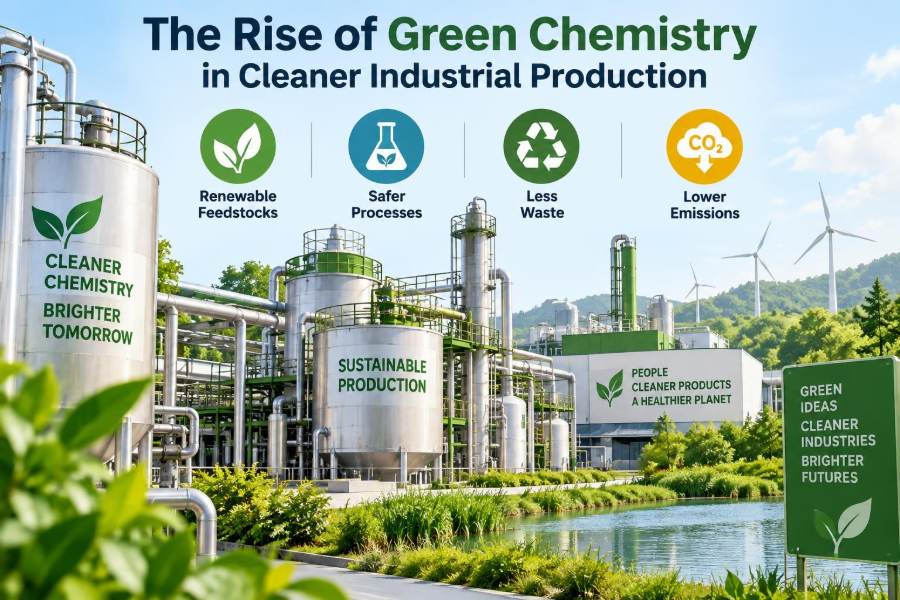
The rise of green chemistry reflects a deeper change in industrial thinking. Pollution control remains necessary, but the most durable gains often come when product and process decisions prevent waste and hazard before they enter the plant’s material balance.
For chemical engineers, this means treating environmental performance as a design variable alongside conversion, selectivity, cost, throughput, reliability, and safety. A cleaner process is rarely created by one substitution alone; it emerges from choices that reinforce one another from molecule to manufacturing system.
Green chemistry is cleaner industrial production by design: make the desired product with fewer unwanted materials, less avoidable hazard, and a clear view of consequences across its life cycle. That is both a technical challenge and a practical opportunity for the profession. 🧪🌱🏭