
A pump is running at its normal speed, yet the flow rate is lower than expected. A heat exchanger is not meeting its duty. A pipeline seems unusually difficult to clean. These can look like separate operating problems, but the behavior of the flowing fluid may connect them.
Engineers need a practical way to describe whether a fluid moves in orderly layers, in constantly mixing eddies, or somewhere between those extremes. That distinction affects pressure drop, heat transfer, mixing, erosion, fouling, and scale-up.
Reynolds number is the dimensionless quantity that provides that starting point. It does not solve every fluid-flow problem, but it tells engineers which physical effects are likely to dominate and which correlations, design assumptions, and operating concerns deserve attention.
From water in a utility line to a viscous polymer in a jacketed vessel, Reynolds number turns a complicated moving-fluid situation into a meaningful comparison between inertia and viscosity.
🌊 The Basic Question Reynolds Number Answers
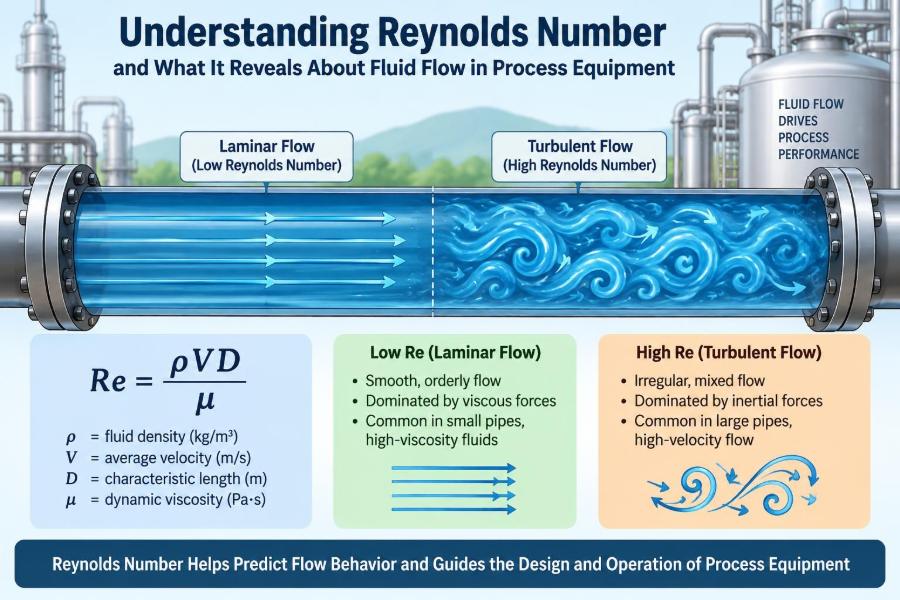
Reynolds number, usually written as Re, compares the tendency of a fluid to keep moving and form disturbances with the tendency of its viscosity to resist those disturbances. In simple terms, it asks: will the fluid motion stay relatively orderly, or will momentum overcome viscous damping and encourage mixing?
A low Reynolds number indicates that viscous effects strongly shape the flow. A high Reynolds number indicates that inertial effects are more influential. This is why the same pipe can exhibit very different flow behavior when carrying water versus a heavy oil.
⚖️ Inertia Versus Viscosity
Inertia is the resistance of moving matter to a change in speed or direction. In a flowing fluid, inertia helps a disturbance persist, grow, and travel downstream.
Viscosity is a fluid’s internal resistance to deformation or shearing. It transfers momentum between neighboring layers and smooths out velocity differences. Honey has much higher viscosity than water, so it more strongly suppresses motion that would otherwise become irregular.
Reynolds number is therefore a ratio, not a material property by itself. The same liquid may have a low or high Reynolds number depending on its velocity and the equipment geometry.
🧮 The Standard Pipe-Flow Equation
For flow in a circular pipe, the most common form is:
Re = ρVD / μ
It can also be written as:
Re = VD / ν
Here, ρ is fluid density, V is average fluid velocity, D is the pipe’s internal diameter, μ is dynamic viscosity, and ν is kinematic viscosity, where ν = μ/ρ. The result has no units, which allows engineers to compare geometrically similar systems even when their absolute sizes differ.
📏 Why Characteristic Length Matters
The diameter in the pipe equation is a characteristic length: the physical dimension that best represents the scale over which the flow develops. For a circular pipe, internal diameter is natural. For other shapes, it may not be.
Using the wrong length can produce a Reynolds number that looks precise but has no useful physical interpretation. Before calculating, identify the flow geometry and the correlation or design method being used. Its definition determines the appropriate characteristic length.
🔄 Hydraulic Diameter for Noncircular Ducts
Rectangular ducts, annuli, and irregular channels are common in process equipment. For internal flow in these passages, engineers often use the hydraulic diameter:
Dh = 4A / Pwet
A is the flow cross-sectional area, and Pwet is the wetted perimeter. Hydraulic diameter allows many internal-flow relationships developed for pipes to be applied approximately to noncircular passages.
It is a useful convention, not a guarantee that every detail matches circular-pipe behavior. Strongly noncircular passages, narrow gaps, and unusual entrance conditions can require more specialized treatment.
🛢️ Viscosity Makes Process Fluids Different
Many textbook examples use water because its viscosity is relatively low and familiar. Process plants handle fluids with far wider behavior: oils, syrups, slurries, molten polymers, fermentation broths, and non-Newtonian coatings.
A high-viscosity fluid can remain in the laminar regime at flow rates that would make water turbulent. This can create large temperature gradients in heated lines, slow radial mixing, and substantial pumping requirements. Conversely, reducing viscosity by heating a liquid can sharply change Reynolds number and operating behavior.
🌡️ Temperature Can Change the Flow Regime
For most liquids, viscosity decreases as temperature rises. If density and velocity change only modestly, Reynolds number increases. A viscous feed that is laminar during a cold startup may behave quite differently after reaching operating temperature.
Gas behavior is more complicated because both density and viscosity vary with temperature and pressure. For compressible systems, engineers should evaluate properties at conditions representative of the actual flow rather than relying on room-temperature values.
This is why a Reynolds number calculated from a datasheet can be misleading if the process temperature has not been considered.
🧵 Laminar Flow: Orderly Layers
In laminar pipe flow, fluid moves in relatively smooth layers with limited cross-stream mixing caused by turbulence. For fully developed Newtonian flow in a straight circular pipe, the velocity profile is parabolic: velocity is highest at the center and falls to zero at the wall because of the no-slip condition.
Laminar flow is not automatically undesirable. It can provide predictable residence-time behavior and lower frictional losses at a given low flow rate. But it often limits heat and mass transfer because material near the wall exchanges slowly with the faster-moving core.
🌪️ Turbulent Flow: Eddies and Mixing
Turbulent flow contains fluctuating eddies over a range of sizes. These fluctuations move momentum, heat, and species across the stream much more effectively than molecular diffusion alone.
In process equipment, turbulence often improves heat-transfer coefficients, blending, suspension of solids, and wall renewal. The trade-off is usually a higher pressure drop, greater pumping power, and potentially more vibration, noise, or erosion where velocity is high or particles are present.
Turbulence is not random in the sense of being unknowable; it is commonly handled through experimentally supported correlations and conservative mechanical design.
🚧 The Transitional Region Is Uncertain
Between clearly laminar and clearly turbulent conditions lies a transitional region. In smooth, straight circular pipes, laminar flow is commonly associated with Reynolds numbers below roughly 2,100, while fully turbulent behavior is often assumed above roughly 4,000.
Those values are guidelines, not universal boundaries. Pipe roughness, inlet disturbances, vibration, fittings, pulsation, and changes in diameter can trigger turbulence earlier. Carefully controlled laboratory flow can remain laminar above the familiar threshold.
A design operating near transition deserves extra caution because small process changes may alter pressure drop or heat-transfer behavior noticeably.
📊 Regime Guide for Circular Pipe Flow
| Approximate Reynolds number | Typical description | Practical implication |
|---|---|---|
| Below about 2,100 | Laminar | Viscosity dominates; mixing across the pipe is limited. |
| About 2,100 to 4,000 | Transitional | Behavior is sensitive to disturbances and geometry. |
| Above about 4,000 | Turbulent | Mixing and wall transport increase; friction behavior changes. |
These ranges apply most directly to fully developed flow of Newtonian fluids in smooth circular pipes. They should not be copied uncritically into every reactor, channel, or multiphase system.
🚰 Velocity Is Usually an Average Value
In pipe calculations, velocity normally means the bulk or average velocity:
V = Q / A
Q is volumetric flow rate and A is the internal cross-sectional area. It is not the centerline velocity, which is higher than average in both laminar and turbulent flow.
A common calculation error is to combine a flow rate in one set of units with an area in another. Convert consistently before calculating. A physically plausible Reynolds number still may be wrong if a diameter was entered in millimeters while velocity was treated in meters per second.
🧪 A Simple Water-Line Example
Consider a hypothetical water stream at ordinary process conditions flowing through a 50 mm internal-diameter pipe at an average velocity of 1 m/s. Using water properties near room temperature, the Reynolds number is on the order of tens of thousands.
That result suggests turbulent pipe flow. An engineer would then select turbulent-flow friction-factor and heat-transfer relationships, while checking whether fittings, roughness, and actual temperature make a meaningful difference.
The example is intentionally approximate: accurate design still requires verified fluid properties and the actual pipe internal diameter.
🍯 A Viscous-Liquid Contrast
Now imagine a liquid with a viscosity hundreds of times greater than water moving through the same pipe at the same average velocity. Its Reynolds number may fall into the laminar range despite the apparently brisk line velocity.
That outcome changes the engineering questions. Heat added through the wall may penetrate slowly toward the center. A static mixer may be needed if blending is critical. Pressure-drop estimation must use laminar-flow relationships rather than a turbulent correlation simply because the pump is operating quickly.
📉 Reynolds Number and Pressure Drop
Pressure loss in a straight pipe is often estimated with the Darcy–Weisbach equation:
ΔP = f(L/D)(ρV²/2)
The friction factor f depends strongly on Reynolds number and, in turbulent flow, relative roughness. For fully developed laminar flow of a Newtonian fluid in a circular pipe, the Darcy friction factor is f = 64/Re.
In turbulent flow, the relationship is more complex. Roughness can increase resistance because surface features interact with turbulent motion near the wall. This is why Reynolds number is central to line sizing and pump-head calculations.
🔥 Heat Transfer Depends on Flow Behavior
Reynolds number appears in convective heat-transfer correlations, usually alongside the Prandtl number and sometimes the Nusselt number. These dimensionless groups link flow behavior to the ability of a fluid to transfer heat at a wall.
Higher Reynolds number often means stronger convection because fluid near the wall is replaced more frequently. However, “higher” is not always economically better. Raising velocity increases pumping power, may increase vibration, and can worsen erosion or tube wear.
Heat-exchanger design is therefore an optimization problem, not a simple instruction to maximize turbulence.
🧂 Mass Transfer and Dissolution
The same wall-renewal effect influences mass transfer. Turbulent motion can improve dissolution, extraction, gas absorption, and transport of solutes to or from a surface.
In laminar systems, diffusion can dominate transport across streamlines. This is especially relevant when a reaction occurs at a catalyst surface or when a dissolved species must move through a boundary layer near equipment walls.
Reynolds number alone does not predict mass-transfer rate, but it identifies whether convection is likely to be weak or vigorous and helps select appropriate Sherwood-number correlations.
🌀 Reynolds Number in Agitated Tanks
For a mechanically stirred tank, the relevant Reynolds number is commonly based on impeller diameter and rotational speed:
Re = ρND² / μ
Here, N is rotational speed in revolutions per second and D is impeller diameter. The regimes are often described as laminar, transitional, and turbulent, but their numerical boundaries and flow patterns differ from straight-pipe flow.
At low tank Reynolds number, viscous circulation dominates and impeller power behavior differs substantially from that in turbulent mixing. Baffles, impeller type, tank shape, and fluid rheology all remain important.
🧱 Packed Beds and Porous Media Need Care
Flow through catalyst pellets, filters, and packed columns moves through tortuous passages rather than a single open pipe. Reynolds number may be based on particle diameter, superficial velocity, and a chosen fluid-property definition.
Such a Reynolds number supports correlations such as those used for pressure loss in packed beds, but it does not carry the same regime interpretation as pipe Reynolds number. Void fraction, particle shape, packing quality, and wall effects also influence the result.
Always use the Reynolds-number definition specified by the relevant correlation.
💨 Gas Flow and Compressibility
Gas density can change substantially along a line when pressure changes are significant. Since density appears in Reynolds number, local values can vary from inlet to outlet even if mass flow rate is constant.
For modest pressure changes, an average-property estimate may be adequate for screening. For compressors, long high-pressure gas lines, nozzles, or systems with large pressure drops, a compressible-flow analysis is usually needed.
Reynolds number still matters, but it works alongside Mach number, pressure ratio, temperature change, and flow acceleration.
🪨 Roughness Does Not Change Re Directly
Pipe roughness is often confused with Reynolds number because both affect friction. Reynolds number itself depends on fluid properties, velocity, and characteristic length; roughness is not part of its standard definition.
Roughness matters separately through relative roughness, commonly expressed as roughness height divided by pipe diameter. In turbulent flow, both Reynolds number and relative roughness are used to determine friction factor.
This distinction helps prevent a frequent mistake: trying to “correct” Reynolds number for a rough pipe instead of using roughness in the friction-factor step.
🧷 Fittings Create Local Flow Disturbances
Valves, elbows, tees, reducers, entrance sections, and partially open control valves disturb the velocity profile. They may cause separation, recirculation, swirl, or local turbulence even if the nominal Reynolds number is low.
These components are usually handled with minor-loss coefficients or equivalent-length methods for pressure-drop calculations. Their influence is especially important in short lines where straight-pipe friction is small compared with losses through fittings.
A single Reynolds number for the whole system is useful, but it cannot describe every local flow feature.
📐 Fully Developed Flow Is an Assumption
Many pipe-flow equations assume fully developed flow, meaning the shape of the velocity profile no longer changes in the downstream direction. Real fluid entering a pipe from a vessel, bend, or valve needs some distance to develop.
Entrance length depends on Reynolds number and regime. In short channels, compact heat exchangers, and laboratory devices, the flow may remain developing over a large fraction of the passage.
When that occurs, pressure-drop and heat-transfer behavior can differ from fully developed predictions. Equipment-specific correlations are often the better choice.
🧬 Non-Newtonian Fluids Need Modified Methods
Newtonian fluids have a viscosity that is independent of shear rate at a given temperature and pressure. Many process fluids do not. Polymer melts, paints, food products, slurries, and biological fluids may shear-thin, shear-thicken, or exhibit a yield stress.
For these materials, a single constant viscosity may not represent the flow. Engineers may use apparent viscosity at a relevant shear rate or a generalized Reynolds number derived from a rheological model.
Applying the standard Newtonian pipe formula without checking rheology can misclassify the regime and produce unreliable pressure-drop estimates.
🫧 Multiphase Flow Breaks Simple Rules
Gas-liquid, liquid-solid, and gas-solid flows contain interfaces, slip between phases, and changing phase distribution. A bulk Reynolds number can still provide a reference, but it cannot fully characterize the system.
For example, bubbles can alter friction and heat transfer, while suspended solids can settle, abrade surfaces, or change apparent viscosity. Flow maps and specialized multiphase correlations are commonly required.
The practical lesson is not to abandon Reynolds number, but to recognize its limits. It is one descriptor within a more complex physical picture.
🏭 Scale-Up Uses Dynamic Similarity
Reynolds number is valuable when scaling equipment because matching geometric dimensions alone does not guarantee similar flow behavior. Two geometrically similar systems can have very different mixing or friction behavior if their Reynolds numbers differ widely.
Maintaining equal Reynolds number helps preserve the balance between inertia and viscosity. Yet process scale-up may also require matching other dimensionless groups, such as Froude number where gravity matters or Weber number where surface tension matters.
In practice, it is often impossible to match every group simultaneously. Engineers prioritize the ones governing the performance or risk of interest.
🧾 Choosing the Right Correlation
A Reynolds number becomes useful when connected to a correlation whose assumptions match the equipment. Before using one, check the following:
- fluid type and whether Newtonian behavior is assumed;
- geometry, including whether the passage is circular, annular, packed, or externally flowed;
- flow regime and valid Reynolds-number range;
- thermal boundary condition when estimating heat transfer;
- surface roughness, development length, and entrance effects.
A correlation outside its recommended range may still be used for a rough estimate, but the uncertainty should be stated rather than hidden behind extra decimal places.
❌ Common Reynolds Number Mistakes
Several errors recur in calculations and design reviews. The most preventable are unit inconsistency, use of outside rather than inside pipe diameter, and property values taken at the wrong temperature.
- Using dynamic viscosity in a formula that requires kinematic viscosity, or vice versa.
- Treating a pipe-flow transition threshold as universal for every geometry.
- Assuming a high Reynolds number guarantees acceptable mixing everywhere in a vessel.
- Ignoring non-Newtonian rheology for viscous process materials.
- Using a bulk Reynolds number to represent a complex multiphase flow without additional analysis.
Each mistake is a reminder that Reynolds number is a model input, not an automatic design verdict.
🔍 A Reliable Calculation Workflow
- Define the equipment geometry and select the appropriate characteristic length.
- Obtain flow rate and calculate the relevant average or superficial velocity.
- Determine density and viscosity at representative operating conditions.
- Use one consistent unit system throughout the calculation.
- Calculate Reynolds number and identify the likely regime.
- Select correlations that match the geometry, regime, and fluid behavior.
- Check sensitivity if temperature, composition, or flow rate varies during operation.
This workflow is simple enough for a spreadsheet and structured enough to catch many early-stage design errors.
🛠️ Using Re in Troubleshooting
When plant performance shifts, recalculating Reynolds number can clarify what changed physically. A lower flow rate, higher viscosity caused by cooling, or increased solids concentration may move the system toward laminar behavior and reduce heat transfer.
It can also help explain why cleaning is difficult. Lower near-wall mixing may allow deposits to persist, while very high velocity can create unacceptable mechanical wear. The calculation does not identify the deposit by itself, but it guides the next diagnostic question.
Trend actual temperature, flow, pressure drop, and composition alongside predicted changes in Reynolds number whenever data are available.
🧠 The Core Principle to Remember
Reynolds number reveals the competition between inertial motion and viscous resistance. That competition shapes velocity profiles, turbulence, friction, and transport at equipment surfaces.
Its greatest value is not the number alone. Its value is the engineering judgment it supports: recognizing likely flow behavior, choosing valid models, anticipating operational changes, and knowing when a simple single-phase pipe assumption is no longer adequate.
Calculate Reynolds number carefully, interpret it in the context of geometry and fluid behavior, and use it as a guide rather than a substitute for the full physics of the process.
Whether the task is sizing a transfer line, diagnosing a heat exchanger, selecting a mixer, or scaling a pilot plant, Reynolds number provides a compact and powerful first view of what the fluid is likely to do. Good fluid-flow decisions begin by asking which forces are actually controlling the motion. 🧪🌊⚙️