
A glass of drinking water, a hospital oxygen supply, a dairy plant concentrating milk, and a semiconductor factory making ultrapure water may seem unrelated. In each case, a thin barrier can determine whether the final product is safe, usable, and economical.
That barrier is a membrane: a material engineered to let some molecules or particles pass while retaining others. The basic idea resembles a coffee filter, but industrial membranes work at far smaller scales and are driven by pressure, concentration differences, electric fields, or temperature.
Membrane technology matters because separation is central to chemical engineering. Many conventional separations require heating, cooling, or chemical addition. Membranes can sometimes achieve the required split with less energy or a smaller footprint, although they introduce their own challenges, especially fouling and pressure loss.
Understanding where membranes work well, where they do not, and how engineers protect them helps explain their expanding role in water treatment, gas processing, food production, medicine, and resource recovery.
🧫 What a Membrane Actually Does
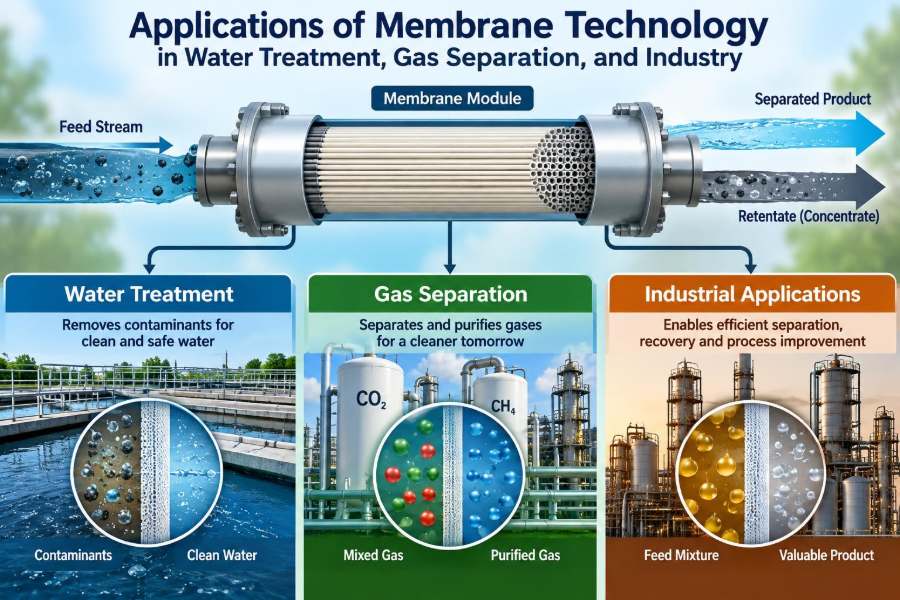
A membrane is a selective barrier between two streams. The stream that passes through is called the permeate, while the retained stream is the retentate, concentrate, or reject stream.
Selection may depend on particle size, molecular diffusivity, electrical charge, solubility in the membrane material, or affinity for specific chemical groups. A membrane is therefore not simply a screen with holes; many operate through molecular transport within a dense material.
🔀 Separation at the Heart of Process Engineering
Chemical plants routinely separate mixtures because feedstocks and products are rarely pure. Distillation, absorption, adsorption, extraction, crystallization, and filtration all serve this purpose. Membranes add another family of unit operations.
Their major attraction is that many membrane processes avoid a phase change. Distillation, for example, commonly needs vaporization and condensation, whereas a pressure-driven membrane can separate at near-ambient temperature. That advantage is strongest when the feed is dilute, heat-sensitive, or difficult to evaporate.
🧭 The Driving Forces Behind Transport
Molecules do not cross a membrane without a driving force. In liquid treatment, the most familiar force is pressure. In gas separation, a difference in partial pressure is often the key variable.
Other membrane systems use concentration gradients, electrical potential, or vapor-pressure differences. The relevant driving force must exceed opposing effects such as osmotic pressure, concentration polarization, and frictional resistance within the membrane.
- Pressure difference: used in microfiltration, ultrafiltration, nanofiltration, and reverse osmosis.
- Concentration difference: used in dialysis and some forward-osmosis systems.
- Electrical potential: used in electrodialysis.
- Partial-pressure difference: used in polymeric gas-separation membranes.
📏 Membrane Pore Size and Selectivity
A useful first classification is based on separation scale. Larger-pore membranes retain suspended solids and microorganisms; tighter membranes reject progressively smaller dissolved species. This is a guide rather than an absolute rule because solute shape, charge, and operating conditions also matter.
| Membrane class | Typical separation target | Common example |
|---|---|---|
| Microfiltration | Suspended solids, many bacteria | Clarifying surface water |
| Ultrafiltration | Colloids, viruses, macromolecules | Protein concentration |
| Nanofiltration | Multivalent ions and small organics | Water softening |
| Reverse osmosis | Most dissolved salts | Desalination |
Choosing a tighter membrane is not automatically better. Higher rejection often requires greater pressure and can produce a more difficult concentrate stream.
💧 Microfiltration for Particle Removal
Microfiltration generally removes relatively large particles, including silt, algae, and many bacteria. It is often used as a pretreatment step before tighter membranes or as a substitute for some conventional clarification stages.
In a municipal treatment train, microfiltration can provide consistently low turbidity even when raw-water quality changes after rain. It does not reliably remove dissolved salts or small dissolved organic molecules, so downstream treatment may still be necessary.
🧬 Ultrafiltration and Macromolecules
Ultrafiltration retains colloidal material, proteins, emulsified oils, and many microorganisms. Instead of specifying a pore diameter, ultrafiltration membranes are often described by molecular-weight cut-off, an approximate indication of which macromolecules they retain.
This makes ultrafiltration valuable in drinking-water treatment and in industries that need to separate proteins without exposing them to high temperatures. The cut-off is not a sharp boundary: rejection depends on molecular shape, interactions, and the operating environment.
🧂 Nanofiltration for Selective Softening
Nanofiltration occupies the space between ultrafiltration and reverse osmosis. It can strongly reject divalent ions such as calcium and magnesium while allowing more monovalent ions to pass than reverse osmosis would.
That selective behavior is useful for water softening, color removal, and reducing some natural organic matter. It can require less pressure than reverse osmosis, but water chemistry must be studied carefully because scale-forming salts may concentrate near the membrane surface.
🌊 Reverse Osmosis and Desalination
Reverse osmosis, or RO, uses pressure to overcome the natural osmotic tendency of water to move toward a more concentrated solution. Water passes through a dense selective layer while most dissolved salts remain in the feed-side concentrate.
RO is central to seawater and brackish-water desalination, as well as high-purity industrial-water production. It is not a universal cure for water scarcity: it needs substantial pumping energy, careful pretreatment, reliable maintenance, and a responsible plan for managing concentrated brine.
🏙️ Drinking-Water Treatment Trains
A membrane rarely works alone. A practical water-treatment system combines barriers so that each stage handles a defined risk. Intake screening and coagulation may remove large debris and destabilize particles before membrane filtration.
A representative train might include pretreatment, microfiltration or ultrafiltration, activated carbon where organics are a concern, and RO or another polishing step where dissolved contaminants must be reduced. Disinfection may still be used to protect water during storage and distribution.
♻️ Membranes in Wastewater Reuse
Wastewater reuse requires reliable control of solids, microbes, nutrients, and trace contaminants appropriate to the intended use. Membrane bioreactors combine biological treatment with membrane filtration, allowing solids to be retained while clarified water leaves the bioreactor.
For higher-quality reuse, membrane bioreactor effluent may be followed by RO and oxidation or disinfection. The required treatment level depends on the source water and end use; irrigation, industrial cooling, and potable reuse do not have identical quality targets.
🧪 Industrial Water and Ultrapure Supplies
Boilers, cooling systems, laboratories, pharmaceutical operations, and electronics manufacturing can be more sensitive to dissolved impurities than ordinary municipal users. Even small quantities of hardness ions, silica, particles, or organic matter can cause deposits, corrosion, product defects, or instrument problems.
Membrane systems are frequently paired with ion exchange, ultraviolet treatment, polishing filters, and careful storage. The engineering task is not merely to produce clean water once, but to sustain the needed quality at the point of use.
🌬️ Gas Separation Through Selective Permeation
Gas membranes usually separate by a solution-diffusion mechanism. A gas first dissolves into a dense polymer layer, diffuses through it, and desorbs on the low-pressure side. Faster-permeating gases become enriched in the permeate.
Unlike a simple sieve, the membrane’s chemistry matters greatly. Carbon dioxide may permeate rapidly through a membrane that is relatively resistant to methane, while a different material may be designed for hydrogen recovery or oxygen enrichment.
⛽ Removing Carbon Dioxide from Natural Gas
Raw natural gas can contain carbon dioxide, water vapor, nitrogen, hydrogen sulfide, and heavier hydrocarbons. Carbon dioxide reduces heating value and can contribute to corrosion when water is present, so it is commonly removed before gas is transported or sold.
Membrane systems can remove carbon dioxide from methane-rich gas, particularly where compact modular equipment is helpful. Multi-stage designs, recycle streams, and upstream dehydration may be needed because methane loss and pressure requirements affect process economics.
🔋 Hydrogen Recovery and Refinery Streams
Refineries and chemical plants often use hydrogen-rich streams in hydrotreating, ammonia synthesis, and other processes. A membrane can recover hydrogen from mixtures containing hydrocarbons, nitrogen, carbon monoxide, or carbon dioxide, depending on the membrane and feed conditions.
Recovered hydrogen can reduce fresh-hydrogen demand, but contaminants must be considered. Some compounds can plasticize, poison, or otherwise degrade membrane performance, so feed conditioning and material selection are essential.
🏥 Oxygen Enrichment and Medical Uses
Gas membranes can enrich oxygen from air because oxygen and nitrogen permeate at different rates through suitable materials. These systems are used in some oxygen-generation applications, where the required purity and flow rate match membrane capabilities.
Medical gas supply is safety-critical. Equipment design, monitoring, backup capacity, maintenance, and applicable regulations are as important as the membrane itself. A separation method should never be evaluated only by its laboratory selectivity.
🧯 Vapor Recovery and Emission Control
Membranes can recover valuable organic vapors from gas streams or reduce emissions before discharge. Potential applications include solvent recovery, fuel-vapor management, and treatment of selected volatile-organic-compound streams.
The best option depends on concentration and flow rate. Very dilute streams may favor adsorption or oxidation, while membranes can be attractive when the permeated vapor can be condensed or recycled. Hybrid systems often provide a better overall solution than a membrane alone.
🥛 Food and Beverage Processing
Food manufacturers use membranes to concentrate, fractionate, clarify, and stabilize products at relatively mild temperatures. Ultrafiltration can retain proteins, while microfiltration can remove microorganisms or clarify beverages without the thermal exposure associated with some alternative processes.
In dairy processing, membrane operations can separate protein-rich fractions from permeate containing water, lactose, and minerals. Product quality, flavor, viscosity, and sanitation requirements shape the operating window, so a separation that looks efficient on paper may still be unsuitable for a specific food.
💊 Pharmaceutical and Biotechnology Applications
Membranes are widely used to clarify cell cultures, concentrate biological products, exchange buffers, and sterilize selected liquids. Their gentle operation can be especially valuable for sensitive proteins, enzymes, and other biologically active materials.
Validation is crucial in these settings. Engineers must demonstrate consistent retention, manage extractables from materials, prevent cross-contamination, and confirm cleaning or single-use integrity. Membrane performance is part of a controlled manufacturing system, not an isolated number on a datasheet.
⚙️ Membrane Modules and Plant Layout
Membranes are packaged into modules that provide a large active area in a practical device. Common forms include spiral-wound, hollow-fiber, tubular, and plate-and-frame modules, each with different strengths in packing density, cleanability, and tolerance of solids.
Spiral-wound modules are widely used for RO and nanofiltration because they are compact. Tubular designs often tolerate more viscous or solids-containing feeds but generally require more space and pumping energy. Module selection should follow feed properties, not habit.
📈 Flux, Recovery, and Rejection
Flux is the permeate flow rate per unit membrane area. Recovery is the fraction of feed converted to permeate. Rejection describes how effectively a solute is retained. These are related but cannot be optimized independently.
Pushing for very high recovery raises the concentration of retained species and can increase scaling or fouling risk. Raising pressure may initially increase flux, but the gain can diminish when concentration polarization or compaction becomes significant.
🧱 Concentration Polarization Near the Surface
As solvent passes through a membrane, rejected solutes accumulate near the feed-side surface. This local enrichment is called concentration polarization. It creates an additional barrier to transport and can make the membrane appear less productive.
Crossflow velocity, spacer design, and controlled recovery help limit this boundary layer. Engineers distinguish concentration polarization from fouling: polarization is usually reversible during operation, whereas fouling involves material deposited on or in the membrane.
🦠 Fouling, Scaling, and Biofouling
Fouling is one of the main practical limits on membrane systems. Particles can form a cake layer, organic compounds can adsorb, salts can precipitate as scale, and microorganisms can establish biofilms.
These mechanisms often overlap. A roughened or scaled surface can encourage further deposition, while biofilms may alter local chemistry. Symptoms include declining flux, rising pressure drop, lower product quality, and more frequent cleaning.
🧼 Pretreatment and Cleaning Strategies
Good pretreatment is usually less costly than repeatedly rescuing a fouled membrane. Depending on the feed, it may include screening, clarification, cartridge filtration, pH adjustment, antiscalant dosing, carbon treatment, or removal of oxidants that could damage the membrane.
Cleaning methods must match the foulant and membrane material. Water flushing, backwashing, air scouring, acids, alkalis, surfactants, enzymes, and disinfectants may be used under controlled conditions. A harsh chemical that removes deposits but shortens membrane life is not a successful cleaning program.
⚡ Energy Use and Pumping Penalties
Membrane systems are often described as energy-efficient, but that statement requires context. They may avoid the large thermal duty of evaporation or distillation, yet pressure-driven systems need pumps, and high-salinity RO requires substantial pressure.
Energy performance depends on feed concentration, target purity, recovery, hydraulic design, and energy-recovery equipment. The correct comparison is with realistic alternatives that provide the same product quality, not with an unrelated separation duty.
🌱 Brine, Concentrate, and Material Management
Every selective separation produces at least two streams. When membranes purify water, the retained contaminants do not disappear; they become concentrated in the reject. Disposal, treatment, reuse, or further concentration must be considered at the design stage.
Possible routes include controlled discharge where permitted, evaporation, crystallization, deep-well injection in suitable locations, or recovery of useful materials. Each route has environmental, regulatory, energy, and site-specific implications. Ignoring concentrate management can make an otherwise sound process impractical.
🔗 Hybrid Processes Often Work Best
Membranes are powerful tools, not complete replacement for every conventional operation. Pretreatment may use sedimentation or adsorption; post-treatment may use ion exchange, disinfection, stripping, crystallization, or thermal concentration.
For example, a gas membrane may bulk-remove carbon dioxide, followed by another technology for final polishing. A wastewater system may pair biological treatment with membranes because microbes destroy biodegradable matter while the membrane retains solids. Integration is often the real engineering achievement.
🧠 Choosing the Right Membrane Process
Process selection starts with a clear separation objective: what must be removed, what must be retained, and what product quality is actually needed? Feed composition, variability, temperature, pressure, solids content, and cleaning constraints are equally important.
- Characterize the feed over realistic operating conditions, not a single ideal sample.
- Define product specifications and allowable losses of valuable components.
- Assess pretreatment needs and concentrate-management options early.
- Test membrane compatibility with chemicals, temperature, and cleaning agents.
- Compare lifecycle energy, maintenance, replacement, and disposal costs.
🚫 Common Design and Operating Mistakes
A common mistake is sizing equipment from clean-water flux data. Real feeds foul, vary in temperature, and create pressure losses, so conservative design margins and pilot testing are often justified.
Other failures include treating all fouling as the same problem, operating at excessive recovery, neglecting instruments, and delaying cleaning until deposits become difficult to remove. Another frequent error is choosing a membrane based only on rejection while overlooking product yield and downstream consequences.
🔬 New Materials and Smarter Monitoring
Research continues on more selective polymers, ceramic membranes, thin-film composites, surface coatings, and mixed-matrix materials containing dispersed particles. The goal is often to improve the trade-off between permeability, selectivity, chemical resistance, and fouling tolerance.
At the plant level, sensors and data analysis can detect changes in normalized flux, pressure drop, conductivity, or gas composition before a major loss of performance occurs. Promising laboratory materials still need long-term testing under realistic feeds before broad industrial adoption.
🧩 The Core Principle: Selectivity Must Serve the Whole Process
Membranes make difficult separations possible because they control molecular transport through a compact barrier. Their usefulness spans particle removal, desalination, gas upgrading, biological processing, and product recovery.
Yet membrane performance is never only a property of the sheet or fiber. Feed pretreatment, module design, hydrodynamics, cleaning, energy supply, product requirements, and concentrate handling determine whether a system succeeds over years of operation.
The best membrane process is not the one with the most impressive laboratory specification; it is the one that delivers the required separation reliably, safely, and responsibly within the complete process. That systems view is what turns a selective barrier into a practical chemical-engineering solution. 🧪💧⚙️