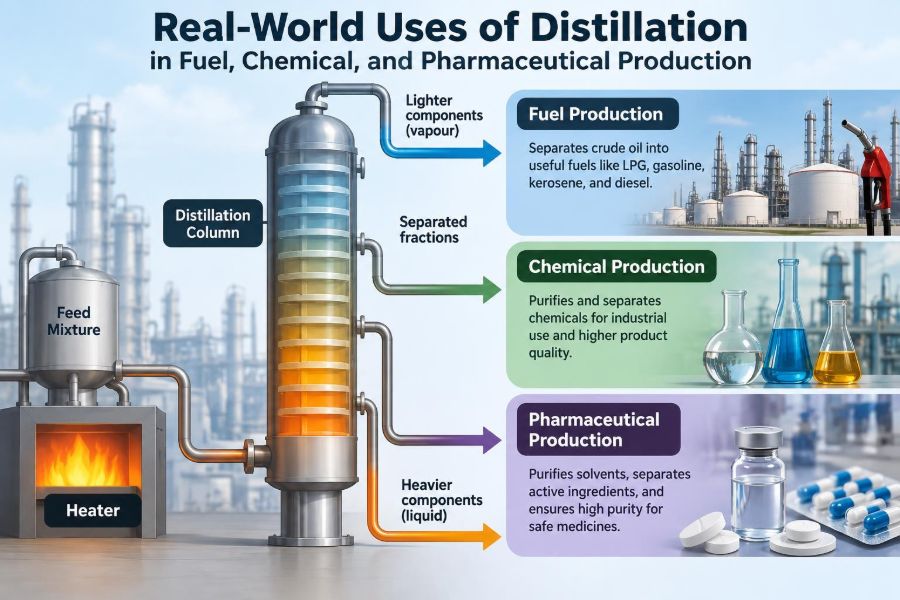

A car pulling away from a service station, a bottle of hand sanitizer, and a blister pack of tablets may seem to have little in common. Yet each can depend on a separation step that happens quietly inside tall industrial columns, compact laboratory glassware, or carefully controlled pharmaceutical equipment.
That step is distillation: separating substances by using differences in volatility, or how readily they enter the vapor phase. It is one of the most recognizable operations in chemical engineering because it turns complicated liquid mixtures into usable products.
The principle can sound simple—heat a mixture, collect what evaporates—but real plants must manage energy, pressure, product specifications, safety, and environmental limits at the same time. The difference between a successful separation and an expensive failure often lies in those details.
From crude-oil refining to solvent recovery and sterile drug manufacture, distillation remains a practical example of how thermodynamics becomes industrial reality.
🔬 Distillation begins with volatility
When a liquid mixture is heated, its components do not all vaporize equally. Components with a greater tendency to escape into vapor are described as more volatile. In a simple mixture, the vapor is usually richer in the more volatile component than the remaining liquid.
Distillation repeatedly uses this vapor–liquid composition difference. Vapor is created, partially condensed, and contacted with liquid many times so that one end of a column becomes enriched in lighter components and the other in heavier components.
Boiling point is a useful first clue, but it is not the whole story. Separation behavior also depends on composition, pressure, and molecular interactions between components.
🌡️ Boiling is not the same as pure-component separation
A common beginner’s mistake is to imagine that each compound waits for its own boiling point and then boils alone. In mixtures, components generally evaporate together. Their relative amounts in the vapor change as temperature and liquid composition change.
This is why industrial distillation relies on vapor–liquid equilibrium, often abbreviated VLE. Engineers use equilibrium data and models to estimate how much enrichment can occur on each stage of a column.
For example, ethanol can be concentrated from a water-containing mixture by ordinary distillation, but an ethanol–water azeotrope limits the purity achievable by this method at a given pressure.
🏗️ The distillation column is a contactor
Most continuous industrial distillation occurs in a vertical column. Rising vapor meets descending liquid, enabling heat and mass transfer. The liquid transfers more volatile material into the vapor, while the vapor transfers less volatile material into the liquid.
A feed stream enters around the middle of the column. Material above the feed is called the rectifying section, where the overhead product is enriched in light components. Material below it is the stripping section, where remaining light material is removed from the heavier liquid.
This countercurrent arrangement is far more effective than a single boil-and-condense step.
🪜 Trays and packing create repeated separation stages
Columns need internal surfaces or devices that bring vapor and liquid into close contact. Tray columns use horizontal plates, while packed columns contain structured or random packing with a large wetted surface area.
A tray is often treated as an approximate equilibrium stage, although real trays never reach perfect equilibrium. Packed columns are commonly described through equivalent theoretical stages or height-equivalent measures.
- Trays are robust and familiar in large refinery services.
- Structured packing can offer low pressure drop, which is valuable under vacuum.
- Random packing can be economical for certain duties, especially smaller columns.
The best choice depends on flow rates, fouling tendency, pressure drop limits, materials of construction, and operating flexibility.
🔥 The reboiler supplies the upward-driving vapor
At the bottom of a column, a reboiler heats part of the bottoms liquid and sends generated vapor back upward. This vapor is the main carrier that strips lighter compounds out of the descending liquid.
The remaining bottom liquid, or bottoms product, is rich in less volatile material. In petroleum processing, it may feed another separation unit, a conversion process, or a product blending operation.
Reboiler duty is usually one of the column’s largest energy demands. Excessive heating can also damage heat-sensitive materials or cause undesirable reactions in the bottom section.
❄️ The condenser and reflux sharpen the overhead product
Vapor leaving the top of the column is cooled in a condenser. Some or all of it becomes liquid. A portion is withdrawn as distillate, while another portion returns to the column as reflux.
Reflux is not wasted product. It provides descending liquid for repeated vapor–liquid contact in the upper column and improves separation. Increasing reflux can improve purity, but it also increases internal flows and energy use.
At very low reflux, a target specification may be impossible. At excessively high reflux, utility costs and equipment loading can become impractical.
⚖️ Material balances keep the process honest
Every distillation design begins with conservation of mass. For a steady process, the total feed rate equals the total product rate when accumulation is negligible. Component balances track where each chemical leaves.
If a feed contains a light component that must mainly leave overhead, engineers calculate the required distillate and bottoms compositions before selecting internals or estimating energy duty.
These balances also help diagnose plants. An unexplained mismatch between measured flows can reveal instrument error, leaks, incorrect sampling, or unaccounted recycles.
📈 Energy balances reveal the real operating cost
Distillation is often energy intensive because vapor must be generated and then condensed. The same latent heat is effectively added at the reboiler and rejected at the condenser, although heat integration can reduce the net utility burden.
Energy balances connect feed condition, reboiler duty, condenser duty, product temperatures, and phase changes. A feed entering cold may require more heating than a partially vaporized feed of identical composition.
For large plants, even modest reductions in steam demand or cooling duty can matter substantially over long operating periods.
🛢️ Atmospheric crude distillation starts refinery separation
Crude oil is not one substance; it is an exceptionally broad mixture of hydrocarbons and smaller amounts of sulfur-, nitrogen-, oxygen-, and metal-containing compounds. An atmospheric crude unit separates it into broad boiling-range fractions rather than pure chemicals.
The crude is heated in a furnace and introduced into a fractionating column. Lighter material rises toward the top, while heavier fractions leave from lower locations or the bottom.
This first separation makes downstream processing manageable. It directs material toward gasoline blending, jet fuel processing, diesel production, catalytic conversion, lubrication-related streams, or heavy-residue handling.
⛽ Refinery cuts are ranges, not single molecules
A refinery side draw such as naphtha, kerosene-range material, or gas oil contains many compounds. It is defined primarily by a boiling range and intended downstream use, not by a single molecular formula.
| Typical refinery fraction | General character | Common downstream role |
|---|---|---|
| Light gases and light ends | Very volatile hydrocarbons | Fuel gas, LPG recovery, petrochemical feed |
| Naphtha | Relatively light liquid hydrocarbons | Gasoline blending or reforming feed |
| Kerosene-range fraction | Intermediate-boiling material | Jet-fuel and heating-fuel processing |
| Gas oil | Heavier distillate | Diesel-related streams or conversion feed |
| Residue | Highest-boiling material | Vacuum processing, asphalt, or conversion routes |
Actual cut points vary with crude type, refinery configuration, and product targets. Distillation sorts molecules by volatility; it does not automatically make every fraction meet final fuel specifications.
🌬️ Steam stripping improves side-draw recovery
Steam is often injected into refinery strippers connected to side draws. By lowering the hydrocarbon partial pressure, steam helps vaporize lighter components at a lower hydrocarbon temperature than would otherwise be required.
The lighter material returns toward the main column, while the stripped side product becomes less volatile and better aligned with its intended boiling range. This is a practical use of partial-pressure effects.
Steam addition is useful, but it also creates water handling and energy considerations. The system must separate condensed water and manage any dissolved or entrained hydrocarbons.
🕳️ Vacuum distillation protects heavy refinery feeds
Some heavy hydrocarbons would require very high temperatures to boil at atmospheric pressure. Those temperatures can cause thermal cracking, coke formation, or product degradation.
Vacuum distillation lowers operating pressure so these materials boil at lower temperatures. A vacuum tower processes atmospheric residue into vacuum gas oils and a heavier vacuum residue.
Maintaining vacuum is technically demanding. Air leakage, noncondensable gases, condenser performance, and pressure drop through column internals all affect the achievable pressure.
🔁 Distillation prepares feeds for conversion units
Refineries use conversion units because straight-run fractions do not always match fuel demand. Fluid catalytic cracking, hydrocracking, coking, and reforming alter molecules; distillation organizes the resulting mixtures before and after these reactions.
A hydrocracker effluent, for example, contains gases, light liquids, and heavier material. Fractionation separates products into streams suitable for treating, blending, recycle, or further processing.
Distillation therefore works alongside reaction engineering. It defines feed quality, recovers products, and prevents incompatible boiling-range materials from moving into the wrong unit.
🧪 Petrochemical fractionation isolates valuable feedstocks
Petrochemical plants rely on tighter separations than crude fractionation. Steam cracking produces a complex gas mixture that can include hydrogen, methane, ethylene, propylene, and heavier hydrocarbons. A sequence of compression, cooling, and distillation steps separates saleable building blocks.
These columns may operate at low temperatures and elevated pressures. Their design must account for refrigeration integration, compression energy, and the behavior of light hydrocarbons.
Ethylene and propylene are especially valuable examples because they become starting materials for many polymers and chemical intermediates. High-purity specifications make separation performance critical.
🧯 Chemical plants recover and recycle solvents
In fine chemical and specialty chemical production, solvents often enable reactions, extraction, crystallization, washing, or product formulation. Recovering them by distillation can reduce fresh-solvent purchases and lower waste volumes.
Consider a hypothetical reaction using ethyl acetate as a solvent. After product isolation, a distillation system may recover solvent-rich overhead material for purification and reuse, provided impurities remain controlled.
Reuse is not automatically safe or effective. Trace water, reaction by-products, corrosion products, or high-boiling contaminants can accumulate across cycles and may require purge streams or additional purification.
🧫 Batch distillation suits flexible multiproduct operations
Continuous columns are excellent when feed rate and composition are stable for long periods. Batch distillation is often preferred where campaigns are smaller, recipes change frequently, or several products use the same equipment.
In a batch still, the pot composition changes over time. Early distillate can be richer in the most volatile component, while later fractions become progressively heavier.
Operators may collect “heads,” “main cut,” and “tails” based on composition, temperature trends, or analytical results. This flexibility is useful, but production scheduling and cleaning become central operational concerns.
💊 Pharmaceutical distillation focuses on purity and control
Pharmaceutical manufacturing may use distillation to recover process solvents, concentrate streams, prepare purified solvent systems, or produce specific purified intermediates. The exact role depends on the drug substance, formulation process, and facility design.
Unlike commodity processing, batch traceability and contamination control can be as consequential as throughput. Equipment must be cleaned, maintained, and operated under validated procedures appropriate to the process.
Distillation does not make a product sterile by itself, nor does it replace all purification methods. It is one separation tool within a broader quality system.
🧴 Solvent quality can influence drug-product consistency
Residual solvent composition may affect crystallization behavior, drying time, extraction selectivity, and impurity profiles. In some processes, a small change in solvent-water ratio can alter the solid form of an intermediate.
That is why recovered solvent often requires testing before reuse. A material that looks clear and has the expected boiling behavior may still contain impurities that interfere with a sensitive later step.
Quality limits and acceptable reuse strategies are process-specific. They should be based on validated process knowledge rather than the assumption that distillation always restores a solvent to “as-new” condition.
🌿 Molecular distillation handles especially sensitive materials
For highly heat-sensitive, high-boiling substances, conventional distillation can hold material at elevated temperature for too long. Short-path or molecular distillation uses very low pressure and a short travel distance between evaporator and condenser.
Under these conditions, evaporated molecules can reach the condenser with fewer collisions, and residence time can be limited. This approach is used in selected applications involving fragrances, specialty lipids, vitamins, and other delicate materials.
It is not a universal replacement for conventional columns. Equipment cost, throughput, feed characteristics, and vacuum requirements must justify its use.
🌀 Azeotropes create a separation boundary
An azeotrope is a mixture whose vapor has the same composition as its liquid at a particular condition. At that point, ordinary distillation no longer enriches one component relative to the other.
The ethanol–water system is a familiar teaching example. When high-purity ethanol is needed beyond the azeotropic limit under ordinary conditions, engineers may use molecular sieves, extractive distillation, pressure-swing approaches, or other dehydration methods.
The lesson is broader: a favorable boiling-point difference does not guarantee unlimited separation. Molecular interactions can place a hard constraint on a simple flowsheet.
🧲 Extractive and azeotropic distillation add another separation lever
Extractive distillation introduces a relatively nonvolatile solvent that changes relative volatility, allowing components that are difficult to separate to behave more differently in the column. The added solvent is later recovered in another step.
Azeotropic distillation uses an entrainer to form a new azeotropic behavior that helps remove one component. These methods require careful solvent selection, recovery design, safety assessment, and contamination control.
They can be effective, but they add equipment and operating complexity. Alternatives such as adsorption, membranes, or liquid–liquid extraction may be better for some systems.
📉 Relative volatility predicts separation difficulty
Relative volatility compares how strongly two components prefer the vapor phase. A value well above one generally indicates that distillation is more feasible; a value approaching one indicates a difficult split that may need many stages and high reflux.
Relative volatility is not fixed in every practical situation. It can change with temperature, pressure, and mixture composition, especially for nonideal systems.
For engineers, this means a shortcut calculation is a starting point, not a substitute for reliable property data and rigorous simulation when decisions carry substantial cost or safety consequences.
📏 Product specifications shape column design
Design begins with required product quality: allowable light material in bottoms, allowable heavy material in distillate, water content, sulfur-related limits, solvent assay, or another measurable property.
Those specifications influence the number of theoretical stages, reflux ratio, feed location, pressure, and heat-exchanger duties. A more demanding specification usually requires more separation effort, although the relationship is not always linear.
Overdesigning purity can waste energy; underdesigning it can make a product unusable. Good specifications reflect what downstream equipment and customers genuinely need.
🎛️ Pressure is a powerful operating variable
Changing pressure changes boiling temperatures and equilibrium behavior. Lower pressure can protect temperature-sensitive compounds, while higher pressure can make condensation possible using available cooling utilities.
Pressure selection affects more than the column itself. It also determines compressor needs, vacuum-system design, heat-integration opportunities, and mechanical requirements.
For example, a top temperature low enough for cooling water may avoid refrigeration, but raising pressure too much can make the vapor–liquid separation less favorable. Design is a compromise, not a one-variable optimization.
🧠 Heat integration reduces the steam-and-cooling burden
Because one column rejects heat while another requires it, plants can sometimes exchange heat between processes. Feed preheating, pumparounds, multi-effect arrangements, and heat-integrated column pairs are common concepts.
Heat integration must respect temperature driving force and operational stability. Heat available at a low temperature cannot automatically replace high-temperature reboiler steam.
Modern design work often evaluates energy use early, before equipment layout becomes fixed. Retrofitting energy recovery later can be possible, but space, controllability, and return on investment may limit options.
🚧 Flooding, weeping, and entrainment limit capacity
Columns have hydraulic limits. If vapor flow becomes too high, liquid can be carried upward or accumulate excessively, producing flooding. Separation deteriorates, pressure drop rises, and stable operation may be lost.
If vapor flow is too low on tray columns, liquid may leak through tray perforations rather than flowing across the tray as intended. This is called weeping and reduces contacting efficiency.
Entrainment—liquid droplets carried with vapor—can contaminate overhead product even before full flooding occurs. Operators watch pressure profiles, temperature patterns, flow rates, and product analyses for warning signs.
🧼 Fouling and corrosion gradually change performance
Deposits on heat-transfer surfaces reduce reboiler and condenser performance. Polymer formation, salts, coke, biological growth in cooling systems, or solids in the feed can all contribute, depending on service.
Corrosion is equally significant. Chlorides, acids, sulfur compounds, water, and oxygen ingress can demand careful material selection and process control.
A column may appear to have a separation problem when the root cause is actually a fouled exchanger, damaged distributor, leaking tray, or an inaccurate temperature measurement.
🦺 Distillation safety involves pressure, heat, and flammability
Distillation systems may contain hot surfaces, pressurized vapor, vacuum equipment, flammable solvents, toxic compounds, or reactive materials. Safe design considers relief systems, inerting where appropriate, ventilation, ignition control, isolation, and operating procedures.
Vacuum service has its own hazards. Loss of vacuum can change boiling behavior quickly, and equipment not designed for external pressure can be vulnerable to collapse.
Separating a mixture does not eliminate chemical hazards. In fact, it can concentrate hazardous components into a smaller stream, which must be anticipated in design and handling plans.
📊 Measurements turn a column into a controllable process
Typical measurements include pressure, temperatures along the column, reflux flow, reboiler heat input, feed rate, liquid levels, and online or laboratory composition analyses. No single measurement tells the full story.
Temperature is often used as an indirect composition indicator when pressure is stable and the mixture behavior is well understood. But changes in pressure or feed composition can make a familiar temperature misleading.
Control systems commonly maintain pressure, reflux, bottoms level, and heat input while operators or advanced controls adjust targets to meet quality requirements.
🔍 Troubleshooting starts with patterns, not guesses
When overhead purity suddenly worsens, increasing reflux may help, but it should not be the only response. First ask what changed: feed composition, feed temperature, pressure, utility supply, column differential pressure, instrument reliability, or product draw rate.
A disciplined approach is to compare current trends with normal operating behavior and verify the material balance where possible. Sampling technique also matters; a poor sample can send a team toward the wrong diagnosis.
- Rising pressure drop may suggest loading, fouling, or flooding.
- Unexpected temperature shifts can point to pressure changes or composition movement.
- Declining heat transfer can indicate exchanger fouling or utility-side problems.
- Persistent off-spec product may require checking internals, not merely adjusting controls.
🧑🏫 What students should connect across applications
A refinery tower, a solvent-recovery still, and a pharmaceutical vacuum unit may look different, but they ask the same core questions: What is the equilibrium behavior? Which product specification matters? How much energy is required? What limits stable operation?
Students benefit from connecting textbook tools—phase diagrams, flash calculations, McCabe–Thiele concepts, balances, and control loops—to physical equipment. A stage calculation represents real vapor and liquid contacting, not just lines on a graph.
Working professionals add another perspective: a technically feasible design must also be operable, maintainable, safe, and economically sensible across changing conditions.
🧭 Choosing distillation over another separation method
Distillation is widely used because it is continuous, scalable, well understood, and capable of high purity for many volatile mixtures. However, it is not always the best choice.
Membranes may be attractive for selected dehydration duties. Adsorption can remove trace components effectively. Extraction may suit certain liquid mixtures, while crystallization may be preferable when a target solid has favorable solubility behavior.
The right method depends on volatility, thermal stability, mixture nonideality, desired purity, throughput, available utilities, waste handling, and lifecycle economics.
🔑 The central lesson: separation is controlled trade-off
Real-world distillation succeeds by balancing competing needs: purity against energy use, capacity against hydraulic stability, low temperature against vacuum cost, and solvent recovery against impurity buildup.
Its enduring value comes from the ability to transform mixtures into organized streams that other operations can use. Fuel production relies on boiling-range cuts, chemical plants recover and purify feedstocks, and pharmaceutical facilities manage solvents and sensitive materials under tighter quality constraints.
Distillation is not simply “boiling and collecting”; it is the engineered control of phase behavior, heat, flow, and product quality.
Whether it operates in a refinery tower or a carefully validated batch still, distillation shows how fundamental thermodynamics can become a dependable industrial tool when the entire system is designed and operated thoughtfully. 🧪⚙️🌡️